July 29, 2026
The Bottleneck Nobody Is Watching: When Crude Flows but Fuel Doesn't
There is a peculiar blind spot embedded in the way most people interpret oil market data. Generations of investors, economists, and policymakers have been conditioned to treat crude oil benchmarks as the definitive measure of global energy health. When Brent rises, alarm bells ring. When WTI retreats, relief spreads. However, this reflexive focus on the upstream price signal has increasingly become a source of analytical error, because the real stress in today's energy system is not at the wellhead. It sits several steps downstream, in the refineries, tanker lanes, and fuel depots that transform crude into the products the global economy actually consumes. The argument that refined fuels are driving the oil market crunch is no longer a fringe observation. It is the dominant structural reality of 2026.
When big ASX news breaks, our subscribers know first
Crude Oil Futures as Sentiment Instruments, Not Supply Gauges
Understanding why the crude price signal has become unreliable requires a basic grasp of what crude oil futures actually measure. A futures contract on WTI or Brent does not represent a physical barrel of oil delivered to a consumer. It represents the market's collective guess about where prices will be at a future date, heavily influenced by geopolitical news flow, speculative positioning, and forward expectations about supply and demand balances.
When crude briefly touched $100 per barrel earlier in 2026 before retreating sharply in the same week on ceasefire signals between the United States and Iran, the move illustrated this dynamic precisely. The price spike was not caused by a sudden disappearance of crude oil from global storage. It was caused by fear. Furthermore, the subsequent retreat was not caused by a sudden flood of new supply. It was caused by a reduction in that fear.
Understanding WTI and Brent futures is therefore essential context here. Refined fuel markets work on fundamentally different mechanics. Gasoline, diesel, and jet fuel prices reflect the here-and-now reality of refinery throughput, logistical bottlenecks, export restrictions, and physical inventory levels. These products cannot be conjured from a futures screen. They must be physically processed, stored, and transported. When they are scarce, that scarcity is real and immediate, not speculative.
The core insight that separates sophisticated energy market analysis from surface-level commentary is this: crude oil availability and refined product accessibility are entirely different things. Conflating the two produces dangerously misleading conclusions.
How Crack Spreads Became the Most Important Number in Energy Markets
For anyone seeking to understand where the true pressure in the global energy system is concentrated, crack spreads offer the most honest measure available. A crack spread is the price differential between a barrel of crude oil feedstock and the petroleum products refined from it, most commonly expressed through a benchmark formula such as the NYMEX 3-2-1 crack spread, which represents the margin from processing three barrels of crude into two barrels of gasoline and one barrel of diesel.
When crack spreads are wide, refineries are highly profitable, and that profitability signals one thing above all else: refined fuel is physically scarce relative to the crude available to produce it. The wider the spread, the more acute the downstream shortage.
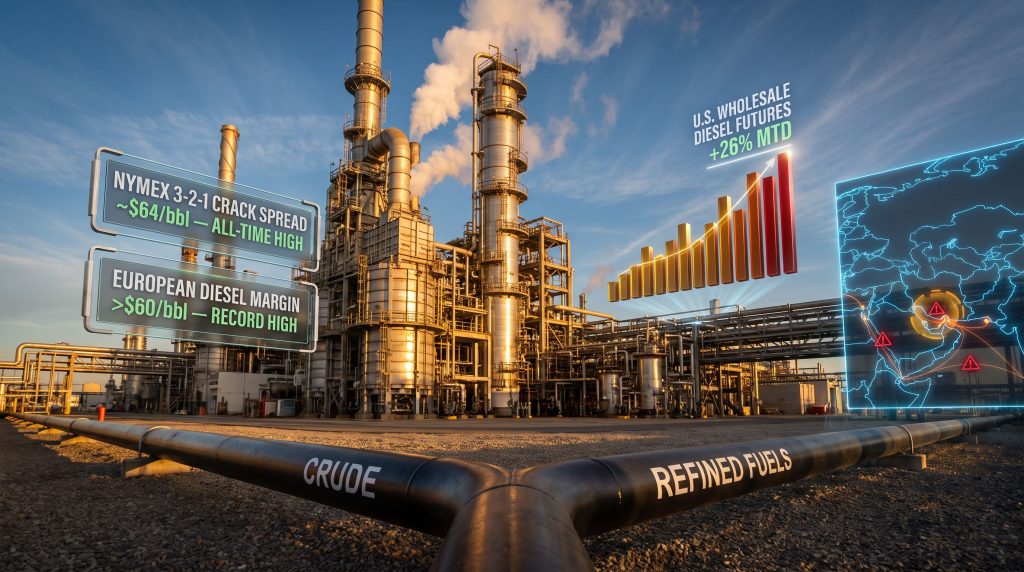
In mid-July 2026, the NYMEX 3-2-1 crack spread broke above its previous June 2022 record of approximately $60 per barrel, reaching close to $64 per barrel. This was not a marginal new high. It was a record that displaced a benchmark set during the most severe period of European energy disruption following Russia's invasion of Ukraine.
European markets told an equally stark story. Diesel refining margins on the continent surged above $60 per barrel, and European gasoline traded at a premium of approximately $41 per barrel over Brent crude, a level last seen in the summer of 2022. The table below captures the full scope of the downstream squeeze:
| Metric | Level | Context |
|---|---|---|
| NYMEX 3-2-1 Crack Spread | ~$64/bbl (mid-July 2026) | New all-time high, surpassing June 2022 record of ~$60/bbl |
| European Diesel Margin | >$60/bbl | Record high following regional supply disruption |
| European Gasoline Premium to Brent | ~$41/bbl | Four-year high; last seen in summer 2022 |
| U.S. Wholesale Diesel Futures (July) | +26% month-to-date | Reflects acute downstream tightness |
| U.S. Commercial Oil Stocks | ~6% below 5-year average | Despite a modest build in the week to July 17 |
| Hormuz Tanker Crossings | Lowest since May 2026 | Crude and product flow severely constrained |
A critical and counterintuitive feature of this period deserves emphasis. Crack spreads did not compress when crude oil prices spiked toward $100 per barrel. Conventional logic might suggest that higher input costs would squeeze refinery margins. The opposite occurred. Analysis from RBN Energy confirmed that demand-side strength on the product side more than absorbed higher crude input costs, allowing refiners to preserve historically attractive margins.
This is a powerful signal that the demand pressure is structural and is originating from the product market itself, not from speculative crude trading. Indeed, crude oil price volatility has repeatedly masked the more consequential story unfolding in downstream fuel markets throughout this period.
The Supply Disruptions Creating a Multi-Front Fuel Crisis
Refinery Strikes and the Hormuz Chokepoint
The geopolitical events of 2026 have not merely disrupted crude oil flows. They have targeted the conversion infrastructure that sits between crude production and fuel delivery. Saudi Aramco's 400,000 barrel-per-day refinery was shut down following a Houthi strike, removing a substantial volume of finished fuel from regional markets at a stroke. This is a qualitatively different disruption from a simple supply route closure. Crude can be rerouted. A destroyed or damaged refinery cannot process product until it is repaired.
Hormuz tanker crossings fell to their lowest level since May 2026, while Red Sea traffic through the Bab el-Mandeb simultaneously dropped to multi-month lows. The combined effect was a pincer movement on both crude delivery and refined product distribution across the most supply-critical region on earth. Consequently, these geopolitical oil market dynamics have redefined how analysts must interpret downstream tightness.
Russia's Diesel Ban and Its European Consequences
A parallel and compounding shock unfolded on Europe's eastern supply frontier. Ukrainian drone attacks on Russian refinery infrastructure triggered a domestic fuel shortage inside Russia severe enough that Moscow imposed a ban on diesel exports. The logic was internally rational: protect domestic supply. The external consequence was that European markets, which had been gradually reducing but not eliminating reliance on Russian petroleum products, absorbed a sudden additional supply deficit precisely when Middle Eastern disruptions were already pushing regional margins to records.
The combination of these two shocks explains the extraordinary European diesel margin of over $60 per barrel. Neither event alone would have been sufficient to produce that outcome. Together, they created a compounding supply crisis with no quick resolution mechanism.
Asian Refinery Run Rates Under Threat
The demand story in Asia adds another dimension to the refined fuels squeeze. Asian refiners outside China had positioned aggressively for a surge of Middle Eastern crude arrivals in August 2026, planning to operate at elevated throughput rates to meet regional fuel demand. At the time of the disruptions, Asian refineries excluding China were running at approximately 80% capacity, already a high rate of utilisation.
June Goh, Senior Oil Analyst at Sparta Commodities, assessed in a published market outlook that those elevated run rates were expected to decline by the end of August as prompt delays in crude arrivals from the Middle East weighed on the operational feasibility of refinery sites across the region. Crude may eventually arrive. However, a delayed arrival means delayed processing, and delayed processing means delayed fuel supply to end markets.
Why a Refined Product Shortage Is More Economically Dangerous Than a Crude Price Spike
The inflation mechanics of a refined fuel shortage are more direct and more damaging than those of an equivalent crude price spike. Crude oil must be processed before it enters the real economy. Diesel does not. It powers agricultural equipment, long-haul trucking, construction machinery, and industrial logistics networks directly and immediately. When diesel becomes scarce or expensive, those cost increases embed themselves into virtually every category of goods production and distribution within weeks.
The macroeconomic consequences are already visible. Economists have revised GDP growth forecasts downward for import-dependent emerging economies including India in response to the broader oil market disruption risks now unfolding. Pakistan's transport sector moved toward strike action over fuel price increases, illustrating how quickly refined fuel costs translate into social and economic disruption in price-sensitive economies.
Jet fuel presents a parallel vulnerability. Post-pandemic aviation demand has recovered strongly, creating elevated and relatively inelastic consumption. Airlines facing acute jet fuel cost increases typically pass those costs through to ticket prices within one to two booking cycles, contributing to broader consumer price inflation in a sector that had only recently returned to profitability.
Three Scenarios for the Refined Fuel Market
| Scenario | Trigger Conditions | Expected Outcome |
|---|---|---|
| Rapid De-escalation | Hormuz reopens fully; Russia resumes diesel exports | Crack spreads normalise over 6 to 8 weeks; inflation pressure eases |
| Prolonged Disruption | Continued Hormuz and Red Sea restrictions; refinery outages persist | Diesel and gasoline margins remain elevated; stagflationary pressure builds in import-dependent economies |
| Escalation Deepens | Additional refinery strikes; new export bans | Fuel shortages become acute; emergency stock releases required; potential demand destruction |
Disclaimer: Scenario projections are speculative and reflect a range of possible outcomes based on current market conditions. They do not constitute investment advice and should not be relied upon as predictions of future prices or policy outcomes.
The IEA's Warning and the Limits of Strategic Reserve Policy
IEA Executive Director Fatih Birol issued a notably direct public assessment of the situation last week. While affirming that IEA member countries collectively hold more than one billion barrels of government-controlled strategic stocks, Birol specifically identified the downstream gap as the market's central vulnerability. His core finding was that refinery activity and product supplies have not kept pace with crude deliveries, leaving markets for diesel and gasoline considerably tighter than crude markets alone would suggest.
This statement carries significant policy implications that extend beyond the immediate crisis. Strategic petroleum reserves were designed for crude oil supply emergencies, not refined product shortages. Releasing crude from the U.S. Strategic Petroleum Reserve, which already sits at four-decade lows, requires additional refinery throughput to convert that crude into usable fuels.
With U.S. refinery utilisation already running at approximately 96.2%, there is minimal spare processing capacity available to absorb a large SPR release into additional finished fuel supply. This is the structural mismatch at the heart of the current crisis. The emergency policy tools available to governments were built for a world where the bottleneck was crude supply. In 2026, the bottleneck is conversion capacity, distribution infrastructure, and physical product inventory.
The next major ASX story will hit our subscribers first
Reading the Right Signals: A Framework for Market Analysis
For investors and analysts seeking to track real energy market stress rather than speculative crude price noise, the following indicators carry the most meaningful signal content in the current environment:
- Crack spreads, particularly the NYMEX 3-2-1 and European diesel margins, as the primary real-time indicator of physical fuel scarcity
- Refinery utilisation rates across the U.S., Europe, and Asia as a measure of how much processing headroom remains in the system
- Tanker traffic data at critical maritime chokepoints including Hormuz, Bab el-Mandeb, and the Suez Canal as a leading indicator of future product availability
- Inventory levels at key storage hubs such as Cushing in the U.S., the ARA complex in Europe, and Singapore for Asian markets as a measure of buffer capacity against further disruptions
- Export restriction announcements from major producing nations, as unilateral policy moves like Russia's diesel export ban can shift regional market balances almost overnight
The inverse relationship between crude price volatility and downstream margin stability also offers a useful analytical signal. Periods when crack spreads remain wide or widen further despite falling crude prices indicate that product demand is structurally elevated and not merely a derivative of crude cost push. That is precisely the condition the market finds itself in now.
Regional Pressure Points: Where the Crunch Lands Hardest
Europe faces a compounding supply problem unlike any other major consuming region. The simultaneous loss of Russian diesel export volumes and reduced Middle Eastern product flows has left European fuel markets exposed to a dual supply deficit with limited short-term remedies. The continent's gasoline premium over Brent at approximately $41 per barrel reflects genuine physical tightness, not positioning or speculation. OPEC's market influence over supply-side decisions has added further uncertainty to the European outlook.
Asia presents a different but equally serious challenge. Adequate crude import volumes do not guarantee refined product availability when processing delays and run-rate reductions intervene. India has been actively sourcing crude from alternative suppliers including Angola and Venezuela as Middle Eastern supply routes became constrained. Indian refinery MRPL has gone further, reportedly barring crude suppliers from using Hormuz and Red Sea routes entirely.
The United States, while better positioned than most due to domestic production strength, is not insulated. Refinery utilisation near 96.2% leaves almost no spare processing capacity. Commercial oil stocks remain approximately 6% below the five-year seasonal average despite a modest inventory build in the week ending July 17, and Cushing storage levels are at multi-year lows. Record U.S. fuel exports have helped offset global supply losses but cannot fully compensate for the disruptions now underway across the Middle East and Russia.
The argument that refined fuels are driving the oil market crunch is not a theoretical proposition. It is a measurable, data-confirmed reality visible in record crack spreads, record diesel margins, depleted inventories across multiple continents, and a direct warning from the world's most authoritative energy institution. The crude price is what traders fear. The fuel margin is what the global economy is actually experiencing. In the current environment, those two signals have rarely been further apart, and the downstream market is delivering the more urgent message.
Want to Stay Ahead of the Next Major Resource Discovery Before the Market Catches On?
While energy markets grapple with record crack spreads and downstream fuel shortages, the broader commodities landscape continues to present significant opportunities for informed investors. Discovery Alert's proprietary Discovery IQ model delivers real-time alerts on significant ASX mineral discoveries the moment they are announced, transforming complex resource data into actionable insights — explore historic discoveries and their returns to see what early positioning can mean, and begin a 14-day free trial to stay ahead of the market.