July 29, 2026
The Strait of Hormuz Factor Is Quietly Rewriting How Iraq Sells Its Oil
Every few decades, a single chokepoint reshapes the economics of global energy. The Strait of Hormuz, through which roughly 20% of the world's traded oil passes, has long been treated as a manageable risk. However, as geopolitical oil price tensions have intensified across the Middle East in 2025 and 2026, the calculus is shifting. For Iraq, a country whose fiscal survival depends almost entirely on crude export revenues, the vulnerability of Gulf shipping lanes has stopped being a theoretical concern and started becoming a budgetary emergency.
That pressure is now producing one of the most consequential infrastructure pivots in Iraqi energy history: a deliberate, government-sanctioned push to revive and dramatically scale Iraq oil exports through Turkey via the Kirkuk-to-Ceyhan corridor.
When big ASX news breaks, our subscribers know first
What Makes the Kirkuk-Ceyhan Pipeline Strategically Irreplaceable
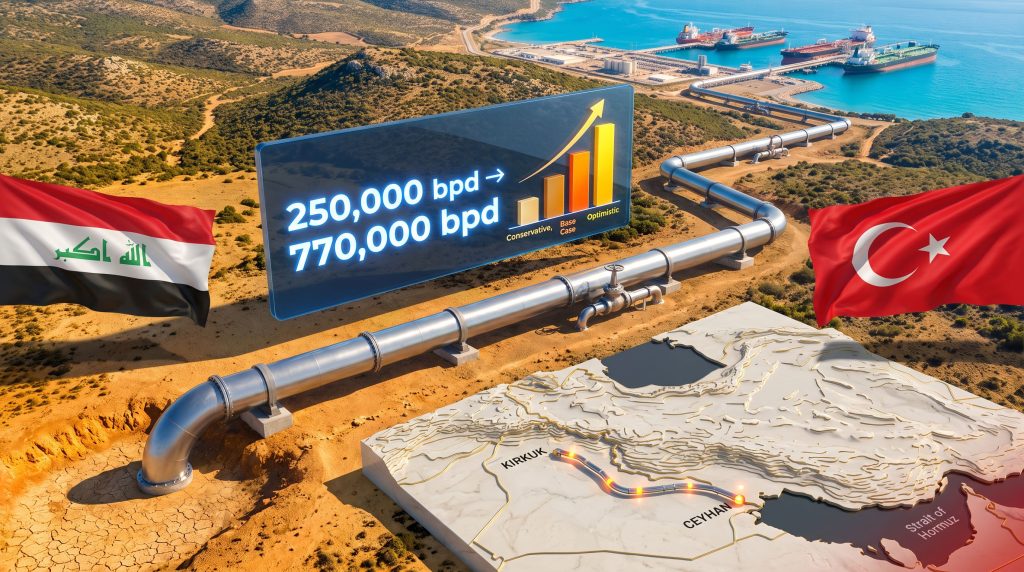
The Iraq-Turkey Crude Oil Pipeline, better known by its origin and terminus points of Kirkuk and Ceyhan, is not a new piece of infrastructure. It was originally constructed with a design throughput capacity of up to 1.6 million barrels per day (bpd), making it one of the most capable crude export arteries in the entire MENA region. Yet for most of the past three years, it sat largely dormant, caught in a web of legal arbitration, contractual disputes between Ankara and Baghdad, and unresolved revenue-sharing tensions with the Kurdistan Regional Government (KRG).
Infrastructure Overview: Iraq-Turkey Pipeline at a Glance
| Feature | Details |
|---|---|
| Pipeline Name | Iraq-Turkey Crude Oil Pipeline (Kirkuk-Ceyhan) |
| Route | Kirkuk, Northern Iraq to Ceyhan, Mediterranean Coast, Turkey |
| Historical Design Capacity | Up to 1.6 million bpd |
| Restart Volume (March 2026) | Approximately 250,000 bpd |
| Cabinet-Approved Target | Up to 770,000 bpd |
| Export Terminal | Ceyhan, Turkey (Mediterranean deepwater port) |
What distinguishes this route from Iraq's southern terminals at Basra is geography. The Ceyhan terminal sits on Turkey's Mediterranean coastline, completely outside the Persian Gulf. Crude loaded at Ceyhan sails westward into the Mediterranean without passing anywhere near the Strait of Hormuz, giving Iraq a Hormuz-independent export pathway that its southern infrastructure cannot replicate.
The pipeline's long dormancy was not due to lack of demand or geological limitations. It was primarily a product of a 2023 international arbitration ruling that ordered Turkey to pay Iraq approximately $1.5 billion in damages for allowing unauthorised Kurdish crude exports between 2014 and 2018. Turkey subsequently shut down the pipeline in March 2023, and the closure lingered for three years, costing Baghdad billions in lost revenue at precisely the moment when oil income was most needed to fund post-conflict reconstruction and social spending.
The restart in March 2026, at an initial flow rate of around 250,000 bpd, represented the resolution of that standoff, enabled largely by a separate but interconnected breakthrough: a revenue-sharing arrangement between Baghdad and the KRG that had blocked northern crude flows for years. Furthermore, Turkey and Iraq reached a formal 12-month agreement in July 2026 to keep this critical pipeline operational, underscoring just how strategically vital the route has become for both nations.
The Baghdad-KRG Revenue-Sharing Equation
Understanding why the pipeline restarted in 2026 requires understanding the relationship between Iraq's federal government and the semi-autonomous Kurdistan Region. The KRG controls substantial crude production in northern Iraq, primarily from fields that feed directly into the Kirkuk-Ceyhan system. For years, disputes over how oil revenues should be divided between Erbil and Baghdad paralysed the northern export corridor.
The March 2026 deal between Iraq and Kurdistan to resume oil exports via Turkey was unlocked by a fiscal compromise between the two governments, allowing KRG-origin crude to flow alongside Kirkuk crude under a shared revenue framework. This arrangement is critical not just for current volumes, but for the proposed ramp-up to 770,000 bpd, since achieving that target requires sustained cooperation from Kurdistan's producing fields.
Significant disputes over the precise revenue allocation formula remain unresolved, and the political relationship between Erbil and Baghdad continues to carry underlying tensions. Any deterioration in that relationship represents one of the most material operational risks to the expansion plan's timeline.
Phased Expansion Targets: From 250,000 to 770,000 Barrels Per Day
Iraq's cabinet has formally approved a phased volume escalation plan for the northern route. The ambition embedded in that plan is striking: scaling throughput from the March 2026 restart level to as high as 770,000 bpd within a compressed operational window of approximately two and a half months.
Iraq's proposed ramp-up along the Kirkuk-Ceyhan corridor represents a more than threefold increase over restart volumes, targeting a pipeline throughput not seen on this route since before the 2023 arbitration-driven shutdown.
The phasing works roughly as follows:
-
Phase 1: Restart at approximately 250,000 bpd following the Baghdad-KRG agreement and pipeline rehabilitation work completed in late 2025 and early 2026.
-
Phase 2: Technical assessments by the North Oil Company (NOC) confirm expanded pumping capacity, allowing graduated volume increases tied to diplomatic progress on the bilateral treaty framework with Turkey.
-
Phase 3: Full cabinet-target volumes of up to 770,000 bpd, contingent on treaty renewal, infrastructure confirmation, and sustained KRG cooperation.
The North Oil Company, which manages extraction operations across Iraq's northern fields, has publicly confirmed that technical and engineering preparations have been completed and that the pipeline system is operationally ready to commence and expand pumping. In practical pipeline terms, this means pressure-testing, pump station inspections, corrosion assessments along the line, and verification of flow measurement systems at both the Kirkuk origin point and the Ceyhan terminal.
The Ankara Talks: Who Was There and What Was at Stake
The diplomatic machinery driving this expansion came into sharp focus when a high-level Iraqi delegation travelled to Turkey for direct ministerial-level talks with Turkey's Ministry of Energy and Natural Resources. The delegation's composition signalled that Baghdad was treating this as a strategic priority rather than a routine technical negotiation.
Key Iraqi Delegation Members
| Official | Institutional Role |
|---|---|
| Nasser Aziz | Deputy Oil Minister for Extraction Affairs, Delegation Head |
| Nizar Al-Shatri | Director General, State Organisation for Marketing of Oil (SOMO) |
| Faisal Hamadi Ramadan | Director General, North Oil Company |
| Senior Ministry Officials | Legal, Economic, and Internal Audit Departments |
Three core agenda items dominated the Ankara discussions:
-
Pipeline agreement renewal: The bilateral treaty governing Iraq-Turkey oil transit was approaching its expiry in late July 2026, creating an urgent legal deadline that, if missed, could have suspended export rights entirely.
-
Capacity expansion terms: Both sides needed to agree on the commercial and technical framework for scaling volumes well beyond the March 2026 restart levels.
-
Route security provisions: The overland pipeline traverses challenging terrain, including areas with historical exposure to security incidents in southeastern Turkey. Strengthening protection along the Kirkuk-to-Ceyhan corridor was framed as a non-negotiable precondition for any volume increase.
The talks also served as preparation for an anticipated visit by Iraqi Prime Minister Ali Al-Zaidi to Ankara, where broader bilateral agreements spanning energy, trade, and security cooperation were expected to be formalised.
Northern vs. Southern: Iraq's Dual-Route Export Architecture
To appreciate the strategic importance of scaling Iraq oil exports through Turkey, it helps to understand what southern terminals currently carry and why Hormuz exposure creates such a concentrated vulnerability. In addition, understanding the current crude oil market context helps frame just how much is at stake for Baghdad's fiscal position.
Comparative Export Infrastructure Analysis
| Dimension | Kirkuk-Ceyhan (Northern) | Basra/Gulf Terminals (Southern) |
|---|---|---|
| Geographic Risk Exposure | Bypasses Strait of Hormuz entirely | Fully exposed to Hormuz disruption |
| Current Throughput | ~250,000 bpd (scaling phase) | Majority of Iraq's ~3.3 million bpd |
| Operational Status | Reactivated March 2026 | Operational but geopolitically vulnerable |
| Geopolitical Dependencies | Iraq-Turkey treaty, KRG alignment | Gulf security, Hormuz passage stability |
| Strategic Function | Diversification hedge | Primary revenue backbone |
Iraq currently exports the vast majority of its roughly 3.3 million bpd of total crude production through southern terminals, primarily the Basra Oil Terminal in the northern Persian Gulf. That terminal, while efficient, sits at the mouth of the Hormuz corridor. When regional tensions spike, insurance premiums for Gulf tanker voyages rise sharply, buyers sometimes look for alternative supply sources, and the discount applied to Iraqi crude in spot markets can widen, directly compressing Baghdad's per-barrel revenue.
The northern route fundamentally changes that equation by providing Mediterranean-delivered barrels that carry no Hormuz risk premium for buyers. Furthermore, the OPEC influence on oil pricing decisions adds another layer of complexity to Iraq's export strategy, as Baghdad must balance its diversification ambitions against its quota obligations within the wider producer group.
The next major ASX story will hit our subscribers first
Syria as a Second Mediterranean Corridor
One dimension of Iraq's export diversification strategy that has attracted less attention is the parallel planning for a Syria-linked pipeline corridor. Iraq's Oil Minister indicated that Baghdad is accelerating preparatory work on a pipeline connecting Iraqi producing fields to Mediterranean-facing ports across both Turkey and Syria.
This signals that the Kirkuk-Ceyhan revival is one element of a broader multi-corridor architecture rather than a standalone infrastructure play. A Syria routing, if eventually developed, would give Iraq redundancy even within its Mediterranean export strategy, reducing dependence on any single transit country or bilateral treaty framework.
The potential Syria corridor remains at an early planning stage and faces substantial political, security, and infrastructure challenges before it could carry meaningful volumes.
Scenario Analysis: Three Trajectories Through 2027
| Scenario | Export Volume Target | Key Assumption | Revenue Impact for Baghdad |
|---|---|---|---|
| Conservative | 250,000-300,000 bpd | Treaty extended, limited KRG cooperation | Modest fiscal relief, limited diversification |
| Base Case | 500,000-600,000 bpd | Full Baghdad-KRG alignment, treaty renewed | Meaningful budget stabilisation |
| Optimistic | ~770,000 bpd | Maximum ramp-up achieved, security maintained | Structural export diversification achieved |
For the optimistic scenario to materialise, several conditions must hold simultaneously:
-
The bilateral pipeline treaty with Turkey must be renewed without significant commercial renegotiation that adds transit costs.
-
The KRG must maintain its revenue-sharing commitment and sustain field-level production from Kurdistan's northern producing assets.
-
Security along the overland pipeline route through southeastern Turkey must remain stable.
-
Infrastructure assessments must confirm that the pipeline's pump stations and line pipe can support the step-change in throughput without requiring major capital expenditure that could delay the timeline.
The risk factors that could derail the expansion are equally concrete. Legal complications surrounding the original arbitration award have not been fully resolved. Any reignition of that dispute could create leverage for either party to slow the expansion. Political turbulence within the KRG or a deterioration in Erbil-Baghdad relations could constrain the volume of Kurdish crude feeding into the system.
Consequently, global oil price weakness — if sustained — could also reduce Baghdad's urgency to push the expansion forward. The trade war and oil prices dynamic has already demonstrated how quickly macro-level price pressures can undermine producer revenue forecasts, making the marginal cost of maintaining multiple export routes harder to justify at lower price levels.
Kirkuk Crude Quality and Mediterranean Buyer Dynamics
One dimension of this expansion that deserves closer attention is the crude quality profile. Kirkuk crude is a medium-sour grade with an API gravity of approximately 35 degrees and a sulphur content of around 2.1%. That places it in a similar quality bracket to certain Middle Eastern medium grades but with characteristics that differ meaningfully from Basra Light, which is slightly heavier and carries a higher sulphur content.
Mediterranean refiners, particularly those in southern Europe and Turkey itself, are generally well-configured to process medium-sour barrels. An increase in Kirkuk availability at Ceyhan would therefore land in a market with established refinery demand and competitive pricing benchmarks.
However, the global oil price shock of recent years has made buyers more discerning. For instance, buyers now view a credible alternative to North African medium grades like Libyan Es Sider or Algerian Saharan Blend more favourably, particularly in cases where supply disruptions affect those streams.
From an OPEC+ compliance standpoint, any significant expansion of Iraqi northern exports carries a compliance dimension. Iraq has historically struggled to meet its OPEC+ production quota commitments, and a ramp-up in northern throughput would need to be considered in the context of Baghdad's overall production ceiling rather than treated as additive volume outside the quota framework.
Frequently Asked Questions: Iraq Oil Exports Through Turkey
Why Did Iraq Resume Oil Exports Through Turkey in 2026?
The resumption followed the resolution of a revenue-sharing dispute with the Kurdistan Regional Government and progress on the bilateral pipeline treaty framework with Ankara, ending a roughly three-year shutdown triggered by an international arbitration ruling.
What Is the Maximum Capacity of the Kirkuk-Ceyhan Pipeline?
The pipeline was originally designed to handle up to 1.6 million bpd, though current restart volumes are approximately 250,000 bpd, with a cabinet-approved target of up to 770,000 bpd.
How Does the Baghdad-KRG Agreement Affect Pipeline Operations?
The agreement allows Kurdish-origin crude to flow through the pipeline under a shared revenue arrangement, which is essential since KRG field production contributes meaningfully to total northern export volumes.
When Did the Iraq-Turkey Pipeline Treaty Come Up for Renewal?
The bilateral pipeline agreement approached its expiry in late July 2026, creating the legal urgency behind the Ankara ministerial talks.
What Is SOMO's Role in Managing Iraq's Crude Exports?
The State Organisation for Marketing of Oil serves as Iraq's sovereign crude marketing body, responsible for negotiating and managing term sales contracts with international buyers and coordinating export logistics across both the northern and southern export routes.
What Are the Main Risks to Sustaining the Northern Export Route?
The primary risks include unresolved arbitration legacy issues, KRG-Baghdad political tensions, overland pipeline security in southeastern Turkey, and the commercial terms embedded in any renewed bilateral transit treaty. The current crude oil market environment further compounds these risks by influencing how urgently Baghdad pursues volume expansion.
Key Takeaways
-
Iraq restarted crude flows through the Kirkuk-Ceyhan pipeline in March 2026 at an initial rate of approximately 250,000 bpd following a breakthrough Baghdad-KRG revenue-sharing agreement.
-
Cabinet-approved targets call for a potential ramp-up to 770,000 bpd through the northern corridor, representing a more than threefold increase over restart volumes.
-
The Iraq-Turkey pipeline treaty approached expiry in late July 2026, making Ankara talks an urgent diplomatic priority for both nations.
-
A high-level Iraqi delegation including SOMO Director General Nizar Al-Shatri and North Oil Company Director General Faisal Hamadi Ramadan participated directly in the Ankara negotiations.
-
The Kirkuk-Ceyhan route's core strategic value is its Hormuz-independent access to Mediterranean shipping lanes, insulating a portion of Iraq's export revenues from Gulf security risks.
-
Baghdad is simultaneously exploring a Syria-linked pipeline corridor as a secondary Mediterranean export option, indicating a broader long-term diversification strategy beyond the Turkey route alone.
-
The North Oil Company has formally confirmed that technical preparations are complete and the pipeline system is ready to resume and scale pumping operations from Kirkuk northward to Ceyhan.
This article is intended for informational purposes only and does not constitute investment, financial, or legal advice. Projections regarding export volumes, revenue impacts, and treaty outcomes are subject to significant political, operational, and market uncertainties. Readers should conduct independent research before making any decisions based on the information contained herein.
Want to Capitalise on the Next Major Resource Discovery Before the Broader Market?
Discovery Alert's proprietary Discovery IQ model delivers real-time alerts on significant ASX mineral discoveries, transforming complex resource data into actionable investment insights for both short-term traders and long-term investors — explore historic examples of exceptional discovery returns to understand what's possible, and begin your 14-day free trial at Discovery Alert to position yourself ahead of the market.