July 29, 2026
The Hidden Architecture of Libya's Oil Instability
Energy markets are accustomed to geopolitical risk, but few producing nations generate supply uncertainty with the consistency and structural predictability of Libya. Unlike disruptions caused by sudden conflict or natural disaster, Libya's recurring oilfield closures follow a pattern rooted in institutional design failures that predate any individual political crisis. Understanding this pattern is essential to grasping why the Libya El Feel oilfield halted once again, and why markets should treat this not as an isolated event but as an expression of a deeper, chronic dysfunction.
Since the collapse of the Gaddafi government in 2011, Libya's energy infrastructure has functioned less as a national asset and more as a political bargaining chip. Armed factions, civil protest movements, and rival administrative bodies have all, at various points, used oilfield access as leverage. The El Feel shutdown fits squarely within this tradition, and broader oil price movements have only amplified the consequences of such closures on global benchmarks.
When big ASX news breaks, our subscribers know first
Why Libya's Oil Sector Has Never Fully Recovered
The 2011 transition did not simply change Libya's government. It dismantled the centralised authority structures that had, however imperfectly, maintained consistent energy production. What emerged in the aftermath was a dual-authority system, with competing governance centres in Tripoli and eastern Libya creating a permanent condition of institutional ambiguity around the National Oil Corporation (NOC) and its operational mandate.
This ambiguity is not incidental. It creates a governance vacuum at the field level, where local grievances, factional interests, and civil protests can escalate directly into production stoppages without any single authority possessing both the legitimacy and the capacity to intervene quickly and conclusively.
The scale of Libya's production losses over the past decade reflects just how costly this structural fragility has been:
| Year | Estimated Capacity (bpd) | Actual Output (bpd) | Primary Disruption Cause |
|---|---|---|---|
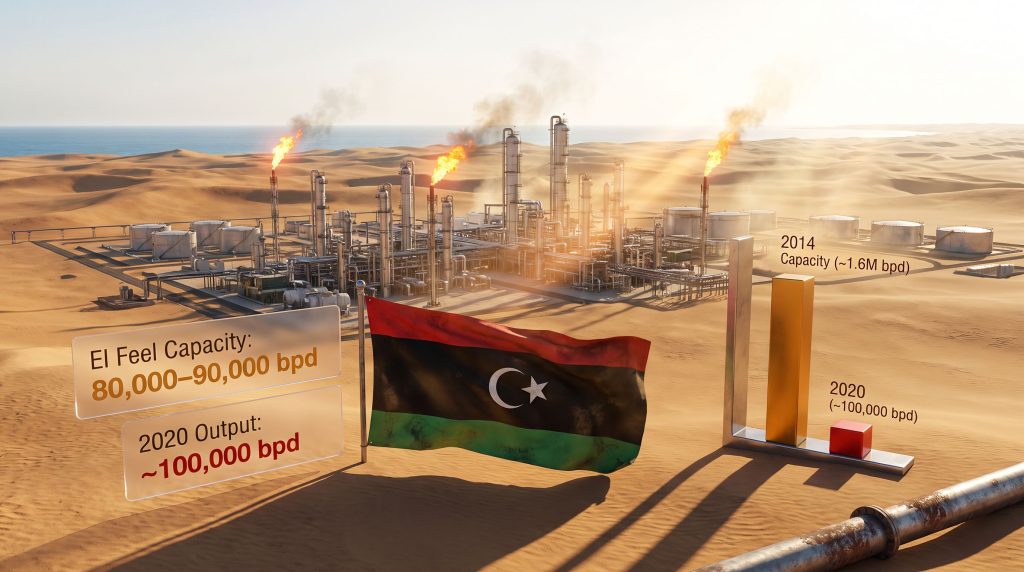
| 2014 | ~1.6M | ~200,000 | Civil conflict, port blockades |
| 2020 | ~1.2M | ~100,000 | Eastern blockade, political standoff |
| 2022 | ~1.2M | ~600,000–900,000 | Rotating field closures |
| 2025–2026 | ~1.2M | Variable | Political protests, infrastructure disputes |
Libya holds the largest proven oil reserves in Africa, yet consistently produces well below capacity. That gap between potential and reality is the defining feature of its oil sector, not a temporary aberration.
Within OPEC+, Libya occupies a unique position: it is formally exempt from production quota obligations precisely because its output is too unstable to plan around. This exemption, while practically necessary, also removes a key incentive for Libyan political actors to prioritise consistent production. Furthermore, OPEC's market influence over global supply management becomes more complex when member states operate outside standard quota frameworks in this manner.
El Feel and Mellitah: More Than Just an Oilfield
Operational Profile and Strategic Weight
El Feel operates with a production capacity of between 80,000 and 90,000 barrels per day under normal conditions. It is managed through the Mellitah Oil and Gas complex, a joint venture between Libya's state-owned National Oil Corporation and Italian energy major Eni. Geographically, El Feel sits within Libya's western oil corridor, making it a material contributor to the country's total daily output, which typically ranges between 700,000 and 1.1 million bpd depending on the prevailing level of disruption.
A full halt at El Feel therefore represents a reduction of roughly 8 to 13 percent of Libya's national production at a single stroke, before any secondary effects are counted.
The Mellitah Complex as a Dual-Function Node
What makes the Mellitah complex particularly significant is that it does not function solely as a crude oil processing and export facility. It simultaneously serves as a critical conduit for gas supply to domestic power generation infrastructure. This dual dependency means that any forced closure of Mellitah creates a cascading failure across two separate energy systems at once.
When protesters closed Mellitah, they did not simply interrupt crude exports. They cut the gas supply feeding Libyan power plants, triggering immediate generation unit shutdowns and threatening the stability of the national electricity grid.
This is a distinction that often goes underappreciated in international reporting. The Mellitah complex is not simply an oil hub. It is an integrated energy node, and its disruption carries humanitarian consequences that extend well beyond oil revenue calculations.
Anatomy of the El Feel Shutdown
How the Disruption Unfolded
In the early hours of the shutdown, protesters gained access to and effectively closed the Mellitah complex. According to Reuters, production at El Feel was brought to a complete halt, while output at the Wafa oilfield was partially suspended as a direct consequence of the same operational disruption.
The National Oil Corporation characterised the situation as a matter of serious concern, formally documenting that the complex closure had caused a severe reduction in fuel and gas supplies reaching domestic power generation plants. Multiple generation units were forced offline as a result.
The NOC's public assessment went further, warning that if the closure continued, the risk of instability across Libya's public electricity grid would escalate significantly. In the most severe scenario, the corporation indicated that a total grid collapse was a credible outcome if the situation was not resolved promptly. This is not routine corporate risk language. For an oil-producing nation to warn of national blackout conditions as a direct consequence of a single oilfield closure speaks to just how tightly integrated Libya's energy systems have become, and how fragile those integrations are.
Government Response
Prime Minister Abdulhamid al-Dbeibah issued direct orders to security forces to regain control of the Mellitah complex, restore gas pipeline flows, and resume supply to power plants without delay. The fact that a head of government was personally directing field-level security interventions at an oilfield highlights the degree to which energy infrastructure management and political authority have become inseparable in Libya.
Historically, such interventions have produced mixed results. Some prior closures resolved within days following security force deployment. Others have persisted for weeks, particularly where the underlying political grievance remained unaddressed after the physical situation was contained.
Recurring Disruption: Pattern, Not Anomaly
El Feel has a documented history of shutdowns that predates the most recent event. A prior stoppage in March 2026 was resolved relatively quickly, reinforcing the pattern of brief but operationally significant closures that characterise Libya's field-level disruptions. However, brevity should not be mistaken for insignificance. Even short stoppages carry real consequences:
- Export schedules are disrupted, forcing buyers to seek alternative supplies at short notice
- Contract fulfilment obligations come under pressure, with potential force majeure implications for international partners
- Downstream European refiners, who depend on Libyan light sweet crude for specific refinery configurations, face short-term feedstock gaps
- Each disruption reinforces the perception among investors that Libyan output is structurally unreliable
Categorising Libya's Disruption Drivers
| Disruption Category | Examples | Frequency | Recovery Timeline |
|---|---|---|---|
| Political standoffs | Rival government disputes over NOC control | High | Weeks to months |
| Civil protests / field seizures | Mellitah complex closure | Moderate–High | Days to weeks |
| Technical/infrastructure failures | Pipeline faults, equipment degradation | Moderate | Days to weeks |
| Armed conflict / security incidents | Civil war-era blockades | Lower (post-2020) | Months |
The shift in dominant disruption type from armed conflict toward civil protest and political standoffs since 2020 is itself analytically significant. It suggests that while outright military confrontation has diminished, the underlying governance failures that enable disruptions have not been resolved. They have simply found new expression, a pattern consistent with the broader geopolitical tensions that continue to reshape energy supply chains across the region.
Global Market Implications and the Libyan Supply Discount
Brent Crude Sensitivity and the Libya Variable
Libya produces predominantly light sweet crude grades, which are among the most valuable on global markets due to their lower sulphur content and higher yield of refined products. European refiners, particularly in Italy, Spain, and Germany, have historically configured refinery operations around Libyan crude blends. When Libyan supply is disrupted, these buyers cannot simply substitute with heavier grades without incurring processing inefficiencies and cost penalties.
This creates a structural price sensitivity in Mediterranean crude markets that is disproportionate to Libya's share of global supply. Traders and market analysts effectively apply what might be described as a Libya discount to supply projections, treating Libyan output as inherently variable and pricing that uncertainty into forward market positions. For a fuller picture, crude oil price analysis for 2025 illustrates how these recurring disruptions feed into broader benchmark volatility.
The Domestic Paradox
Perhaps the most striking dimension of Libya's situation is the domestic energy paradox it creates. A country holding Africa's largest proven oil reserves consistently subjects its own population to fuel shortages and electricity outages as a direct consequence of oilfield disruptions. The NOC's warning about potential grid collapse is not a hypothetical risk scenario. It is a credible operational forecast rooted in the physical reality that Libya's domestic power generation is critically dependent on the same infrastructure that international operators use to export crude.
Eni's Exposure and the International Operator Dilemma
For Eni, operating in Libya through the Mellitah joint venture represents both a strategic asset and a persistent risk management challenge. Libya holds genuine long-term value for international energy companies, with large underdeveloped reserves and proximity to European markets. Yet each disruption event tests the limits of force majeure clauses, stresses contract relationships with downstream buyers, and draws regulatory and investor scrutiny to the company's exposure to politically unstable operating environments.
The fundamental calculus for international operators in Libya comes down to this: the reserves are real, the proximity to demand markets is genuine, and the commercial upside is substantial. However, as Hellenic Shipping News reports, the institutional environment makes reliable production planning extremely difficult, and that uncertainty is permanently embedded in the risk premium attached to any Libyan energy investment. In addition, the ongoing sanctions on oil trade affecting other major producers have further complicated the global supply picture within which Libyan disruptions must be assessed.
The next major ASX story will hit our subscribers first
What Stabilisation Would Actually Require
Institutional and Security Prerequisites
Long-term stabilisation of Libya's oil sector would require a sequence of institutional changes that go well beyond technical infrastructure upgrades:
- Formation of a unified national government with legitimate authority recognised across both Tripoli and eastern Libya
- Structural reform of the NOC's governance framework to insulate operational decisions from direct political interference
- Establishment of a dedicated energy infrastructure protection force with cross-factional legitimacy and genuine enforcement capacity
- Resolution of the underlying political economy of oilfield leverage, which requires addressing the grievances that motivate civil actors to seize energy infrastructure as a protest tool
Scenario Outlook
| Scenario | Conditions Required | Near-Term Probability | Output Outlook |
|---|---|---|---|
| Stabilisation and Growth | Unified government, security reform | Low | 1.2M–1.6M bpd |
| Status Quo (Managed Instability) | Continued dual-authority, periodic disruptions | High | 700K–1.1M bpd |
| Escalation | Renewed conflict, prolonged shutdowns | Moderate | Below 500K bpd |
The status quo scenario represents the most probable near-term trajectory. Libya is likely to continue producing at variable but significant levels, interrupted by periodic closures that are disruptive but not permanently incapacitating. This is not a stable equilibrium. It is a managed dysfunction that erodes long-term investment confidence and prevents Libya from realising the production levels its reserves would otherwise support.
Restoring Libya's oil sector to its pre-2011 capacity of approximately 1.6 million bpd would require substantial capital investment across pipeline networks, processing facilities, and export terminal infrastructure, in addition to the institutional reforms outlined above. Consequently, the Libya El Feel oilfield halted scenario is not simply a market event — it is a reminder that without the political prerequisites in place, infrastructure investment alone cannot deliver sustained production gains.
Disclaimer: This article contains forward-looking scenario analysis and production forecasts. These represent analytical assessments based on available information and historical patterns, not confirmed outcomes. Energy market conditions and Libya's political situation are subject to rapid change. Nothing in this article constitutes financial or investment advice.
Want to Stay Ahead of the Next Major Resource Discovery?
While Libya's structural oil instability continues to create volatility across global energy markets, Discovery Alert's proprietary Discovery IQ model scans ASX announcements in real time — instantly identifying significant mineral discoveries and translating complex data into actionable opportunities for traders and investors at every level. Explore how historic discoveries have generated substantial market returns on Discovery Alert's dedicated discoveries page, and begin your 14-day free trial today to position yourself ahead of the market.