June 23, 2026
When Industrial Necessity Collides With Environmental Law
Across Europe, the tension between sustaining critical industrial infrastructure and meeting increasingly rigorous environmental governance standards is producing landmark legal decisions. The aluminium supply chain sits at the centre of this tension, dependent as it is on a refining process that generates enormous volumes of chemically hazardous waste. When that waste accumulates over decades at a single facility, the question of where it goes next is not merely logistical. It becomes a test of planning law, ecological responsibility, and institutional competence.
The Aughinish Alumina red mud expansion Irish High Court ruling, handed down in June 2026, is precisely such a test. It is a decision that reaches well beyond its immediate geographic and industrial context, touching on questions of procedural integrity, flood risk governance, and the increasingly visible role of civil society in shaping large-scale infrastructure outcomes.
When big ASX news breaks, our subscribers know first
Understanding Red Mud: The Unavoidable By-Product of Alumina Refining
What the Bayer Process Creates and Why Storage Is Non-Negotiable
To understand the significance of this ruling, it helps to begin with the chemistry. Alumina, the intermediate compound refined into aluminium metal, is extracted from bauxite ore through the Bayer process. This involves dissolving the bauxite in hot caustic soda, separating the aluminium-bearing liquid, and then precipitating alumina from the solution.
What remains after this extraction is bauxite residue, commonly called red mud, a term that reflects both its colour and its consistency at the point of generation. Red mud is highly alkaline, with pH levels typically ranging between 10 and 13, making it corrosive to biological systems if released uncontained into the natural environment.
Beyond alkalinity, red mud contains residual heavy metals whose specific composition depends on the origin of the bauxite ore. Common contaminants include arsenic, chromium, and vanadium. None of these are benign in aquatic or terrestrial ecosystems.
Critically, there is no way to eliminate red mud from the Bayer process without fundamentally redesigning it. For every tonne of alumina produced, approximately 1 to 1.5 tonnes of bauxite residue is generated, depending on bauxite ore quality. Facilities processing lower-grade ore can generate considerably more. At industrial scale, this means red mud accumulates relentlessly over a refinery's operational lifetime.
The Scale of Aughinish's Residue Challenge
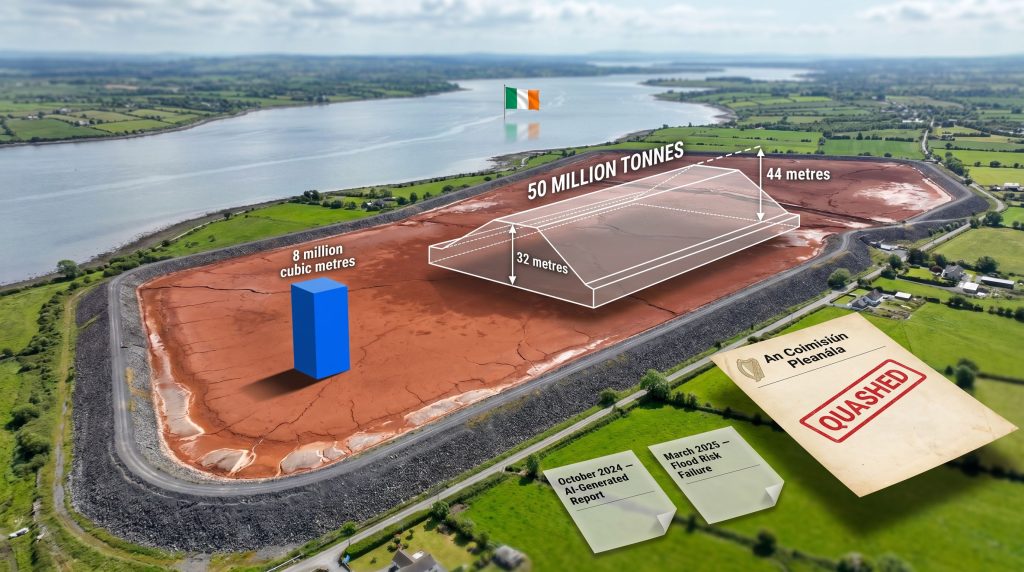
Aughinish Alumina, located on the Shannon Estuary in County Limerick, is the largest alumina refinery in Europe. Its operational history stretches back to 1983, and over that period the facility has accumulated an estimated 50 million tonnes of bauxite residue at its Bauxite Residue Disposal Area (BRDA).
The proposed expansion at the centre of the court ruling sought to increase BRDA storage capacity by 8 million cubic metres, with the height of the storage area rising from 32 metres to 44 metres above base level. This additional capacity, which would have also accommodated approximately 22,500 cubic metres of salt cake storage, was projected to sustain refinery operations through to 2039.
Without that expanded capacity, the refinery faces a finite horizon. The current BRDA has a definable upper limit, and once approached, operational continuity becomes contingent on securing alternative residue management solutions, none of which are simple or inexpensive to implement.
What the Court Actually Decided and What It Did Not
Two Grounds, One Outcome
Justice David Holland's ruling quashed the planning permission issued by An Coimisiún Pleanála (ACP) in March 2025. The court identified two primary legal deficiencies in ACP's decision-making process. Furthermore, judicial review proceedings had been granted specifically to examine these procedural concerns in depth.
The first concerned flood risk. The court found that ACP failed to adequately apply the provisions of the Limerick County Development Plan, specifically its Strategic Flood Risk Assessment (SFRA) framework, when evaluating the BRDA expansion. The Shannon Estuary is a tidal waterbody, and climate projections increasingly point toward more intense tidal surge events. Approving a significant increase in the height and volume of a toxic waste storage structure in this setting without rigorous flood risk analysis was, in the court's assessment, legally insufficient.
The second ground involved alkaline seepage. ACP had concluded that basal seepage of alkaline effluent through the base of the expanded facility would remain negligible throughout its operational life. The court found the evidential basis for that conclusion inadequate. Given existing documented evidence of heavy metal presence in groundwater and surface water near the BRDA, this was not a trivial procedural gap.
What the Ruling Deliberately Left Open
Justice Holland was explicit in clarifying the boundaries of his decision. The ruling did not find that the proposed development poses unacceptable environmental risk. It did not permanently refuse planning permission. Instead, it remitted the matter back to ACP for fresh, more rigorous consideration of these specific issues.
This distinction matters enormously. The ruling is procedural and evidentiary in character. It mandates a higher standard of assessment, not a particular outcome. Aughinish Alumina retains the ability to pursue approval through a strengthened application process.
A remittal ruling does not close a project's future. It raises the evidentiary bar that the planning authority must clear before any new approval can be lawfully issued.
A Troubled Approval History: The AI Report Incident and Its Aftermath
The Sequence of Events That Led to a Second Quashing
The June 2026 ruling is not the first time planning permission for the BRDA expansion has been overturned. The project's approval history is notable for reasons that extend well beyond the usual back-and-forth of contested industrial planning applications.
| Event | Date | Outcome |
|---|---|---|
| Initial application submitted to ACP | 2021 | Under review |
| First planning permission granted | October 2024 | Subsequently rescinded |
| Reason for rescission | Late 2024 | Inspector's report produced using AI software |
| Revised planning permission issued | March 2025 | Granted |
| Judicial review by Environmental Trust Ireland | 2025 | Successful |
| Second planning permission quashed | June 2026 | Remitted to ACP |
| Cost ruling hearing scheduled | July 6, 2026 | ETI provisionally awarded costs |
The AI-Generated Report: A Precedent-Setting Institutional Failure
The October 2024 approval was withdrawn after it emerged that the inspector's report underpinning ACP's recommendation had been generated using artificial intelligence software. Both digital and physical copies of the report were destroyed.
This incident is significant well beyond the Aughinish case. Planning decisions at this scale are consequential legal instruments. They are meant to reflect expert human analysis of complex, site-specific technical and environmental factors. The use of AI to generate such analysis, without transparent disclosure or appropriate human verification, represents a form of procedural failure that undermines the legitimacy of the entire approval process.
The revised March 2025 approval, intended to correct that failure, has now itself been set aside. Aughinish Alumina has been seeking this planning approval for nearly five years, and the combination of an AI report controversy and two separate court quashings has created a planning timeline far longer and more uncertain than the company could reasonably have anticipated when it lodged its application in 2021.
Environmental Risk in Context: What Challengers Are Arguing
The Case Brought by Environmental Trust Ireland
Environmental Trust Ireland (ETI), a Limerick-based environmental organisation, brought the judicial review that led to the June 2026 ruling. The grounds it pursued successfully centred on the flood risk and seepage issues ultimately accepted by the court. In addition, the alumina market pressures already weighing on European refiners make this regulatory uncertainty even more consequential for the broader sector.
The Cappagh Farmers Support Group also raised concerns about the structural implications of adding 8 million cubic metres of residue to existing embankment walls built from crushed rock. Their concerns span several interconnected risk categories:
- Structural loading: Increased residue volume raises compressive stress on embankment structures not originally designed to bear expanded loads.
- Quarry blasting proximity: Active blasting operations adjacent to the BRDA introduce vibration forces that could progressively weaken embankment integrity.
- Agricultural contamination: Seepage or failure events could affect soil quality and water sources used by farming operations in the surrounding area.
- Biodiversity and livestock health: The Shannon Estuary supports ecologically significant habitats. Contamination events could have cascading effects on local species and agricultural productivity.
The Ajka Disaster as a Global Reference Point
No discussion of red mud containment risk is complete without reference to the 2010 Ajka alumina plant disaster in Hungary. A containment failure at that facility released approximately 1 million cubic metres of bauxite residue into the surrounding environment, killing 10 people and contaminating the Marcal River system.
The Ajka incident remains the most-cited precedent for catastrophic red mud containment failure globally. The conditions that contributed to it, including elevated storage volumes, structural load on containment walls, and inadequate seepage monitoring, bear more than passing resemblance to the risk factors being contested at Aughinish.
The Ajka disaster demonstrated that red mud containment failures are not theoretical risks. They are events with documented human casualties and lasting environmental consequences.
Aughinish's proposal to raise storage height by 12 metres increases structural demands in a manner that engineers and environmental scientists would evaluate carefully in light of historical precedents. Moreover, ETI's detailed concerns regarding the expansion reflect precisely this kind of evidence-based scrutiny of structural and environmental risk.
The Regulatory Architecture: How Irish Law Governs This Decision
An Coimisiún Pleanála and Its Role
ACP is Ireland's independent planning appeals and major infrastructure decision-making body. For development proposals of the scale and environmental sensitivity of the BRDA expansion, ACP is the relevant competent authority. Its determinations carry significant legal weight but are subject to judicial review where applicants, objectors, or third parties can demonstrate legal error in the decision-making process.
The court's ruling highlights a structural vulnerability in ACP's assessment methodology. Two successive approvals for the same project have been set aside on grounds that are, at their core, about the quality and completeness of the technical evidence underpinning the authority's conclusions.
What the SFRA Requirement Actually Means in Practice
The Strategic Flood Risk Assessment is not a general environmental caution. It is a specific policy instrument within the Limerick County Development Plan that establishes binding assessment criteria for development proposals in flood-risk zones. Industrial waste facilities in tidal proximity are precisely the category of development the SFRA framework was designed to govern.
The court's finding that ACP failed to adequately apply SFRA provisions sets a meaningful precedent. Future applications for industrial residue disposal facilities in Ireland's flood-risk zones will need to demonstrate SFRA compliance to a standard that can withstand judicial scrutiny.
The Path Forward After Remittal
A remittal to ACP for fresh consideration does not carry a fixed timeline. In practice, the following steps are likely:
- ACP commissions or requires additional technical evidence addressing both flood risk under SFRA criteria and seepage modelling across the full operational life of the facility.
- This evidence is subjected to public consultation and expert review.
- ACP issues a fresh determination based on the enhanced evidentiary record.
- Any new approval remains subject to potential further judicial review.
This process is unlikely to conclude in less than 12 to 24 months, extending the planning uncertainty that already clouds Aughinish's operational horizon beyond 2039.
The next major ASX story will hit our subscribers first
Supply Chain Exposure and the Geopolitical Dimension
Europe's Alumina Supply and the Aughinish Factor
Aughinish Alumina's position as Europe's largest alumina refinery means its operational continuity is not purely a local planning matter. European aluminium smelters that source alumina domestically face indirect exposure to this regulatory uncertainty. A prolonged inability to expand BRDA capacity could, over time, constrain the refinery's output or force operational adjustments that affect downstream supply.
The alumina-to-aluminium supply chain is not easily diversified at short notice. Furthermore, bauxite production trends globally suggest that sourcing shifts carry both logistical and cost implications that European producers would find difficult to absorb quickly. The European market's preference for domestically refined alumina reflects both proximity advantages and supply security priorities.
Ownership, Sanctions, and Compounding Risk
The planning dispute does not exist in isolation. Aughinish Alumina is owned by Russian interests, and this ownership structure has attracted growing political and regulatory scrutiny. Ireland's Minister of State Seán Canney has indicated support for potential EU-level sanctions on alumina exports if investigations confirm that Russia-bound shipments are being used for military purposes.
This geopolitical layer compounds the operational risk profile considerably. The refinery now faces simultaneous uncertainty from:
- Unresolved planning status for its essential waste disposal infrastructure.
- Potential trade restrictions on alumina exports linked to end-use concerns, compounding broader aluminium tariff impacts already reshaping global trade flows.
- Reputational and regulatory pressure associated with Russian ownership in a post-2022 geopolitical environment.
None of these factors individually would be sufficient to threaten a facility of Aughinish's scale. In combination, however, they create a risk environment that is materially different from the one that existed when the BRDA expansion application was first lodged in 2021.
Key Takeaways for Industry, Planners, and Observers
The Aughinish Alumina red mud expansion Irish High Court ruling carries implications that extend well beyond the Shannon Estuary. Several broader lessons emerge from the sequence of events that produced it:
- Procedural integrity in planning decisions is foundational. The AI-generated inspector's report incident demonstrated that shortcuts in the assessment process, however technologically novel they may appear, can invalidate approvals entirely.
- Flood risk governance is becoming a higher-order planning constraint. As climate projections for tidal and fluvial flood events become more severe, SFRA-style frameworks will be applied with increasing rigour to industrial waste facilities in sensitive locations.
- Civil society organisations have demonstrated legal effectiveness. ETI's successive successful challenges illustrate that environmental groups with access to capable legal representation can meaningfully shape the outcomes of major industrial planning processes.
- Red mud is not a legacy problem. For refineries still operating the Bayer process, bauxite residue accumulation is an active, ongoing operational challenge that cannot be deferred indefinitely.
- The planning timeline for the BRDA expansion now extends well beyond 2027, with no certainty that a compliant application will succeed. Consequently, the major bauxite producers and downstream aluminium manufacturers watching this case will need to factor its outcomes into their own supply planning.
For those tracking the broader trajectory of bauxite residue management, including emerging approaches to red mud resource recovery and neutralisation, the evolving body of research on bauxite residue sustainability offers detailed technical and strategic context on how the global aluminium industry is beginning to rethink red mud as a potential secondary resource rather than purely a liability.
This article contains forward-looking assessments and timeline projections based on publicly available legal and planning information. These should not be relied upon as legal advice or definitive predictions of regulatory outcomes. Readers with specific legal or operational interests in this matter should seek independent professional guidance.
Want To Stay Ahead of Major ASX Mineral Discoveries Shaping Global Supply Chains?
As regulatory and geopolitical pressures reshape critical mineral supply chains — from alumina refining to bauxite sourcing — Discovery Alert's proprietary Discovery IQ model delivers real-time alerts on significant ASX mineral discoveries, transforming complex market signals into actionable investment insights before the broader market catches on. Explore historic discoveries and their returns to understand the opportunity, then begin your 14-day free trial at Discovery Alert and position yourself ahead of the next major find.