August 5, 2026
The Engineering Challenge That Could Redefine Open-Cut Mining Forever
Battery-electric vehicles have conquered city streets and passenger transport with relative ease. But scaling the same technology to a 240-tonne haul truck operating around the clock in one of Earth's most punishing environments is an entirely different engineering proposition. The Pilbara region of Western Australia sits at the intersection of extreme heat, vast distances, and relentless production schedules, making it the ultimate stress test for any mobile equipment technology that dares to call itself mine-ready.
It is precisely this context that makes the BHP electric haul truck trial at Jimblebar iron ore mine so technically significant. What is being evaluated here is not a concept vehicle on a test track. It is a full-scale production machine, hauling real iron ore, in real conditions, against real productivity benchmarks. The outcome of this trial will carry weight far beyond BHP's own fleet planning.
When big ASX news breaks, our subscribers know first
Why Haul Trucks Are the Central Problem in Mining Decarbonisation
Within the Scope 1 emissions profile of a typical open-cut iron ore operation, haul trucks are not merely a contributor to diesel consumption — they are the dominant source. Industry estimates consistently place haulage at between 40% and 50% of total on-site fuel use in large-scale open-cut mines. At the scale of BHP's Pilbara operations, which collectively move hundreds of millions of tonnes of material annually, the cumulative diesel burn is substantial enough that even partial fleet electrification would deliver measurable emissions reductions.
Both BHP and Rio Tinto (ASX: RIO) have committed to net-zero operational emissions by 2050, with interim reduction targets across the decade. This broader mining electrification shift means that achieving those targets without addressing haul fleet emissions would be arithmetically impossible. Fleet electrification therefore sits not at the periphery of decarbonisation strategy but at its core.
The Pilbara as the World's Hardest Proving Ground
What separates a Pilbara trial from a temperate-climate technology demonstration is the convergence of variables that all work against battery performance simultaneously:
- Ambient temperatures regularly exceeding 40°C, which accelerates battery thermal degradation and increases cooling system energy demand
- Haul distances that can span several kilometres per cycle, placing sustained load demands on drivetrain and energy storage systems
- 24/7 production schedules with minimal equipment downtime tolerance, leaving little margin for charging pauses or unexpected availability losses
- Dust, vibration, and gradient changes that stress mechanical and electrical system integration
Successfully validating a battery-electric haul truck in this environment would effectively demonstrate operability in virtually any open-cut mining context globally. This is why the global mining equipment industry is watching Jimblebar closely.
Caterpillar 793 XE: What the Specifications Actually Mean
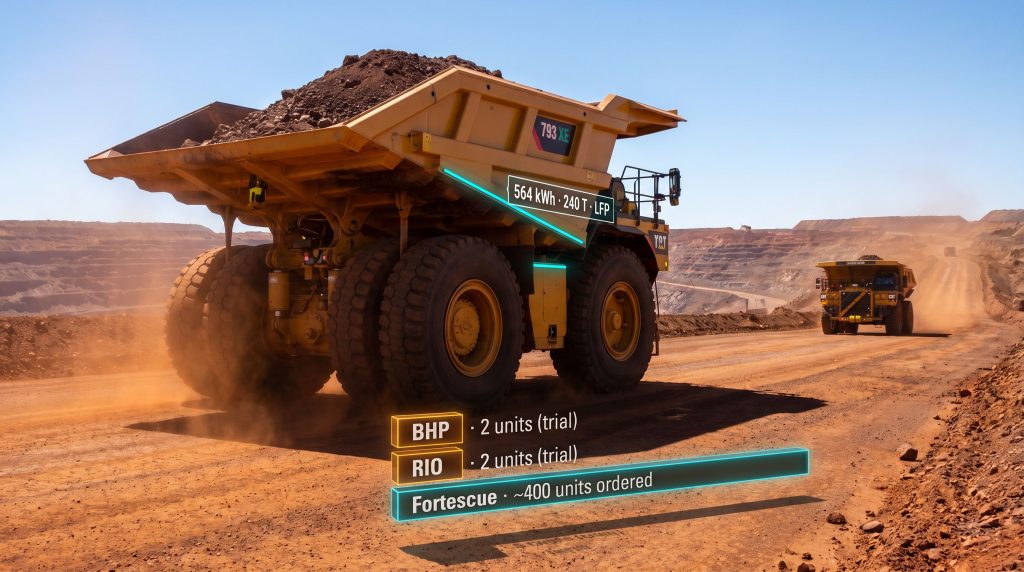
The vehicle at the centre of the BHP electric haul truck trial is the Caterpillar 793 XE Early Learner, a purpose-built battery-electric variant of Caterpillar's established 793 platform. The specifications below provide context for understanding the engineering ambition involved:
| Specification | Detail |
|---|---|
| Vehicle Model | Caterpillar 793 XE Early Learner |
| Rated Payload Capacity | 240 tonnes |
| Maximum Haul Load | Up to 250 tonnes |
| Battery Chemistry | Lithium Iron Phosphate (LFP) |
| Battery Pack Capacity | 564 kWh |
| Electric Motor Output | 480 kW (645 hp) |
| Maximum Speed (loaded) | ~61 km/h |
| Units in Trial | 2 trucks |
| Trial Location | Jimblebar, Pilbara, Western Australia |
To place the 564 kWh battery pack in perspective, the largest passenger electric vehicle battery currently in mass production is approximately 100 kWh. The 793 XE carries more than five times that energy storage capacity, yet must still contend with the enormous power demands of moving a 250-tonne payload up a mine ramp. Furthermore, BHP and Rio Tinto's collaboration on battery-electric haul truck trials signals a shared commitment to validating this technology at scale across the Pilbara.
Why LFP Chemistry Was the Right Call
The selection of Lithium Iron Phosphate chemistry over higher energy-density alternatives such as Nickel Manganese Cobalt (NMC) reflects a deliberate prioritisation of thermal stability over raw energy density. In a Pilbara operating environment, this trade-off is not merely defensible — it is arguably the only technically sound choice.
LFP chemistry offers several advantages relevant to this specific application:
- Thermal runaway threshold is significantly higher than NMC, reducing the risk of catastrophic battery failure in high-ambient-temperature conditions
- Cycle life is substantially longer, with LFP packs typically sustaining 2,000 to 4,000 full charge cycles before meaningful capacity degradation, supporting the continuous operational demands of a mine fleet
- Depth of discharge tolerance is superior, allowing the pack to be regularly drawn down and replenished without accelerating calendar ageing
- LFP chemistry contains no cobalt, eliminating a critical supply chain vulnerability that could affect fleet scaling decisions at the procurement level
The energy density trade-off is real: LFP typically delivers around 150–200 Wh/kg compared to NMC's 200–300 Wh/kg. However, the 793 XE compensates through aggressive energy recovery rather than simply carrying more stored energy.
Regenerative Braking: The Technology That Makes Continuous Operation Possible
The most counterintuitive aspect of the 793 XE's design is that the loaded descent — traditionally the most mechanically demanding phase of a haul cycle — becomes an energy generation event rather than a pure energy expenditure.
In a conventional diesel haul truck, braking on descent requires mechanical brake systems to dissipate kinetic energy as heat, representing a complete loss of that energy. The 793 XE instead uses its electric motors as generators during downhill hauls, converting the gravitational potential energy of a 250-tonne loaded truck into electricity that recharges the battery pack in real time.
How the Haul Cycle Creates a Natural Energy Recovery Opportunity
The typical pit-to-crusher haul cycle in an open-cut mine follows a broadly predictable pattern:
- Loaded descent from the blast bench to the crusher or waste dump, often on a downhill gradient, generating substantial regenerative energy
- Unloading at the crusher or dump, a brief stationary phase
- Empty return up the ramp to the loading point, consuming stored energy
- Loading at the shovel, another stationary phase
In optimised haul profiles where the loaded run is predominantly downhill, regenerative recovery can theoretically offset a significant portion of the energy consumed on the empty uphill return. Under these conditions, the 793 XE is designed to sustain continuous multi-shift operation without dedicated charging stops.
The practical qualification is important: not all haul profiles are created equal. Flat terrain operations, predominantly uphill loaded hauls, or high-ambient-temperature conditions that reduce battery efficiency can all erode the regenerative advantage. This variability is one of the key reasons the Jimblebar trial is structured to collect data across the full range of operating conditions rather than in selectively optimised scenarios.
Charging Infrastructure as a Parallel Validation Objective
Even where regenerative recovery is sufficient for the primary shift cycle, top-up charging between shifts or during extended loading delays requires ground-based fast-charging infrastructure. The trial at Jimblebar is assessing charging system integration alongside vehicle performance, recognising that the infrastructure question is as technically complex as the truck itself.
Key challenges in mine-site fast charging include:
- Grid capacity constraints at remote Pilbara operations where total available power may be limited
- Peak demand management to prevent simultaneous high-power charging events from destabilising on-site electrical supply
- Positioning and accessibility of charging infrastructure within the active mine footprint without disrupting traffic management
- Integration with renewable energy in mining that is increasingly being deployed at Pilbara mine sites to reduce diesel generation dependence
The Four Validation Objectives Structuring the Trial
The Jimblebar trial is not an open-ended technology demonstration. It is structured around four specific validation objectives that will determine whether a scaled trial becomes commercially viable for either BHP or Rio Tinto.
1. Battery Performance Under Real Operating Conditions
This objective focuses on how the LFP pack behaves across full shift cycles at Pilbara ambient temperatures. Specific metrics being monitored include state-of-health evolution over the trial period, thermal management system effectiveness, and the relationship between ambient temperature and available energy capacity. Battery capacity at 40°C+ can be meaningfully lower than manufacturer specifications derived from temperate-climate testing, making this real-world data irreplaceable.
2. Charging Infrastructure Compatibility and Power Management
Beyond vehicle performance, the trial is evaluating whether existing mine-site electrical infrastructure can accommodate the charging demands of a BEV haul fleet without requiring prohibitively expensive grid upgrades. This has direct implications for the capital expenditure modelling of any scaled deployment.
3. Supply Chain and Maintenance Ecosystem Readiness
Caterpillar's authorised dealer for Western Australia, WesTrac, is a central component of this objective. The trial is identifying gaps in high-voltage servicing capability, technician training requirements, and parts availability specifically for BEV drivetrains. Unlike diesel systems, BEV maintenance involves live high-voltage electrical systems requiring specialised safety protocols and tooling that are not yet standardised across the Australian mining maintenance workforce.
4. Scalability Modelling for Fleet-Wide Deployment
Data collected from two trucks operating in real conditions provides the empirical foundation for modelling what full fleet replacement would look like. This includes total cost of ownership projections, infrastructure capital requirements, and the operational uptime equivalence that would need to be demonstrated before a business case for fleet electrification could be sustained.
Comparing Industry Approaches: Caution vs. Conviction
The Jimblebar trial sits within a broader spectrum of electrification philosophies across the Australian iron ore sector. The contrast between BHP's approach and Fortescue's is particularly instructive. Indeed, Australia's iron ore sector is increasingly positioned as a global proving ground for these competing electrification strategies.
| Company | Strategy | Committed Units | Target |
|---|---|---|---|
| BHP (ASX: BHP) | Evidence-based phased trial | 2 (trial phase) | Post-trial scaled assessment |
| Rio Tinto (ASX: RIO) | Joint trial, independent scale decision | 2 (shared trial) | Post-trial scaled assessment |
| Fortescue | Aggressive ordered fleet | ~400 units ordered | Zero emissions by 2030 |
The strategic logic behind BHP's measured approach is grounded in the risk profile of early-stage technology deployment at scale. A fleet of hundreds of diesel haul trucks in the Pilbara represents billions of dollars in capital and millions of tonnes of annual production capacity. Committing that production capacity to unproven technology without structured validation carries a risk profile that most capital-market frameworks would not support.
What BHP Risks by Moving Conservatively
The counter-argument is equally legitimate. In ESG-linked capital markets, decarbonisation progress increasingly influences the cost of capital available to major miners. Institutional investors applying climate-adjusted discount rates to mining assets are watching fleet electrification timelines as a concrete indicator of transition credibility.
There is also a supply chain risk that is rarely discussed openly: as BEV haul truck production scales up globally, early movers may secure preferential allocation of limited manufacturing capacity. A miner that waits for complete validation data may find itself at the back of an OEM production queue when it eventually decides to order.
This dynamic — where the cost of caution includes potential supply chain disadvantage — represents one of the less visible strategic tensions in the industry's electrification debate.
The next major ASX story will hit our subscribers first
Why Jimblebar Is the Right Test Environment
Jimblebar is one of BHP's operating iron ore mines within the Pilbara network, located east of Newman in Western Australia. Its selection as the trial site reflects a deliberate choice to use a representative rather than exceptional operating environment for initial validation purposes.
A site with unusually favourable haul gradients or a compact footprint would produce performance data that overstates real-world applicability. Jimblebar's haul cycle characteristics provide conditions that are more generalisable across BHP's broader Pilbara asset portfolio, meaning that validation data from this site carries transferable value to other operations within the network.
The site's existing electrical infrastructure also provides a practical starting point for charging system integration testing without requiring a purpose-built test facility, which would introduce artificial variables that don't reflect real deployment conditions.
The Path Forward: What Happens After the Trial Concludes
The trial structure explicitly preserves independent decision-making for BHP and Rio Tinto. While both companies are sharing operational data through the joint trial framework, each will evaluate that data against their own fleet replacement economics, emissions trajectory requirements, and capital allocation priorities.
The decision criteria that are likely to determine whether a scaled trial proceeds include:
- Total cost of ownership parity with diesel alternatives over a defined asset life, typically modelled across a 10-year horizon
- Uptime equivalence, meaning BEV trucks must match diesel availability rates that typically exceed 85–90% in mature Pilbara operations
- Infrastructure capital requirements that can be absorbed within existing site development budgets or justified through operating cost savings
- Battery degradation rates that support a commercially viable asset replacement cycle
For Caterpillar, the Jimblebar trial serves a purpose beyond any single customer relationship. Bankable performance data from a tier-one miner operating in the world's most demanding conditions is the most powerful commercial tool available for accelerating global sales of the 793 XE platform. The OEM's investment in the trial reflects an understanding that reference site data from Australia will underpin its BEV haul truck commercial strategy across multiple geographies.
The Broader Significance for Mining Decarbonisation
Fleet Electrification as the Largest Single Lever Available
Within the decarbonisation toolkit available to open-cut iron ore miners, haul fleet electrification represents the single largest addressable source of Scope 1 emissions reduction. Process heat, blasting, and embodied carbon in consumables all present harder abatement challenges with less mature technology pathways. BEV haul trucks, by contrast, represent a technology that exists today, is operating in real mine conditions, and has a credible pathway to commercial viability within this decade.
What a Successful Jimblebar Trial Means for Smaller Operators
Mid-tier and junior miners lack the financial capacity to absorb first-mover technology risk independently. A validated, fully characterised performance dataset from a tier-one operator in a tier-one jurisdiction removes the most significant barrier to BEV adoption across the broader industry. The Jimblebar trial is, in this sense, a public good for the mining sector — even though it is being funded and executed by private commercial interests.
However, the implications extend further still. The rise of critical minerals demand across the energy transition means that smaller miners extracting lithium, cobalt, and nickel will eventually face the same fleet electrification pressures, making successful validation at the BHP scale a significant enabler for the sector more broadly. Furthermore, developments in autonomous truck decarbonisation suggest that battery-electric and hydrogen-powered platforms may ultimately converge with autonomous haulage systems, compounding the transformation facing the industry.
Connecting the Trial to 2050 Net-Zero Commitments
BHP, Rio Tinto, and Caterpillar have each articulated net-zero operational emissions targets centred on 2050. Haul fleet electrification is a necessary but not sufficient condition for achieving those targets. The remaining decarbonisation stack — encompassing processing energy, blasting agents, and supply chain emissions — presents challenges that extend well beyond what any single technology trial can address. But without solving the haulage problem first, the arithmetic of net-zero simply does not work.
The BHP electric haul truck trial at Jimblebar is not merely a technology evaluation. It is the first chapter of a fleet transition story whose full text will take decades to write. Consequently, the arrival of Caterpillar battery-electric haul trucks in the Pilbara marks a moment the global mining equipment industry will look back on as a genuine turning point.
Readers seeking further context on mining technology and innovation across the Australian resources sector are encouraged to explore related coverage at australianminingreview.com.au.
This article contains forward-looking analysis and industry projections. Readers should not interpret any content herein as financial advice. All forecasts, cost projections, and technology timelines are speculative and subject to change based on trial outcomes, market conditions, and commercial decisions by the companies involved.
Want to Know When the Next Major Mining Discovery Hits the ASX?
Discovery Alert's proprietary Discovery IQ model scans ASX announcements in real time, instantly alerting subscribers to significant mineral discoveries across more than 30 commodities — turning complex data into actionable opportunities before the broader market reacts. Explore historic discoveries and the returns they generated, then begin your 14-day free trial at Discovery Alert to position yourself at the forefront of the next major find.