June 23, 2026
The Hidden Bottleneck in America's Battery Ambitions
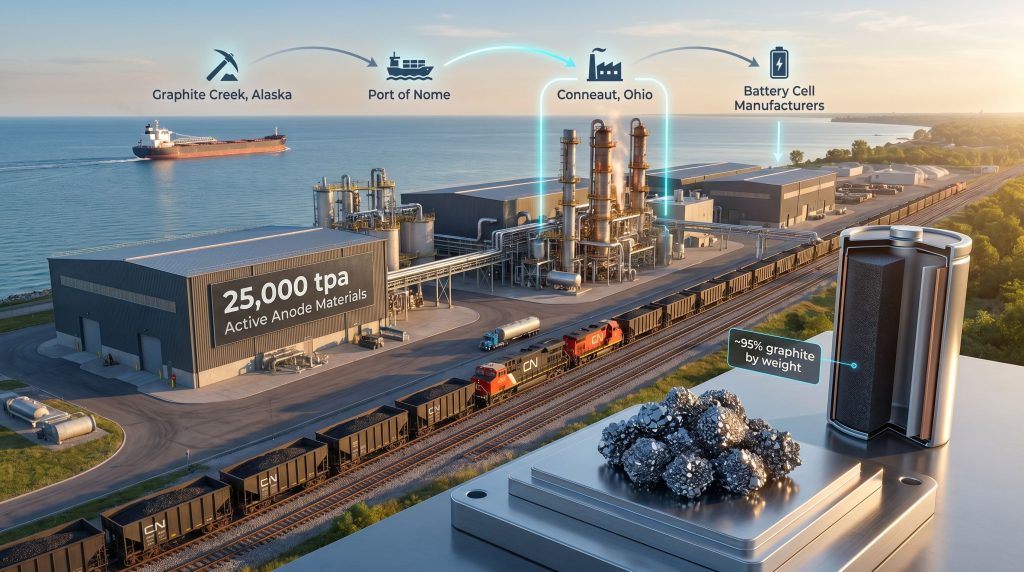
The transformation of raw carbon into a precisely engineered electrochemical material is one of the most technically demanding and capital-intensive steps in the entire lithium-ion battery supply chain. Yet it is also one of the least visible to the public. While attention focuses on lithium, cobalt, and nickel, graphite quietly holds the distinction of being the single largest material input by weight in a standard battery cell, accounting for roughly 95% of the anode mass in most commercial lithium-ion chemistries.
This structural dependency on graphite creates a compounding vulnerability for the United States. Unlike lithium or nickel, where domestic exploration activity has accelerated meaningfully, the U.S. currently produces zero commercial natural graphite. Every tonne consumed by American battery manufacturers is imported, with China historically supplying the overwhelming majority of both natural and synthetic graphite globally. Furthermore, battery supply chain bottlenecks of this nature create foundational risks that are difficult to address quickly.
The Graphite One Ohio anode materials facility in Conneaut, Ohio, represents one of the most advanced attempts to address this structural gap from within U.S. borders.
When big ASX news breaks, our subscribers know first
Why Graphite Is More Technically Complex Than Its Price Suggests
From Raw Carbon to Battery-Grade Material: The Processing Gap
Most discussions of critical mineral supply chains focus on the mining stage. For graphite, however, the mining step is arguably the simpler half of the equation. The commercially decisive transformation occurs in the processing and manufacturing phases, where raw graphite feedstock is converted into active anode material (AAM) through a sequence of highly controlled industrial steps.
AAM is not simply ground-up graphite. It is a precisely engineered product where particle morphology, surface chemistry, and crystalline structure are tuned to specific electrochemical performance requirements. Different battery chemistries demand different AAM specifications:
- High-energy-density formulations require larger graphite particles with high crystallinity, optimising the lithium intercalation capacity per unit mass.
- Fast-charging variants prioritise smaller particle sizes and specific surface treatments that reduce lithium diffusion distances, enabling rapid charge acceptance without structural degradation.
- Energy storage applications (grid-scale batteries) often prioritise cycle life and stability over raw energy density.
The conversion of raw graphite into synthetic AAM requires graphitisation, a thermal process that subjects carbon precursor materials to temperatures typically exceeding 2,500°C in electrically heated Acheson furnaces or similar high-temperature equipment. At these temperatures, disordered carbon structures reorganise into the highly ordered graphitic lattice that gives the material its electrochemical properties.
This process is extraordinarily energy-intensive, which is why access to reliable, high-capacity electrical infrastructure is not a convenience for AAM manufacturers. It is a prerequisite. In addition, the growing global graphite shortage makes investment in domestic processing capability all the more urgent.
The commercial value embedded in graphite is not captured at the mine mouth. It is created in the furnace, through a transformation that requires precision engineering, massive electrical power, and deep materials science expertise.
The Conneaut Site: Infrastructure Logic Behind the Location
Three Pillars That Drove Site Selection
When evaluating candidate locations for an energy-intensive manufacturing facility, the variables that matter most are rarely the ones that make headlines. For the Graphite One Ohio anode materials facility, the selection of Conneaut came down to three infrastructure advantages that collectively reduce both capital expenditure and development timeline risk.
1. CN Railway Direct Access
The property was secured in May 2026 through a transaction with a CN Railway subsidiary, providing immediate connectivity to one of North America's largest freight rail networks. For an AAM facility that will eventually process tens of thousands of tonnes of feedstock annually, bulk rail transport is materially more cost-effective than road haulage across comparable distances.
2. Great Lakes Multimodal Connectivity
Conneaut's position on the southern shore of Lake Erie opens a multimodal logistics corridor that connects the facility to broader North American industrial supply chains. This is particularly relevant given the planned upstream feedstock source: the Graphite Creek deposit in Alaska, where Port of Nome access would enable marine transport connecting to Great Lakes shipping routes.
3. Existing High-Voltage Electrical Infrastructure
Perhaps the most underappreciated advantage of the Conneaut site is the presence of an on-site substation with established high-capacity power supply. For most greenfield industrial sites, securing adequate grid connection for a graphitisation operation requires years of negotiations with utilities. The Conneaut site's existing electrical infrastructure, however, eliminates this bottleneck entirely, offering a meaningful head start on the construction timeline.
Phase-by-Phase Capacity Architecture
What Gets Built, and When
Graphite One has structured the Ohio facility's development as a two-phase buildout, a deliberate risk management approach that allows early revenue generation before the more capital-intensive graphitisation infrastructure is commissioned.
| Parameter | Phase One | Phase Two |
|---|---|---|
| Primary Output | Active Anode Materials (AAM) | Synthetic Graphite + AAM |
| Production Capacity | 10,000 tpa | 25,000 tpa (cumulative) |
| Operational Target | Q4 2027 | Q4 2028 |
| Incremental Capacity | Baseline | +15,000 tpa |
| Permanent Employment | 30-40 roles | Up to 120 additional roles |
| Total Jobs at Full Capacity | – | ~150-160 permanent positions |
The phased approach is strategically sound for several reasons beyond simple risk management. It allows the engineering team to incorporate operational learnings from Phase One into the Phase Two design. It also provides a commercial proof point for potential offtake customers, demonstrating actual production capability before Phase Two financing discussions reach critical junctures.
Engineering Contract: The De-Risking Milestone That Matters
The award of a detailed engineering contract to a specialist anode production facility engineering firm marks the transition from feasibility-stage planning into executable project development. In industrial project management terms, this is a significant de-risking event.
Conceptual and pre-feasibility studies carry substantial uncertainty ranges in their capital cost estimates, often plus or minus 30-40%. Detailed engineering narrows this uncertainty substantially, providing the bankable cost certainty that project financiers require before committing capital. Engineering activities currently underway encompass production line integration design and facility layout optimisation, both of which directly influence construction sequencing and ultimately the Q4 2027 AAM operational target.
The Vertically Integrated Supply Chain Model
Connecting Alaska to Ohio: A Three-Node Architecture
Graphite One's strategic objective extends well beyond building a single manufacturing plant. The company is pursuing a fully domestic, vertically integrated graphite supply chain, an architecture that would represent a genuine first for the United States in this critical material. The three-node structure operates as follows:
[Graphite Creek Mine, Alaska]
         ↓
[Port of Nome → Great Lakes Shipping]
         ↓
[AAM Manufacturing, Conneaut, Ohio]
         ↓
[Battery Cell Manufacturers]
Each node in this chain addresses a different layer of the supply vulnerability. The Alaskan mine removes dependence on imported raw graphite. The Ohio processing facility eliminates the need to send graphite offshore for value-added processing. The direct customer qualification programme creates commercial pull for the finished product. Consequently, this model aligns closely with broader efforts to strengthen America's rare earth supply chain across multiple critical materials simultaneously.
Graphite Creek: The Upstream Asset Underpinning the Model
The Graphite Creek deposit in western Alaska carries significant geological distinction. The U.S. Geological Survey has identified it as the largest known graphite deposit in the United States, providing the upstream resource scale necessary to feed a 25,000 tpa processing facility over a multi-decade mine life.
A development that adds meaningful optionality to the upstream asset came in November 2025, when rare earth element (REE) mineralization was confirmed at the Graphite Creek deposit. This discovery introduces the possibility of multi-commodity production from the Alaskan resource, potentially improving project economics and adding a separate critical mineral stream to the supply chain architecture.
Permitting activities at Graphite Creek are advancing under the federal FAST-41 programme, which establishes a structured, time-bound framework for infrastructure project permitting reviews. FAST-41 provides a procedural pathway rather than project-specific approvals or guaranteed outcomes.
Customer Qualification: Where Commercial Reality Meets Manufacturing Readiness
Sample Deliveries and Offtake Progress
One of the most commercially significant aspects of Graphite One's current development status is the depth of customer engagement already underway. Commercial-grade AAM samples of up to 20 kilograms have been delivered to three major electric vehicle manufacturers and three battery companies for specification and qualification testing.
This is not a trivial milestone. Battery cell manufacturers operate highly conservative qualification processes for anode materials, given the direct impact of AAM quality on cell performance, safety, and warranty obligations. Qualification cycles for new anode material suppliers can take 12 to 24 months or longer, involving extensive electrochemical testing, cycle life evaluation, and thermal abuse testing.
The fact that samples are already in the hands of six separate customers suggests that commercial discussions are running in parallel with, rather than sequentially after, facility construction planning. Binding offtake discussions have been reported as underway with potential customers, though no confirmed agreements have been publicly announced to date.
Furthermore, Graphite One's collaboration with Lucid and other domestic battery materials developers reflects a broader industry push to anchor critical minerals firmly within the U.S. automotive supply chain.
The next major ASX story will hit our subscribers first
Risk Factors and Conditions Governing the Development Timeline
What Must Be Resolved Before Operations Commence
Industrial project development involves navigating multiple parallel workstreams, each carrying its own timeline and execution risk. For the Graphite One Ohio anode materials facility, the critical path runs through the following conditional milestones:
| Risk Category | Current Status | Target Resolution |
|---|---|---|
| Site Control | Secured (May 2026) | Complete |
| Engineering Contract | Awarded (June 2026) | Complete |
| Geotechnical Assessment | Completed | Complete |
| Environmental Permitting | In progress | Q1 2027 |
| Final Property Leases | Pending | Pre-construction |
| Project Financing | Not yet confirmed | Pre-construction |
| Regulatory Approvals | In progress | Multiple workstreams |
| Customer Offtake Agreements | Discussions underway | TBD |
The project financing gap deserves particular attention. No confirmed financing package has been announced as of the engineering contract award. For a facility targeting first production in late 2027, the window for completing financing arrangements, finalising construction contracts, and commencing site works is relatively tight. Investors should treat the Q4 2027 target as conditional on financing being secured within a timeframe that preserves the construction schedule.
Environmental permitting, targeting completion by Q1 2027, is the other critical-path item. Any delays in permitting resolution could compress the construction window or push the Phase One start date into 2028, with cascading effects on the Phase Two timeline.
Regional Economic Significance and the Voltage Valley Context
Ohio's Emerging Role in Battery Materials Manufacturing
The Conneaut facility does not exist in an economic vacuum. Northeast Ohio has been actively positioning itself as a hub for battery materials and electric vehicle supply chain investment. The Graphite One facility, if successfully developed, would represent a meaningful anchor investment within this broader regional economic framework, further reinforcing critical minerals demand as a driver of domestic industrial policy.
At full Phase Two capacity, the facility would support approximately 150 to 160 permanent positions across both phases, with Phase One contributing 30-40 roles from late 2027 and Phase Two adding up to 120 additional permanent jobs from 2028 onward. Beyond direct employment, an AAM manufacturing facility of this scale would generate significant indirect economic activity through supply chain procurement, utilities consumption, and professional services requirements.
The identification of co-located recycling infrastructure as a potential future development adds a further dimension to the facility's long-term economic footprint, though this remains subject to separate feasibility confirmation and financing.
Contextualising 25,000 tpa Within U.S. Battery Demand
A Foundational Asset, Not a Complete Solution
It is worth placing the Phase Two capacity target in the context of actual battery manufacturing demand. A single large-format lithium-ion gigafactory operating at full production typically consumes between 20,000 and 60,000 tonnes of anode material annually, depending on cell chemistry and production volume. This means the Conneaut facility at full 25,000 tpa capacity would represent a meaningful but partial contribution to even a single major customer's annual requirements.
This scale reality does not diminish the facility's strategic importance. Rather, it contextualises the Ohio plant as a foundational first-mover asset in a domestic supply base that will ultimately require multiple facilities of similar or greater scale to fully address projected U.S. battery demand growth. The commercial and technical learnings accumulated through Graphite One's development process, including customer qualification work, engineering execution, and operational ramp-up, represent institutional knowledge with significant value beyond the specific capacity numbers involved.
The combination of a confirmed upstream resource, an advanced midstream facility plan, active customer qualification, and a progressively de-risked development trajectory places the Graphite One Ohio anode materials facility among the most mature domestic graphite supply chain initiatives currently under development in North America. However, whether it reaches full operational capacity on the stated timeline will depend on resolving the financing and permitting variables that remain outstanding. Understanding how it fits within battery raw materials market dynamics provides further context for assessing its long-term significance.
This article contains forward-looking statements regarding project timelines, production capacities, employment projections, and commercial outcomes. All such statements are subject to material risks and uncertainties, including but not limited to financing availability, permitting outcomes, regulatory approvals, and market conditions. Readers should not place undue reliance on these projections. This article does not constitute financial advice.
Want to Stay Ahead of the Next Major Mineral Discovery?
Discovery Alert's proprietary Discovery IQ model delivers real-time alerts on significant ASX mineral discoveries — instantly turning complex mineral data into actionable insights for both short-term traders and long-term investors. Explore historic discoveries and the returns they generated, then begin your 14-day free trial to position yourself ahead of the broader market.