June 23, 2026
The Western Desert's Hidden Productivity Problem: Why Tight Reservoirs Are Reshaping Egypt's Gas Strategy
Across North Africa's hydrocarbon landscape, a quiet technical revolution is unfolding beneath the desert surface. Egypt's Western Desert, long considered a mature and partly depleted production zone, is being reassessed through the lens of modern completion engineering. The central question driving this reassessment is not whether hydrocarbons exist in sufficient quantities, but whether the reservoir rock will yield them at commercially viable rates without aggressive stimulation. The answer, increasingly, is that conventional vertical completions alone cannot deliver the production intensity Egypt's energy balance requires.
This is the broader context in which the Badr Eldin well Egypt gas reserves story becomes genuinely significant, extending well beyond the headline figure of 15 billion cubic feet (bcf) of estimated natural gas reserves.
When big ASX news breaks, our subscribers know first
Egypt's Natural Gas Production Pressure: The Numbers Behind the Need
Egypt's domestic natural gas production trajectory has faced persistent headwinds over the past several years. After peaking with the ramp-up of the giant Zohr offshore field in the Mediterranean, output has faced natural field decline and rising domestic consumption simultaneously. The consequence has been a return to liquefied natural gas (LNG) imports, a position that carries a substantial foreign currency cost for an economy managing tight external balances.
Every additional unit of domestically produced gas carries a dual economic benefit: it displaces an imported LNG cargo priced in US dollars, and it reduces pressure on Egypt's foreign exchange reserves. The Ministry of Petroleum and Mineral Resources has framed increasing local production not simply as an operational target, but as a macroeconomic imperative. The petroleum minister explicitly noted that expanding domestic output is critical to reducing the cost burden of petroleum product and LNG imports — a concern closely tied to the broader LNG supply outlook across the region.
The Western Desert, Egypt's most intensively drilled onshore basin, sits at the centre of this near-term production growth strategy. Unlike the technically complex and capital-intensive offshore Mediterranean developments, Western Desert wells can be brought online relatively quickly once the right completion technology is applied.
What the Badr Eldin Well Discovery Actually Tells Us
BED 15-31: Key Production Parameters
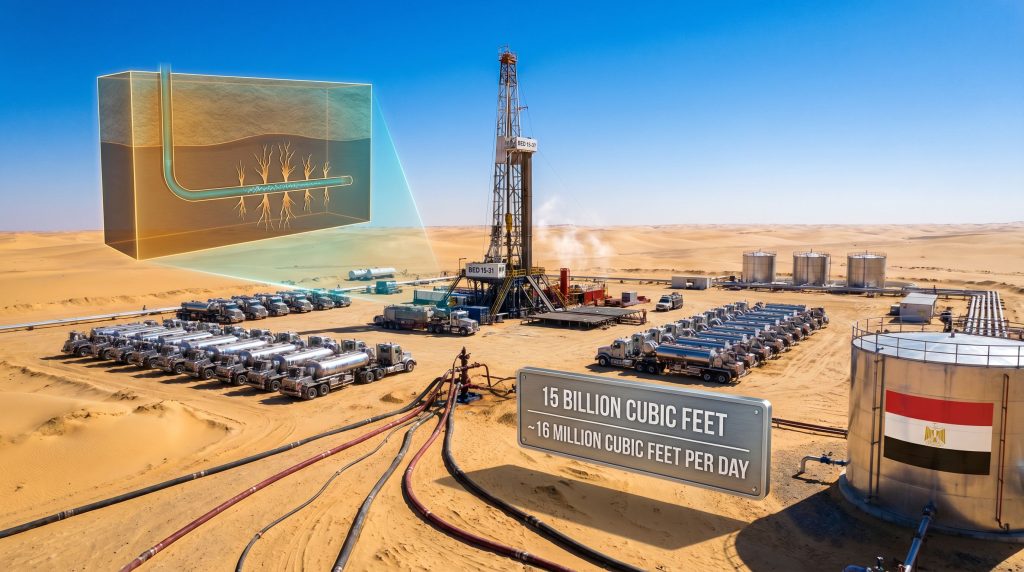
The well designated BED 15-31, located in the Badr–15 area of the Western Desert and operated by Badr El-Din Petroleum Company (BAPETCO), represents more than a single reserve addition. It is a proof-of-concept for the application of hydraulic fracturing technology in Western Desert formations that would otherwise underperform.
| Parameter | Reported Figure |
|---|---|
| Estimated Gas Reserves Added | ~15 billion cubic feet (bcf) |
| Daily Gas Production Rate | ~15 million cubic feet per day |
| Daily Condensate Output | ~500 barrels per day |
| Discovery Date | November 2025 |
| Production Commencement | End of June 2026 |
| Operating Zone | Badr–15 Area, Western Desert, Egypt |
The condensate component deserves particular attention. Condensate, a light liquid hydrocarbon that co-produces alongside natural gas, carries independent commercial value and is priced closer to crude oil benchmarks than pipeline gas. For wells in the Western Desert, condensate yields improve the overall revenue economics of gas-focused drilling programmes, effectively subsidising the cost of gas development with a higher-value liquid revenue stream.
Why 15 BCF Matters More Than It Appears in Isolation
At first glance, 15 bcf appears modest against Egypt's national production and consumption volumes. However, the significance of BED 15-31 lies not in the absolute reserve number but in what it demonstrates about the scalability of hydraulic fracturing across candidate formations in the Western Desert. Furthermore, this scalability argument is central to how analysts are reappraising the natural gas price trends relevant to North African producers.
When the methodology proven at one well is replicated across dozens of identified candidate formations in the same basin, the cumulative reserve and production impact becomes material at the national level. A pipeline of 20 to 30 similarly stimulated wells could aggregate to several hundred bcf of incremental reserves.
This aggregation logic is precisely what underpins Egypt's five-year petroleum plan, which embeds technology adoption as a core delivery mechanism rather than treating individual discoveries as standalone events.
The Engineering Case for Hydraulic Fracturing in Tight Western Desert Formations
How Reservoir Permeability Determines Whether a Well Produces or Fails
A concept rarely discussed outside technical petroleum engineering circles is the relationship between reservoir permeability and commercial flow rates. Permeability measures how easily fluids move through pore spaces in rock. In high-permeability reservoirs, hydrocarbons flow naturally and abundantly toward the wellbore under pressure differential. In low-permeability, or tight, formations, the rock essentially resists fluid movement, meaning a well drilled conventionally may test positive for hydrocarbons but produce at sub-commercial rates.
Many Western Desert formations fall into the tight category. This is not a geological failure; it is an engineering challenge. Hydraulic fracturing resolves this challenge by:
- Injecting a high-pressure fluid mixture into the target formation at pressures exceeding the rock's tensile strength
- Propagating fractures outward from the wellbore through the reservoir rock, creating conductive pathways
- Carrying a solid material called proppant, typically sand or ceramic beads, deep into those fractures
- Allowing the proppant to hold the fractures open after pressure is released, maintaining permeability long-term
- Enabling hydrocarbons to flow through the propped fracture network toward the wellbore at commercially viable rates
The result is a fundamental transformation of a well's productivity profile. Formations that would produce only marginally under conventional completion can, after fracturing, deliver flow rates that justify development investment.
Horizontal Drilling: Multiplying Reservoir Contact Area
Hydraulic fracturing's effectiveness is amplified dramatically when combined with horizontal drilling. A conventional vertical well contacts only the vertical thickness of a reservoir, typically measured in tens of metres. A horizontal well, by contrast, extends its wellbore laterally through the reservoir for distances of 1,000 metres or more, multiplying the surface area through which hydrocarbons can enter the wellbore.
When multi-stage hydraulic fracturing is then applied along that horizontal lateral, creating fractures at multiple intervals, the combination achieves reservoir contact that no conventional vertical well can replicate. Industry data consistently shows that horizontal wells with multi-stage fracturing in tight formations can recover several multiples of the reserves achievable through conventional vertical completions in the same rock.
The Ministry of Petroleum confirmed that infrastructure to support the expansion of both horizontal drilling and hydraulic fracturing technologies has been prepared, positioning Egypt to scale these approaches across multiple operators and concession areas simultaneously.
EGPC's Role: Technology Coordinator, Not Just Regulator
Workshop-Based Knowledge Transfer and Economic Modelling
An underappreciated function of the Egyptian General Petroleum Corporation (EGPC) is its role as a technology deployment coordinator rather than simply a licensing and regulatory body. The ministerial visit to BAPETCO's fields included a workshop attended by EGPC officials, production companies, and oilfield service providers — an event that reflects a deliberate knowledge-transfer structure rather than a ceremonial occasion.
These workshops serve several practical functions:
- Standardising well design templates that can be replicated across concession areas to reduce engineering costs
- Sharing reservoir data and fracture performance results between operators to accelerate learning curves
- Aligning oilfield service providers on equipment availability, pricing frameworks, and logistics planning
- Presenting economic modelling outputs that help operators and state entities evaluate the return on investment for technology-intensive completion programmes
The economic modelling dimension is particularly important. Hydraulic fracturing and horizontal drilling carry higher upfront costs than conventional completions. Convincing operators to deploy these methods at scale requires demonstrated economics showing that the incremental production uplift justifies the additional investment, particularly in a joint venture environment where both state entities and private partners share costs and returns.
The Role of Payment Settlements in Restoring Investor Confidence
A less frequently analysed factor shaping Egypt's upstream technology adoption is the settlement of outstanding dues owed to international investment partners. The petroleum minister specifically referenced the resolution of these arrears and the establishment of structured monthly payment arrangements as conditions that have restored the confidence of international operators to commit capital to technology-intensive programmes.
This matters because hydraulic fracturing and horizontal drilling programmes require investment partners willing to commit significant capital upfront, often on multi-well programme contracts with oilfield service companies. Uncertainty about payment timelines or the recoverability of invested capital can suppress this willingness entirely, regardless of the technical merits of the opportunity.
Egypt's Gas Portfolio: Where the Western Desert Fits
| Development Zone | Primary Resource | Technology Focus | Strategic Role |
|---|---|---|---|
| Western Desert (Onshore) | Gas and Condensate | Hydraulic fracturing, horizontal drilling | Near-term production growth |
| East Mediterranean (Offshore) | Deep-water gas | Subsea infrastructure, LNG processing | Long-term export capacity |
| Nile Delta (Onshore/Shallow Offshore) | Gas | Conventional development | Mature base production |
| Red Sea (Exploration Stage) | Oil and Gas (prospective) | Seismic surveys, exploratory drilling | Future reserve potential |
The Western Desert's competitive advantage within this portfolio is speed-to-production. Offshore Mediterranean developments, while larger in absolute resource terms, require years of subsea infrastructure construction and multi-billion dollar capital commitments before first gas. Western Desert wells, by contrast, can be drilled, completed, and connected to existing pipeline infrastructure within months.
This speed advantage makes the onshore Western Desert the primary lever available to Egypt for bridging the gap between current domestic production and near-term demand, while offshore megaprojects mature over longer horizons. In addition, the global steel demand outlook reinforces why energy-intensive economies across the region are prioritising domestic gas security to keep industrial costs competitive.
The next major ASX story will hit our subscribers first
From Wellbore to Reserve Booking: A Step-by-Step Process
Understanding how a single well discovery translates into formally recognised national reserves illuminates why the Badr Eldin well Egypt gas reserves announcement carries institutional weight beyond its production numbers. Consequently, the process below reflects the rigorous technical and regulatory pathway that underpins energy transition demand strategies across emerging markets.
- Exploration drilling confirms hydrocarbon presence through mud logging, wireline logging, and formation evaluation
- Extended well testing establishes stabilised flow rates, reservoir pressure, fluid composition, and condensate-gas ratios
- Volumetric analysis applies reservoir geometry, porosity, and recovery factor assumptions to calculate recoverable volumes
- Material balance modelling cross-checks volumetric estimates against pressure depletion behaviour observed during testing
- Reserve classification assigns discovered volumes to proved, probable, or possible categories under applicable reporting standards
- Regulatory and corporate reporting formalises the reserve addition in national accounts and any relevant corporate disclosures
- Production scheduling and facilities planning determines offtake rates, pipeline tie-in requirements, and production plateau duration
Each of these steps involves significant technical judgement, and the reported 15 bcf figure reflects the outcomes of this process applied to BED 15-31's specific reservoir characteristics. According to reporting on the discovery, the well is also expected to play a role in validating Egypt's broader push to expand fracturing technologies across the basin.
Frequently Asked Questions: Badr Eldin Well and Egypt Gas Reserves
What is the Badr Eldin well and where is it located?
The BED 15-31 well is a gas and condensate discovery situated in the Badr–15 area of Egypt's Western Desert, developed under a joint venture arrangement involving Badr El-Din Petroleum Company (BAPETCO).
How much gas will the Badr Eldin well add to Egypt's reserves?
The discovery is expected to contribute approximately 15 bcf of natural gas alongside condensate production of around 500 barrels per day, with production commencement targeted by end of June 2026.
Why is hydraulic fracturing being used in the Western Desert?
The target formations in the Badr–15 area have insufficient natural permeability to deliver commercial flow rates through conventional completions. Hydraulic fracturing creates conductive fracture networks that unlock the reservoir's productivity potential.
Who coordinates upstream gas development in Egypt?
The Egyptian General Petroleum Corporation (EGPC) coordinates upstream activities across Egypt's onshore concession areas, working alongside joint venture operators, international oil companies, and domestic production entities.
How does more domestic gas production help Egypt's economy?
Each additional unit of domestic gas production displaces a unit of imported LNG, reducing Egypt's foreign currency expenditure on energy imports and improving the country's trade balance and energy security position. Furthermore, scaling onshore production forms a critical pillar of the broader clean energy transition now reshaping energy policy across the region.
Disclaimer: This article contains forward-looking statements and production projections based on publicly available reporting. Actual reserve additions and production rates may differ from estimates due to reservoir uncertainty, operational factors, and commodity price changes. This content does not constitute financial or investment advice.
For ongoing coverage of Egypt's upstream oil and gas sector and broader North Africa energy developments, Zawya's Energy and North Africa sections at zawya.com provide a reliable reference for tracking regional petroleum activity.
Want to Track the Next Major Resource Discovery Before the Broader Market Does?
Discovery Alert's proprietary Discovery IQ model delivers real-time alerts on significant ASX mineral discoveries, transforming complex resource data into clear, actionable investment insights — much like the engineering breakthroughs reshaping Egypt's gas strategy are unlocking value that conventional analysis would overlook. Explore historic examples of exceptional discovery returns and begin your 14-day free trial to position yourself ahead of the market.