
June 23, 2026
The Institutional Trap: Why Morocco Cannot Resolve Its Biggest Industrial Deadlock
Across resource-dependent economies, few governance challenges are as structurally revealing as the fate of a legacy industrial asset caught between judicial authority, political ambition, and fiscal reality. When these three forces operate on incompatible timelines, the result is not simply policy inaction. It is a compounding liability that grows more expensive with every year it remains unresolved. The Morocco Samir refinery state takeover rejection by the upper house of parliament in June 2026 has made the deadlock both more visible and more urgent, exposing deep structural fault lines in how Morocco governs its most strategically sensitive industrial assets.
When big ASX news breaks, our subscribers know first
A Facility That Defined Morocco's Industrial Identity
Few industrial assets carry the symbolic and economic weight of the Samir refinery. Built under state ownership in 1959 and located in the Atlantic port city of Mohammedia, the facility was the cornerstone of Morocco's domestic energy infrastructure for nearly four decades. Before its closure, it supplied approximately 65% of the country's domestic fuel demand and operated at a refining capacity of 200,000 barrels per day, making it one of the most strategically significant industrial sites on the African continent.
The transition to private ownership came in 1997 when the Moroccan state sold the refinery to Corral Morocco Holdings, a Sweden-registered entity linked to Saudi businessman Sheikh Mohammed Hussein Al Amoudi. The privatisation was consistent with broader liberalisation trends sweeping emerging market economies during that period. However, the financial architecture supporting the refinery deteriorated over time. Debt accumulated steadily, eventually surpassing $4 billion, and in 2015 the facility ceased operations. The Casablanca Commercial Court ordered court-supervised liquidation in 2016, setting in motion a legal process that remains unresolved nearly a decade later.
What makes the Samir case particularly instructive is not the scale of the debt alone, but the way in which the refinery's collapse exposed the limitations of Morocco's privatisation model for strategic industrial assets. When a facility supplying two-thirds of national fuel demand is allowed to accumulate liabilities of this magnitude without triggering an earlier state intervention, it points to a structural gap in how energy security assets are monitored and governed. Furthermore, these challenges are not unique to Morocco, as North African mining markets and broader energy sectors across the region face comparable governance dilemmas.
The Parliamentary Vote: What Was Actually Being Decided
The June 2026 rejection by Morocco's upper house is frequently reported as a decision on whether to reopen the refinery. That framing, however, misrepresents what was actually on the table. The proposal put before parliament was specifically a mechanism for transferring Samir's industrial assets into state ownership through renationalisation. Reopening was a downstream possibility, not the immediate legislative objective.
Understanding this distinction matters because it changes how the vote should be interpreted. According to reporting by Hespress, two primary concerns drove the rejection:
- Active international arbitration proceedings create legal exposure for Morocco if the state were to intervene in asset ownership unilaterally.
- Absorbing a distressed asset carrying more than $4 billion in accumulated debt into the public balance sheet carries significant fiscal risk, particularly given Morocco's existing subsidy obligations.
Proponents of the proposal framed state acquisition differently. A substantial portion of the debt Samir owes is owed directly to Moroccan public institutions, which creates a theoretical basis for a debt-offset asset transfer that would not require net new public spending of equivalent scale. Proponents also argued that continued import dependency represents a larger long-term fiscal cost than a structured state takeover.
Neither argument prevailed. The upper house's rejection preserves the status quo of court-supervised liquidation while leaving the underlying energy security problem unaddressed.
The Legal Architecture That Controls Every Outcome
To understand why the Samir deadlock is so resistant to resolution, it is essential to understand the role of the Casablanca Commercial Court. Since ordering liquidation in 2016, the court has functioned not merely as an administrative body but as the primary institutional gatekeeper through which every proposed resolution must pass.
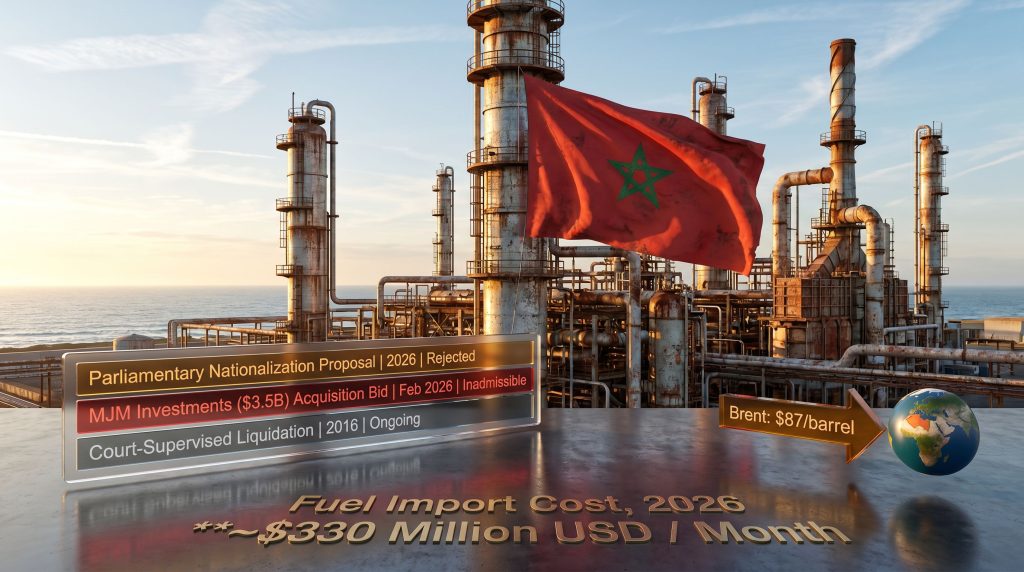
This became starkly visible in February 2026 when Dubai-based MJM Investments submitted an acquisition bid of approximately $3.5 billion for Samir's industrial assets. The Casablanca Commercial Court declared the bid inadmissible in the same month, finding that the conditions proposed by the investor were structurally incompatible with the requirements of the court-supervised sale process, according to reporting by H24info.
The table below illustrates the pattern of failed resolution attempts:
| Attempted Resolution | Year | Outcome | Blocking Factor |
|---|---|---|---|
| Court-supervised liquidation ordered | 2016 | Ongoing | Debt complexity, legal process |
| Parliamentary nationalisation proposal | 2026 | Rejected by upper house | Arbitration risk, fiscal exposure |
| MJM Investments ($3.5B) acquisition bid | Feb 2026 | Declared inadmissible | Conditions incompatible with court framework |
Within a single calendar year in 2026, both of the available resolution pathways have been formally blocked. This is not coincidental. It reflects a deeper problem: the court's liquidation framework was designed for conventional insolvency proceedings, not for strategically sensitive industrial assets where geopolitical, fiscal, and social considerations intersect.
The Arbitration Constraint Explained
One of the least understood aspects of the Samir situation is how international arbitration proceedings interact with domestic policy options. When active arbitration is underway, unilateral state intervention in asset ownership can expose the intervening government to sovereign liability claims under international investment law. The cross-jurisdictional complexity arising from the original ownership structure, involving a Sweden-registered entity with links to a Saudi national, means that any attempted state takeover would potentially trigger claims under bilateral investment treaties.
This is not a theoretical risk. International arbitration awards against sovereign states have resulted in multi-billion-dollar liability judgements in comparable cases elsewhere. For a government already spending approximately 3 billion Moroccan dirhams, equivalent to roughly $330 million USD, per month on fuel subsidies, the prospect of an additional arbitration liability is a credible deterrent to unilateral action. Consequently, the Morocco Samir refinery state takeover rejection must be understood partly as a risk management decision rather than purely a political one.
Fiscal Arithmetic: The Cost of Indefinite Inaction
The monthly subsidy figure is the number that reframes every other aspect of the Samir debate. At approximately $330 million per month, Morocco's fuel subsidy burden amounts to nearly $4 billion annually at current rates, according to data reported by Arabian Gulf Business Insight. This figure is strikingly close to the total debt that triggered Samir's liquidation in the first place.
The fiscal cost of import dependency is now approaching the scale of the debt that made renationalisation politically contentious. Every month of inaction effectively spends the equivalent of a fraction of the MJM acquisition bid on subsidising imported fuel.
This arithmetic has been further complicated by external supply chain disruptions. The de facto closure of the Strait of Hormuz has materially worsened Morocco's exposure as an almost entirely import-dependent fuel economy. Morocco's geographic position, facing the Atlantic without domestic crude production, makes it structurally vulnerable to disruptions in Middle Eastern supply corridors in a way that landlocked or crude-producing economies are not.
Fitch has revised its 2026 Brent crude oil price outlook upward to $87 per barrel from a previous forecast of $70, citing the prolonged nature of Hormuz disruption. For Morocco, each upward revision in crude prices directly translates into higher subsidy expenditure and greater fiscal pressure.
The Breakeven Question Most Analysts Are Not Asking
A useful analytical frame that receives insufficient attention in coverage of the Samir situation is the crude price breakeven threshold at which domestic refining becomes unambiguously preferable to continued import subsidisation. This calculation is more complex than it appears because it must account for:
- The capital investment required to return Samir to operational status.
- The ongoing operating cost differential between domestic refining and importing refined products.
- The timeline to first operational output following any reactivation investment.
- The opportunity cost of capital committed to site rehabilitation versus alternative energy infrastructure.
At $87 per barrel, the case for domestic refining capacity strengthens considerably compared to the $70 per barrel environment that preceded the Hormuz disruption. This dynamic has not changed the legal or political calculus, but it has sharpened the urgency of finding a resolution.
Four Scenarios for What Happens Next
Given the failure of both available resolution pathways in 2026, the realistic forward options are narrower than public commentary typically acknowledges.
Scenario 1: Continued Liquidation (Status Quo)
The court process continues without political intervention. Asset deterioration risk increases over time, progressively reducing the eventual sale value. The fiscal subsidy burden compounds indefinitely. This is the path of least institutional resistance and the most fiscally damaging over a multi-year horizon.
Scenario 2: Revised Private Acquisition Framework
A new investor submits a bid structured to satisfy the admissibility requirements the MJM bid failed to meet. This requires either a different investor approach or a modification to the court's sale framework. The timeline is uncertain and depends entirely on court flexibility and the availability of credible investor interest.
Scenario 3: Hybrid Public-Private Recapitalisation
State entities participate as minority stakeholders rather than full owners. A debt-for-equity conversion involving public creditors could reduce the effective acquisition cost for incoming private operators. This structure avoids the full legal exposure of outright nationalisation while preserving a degree of public interest oversight. Precedents exist in industrial restructuring cases across the MENA region and sub-Saharan Africa.
Scenario 4: Strategic Reorientation
Morocco redirects energy security investment toward renewable energy capacity and diversified import infrastructure rather than refinery rehabilitation. The Samir site is repurposed for alternative industrial use. This scenario is politically challenging given sustained labour union pressure, but is economically viable within a long-term energy transition strategy context.
Analysts examining North African energy governance increasingly identify Scenario 3 as the most legally defensible path forward, provided that arbitration proceedings can be resolved or structurally ring-fenced before any hybrid acquisition is attempted.
The next major ASX story will hit our subscribers first
The Social and Labor Dimension: A Political Variable That Will Not Disappear
The Samir debate cannot be reduced to balance sheets and legal frameworks. Hundreds of former employees have maintained sustained advocacy campaigns for more than a decade, supported by national labour federations. Their pressure has elevated the political salience of the renationalisation debate far beyond what the economic fundamentals alone would justify.
The Mohammedia regional economy, anchored for decades by the refinery's supply chain, port logistics activity, and direct employment, continues to bear the downstream costs of the site's closure. This creates a constituency for resolution that transcends partisan lines in the Moroccan parliament, making the issue recurrent regardless of how many times individual proposals are rejected.
The risk is that this social pressure drives policy decisions through political urgency rather than structured economic and legal analysis. The Arab Reform Initiative has noted that the upper house's June 2026 rejection suggests institutional caution has so far prevailed over political expediency. Whether that equilibrium holds under intensifying fiscal pressure from rising crude prices and Hormuz disruption remains an open question.
Frequently Asked Questions: Morocco Samir Refinery State Takeover Rejection
Why did Morocco's upper house reject the Samir refinery nationalisation proposal?
The upper house cited two primary concerns: legal liability arising from active international arbitration proceedings, and the fiscal risk of absorbing a distressed industrial asset carrying more than $4 billion in accumulated debt onto the public balance sheet.
Is the Samir refinery permanently closed?
The facility has been effectively non-operational since 2015 and entered court-supervised liquidation in 2016. It has not been formally decommissioned, but no credible operational timeline currently exists.
What happened to the $3.5 billion MJM Investments bid?
The Casablanca Commercial Court declared the February 2026 bid inadmissible, finding that the conditions proposed by the investor were incompatible with the requirements of the court-supervised liquidation process.
How much is Morocco spending on fuel subsidies because of the refinery's closure?
Morocco is spending approximately 3 billion Moroccan dirhams, or around $330 million USD, per month on fuel price subsidies as of 2026, according to Arabian Gulf Business Insight data.
Could Morocco still nationalise the Samir refinery in future?
The political debate remains open despite the current rejection. Any future attempt would need to navigate active arbitration proceedings and satisfy the court's liquidation framework. These are significant but not permanent obstacles, depending on how the legal landscape evolves.
What the Samir Deadlock Reveals About Energy Governance in North Africa
The Morocco Samir refinery state takeover rejection is not an isolated political event. It is a symptom of a governance pattern observable across multiple African economies where legacy industrial assets intersect with insolvency law, energy security strategy, and cross-border investment obligations simultaneously. Furthermore, broader geopolitical trade tensions are compounding the difficulty of attracting credible private sector interest in complex industrial restructuring cases of this kind.
Key structural observations from the Samir case include:
- Rejecting nationalisation does not resolve the energy security challenge; it defers it at an ongoing fiscal cost of approximately $330 million per month.
- Both primary resolution pathways, state acquisition and private sale, were formally blocked within the same calendar year.
- The Strait of Hormuz disruption has transformed a slow-moving domestic policy debate into an acute supply vulnerability with immediate fiscal consequences.
- Fitch's revised Brent forecast of $87 per barrel compounds subsidy expenditure in real time, narrowing the window for low-cost resolution.
- The admissibility failure of the MJM bid raises broader questions about the predictability of court-supervised sale frameworks for future investors considering African industrial assets of comparable complexity.
For Morocco, the path forward requires not just a new investor or a revised legal argument. It requires an integrated resolution framework that can simultaneously satisfy the court's liquidation mandate, ring-fence arbitration exposure, and produce a fiscally defensible outcome. That is a high bar. But the monthly cost of failing to clear it is now measurable in hundreds of millions of dollars.
This article is intended for informational purposes only and does not constitute financial or investment advice. Forward-looking statements, scenario projections, and fiscal estimates involve uncertainty and should not be relied upon as definitive forecasts. Readers are encouraged to consult independent sources for investment decisions.
Want to Track the Commodity Shifts Driving Africa's Energy and Resource Landscape?
Discovery Alert's proprietary Discovery IQ model delivers real-time alerts on significant ASX mineral discoveries, instantly translating complex commodity data into actionable investment insights — including opportunities shaped by the kind of supply disruptions and resource governance shifts explored above. Explore historic discoveries and their market returns, then begin your 14-day free trial at Discovery Alert to position yourself ahead of the market.