
June 23, 2026
The Purity Threshold That Separates Commodity Alumina From Critical Materials
Not all alumina is created equal. The difference between standard smelter-grade alumina and high purity alumina suitable for advanced manufacturing is not merely a matter of refinement — it represents an entirely different value chain, a different set of customers, and a fundamentally different commercial logic. At the centre of this distinction sits a single threshold: 99.99% purity, or what the industry calls the 4N standard.
Understanding why this threshold matters, and why a kaolin-based processing route challenges decades of incumbent production chemistry, is essential context for evaluating what the Andromeda Metals high purity alumina pilot plant represents — not just as a corporate milestone, but as a potential inflection point in how specialty alumina is sourced globally.
When big ASX news breaks, our subscribers know first
What 4N Purity Actually Means in Practice
The naming convention for ultra-pure materials follows a straightforward logic: each N represents a nine. So 4N equals 99.99% purity, 4N+ denotes material exceeding this baseline (such as 99.999% or higher), and 5N indicates 99.999% purity across the full elemental profile. The gap between 3N and 4N may appear statistically small, but in applied manufacturing, trace impurities at the parts-per-million level can catastrophically compromise product performance.
Why End-Use Applications Are Unforgiving of Impurities
Three primary sectors drive the overwhelming share of 4N HPA demand globally, and the critical minerals demand surge in recent years has intensified pressure across each of them:
- LED phosphor manufacturing, where alumina substrates must maintain precise optical properties free from contamination
- Lithium-ion battery separator coatings, where HPA applied to polymer separators improves thermal stability and reduces the risk of thermal runaway
- Synthetic sapphire production, used in semiconductor wafers, optical windows, and high-durability watch crystals, where crystal clarity requires near-perfect feedstock purity
In each of these applications, impurities are not a quality nuisance — they are a functional failure point. This is what sustains the significant price premium that 4N and 4N+ HPA commands over conventional alumina, which typically sells for approximately USD $300 to $400 per tonne. By contrast, high-grade 4N HPA has historically traded in ranges from USD $20,000 to over $30,000 per tonne, depending on purity grade, form factor, and supply contract terms.
The economic gap between smelter-grade alumina and 4N HPA is not incremental — it is transformational. The same raw material, refined to a different purity specification, can be worth 50 to 100 times more per tonne.
Kaolin as a Feedstock: The Chemistry That Makes This Route Different
Most commercial HPA production today relies on one of two conventional pathways: the aluminium alkoxide process, which uses aluminium metal or organic precursors and involves high chemical and energy inputs, or hydrolysis-based methods linked directly to primary aluminium production infrastructure. Both approaches tie the HPA producer to upstream aluminium market dynamics, including energy costs and metal pricing volatility.
Kaolin-derived HPA represents a structurally distinct alternative. Kaolin is a naturally occurring aluminosilicate clay mineral. When subjected to specialised leaching and purification chemistry, it can yield aluminium compounds of exceptional purity — while also producing silica-rich by-product streams that carry their own commercial potential. The key challenge has always been achieving consistent 4N purity at commercially meaningful throughput, rather than only under controlled laboratory conditions.
The Great White Deposit and Its Strategic Positioning
Andromeda Metals is developing its high purity alumina project around the Great White kaolin deposit located in South Australia. The deposit provides a domestic, independently sourced feedstock base that is not connected to conventional bauxite refining or aluminium smelting supply chains. This geographic and supply-chain independence is increasingly relevant to manufacturers in North America, Europe, Japan, and South Korea who are actively seeking to reduce exposure to geographically concentrated critical material supply.
| Feature | Traditional HPA Route (Aluminium Alkoxide) | Andromeda's Kaolin-Based Route |
|---|---|---|
| Primary Feedstock | Aluminium metal or alkoxide precursors | Kaolin clay (Great White deposit) |
| Supply Chain Dependency | Linked to primary aluminium production | Independent mineral feedstock |
| Purity Achieved (Lab Scale) | Typically 4N to 4N+ | 99.9985% (4N+) confirmed |
| By-Product Potential | Limited | Amorphous silica, potential gallium recovery |
| Geographic Origin | Globally distributed | South Australia (domestic supply chain) |
From Laboratory Results to Continuous Production: Why the Pilot Plant Is the Critical Test
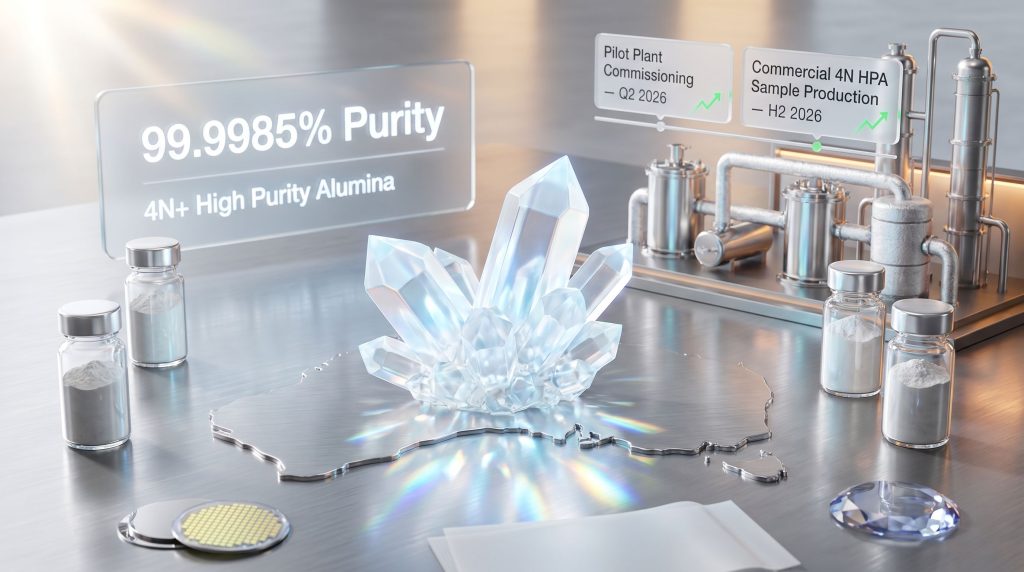
Laboratory-scale testwork at Andromeda confirmed alumina purity of 99.9985% — a 4N+ result that comfortably exceeds the minimum 4N threshold. A scoping study completed in 2025 added economic validation, indicating competitive production costs and favourable project-level economics. These are meaningful results, but they carry an important caveat that is often underappreciated outside the industry.
The Batch-to-Continuous Production Gap
Laboratory results are typically generated under batch processing conditions, where each production run can be individually controlled and optimised. Pilot-scale and commercial production operate on a continuous basis, where the process flowsheet must maintain consistent purity thresholds across extended uninterrupted runs. Variables that can be managed easily in batch mode — feedstock mineralogical variation, reagent concentration drift, temperature gradients, and contamination ingress — become significantly more difficult to control when a process runs continuously over days or weeks.
Moving from batch laboratory production to sustained continuous operation is one of the most technically demanding transitions in high-purity materials development. Purity that holds in a beaker does not automatically hold across a 72-hour continuous run.
What the pilot plant commissioning program is designed to validate:
- Stability of the process flowsheet under sustained operating conditions, not just optimal batch runs
- Statistical robustness of purity data across multiple production intervals
- Production of sufficient commercial-volume material for genuine customer qualification testing
- Identification of operating variables that affect purity consistency at throughput scale
- Generation of preliminary cost-per-kilogram data for incorporation into feasibility modelling
The Andromeda Metals high purity alumina pilot plant commenced commissioning in Q2 2026 and is scheduled to operate continuously through Q3 2026. Commercial-grade 4N HPA sample production is targeted for the second half of 2026, with customer dispatch to follow as part of a structured qualification testing program.
The By-Product Dimension: Gallium and Amorphous Silica as Unmodelled Upside
One of the less widely discussed aspects of kaolin-derived HPA production is the potential for economically meaningful by-product recovery. The leaching and purification chemistry involved in extracting aluminium compounds from aluminosilicate feedstocks generates silica-rich residues that, depending on their physical and chemical form, can be valuable as amorphous silica.
Amorphous silica finds application in specialty coatings, rubber compounding, pharmaceutical excipients, and high-performance construction materials. Its market value depends substantially on purity and physical form, but confirmed commercial-grade production could contribute a meaningful secondary revenue stream.
The gallium dimension carries additional strategic weight. Gallium is a minor metal recovered primarily as a by-product of bauxite processing, and it plays a critical role in compound semiconductor manufacturing. Furthermore, as covered in analysis of gallium critical mineral deposits, several major producing nations have implemented export controls on gallium in recent years, significantly tightening available supply to Western manufacturers.
Investor note: Neither amorphous silica nor gallium was incorporated into Andromeda's 2025 scoping study economic model. If the pilot plant program confirms commercial recovery potential for either material, this would represent upside that has not yet been reflected in any published project financial assessment.
Potential by-product value drivers at a glance:
- Amorphous silica: Industrial and specialty applications including rubber, pharmaceuticals, and performance coatings
- Gallium: Critical semiconductor metal facing constrained global supply; subject to bismuth-style export restrictions in major producing nations
- Combined effect on economics: Confirmed recovery of both materials could meaningfully reduce net HPA production costs by offsetting processing expenses against by-product revenues
Customer Qualification: The Invisible Gatekeeper to Commercial HPA Supply
One aspect of the HPA market that is rarely explained clearly is how demanding the path to a commercial supply agreement actually is. Unlike bulk commodity markets where buyers and sellers transact based largely on published specifications, high-purity materials markets require customers to conduct extensive in-house qualification testing before committing to any supply relationship.
Typical HPA customer qualification stages:
- Initial sample receipt and independent chemical purity verification against supplier specifications
- Physical and morphological characterisation, including particle size distribution, surface area, and crystal phase analysis
- Application-specific performance testing, such as separator coating trials for battery manufacturers or phosphor integration testing for LED producers
- Consistency verification across multiple separately produced sample batches
- Commercial terms negotiation, including volume commitments, pricing mechanisms, and quality assurance protocols
- Formal supply agreement execution
This process commonly spans 12 to 24 months even for suppliers with well-established production histories. For a new entrant seeking qualification with technically demanding manufacturers, the timeline can extend further. This is precisely why Andromeda's targeted H2 2026 commercial sample production timeline is strategically significant: earlier sample dispatch provides more runway for qualification to complete before any transition to commercial-scale production. The broader battery raw materials market is placing additional urgency on this timeline, as separator coating demand continues to accelerate.
The next major ASX story will hit our subscribers first
How Andromeda's Route Compares to the Broader HPA Production Landscape
The global HPA industry is currently dominated by a relatively small number of producers, with significant production concentration in Asia. This geographic concentration has become a growing concern for manufacturers in allied nations who require assured access to 4N and 4N+ material for advanced technology applications.
| Production Route | Key Advantage | Key Risk | Typical Purity Range |
|---|---|---|---|
| Aluminium Alkoxide Process | Established, well-characterised technology | High energy and chemical input costs | 4N to 5N |
| Hydrolysis of Aluminium Metal | Scalable with existing infrastructure | Tied to aluminium price volatility | 4N |
| Kaolin-Derived (Andromeda Method) | Independent feedstock; by-product potential | Technology still at pilot validation stage | 4N+ (lab confirmed) |
| Bayer Process Derivative | Leverages existing refinery assets | Difficult to achieve 4N+ without extensive purification | 3N to 4N |
The kaolin-derived approach occupies a distinctive position in this landscape. Its primary strength is feedstock independence, combined with the potential for a simplified supply chain that sources entirely from a single domestic deposit. Its primary risk remains the pilot validation challenge: laboratory-confirmed purity must be replicated under continuous operating conditions before the route can be considered commercially de-risked.
The Andromeda HPA Development Milestone Timeline
| Milestone | Target Period | Status |
|---|---|---|
| Laboratory purity confirmation (99.9985%) | Pre-2026 | Completed |
| Scoping study with favourable economics | 2025 | Completed |
| Pilot plant commissioning | Q2 2026 | Initiated |
| Continuous pilot plant operation | Q3 2026 | In progress |
| Commercial 4N HPA sample production | H2 2026 | Targeted |
| Customer qualification testing dispatch | H2 2026 | Planned |
| Feasibility study advancement | Post-2026 | Pending pilot outcomes |
What the Pilot Phase Means for the Critical Minerals Supply Chain Debate
The broader context in which the Andromeda Metals high purity alumina pilot plant sits is a global realignment of critical material supply chains. Manufacturers across the electric vehicle, semiconductor, and advanced optics sectors have moved from passive acknowledgement of supply concentration risk to active procurement diversification programs. Suppliers capable of offering verified, consistent 4N HPA from geographically diverse and politically stable jurisdictions are increasingly sought after.
Australia's position as a jurisdiction with substantial kaolin resources, established mining regulation, and proximity to key Asian manufacturing markets gives domestically based HPA developers a structural advantage. This advantage is further reinforced by ongoing momentum in critical raw materials policy across major economies, which is actively incentivising supply chain diversification away from concentrated sources.
However, whether that structural advantage translates into commercial success depends entirely on the technical outcomes that pilot programs like Andromeda's are designed to validate. The H2 2026 sample production and customer dispatch program represents the first genuine opportunity for the project to be evaluated not by laboratory data or scoping study projections, but by the actual material quality assessments of sophisticated industrial end-users.
According to Andromeda's own project update, the breakthrough in HPA production confirmed through laboratory testing positions the company as a credible contender in the global 4N supply landscape — provided the Andromeda Metals high purity alumina pilot plant can replicate those results at scale. That is the test that ultimately matters.
This article contains forward-looking statements and projections relating to development timelines, project economics, and market conditions. These involve inherent uncertainty and should not be construed as investment advice. Readers should conduct independent research and consult qualified financial advisers before making investment decisions.
Want to Stay Ahead of the Next Major Critical Minerals Discovery?
Discovery Alert's proprietary Discovery IQ model instantly identifies significant ASX mineral discoveries across critical materials including alumina, gallium, and beyond — transforming complex announcement data into actionable investment insights the moment they hit the market. Explore historic discoveries and their extraordinary returns, then begin your 14-day free trial at Discovery Alert to position yourself ahead of the broader market.