August 6, 2026
Mining's Technological Inflection Point: Why the Industry Is Transforming From the Ground Up
Across long commodity cycles, the mining sector has periodically absorbed new tools without fundamentally changing how it operates. Mechanisation replaced manual labour. Computers replaced paper logs. But what is unfolding now represents something categorically different. The latest technological innovations in mining are not layering onto existing workflows; they are rebuilding the operational logic of extraction itself, from how ore bodies are identified to how waste is managed and how workers are trained.
This transformation is being driven by a convergence of forces that did not previously exist at the same time: critical mineral demand that legacy methods cannot satisfy at scale, institutional capital demanding measurable ESG performance, and orebodies that are becoming progressively deeper, lower grade, and more geologically complex. The result is a technology adoption curve steeper than anything the industry has experienced before.
When big ASX news breaks, our subscribers know first
The Performance Pressures Forcing Change
Understanding why technology investment has accelerated requires examining what operational conditions now look like for the average miner. Several compounding pressures are at work simultaneously:
- Rising extraction costs as deposits move deeper into geologically challenging ground
- Stricter emissions and water reporting frameworks embedded in financing covenants and procurement policies
- Workforce safety obligations in environments where diesel particulate matter, slope instability, and equipment proximity risks remain endemic
- Demand for lithium, copper, cobalt, and nickel that is growing faster than conventional production capacity can respond
None of these pressures can be resolved through incremental efficiency gains alone. They require structural changes to how mines are designed, operated, and monitored. Technology is the mechanism through which those structural changes are being delivered, and mining automation transformation is at the centre of this shift.
Autonomous Systems and the Reinvention of Haulage
Continuous Operation as a Competitive Variable
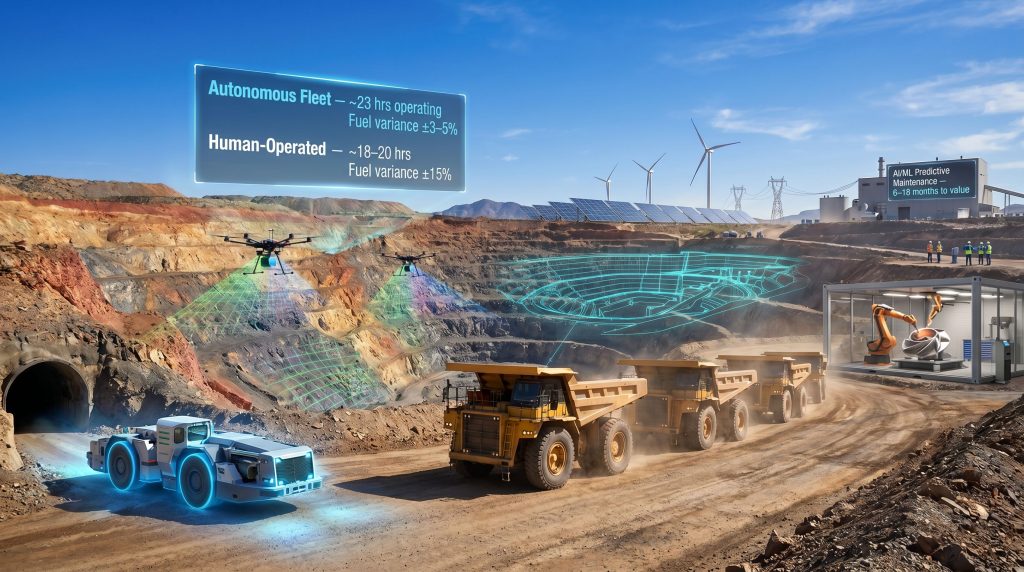
Autonomous haulage systems represent one of the highest-impact technology deployments across the mining sector today. Driverless haul trucks, operating on GPS-guided routes with real-time obstacle detection, eliminate the productivity losses associated with shift changes, fatigue management, and human error. Where a human-operated fleet typically delivers between 18 and 20 productive operating hours per day, an autonomous fleet can sustain close to 23 hours of continuous operation.
The performance differential compounds beyond operating hours. Autonomous systems maintain payload consistency across every cycle, reducing the variance that accumulates over thousands of haul runs into meaningful fuel and processing cost savings. Fuel consumption variance in autonomous fleets typically sits between 3 and 5 percent, compared to as much as 15 percent in human-operated equivalents.
| Performance Metric | Human-Operated Fleet | Autonomous Fleet |
|---|---|---|
| Operating hours per day | 18 to 20 hours | Approximately 23 hours |
| Fuel consumption variance | Up to 15% | 3 to 5% |
| Incident frequency | Elevated during fatigue windows | Significantly reduced |
| Payload consistency | Variable by operator | Optimised per cycle |
Semi-Autonomous Drilling and Robotic Material Handling
Beyond haulage, semi-autonomous drill rigs are deploying GPS guidance and real-time feedback loops to maintain precision across complex ore geometries. The practical benefit is not simply accuracy; it is the ability to maintain consistent blast fragmentation, which directly affects downstream crushing and grinding efficiency. Furthermore, the advances in AI in drilling and blasting are compounding these gains considerably. Over-fragmentation and under-fragmentation both carry energy and cost penalties that accumulate at scale.
Artificial Intelligence Across the Full Mining Value Chain
AI and machine learning are being applied far beyond the narrow use cases of early deployments. The latest technological innovations in mining now leverage AI at every stage of the value chain, creating compounding efficiency gains across interconnected operational systems. AI-powered mining efficiency tools, in particular, are demonstrating measurable improvements across exploration, processing, and logistics functions.
Key applications currently in commercial use include:
- Exploration: AI-assisted geological modelling narrows drill target zones, reducing the number of unproductive holes and cutting exploration cost per resource tonne
- Predictive maintenance: Machine learning algorithms process sensor data streams in real time, detecting equipment anomalies before failures materialise and shifting maintenance from reactive to prescriptive
- Processing optimisation: Neural networks dynamically adjust flotation circuits, reagent dosing, and mill throughput based on continuous ore variability data
- Logistics: Predictive scheduling models reduce haul cycle times and fuel burn by optimising dispatch sequences
- Safety: Computer vision systems identify unsafe worker behaviours and proximity hazards in real time, triggering alerts before incidents occur
The shift from reactive to prescriptive maintenance deserves particular attention. In conventional operations, equipment is inspected on fixed schedules or repaired after failure. AI-driven systems instead identify the specific failure mode developing inside a component, its projected timeline, and the optimal intervention point. This capability reduces unplanned downtime, which remains one of the largest sources of operating cost variance in mining.
Digital Twins: Operating the Mine Before It Operates
Physics-Based Virtual Replicas as Planning Infrastructure
Digital twins are continuously updated, physics-based virtual replicas of a mine's physical assets, infrastructure, and processes. Rather than being a visualisation tool, a properly deployed digital twin functions as an operational command layer, running scenarios in parallel with the live operation.
By 2030, the majority of critical dewatering and processing assets at major mining operations are expected to have digital counterparts running in cloud environments. The operational value of this capability is substantial:
- Underground groundwater influx scenarios can be modelled and response plans tested before the physical event occurs
- Ore body geometry changes can be incorporated into extraction sequencing without physical trial and error
- Real-time equipment performance can be benchmarked continuously against theoretical efficiency curves, identifying drift before it becomes costly
- Operators can be trained in high-fidelity simulated environments that mirror the specific characteristics of their actual workplace
A less commonly discussed application of digital twin technology is its role in pump system optimisation. Next-generation pumping stations use digital twins to model sudden changes in ore-specific gravity or groundwater influx, applying optimal operating parameters to the physical fleet automatically. This eliminates the traditional engineering practice of applying conservative safety margins to pump operation, recovering the energy waste those margins generate across an entire mine life.
Drones, LiDAR, and the Intelligence Layer Above the Mine
Speed, Safety, and Geospatial Precision
Drone-based aerial surveys compress timelines that previously extended across days or weeks into hours. LiDAR-equipped unmanned aerial systems generate dense point cloud data sets that feed directly into 3D geological modelling software, with centimetre-level accuracy across complex terrain.
Operational applications extend well beyond basic surveying:
- Stockpile volumetric measurement for real-time inventory reconciliation, eliminating the manual survey delays that create discrepancies between physical and recorded tonnages
- Tailings storage facility inspection conducted without exposing personnel to the hazardous environments around dam walls and berms
- Thermal imaging for detecting spontaneous combustion signatures in coal operations and identifying structural anomalies in infrastructure
- Environmental rehabilitation monitoring of revegetated zones and water catchment areas at intervals previously impractical to survey manually
The data outputs from drone surveys integrate with GPS and GIS platforms, allowing mine planners to overlay geological data, equipment positions, and infrastructure layouts in a unified spatial environment. This integration feeds directly into autonomous equipment navigation systems, enabling precise route planning and collision avoidance based on current site conditions rather than static base maps.
The next major ASX story will hit our subscribers first
Electrification and the Underground Energy Revolution
Why Battery-Electric Vehicles Deliver Compounding Benefits Underground
The transition from diesel to battery-electric vehicles in underground mining produces benefits that extend well beyond emissions reduction. Diesel combustion underground generates particulate matter that requires substantial ventilation infrastructure to manage. That infrastructure consumes significant electrical energy, often representing one of the largest power draws on a deep underground mine.
Eliminating diesel underground reduces:
- Ventilation infrastructure requirements and their associated capital and operating costs
- Heat generation, improving working conditions and reducing refrigeration load at depth
- The carbon intensity of the mine's Scope 1 emissions profile
- Long-term exposure risk for underground workers to diesel particulate matter, which carries recognised health consequences
Regenerative braking on decline haulage adds a further dimension. As loaded trucks descend ore drives, kinetic energy is recovered back into the battery system rather than being dissipated as heat through conventional braking. This energy recovery meaningfully improves overall site energy efficiency and reduces battery charging requirements.
Smart Energy Management: Microgrids and Load Optimisation
Remote mining sites are increasingly deploying hybrid microgrid systems integrating solar, wind, and battery storage alongside diesel or grid backup. Intelligent load-shifting software schedules energy-intensive operations, including water pumping, crushing, and grinding, to align with peak renewable generation windows. This approach stabilises energy costs against fuel price volatility while reducing diesel consumption per tonne of ore processed.
A technically significant development in this space involves IE4 and IE5 ultra-premium efficiency motors paired with Variable Frequency Drives. Rather than operating pumps and fans at fixed speeds, VFDs function as dynamic energy regulators, continuously matching motor output to actual demand as mine depth, slurry density, and process requirements change in real time. Fixed-speed pumping is progressively becoming operationally obsolete in well-capitalised operations.
IIoT, Wearables, and the Connected Mine Safety System
Sensor Networks That See the Mine in Real Time
Industrial Internet of Things platforms aggregate data from thousands of sensors distributed across equipment, infrastructure, and the mine environment, creating a real-time operational picture that was previously impossible to assemble. Safety-critical applications include:
- Slope stability monitoring: Radar and tiltmeter arrays detect wall movement at thresholds far below what visual inspection can identify, providing warning time for evacuation
- Tailings dam safety: Piezometers and settlement monitors feed automated alert systems, addressing one of the highest-consequence failure modes in the industry
- Equipment health: Vibration, temperature, and acoustic sensors detect bearing degradation, hydraulic pressure anomalies, and structural fatigue before components fail
- Atmospheric monitoring: Gas detection networks in underground headings provide continuous air quality data, triggering ventilation responses automatically
According to insights from AusIMM, connected sensor infrastructure is becoming a foundational capability rather than an optional upgrade for modern mining operations.
Wearables and Personnel Tracking
Smart wearables that monitor physiological indicators including heart rate, thermal stress, and fatigue signatures represent an important frontier in workforce protection. Rather than responding to incidents after they occur, these systems generate alerts when physiological data suggests a worker is approaching a threshold that increases incident risk.
RFID-based personnel tracking systems provide real-time underground location data for all workers, accelerating emergency mustering and significantly improving the speed and reliability of evacuation coordination during fires, inundations, or ground falls.
Virtual Reality Training and the Zero-Consequence Learning Environment
Building Competency Without Physical Risk
VR training platforms allow mining personnel to rehearse complex, high-stakes procedures including equipment operation, emergency response, and confined space entry in photorealistic environments that replicate the precise characteristics of their actual workplaces. Trainees experience the consequences of operational errors without physical risk, building procedural memory and decision-making competency at a pace that traditional classroom and on-equipment training cannot match.
Beyond safety benefits, VR eliminates the logistical and cost burden of transporting trainees to remote mine sites or deploying live equipment and instructors during the learning phase. Specific training scenarios currently being delivered through VR include:
- Operation of blast hole drills, large haul trucks, and underground loaders in site-specific configurations
- Emergency scenario rehearsal covering fires, inundations, and pit wall failures
- Complex maintenance procedures on processing plant machinery where errors carry high repair and downtime costs
Operational insight: VR training programmes reduce both direct training costs and the logistical complexity of onboarding workers for technically demanding and geographically remote operations, while simultaneously improving retention of safety-critical procedures through experiential learning.
Additive Manufacturing: Ending the Parts Supply Chain Bottleneck
On-Demand Component Production at the Point of Need
Three-dimensional printing addresses one of the most operationally costly characteristics of remote mining: the lead time between component failure and restoration of equipment to service. In conventional supply chains, sourcing specialised components for mining equipment can involve weeks of freight transit and procurement delays, during which the affected machine sits idle.
On-site additive manufacturing changes this logic entirely:
- A component failure is identified and the damaged part is assessed
- A digital design file is retrieved from the manufacturer's library or reverse-engineered using 3D scanning technology
- The component is printed using the appropriate material, polymer, composite, or metal alloy
- The printed part is quality-checked and installed, returning the equipment to service
While polymer and composite component printing is already in commercial use at remote mine sites, metal additive manufacturing for structural and wear-resistant components is advancing rapidly. The range of components that can be printed on-site will expand substantially over the next five years as material science capabilities mature.
Advanced Metallurgy and Circular Water Management
Paste Tailings, Zero-Discharge Systems, and Smart Water Networks
Water management is moving from a compliance function to a circular resource strategy. The shift is being enabled by pumping and processing technologies that can handle substantially higher solids concentrations than previous generations of equipment could manage.
Paste tailings systems, capable of pumping slurries with solids content at or above 70 percent, allow mines to recover and recycle large volumes of process water that would otherwise be lost to evaporation in conventional tailings storage. Dry-stack tailings systems extend this logic further, eliminating liquid tailings impoundments in water-stressed regions entirely.
Supporting this capability requires significant advances in pump metallurgy. Nano-structured ceramics and high-chrome alloys with self-healing microstructures are being introduced to withstand the severe abrasion of super-thickened slurries. These materials extend mean time between failures, reduce the frequency of parts replacement, and lower the carbon footprint associated with manufacturing and transporting spare components to remote sites.
Integrated spectral analysers embedded in pump systems can now monitor water chemistry in real time, detecting changes in pH, turbidity, and heavy metal concentrations. The pumping network routes water flows to appropriate treatment or recycling loops automatically based on quality data, preventing clean water contamination and maximising recovery rates.
By 2035, the boundary between mechanical pump infrastructure and digital control systems is expected to become effectively indistinguishable. Pumping stations will operate as intelligent nodes within the mine's broader Manufacturing Execution System, synchronising fluid movement with extraction objectives and processing capacity in real time.
Technology Adoption Roadmap: Prioritising Investment by ROI and Complexity
Not all technologies deliver value on the same timeline or at the same implementation cost. A structured evaluation framework helps operators sequence investment to capture near-term returns while building toward longer-term capability. Furthermore, data-driven mining operations are increasingly informing how these investment decisions are sequenced and prioritised.
| Technology Category | Primary Benefit | Implementation Complexity | Approximate Time to Value |
|---|---|---|---|
| Drone surveying | Survey cost reduction and speed | Low | Immediate |
| AI/ML predictive maintenance | Cost reduction via uptime | Medium | 6 to 18 months |
| IIoT sensor networks | Safety and uptime improvement | Medium | 6 to 12 months |
| VR training platforms | Safety and workforce cost | Low to medium | 3 to 6 months |
| 3D printing (additive manufacturing) | Supply chain resilience | Medium | 6 to 12 months |
| Digital twins | Planning and risk reduction | High | 2 to 3 years |
| Autonomous haulage systems | Productivity and safety | High | 2 to 4 years |
| Battery-electric vehicles | Emissions and ventilation cost | High | 3 to 5 years |
Overcoming the Barriers to Adoption
Several structural barriers slow the pace at which operators can realise technology benefits:
- Capital intensity: Technology-as-a-service and equipment leasing models are reducing the upfront barrier for smaller and mid-tier operators
- Workforce capability gaps: Partnerships with technology vendors and structured internal reskilling programmes are the primary mechanisms through which operators are bridging the skills deficit
- Connectivity in remote environments: Private LTE and 5G networks, combined with low-earth orbit satellite broadband, are extending reliable data connectivity to previously isolated mine sites
- Legacy system integration: Phased integration roadmaps that interface existing operational technology with modern IT platforms reduce disruption risk during the transition
Metal Recycling as a Strategic Technology Investment
A dimension of the latest technological innovations in mining that receives less attention than autonomous systems or AI is the growing sophistication of secondary resource recovery. Hydrometallurgical and pyrometallurgical processing advances are enabling the recovery of high-value metals from electronic waste, spent catalysts, and complex secondary streams that were previously uneconomic to process.
Sophisticated sorting and separation technologies now allow high-purity metal recovery from mixed waste inputs. Recycled metal production requires substantially less energy than primary extraction, reducing the carbon intensity of metal supply chains and supporting the decarbonisation commitments embedded in corporate procurement policies. The World Economic Forum's assessment of mining innovation highlights secondary recovery as an increasingly important pillar of responsible resource stewardship.
Spent catalysts from refining operations, once treated as hazardous waste, are increasingly recognised as strategic secondary resources. Processes capable of converting more than 99 percent of vanadium-bearing refinery residues into saleable specialty metals while eliminating hazardous waste characteristics represent the frontier of this approach. The ability to transform refinery waste streams into commercially valuable alloys while producing materially lower carbon emissions than primary extraction is becoming a differentiating capability in circular economy strategies.
Disclaimer: Statements referring to future technology capabilities, adoption timelines, performance projections, and market developments in this article represent forward-looking assessments based on current industry trends. They should not be interpreted as investment advice or guarantees of future outcomes. Actual results may differ materially from projections as a result of technical, market, regulatory, or other factors.
Frequently Asked Questions: Latest Technological Innovations in Mining
What is the most impactful technology currently being adopted in mining?
Autonomous haulage systems and AI-driven predictive maintenance are widely regarded as delivering the most measurable near-term impact, with productivity and safety improvements that can be quantified at scale.
How are drones being used in modern mining operations?
Drones are deployed for topographic surveying, stockpile volume measurement, tailings facility inspection, thermal anomaly detection, and environmental monitoring, replacing manual methods that are slower, more expensive, and more hazardous.
What is a digital twin in a mining context?
A digital twin is a continuously updated, physics-based virtual replica of a mine's physical assets and processes. It runs in parallel with live operations, enabling scenario simulation, performance optimisation, and predictive maintenance without disrupting the physical operation.
How does electrification benefit underground mining specifically?
Battery-electric vehicles eliminate diesel exhaust underground, reducing ventilation infrastructure requirements, lowering heat generation, improving air quality, and cutting Scope 1 emissions, while regenerative braking recovers energy on decline haul routes.
Is additive manufacturing commercially viable for mining applications today?
Polymer and composite component printing is already in active commercial use at remote mine sites. Metal additive manufacturing for structural components is advancing rapidly and is expected to become mainstream within five years.
How does VR training improve safety outcomes?
VR enables workers to rehearse high-risk procedures in zero-consequence simulated environments, building decision-making competency and procedural memory before exposure to live hazards, which demonstrably reduces training-related incidents and improves preparedness.
Want to Know Which ASX Companies Are Leading the Next Wave of Mineral Discovery?
Discovery Alert's proprietary Discovery IQ model delivers real-time alerts on significant ASX mineral discoveries, transforming complex geological data into actionable investment insights — the same kind of transformative opportunity that autonomous systems and AI are creating across the mining sector today. Explore how historic discoveries have generated substantial returns on Discovery Alert's dedicated discoveries page, and begin your 14-day free trial to position yourself ahead of the market.