June 23, 2026
The North Sea Carmen Discovery Confirmed: What 107 MMboe Means for Norwegian Offshore Development
Mature hydrocarbon basins rarely announce their decline in a straight line. The Norwegian Continental Shelf (NCS) is a compelling example of a basin that has confounded peak-production pessimists for decades, continuing to yield commercially meaningful discoveries long after the major field developments of the 1970s and 1980s. The North Sea Carmen discovery confirmed in 2026 fits squarely within this narrative, adding another chapter to a geological story that the industry has been writing for over fifty years.
When big ASX news breaks, our subscribers know first
Understanding the Carmen Gas-Condensate Accumulation
Carmen is not a conventional oil field, nor is it a dry gas reservoir. It occupies the commercially interesting middle ground known as a gas-condensate accumulation, a hydrocarbon system in which lighter liquid hydrocarbons remain dissolved within a gas phase under reservoir pressure, then separate out as valuable condensate liquids once brought to surface conditions. This dual-stream characteristic means that operators can generate revenue from both gas sales and condensate production, often improving project economics relative to a dry gas discovery of equivalent volume.
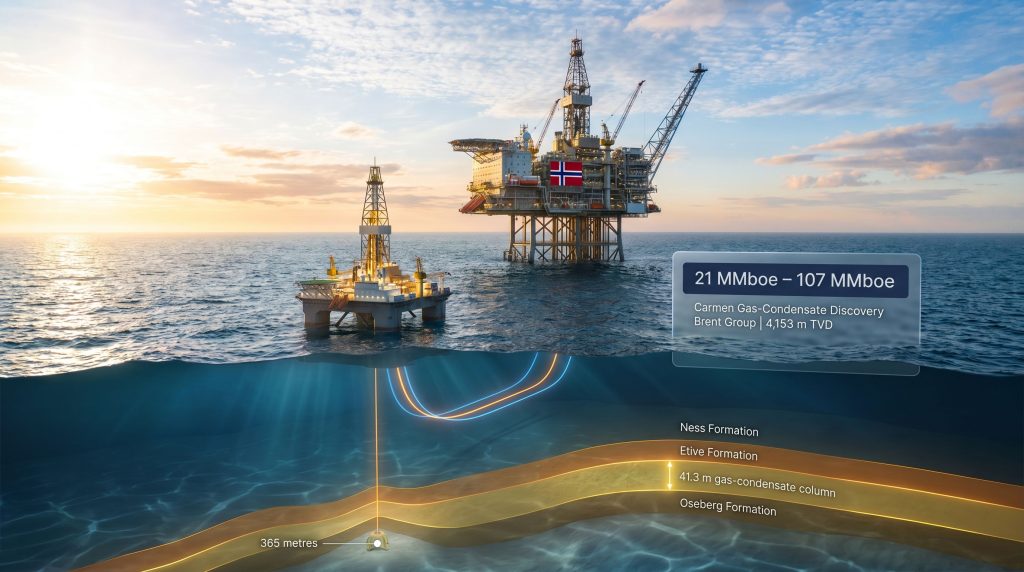
The appraisal well 35/10-16 S, drilled within Production Licence PL1148, successfully delineated the accumulation first identified in 2023 by discovery wells 35/10-10 S and 35/10-10 A. The confirmed recoverable resource range sits between 21 million barrels of oil equivalent (MMboe) and 107 MMboe, or approximately 3.4 to 17 million standard cubic metres of oil equivalent in metric terms.
| Parameter | Detail |
|---|---|
| Discovery Type | Gas-condensate accumulation |
| Recoverable Resource Range | 21 MMboe to 107 MMboe |
| Metric Equivalent | 3.4 to 17 million standard cubic metres of oil equivalent |
| Water Depth | 365 metres |
| Total Vertical Depth | 4,153 metres below sea level |
| Appraisal Well | 35/10-16 S |
| Production Licence | PL1148 |
| Original Discovery Year | 2023 |
| Appraisal Confirmation | 2026 |
The fivefold spread between the low and high resource estimates is not a sign of poor geological work. It reflects the genuine complexity of the Brent Group reservoir system at depth, and is entirely normal at this stage of appraisal. Narrowing this range is the explicit purpose of any further drilling campaign.
Geographic Positioning: Why Location Drives Commercial Logic on the NCS
Carmen sits approximately 25 km northwest of the Troll field and 35 km east of the Kvitebjørn field in the northern Norwegian North Sea. For those unfamiliar with North Sea geography, Troll is one of the largest offshore gas fields ever developed globally, and its proximity establishes Carmen's location within one of the most densely infrastructured corridors on the NCS.
This matters enormously in a basin where the cost of building standalone development infrastructure can easily exceed several billion dollars. Fields discovered adjacent to existing platforms, subsea pipelines, and export systems can often bypass this capital burden entirely through what the industry calls an infrastructure-led exploration (ILX) strategy. Furthermore, the underlying logic is straightforward:
- Subsea tie-back developments avoid the capital expenditure of dedicated platforms or floating production units.
- Existing export pipelines eliminate the need for new long-distance pipeline construction.
- Host platform processing facilities can often accommodate additional throughput from nearby discoveries.
- Development timelines are compressed compared to standalone projects, improving project returns.
Carmen's candidacy as a tie-back to the Kvitebjørn platform is therefore not incidental — it is the central commercial thesis of the entire discovery. Much like offshore gas infrastructure in other mature basins, proximity to existing facilities can be the deciding factor in a project's commercial viability.
Reservoir Geology: The Brent Group at Depth
The Carmen accumulation is hosted within the Middle Jurassic Brent Group, a reservoir sequence that geologists have studied extensively across the North Sea for decades. The Brent Group was deposited in a deltaic environment during the Middle Jurassic period, creating a layered succession of sandstone units with variable reservoir quality depending on depositional environment and subsequent burial history.
Three distinct formations within the Brent Group were encountered with hydrocarbon-bearing intervals at Carmen:
- Ness Formation: Fluvial and deltaic sandstones characterised by variable reservoir quality, reflecting the heterogeneous nature of near-shoreline depositional environments.
- Etive Formation: The highest-quality reservoir unit at Carmen and the primary commercial target, hosting a 41.3-metre gas-condensate column confirmed during appraisal drilling.
- Oseberg Formation: Additional gas-condensate bearing intervals that contribute incremental volumes to the overall resource estimate.
The Etive Formation's reservoir quality at Carmen was described as ranging from poor to moderate, which is a technically significant qualification. At a total vertical depth of 4,153 metres below sea level, Carmen sits at the deeper end of the productive Brent Group fairway. Reservoir quality in the Brent Group typically deteriorates with increasing burial depth as compaction and diagenetic processes progressively reduce porosity and permeability.
This depth-related quality degradation is one of the key variables that will determine actual flow rates and recovery efficiency once development drilling begins.
Poor-to-moderate reservoir quality does not make a field uncommercial, but it does mean that recovery factors and well productivity assumptions need to be stress-tested carefully before committing to a development concept. This is precisely why the resource range remains wide.
The Licence Group: Partners and Their Strategic Interests
| Partner | Role |
|---|---|
| Wellesley Petroleum | Operator |
| DNO | Co-venturer |
| Equinor | Co-venturer |
| Aker BP | Co-venturer |
Wellesley Petroleum is a privately held Norwegian exploration company operating at a scale considerably smaller than its licence partners. Delivering a confirmed commercial discovery of up to 107 MMboe represents a genuinely material value creation event for a company of this size. As operator, Wellesley carries the technical and organisational leadership responsibility for the Carmen appraisal programme.
The participation of Equinor and Aker BP in PL1148 adds a layer of strategic significance beyond simple resource acquisition. Both companies operate extensive infrastructure networks across the northern North Sea. Equinor, in particular, operates the Kvitebjørn platform itself, creating a scenario where the likely tie-back host and a Carmen licence partner are the same entity. This structural alignment between resource ownership and infrastructure ownership can meaningfully accelerate development discussions and reduce negotiation complexity around tie-back commercial terms.
Development Pathway: Tie-Back Economics and the Kvitebjørn Option
The most commercially logical development route for Carmen is a subsea tie-back to the Kvitebjørn platform. Understanding how tie-back developments work helps contextualise why this matters so much to the project's economics:
- Resource confirmation: Appraisal drilling establishes sufficient recoverable volumes to justify development expenditure.
- Host platform capacity assessment: Partners evaluate whether Kvitebjørn retains adequate processing and export capacity within its remaining operational life to accommodate Carmen volumes.
- Subsea concept engineering: Specialists design the production wells, subsea manifolds, flowlines, and umbilicals required to connect Carmen to the host facility.
- Plan for Development and Operation (PDO) submission: A formal development plan is submitted to Norway's Ministry of Energy for regulatory approval.
- Final Investment Decision (FID): Partners commit capital following PDO approval and commercial alignment.
- First production: Typically four to six years from appraisal confirmation for a tie-back development on the NCS.
One dimension that is often underappreciated by those outside the industry is the late-life infrastructure management calculus that underpins Norwegian offshore development decisions. As platforms like Kvitebjørn age, operators face a binary choice between continued operation and decommissioning. The availability of tie-back candidates that extend platform throughput and prolong economic life directly influences this decision. Carmen-style discoveries are therefore strategically important not only for their standalone resource value but for their role in keeping surrounding infrastructure commercially viable.
The next major ASX story will hit our subscribers first
Discovery Size in Context: Where Carmen Sits on the NCS Spectrum
| Discovery Size Category | Approximate MMboe Range | Typical Development Pathway |
|---|---|---|
| Sub-commercial or marginal | Below 10 MMboe | Typically abandoned or held pending technology improvements |
| Small tie-back candidate | 10 to 50 MMboe | Subsea tie-back to nearby infrastructure |
| Mid-size development | 50 to 200 MMboe | Tie-back or standalone FPSO or platform |
| Major discovery | Above 200 MMboe | Standalone development with new infrastructure |
At its low estimate of 21 MMboe, Carmen sits near the lower threshold of commercial viability for a tie-back project in the current cost environment, where offshore development expenses remain elevated relative to pre-2014 cycles. At its high estimate of 107 MMboe, Carmen becomes a genuinely significant mid-size discovery — one that would rank among the more consequential finds on the NCS in recent years.
This asymmetry in outcomes is itself an important insight for industry observers. The upside case at 107 MMboe transforms Carmen from a marginal tie-back candidate into a development that justifies a dedicated well count, enhanced subsea infrastructure, and potentially a phased expansion strategy. The licence partners' indication that the Carmen structure is laterally extensive beyond what the current appraisal well has delineated suggests that additional drilling could shift the resource estimate meaningfully toward the higher end of the range.
The Deepsea Yantai and the Afrodite Connection
The Deepsea Yantai, a sixth-generation semisubmersible rig operated by Odfjell Drilling, conducted the Carmen appraisal in 365 metres of water before being mobilised directly to the Afrodite discovery in licence PL293. This sequential deployment across two separate appraisal targets in the same region is not coincidental. It reflects a deliberate strategy of clustering appraisal operations to maximise rig efficiency and minimise transit costs between wells.
This pattern of concentrated appraisal activity across a defined geographic area is characteristic of what industry practitioners call a basin appraisal campaign, where multiple discoveries within a region are systematically delineated using the same drilling assets. When Afrodite's appraisal results are published, they will provide additional context for the overall resource potential of this part of the NCS and may influence development planning for both discoveries simultaneously.
Norway's Fiscal Framework and the Exploration Incentive
Understanding why a private company like Wellesley Petroleum can afford to operate an exploration and appraisal campaign of this scale requires familiarity with Norway's distinctive upstream fiscal regime. The Norwegian government offers a 78% refund on exploration and appraisal expenditures for qualifying companies through its petroleum tax system. This mechanism dramatically reduces the effective financial risk borne by smaller operators and exploration-focused companies, enabling them to compete in a sector that would otherwise require the balance sheet strength of a supermajor.
This fiscal architecture is specifically designed to maximise exploration activity across the NCS, including in mature areas where incremental discoveries feed existing infrastructure rather than requiring new development. Carmen's confirmation is a direct product of this incentive structure operating as intended.
Geopolitical Relevance: Norwegian Gas in the Post-2022 European Energy Context
Norwegian gas exports carry a dimension of geopolitical relevance that extends well beyond commercial project economics. Following the 2022 energy crisis triggered by disruptions to Russian gas supply into Europe, Norwegian pipeline gas became one of the most strategically important energy commodities on the continent. Norway emerged as Europe's single largest gas supplier by volume during this period, a position it has worked to sustain through continued investment in NCS production capacity.
Consequently, new gas-condensate discoveries like Carmen contribute directly to Norway's ability to maintain and grow its export volumes over the medium term. Broader assessments of the LNG supply outlook highlight how NCS developments remain central to European energy security planning. For European gas buyers seeking long-term supply security from a politically stable partner, the continued productivity of the NCS represents a meaningful component of their overall strategy.
However, it is worth contextualising Carmen within the wider commodity landscape. Movements in Brent oil futures and crude oil price trends will inevitably influence development economics and investment decisions across the NCS in the years ahead. In addition, the broader role of oil in the global economy underscores why confirmations like the North Sea Carmen discovery confirmed in 2026 continue to attract significant commercial and political attention beyond Norway's borders.
Frequently Asked Questions
What is the Carmen discovery in the North Sea?
Carmen is a confirmed gas-condensate accumulation in the Norwegian North Sea, located approximately 25 km northwest of the Troll field. Originally discovered in 2023, the North Sea Carmen discovery confirmed through appraisal drilling in 2026 established recoverable resources of between 21 MMboe and 107 MMboe.
Who operates the Carmen licence?
Wellesley Petroleum serves as operator of Production Licence PL1148, with DNO, Equinor, and Aker BP participating as co-venture partners.
Which geological formations contain hydrocarbons at Carmen?
Hydrocarbon-bearing intervals were confirmed in three formations within the Middle Jurassic Brent Group: the Ness, Etive, and Oseberg formations. The Etive Formation hosts the largest column at 41.3 metres.
How might Carmen be developed?
The primary development concept under evaluation is a subsea tie-back to the nearby Kvitebjørn platform, which would leverage existing processing and export infrastructure to reduce capital expenditure.
Is more drilling planned?
The licence partners have indicated that additional appraisal and exploration drilling is under consideration to fully delineate the lateral extent of the Carmen structure, which could push recoverable estimates toward the upper end of the current range.
Disclaimer: This article is intended for informational purposes only and does not constitute financial or investment advice. Resource estimates cited reflect preliminary appraisal data and are subject to revision as further technical work is completed. Readers should conduct their own due diligence before making any investment decisions related to companies or assets discussed herein.
Want to Stay Ahead of Significant Mineral Discoveries the Moment They Hit the ASX?
While Carmen demonstrates how major resource confirmations can unlock extraordinary value, Discovery Alert's proprietary Discovery IQ model delivers real-time alerts on significant ASX mineral discoveries — turning complex data across 30+ commodities into clear, actionable insights for investors at every level. Visit Discovery Alert's discoveries page to explore historic examples of exceptional returns, and begin your 14-day free trial today to position yourself ahead of the broader market.