June 22, 2026
The Battery-Electric Turning Point in Underground Hard-Rock Mining
For decades, underground hard-rock mining operated under a simple constraint: the more productive the machine, the greater the heat, exhaust, and ventilation burden it placed on the mine. Diesel engines powered the most capable drills, and that relationship between performance and diesel dependence was largely treated as unchangeable. The emergence of battery-electric underground equipment has been gradually eroding that assumption, but the transition has moved slowly because battery technology consistently fell short of diesel benchmarks where it mattered most: sustained power output, operating range, and shift-length endurance.
That gap has now narrowed considerably. The Sandvik DD423iE battery drill represents one of the most technically ambitious attempts yet to close the performance difference between battery-electric and diesel development drilling, and its specifications suggest the industry is approaching a genuine inflection point rather than another incremental improvement.
When big ASX news breaks, our subscribers know first
How the DD423iE Fits Into the Underground Electrification Story
Underground electrification is not a single technology shift. It is a layered transition spanning loaders, trucks, bolters, and development drills, each with different duty cycles, power demands, and operational constraints. Development drills are among the most demanding machines in this transition because they operate under sustained high-load conditions, require rapid repositioning across multiple headings, and are central to mine development schedules that directly affect production timelines.
Sandvik released the diesel variant of its next-generation development drill, the DD423i, in March 2026. The subsequent release of the DD423iE in June 2026 reflects a deliberate dual-pathway product strategy, allowing mine operators at different stages of electrification readiness to access the same underlying performance platform. This approach reduces fleet fragmentation and simplifies cross-training on sites running mixed diesel and battery-electric mining transport.
The DD423iE is the second machine in Sandvik's next-generation development drilling range, and it carries forward all the core mechanical and structural improvements first introduced in the DD423i, while adding a substantially redesigned battery and charging system. Furthermore, the broader mining electrification trend provides important context for understanding why this product generation matters so significantly to operators planning their next fleet investments.
From the DD422iE to the DD423iE: Understanding the Performance Leap
To appreciate what the DD423iE achieves, it helps to understand where its predecessor, the DD422iE, fell short. Battery-electric drills have historically faced a specific operational problem: battery capacity and charging speed were insufficient to sustain performance across a full drilling shift without an extended charging interruption. This created scheduling inefficiencies that undermined the productivity case for electrification.
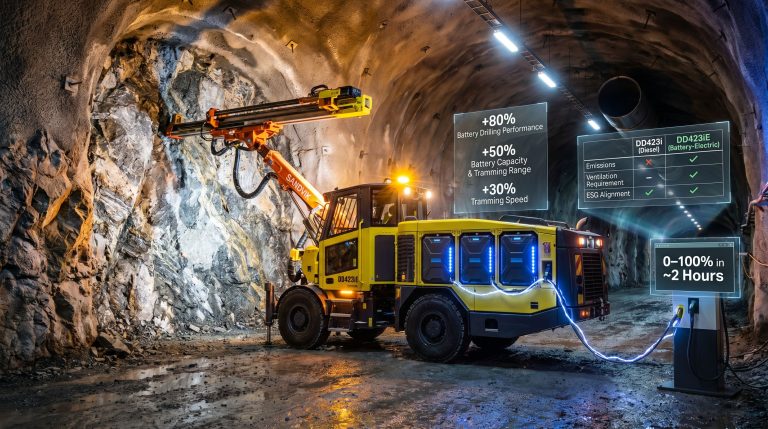
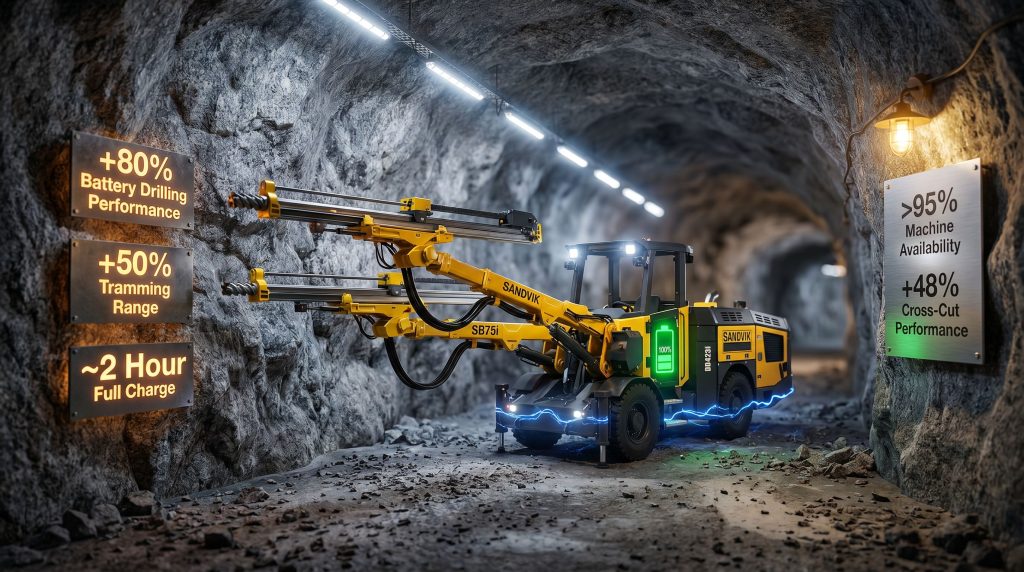
The DD423iE addresses this directly with a 50% increase in battery capacity and a corresponding 50% increase in tramming range compared to the DD422iE baseline. More significantly, battery drilling performance has improved by 80%, and tramming speed has increased by 30%, making the DD423iE the fastest machine in Sandvik's underground drilling portfolio.
The charging architecture has also been fundamentally redesigned. The DD423iE delivers more than triple the charging power while actively drilling, enabling a full 0 to 100% state of charge in approximately two hours. That charging window fits within a single drilling round, which means the machine can complete a charge cycle without requiring a dedicated out-of-production stoppage. This is the operational detail that transforms the economics of battery-electric drilling at the shift and weekly planning level.
DD423iE vs. DD422iE vs. DD423i Diesel: Key Metrics Compared
| Performance Metric | DD422iE (Previous Gen) | DD423i Diesel | DD423iE Battery-Electric |
|---|---|---|---|
| Battery Capacity | Baseline | N/A | +50% vs. baseline |
| Tramming Range | Baseline | N/A | +50% vs. baseline |
| Battery Drilling Performance | Baseline | N/A | +80% vs. baseline |
| Tramming Speed | Baseline | Standard | +30% vs. baseline |
| Drilling Coverage | Baseline | +34.5% | +34.5% (retained) |
| Cross-Cut Performance | Baseline | +48% | +48% (retained) |
| Operator Visibility | Baseline | +55% | +55% (retained) |
| Machine Availability | Standard | >95% | >95% |
| Full Charge Time | Longer than one drilling round | N/A | ~2 hours |
What makes this comparison particularly important is the diesel benchmark. Battery-electric underground equipment has historically been assessed against diesel counterparts and found wanting on raw power metrics. The DD423iE's performance profile now positions it as genuinely competitive with conventional 6-cylinder diesel drills, a threshold that field testing at an active hard-rock gold mine confirmed in real operating conditions.
Core Technical Architecture: LFP Chemistry and Why It Matters Underground
The DD423iE uses three lithium iron phosphate (LFP) battery cells rather than the nickel manganese cobalt (NMC) chemistry found in many consumer and automotive applications. This distinction carries significant practical weight in underground mining environments.
LFP chemistry is engineered for thermal stability, and this is a critical design requirement in confined underground environments where heat dissipation is physically limited and fire risk carries severe operational and safety consequences.
LFP cells operate at lower voltages than NMC alternatives and have a substantially flatter discharge curve, meaning they deliver more consistent power output across the battery's usable range. They are also less prone to thermal runaway, the failure mode most associated with lithium-ion battery fires. Understanding lithium-ion battery risks in underground settings is consequently essential for operators evaluating the full safety profile of battery-electric equipment. In a tunnel environment where evacuation is constrained and ventilation capacity is finite, this chemistry choice reflects a deliberate prioritisation of safety architecture over energy density.
The battery system is supported by multiple layers of monitoring and protection, and the electric drivetrain delivers instant torque across the operating range. Unlike diesel engines, which require time to build torque through the rev range, electric motors produce maximum torque from rest. This characteristic improves tramming responsiveness in confined underground headings where precise machine control reduces the risk of collision with tunnel walls and installed infrastructure.
Structural Improvements Carried Over From the DD423i
The DD423iE retains the full suite of mechanical and structural enhancements first introduced in the diesel DD423i. These include:
- 34.5% greater drilling coverage, expanding the effective reach per setup and reducing the number of repositions required per round
- 48% improvement in cross-cut performance, directly shortening development cycle times across lateral headings
- New SB75i booms with double roll-overs, improving both structural geometry and safety during boom repositioning
- 55% increase in operator visibility, reducing the risk of human error in confined, poorly lit underground workings
- Lightweight service covers with improved accessibility to main components, reducing maintenance time and technician workload
- Machine availability exceeding 95%, a benchmark that reflects both mechanical reliability and the simplified drivetrain of battery-electric architecture
Productivity Implications: What These Numbers Mean at the Face
Performance specifications become meaningful when translated into shift-level and weekly operational outcomes. Consider the cumulative effect of the DD423iE's improvements across a typical deep underground development operation.
A 30% increase in tramming speed directly reduces repositioning time between drill faces. In multi-heading operations where machines move frequently across a level, this reduction in dead time compounds into measurable shift recovery. Combined with a charging window that fits inside a drilling round rather than requiring a separate stoppage, the DD423iE can theoretically sustain back-to-back shift productivity without a dedicated charging interruption.
The 34.5% increase in drilling coverage means fewer setups are required to complete an equivalent round, and the 48% cross-cut performance improvement accelerates the development of lateral access drives, which are often critical path activities on mine development schedules.
In practical terms, the compounding effect of faster tramming, reduced setup frequency, improved cross-cut performance, and in-cycle charging could translate into a material increase in development metres per month for operations running the DD423iE across multiple shifts.
Machine availability above 95% adds another layer to this productivity argument. Battery-electric drivetrains have fewer moving parts than diesel engines, reducing the frequency and complexity of scheduled servicing. Fewer unplanned stoppages and shorter maintenance windows contribute directly to productive time at the face.
Field Validation at Agnico Eagle Finland's Kittilä Mine
Manufacturer specifications carry limited credibility without independent operational validation, and the Sandvik DD423iE battery drill was field tested at Agnico Eagle Finland's Kittilä mine, one of Europe's largest gold mines by production volume and a technically demanding hard-rock operating environment.
Testing at an active gold mine rather than a controlled surface test facility is methodologically significant. The Kittilä mine operates in Finnish Lapland under cold-climate conditions, with deep underground development headings that place genuine demands on machine endurance, battery thermal management, and tramming performance over realistic shift durations.
An operator at the Kittilä site noted that the DD423iE's performance and operating range represented a substantial advancement over predecessor models, and that the machine demonstrated competitive capability against conventional 6-cylinder diesel drills. The observation that this parity with diesel represented a significant generational leap from the DD422iE underscores how far battery-electric development drilling has progressed within a single product generation.
Third-party mine validation matters more than manufacturer benchmarks because active mining operations impose conditions that controlled testing cannot replicate: variable ground conditions, real ventilation constraints, operator behaviour patterns, and the cumulative wear of sustained production cycles.
The next major ASX story will hit our subscribers first
The Financial and Sustainability Case for Battery-Electric Development Drilling
The performance argument for the DD423iE is only part of the commercial rationale. The total cost of ownership calculation for battery-electric versus diesel development drills is increasingly favourable, driven by cost categories that do not appear in simple capital price comparisons. In addition, the broader mining decarbonisation benefits are becoming a material factor in fleet investment decisions across major mining jurisdictions.
Cost Comparison: Battery-Electric vs. Diesel Development Drills
| Cost Category | Diesel Development Drill | Battery-Electric (DD423iE) |
|---|---|---|
| Fuel/Energy Cost Per Shift | Higher (diesel consumption) | Lower (grid or renewable charging) |
| Ventilation Infrastructure Cost | High (diesel exhaust dilution required) | Significantly reduced |
| Maintenance Complexity | Engine-dependent servicing | Simplified drivetrain, fewer moving parts |
| Operator Health Exposure | Diesel particulate matter (DPM) risk | Near-zero DPM underground |
| Sustainability Reporting Contribution | Limited | Supports Scope 1 and 2 emissions reduction |
The ventilation cost reduction is frequently underestimated in initial fleet electrification assessments. Underground mines running diesel equipment must maintain ventilation infrastructure capable of diluting diesel exhaust to safe concentrations throughout the working horizon. This requires substantial fan capacity, ductwork, and ongoing energy consumption. Battery-electric equipment eliminates the exhaust source, allowing ventilation systems to be downsized or redirected as electrification progresses. Furthermore, pairing the DD423iE with renewable power for mines can reduce charging costs further while strengthening the sustainability case.
Diesel particulate matter (DPM) exposure is also a long-term occupational health liability. Regulatory standards for underground DPM limits have tightened progressively across major mining jurisdictions, and the compliance cost trajectory for diesel-heavy fleets is upward. Battery-electric equipment removes the primary source of DPM generation at the working face.
Sandvik's Product Manager for development drills described the Sandvik DD423iE battery drill as combining the company's drilling expertise with the practical benefits of electrification, noting that the machine allows operators to maintain high performance while lowering operating costs and advancing their sustainability objectives, as reported by Global Mining Review in June 2026.
DD423iE Specifications at a Glance
| Specification | Improvement / Value |
|---|---|
| Battery Capacity Increase | +50% |
| Tramming Range Increase | +50% |
| Battery Drilling Performance Improvement | +80% |
| Tramming Speed Increase | +30% |
| Charging Power Increase (vs. previous gen) | More than 3x |
| Full Charge Duration | ~2 hours |
| Drilling Coverage Improvement | +34.5% |
| Cross-Cut Performance Improvement | +48% |
| Operator Visibility Improvement | +55% |
| Machine Availability | >95% |
| Battery Chemistry | Lithium Iron Phosphate (LFP) |
| Battery Units | 3 cells |
| Field Validation Site | Kittilä Mine, Agnico Eagle Finland |
Frequently Asked Questions About the Sandvik DD423iE
What type of batteries does the Sandvik DD423iE use?
The DD423iE uses three lithium iron phosphate (LFP) battery cells. LFP chemistry prioritises thermal stability and safety over maximum energy density, making it particularly well suited to confined underground environments where fire and heat management are critical safety considerations.
How long does it take to fully charge the DD423iE?
A full 0 to 100% state of charge takes approximately two hours. This is shorter than the time required to complete a full drilling round, allowing operators to charge the machine within the production cycle rather than during a separate out-of-production window.
Can the DD423iE charge while actively drilling?
Yes. The DD423iE delivers more than triple the charging power of the DD422iE while actively drilling. This regenerative and concurrent charging capability is central to the machine's ability to maintain shift-length productivity without extended charging stoppages.
How does the DD423iE compare to diesel development drills in performance?
Field testing at the Kittilä mine confirmed that the DD423iE is competitive with conventional 6-cylinder diesel development drills. This represents a significant milestone for battery-electric underground drilling, which has historically underperformed diesel on sustained power output and operating range.
What is the tramming speed improvement of the DD423iE?
Tramming speed has increased by 30% compared to the DD422iE baseline, making the DD423iE the fastest machine in Sandvik's underground drilling portfolio.
What underground conditions is the DD423iE designed for?
The machine is designed for demanding hard-rock underground development operations, including deep-level headings with multiple active faces. Its LFP battery chemistry, multi-layer safety architecture, and structural improvements are specifically engineered for the thermal, spatial, and operational constraints of underground mining.
Has the DD423iE been tested in active mining operations?
Yes. Field testing was conducted at Agnico Eagle Finland's Kittilä mine, an active hard-rock gold mine in Finnish Lapland. Testing at this operational site validated the machine's performance improvements under real production conditions rather than controlled surface trials.
Where Battery-Electric Drilling Goes From Here
The DD423iE's launch does not exist in isolation. It reflects an accelerating competitive dynamic among underground equipment original equipment manufacturers (OEMs), where battery-electric performance benchmarks are being revised upward with increasing frequency. Each product generation that closes the gap with diesel narrows the justification for new diesel investment in underground development fleets.
The simultaneous availability of both the DD423i diesel and the DD423iE battery-electric variant within the same product generation gives mine operators a genuine choice between equivalent performance platforms rather than a compromise between performance and sustainability. For operations not yet equipped with the charging infrastructure to support full battery-electric fleets, the diesel variant preserves access to the same structural and productivity improvements. For operations further along the electrification pathway, the DD423iE delivers those improvements with the additional benefits of reduced ventilation costs, lower DPM exposure, and measurable progress toward Scope 1 and 2 emissions targets.
The trajectory points toward battery-electric development drilling becoming the default specification for new underground development drill orders within this decade, with diesel variants retained only for specific operational contexts where charging infrastructure constraints or duty cycle demands make electrification impractical in the near term.
Disclaimer: Performance figures cited in this article are sourced from Sandvik's published product specifications and field testing outcomes as reported by Global Mining Review in June 2026. Forward-looking statements regarding industry adoption trajectories and total cost of ownership comparisons reflect analytical assessment and should not be interpreted as guaranteed outcomes. Individual mine conditions, energy tariffs, infrastructure configurations, and regulatory environments will affect actual operational and financial results.
Want to Know Which ASX Mining Companies Are Leading the Electrification Charge?
The shift toward battery-electric underground equipment is reshaping mine development economics and accelerating exploration timelines — and Discovery Alert's proprietary Discovery IQ model scans ASX announcements in real time to surface the significant mineral discoveries emerging from this evolving landscape. Explore historic examples of major discoveries and their market returns, then begin your 14-day free trial to position yourself ahead of the next major find.