August 14, 2026
The Sector That Can No Longer Afford to Stand Still
The history of resource extraction is punctuated by long periods of incremental improvement interrupted by sudden technological leaps. The introduction of explosives, mechanised drilling, and eventually open-pit techniques each redefined what was operationally possible. Today, the mining industry is navigating another such inflection point, but this time the forces converging are simultaneous rather than sequential. Falling ore grades, rising energy costs, tightening environmental obligations, and an accelerating global appetite for critical minerals are compressing what would have been a decade of gradual adaptation into just a few years.
Understanding where technological innovations in mining are headed requires more than cataloguing new equipment. It demands a systems-level view of how connectivity, data intelligence, electrification, and advanced materials science are interlocking to redefine the economics and ethics of extraction.
When big ASX news breaks, our subscribers know first
What Smart Mining Actually Means in Practice
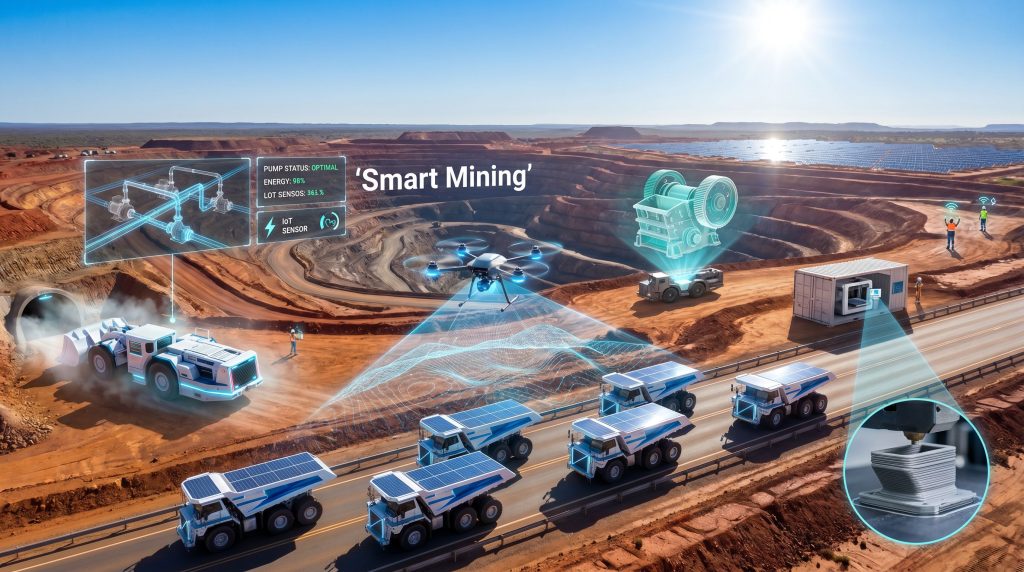
The term smart mining is frequently used but rarely unpacked with precision. At its core, it describes an operational model where physical equipment, digital infrastructure, and human decision-making are no longer separate layers but function as a single integrated system. The goal is not automation for its own sake but the elimination of informational blind spots that have historically caused inefficiency, accidents, and environmental harm.
The five foundational pillars underpinning modern mining digitisation are:
- Connectivity across the entire asset base, including underground and remote environments
- Sensor-driven data collection replacing periodic manual readings with continuous intelligence streams
- AI and machine learning translating raw data into actionable operational decisions
- Automation at the equipment level, reducing human exposure to hazardous conditions
- Digital feedback loops closing the gap between physical performance and planned outcomes
The contrast with legacy approaches is stark across every operational dimension:
| Dimension | Traditional Mining | Smart Mining Model |
|---|---|---|
| Equipment Operation | Manual, human-operated | Autonomous or semi-autonomous |
| Data Collection | Periodic, manual readings | Continuous IoT sensor streams |
| Maintenance Approach | Reactive or scheduled | Predictive and prescriptive |
| Environmental Monitoring | Compliance-based | Real-time, integrated |
| Workforce Role | Primarily physical labour | Technical oversight and data analysis |
Autonomous Equipment: The Productivity Case Is Now Overwhelming
The deployment of autonomous haul trucks has moved well beyond pilot programmes at tier-one operations. These vehicles can sustain continuous 24-hour cycles without fatigue-related performance degradation, delivering measurable gains in tonnes moved per shift compared to manually operated fleets. According to research published across multiple industry sources, autonomous haulage systems have demonstrated productivity improvements ranging from 15% to over 20% at large open-pit operations while simultaneously reducing fuel consumption per tonne hauled.
The distinction between semi-autonomous and fully autonomous systems remains commercially important. Most deployed fleets today operate in semi-autonomous configurations, where remote human supervisors oversee multiple vehicles simultaneously rather than operating individual machines directly. Full autonomy, where no human intervention is required during standard operations, is advancing most rapidly in surface mining contexts where GPS signal reliability and terrain predictability are higher.
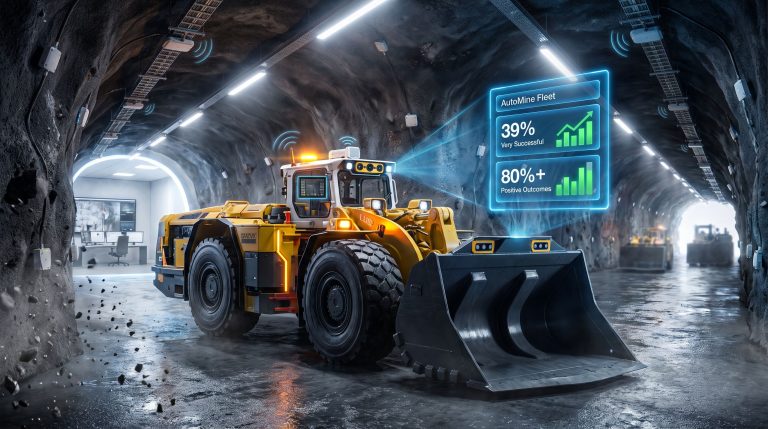
Underground environments present a harder engineering challenge. Navigation in dynamic, GPS-denied spaces requires a fusion of laser-based mapping, inertial guidance, and real-time environment reconstruction. Robotic systems for underground drilling, shotcreting, and ore loading have reached commercial viability at several major operations globally, particularly where the physical environment poses unacceptable risk to human workers.
The labour displacement question attached to autonomous equipment adoption requires careful framing. While operational headcounts at the pit face decline, demand for remote systems operators, data analysts, and maintenance technicians increases. The workforce transition challenge is real, particularly for communities economically dependent on physical mining employment, and deserves deliberate policy attention from operators rather than dismissal.
How Artificial Intelligence Is Reshaping Mining Decision-Making
Artificial intelligence applications in mining are spreading across the full value chain, from geological interpretation through to processing optimisation and environmental compliance. Furthermore, AI in drilling and blasting is emerging as one of the most impactful areas where machine intelligence is replacing manual judgement. Several categories deserve particular attention:
Why Is Predictive Maintenance So Commercially Significant?
Predictive maintenance systems represent one of the most commercially mature AI applications in the sector. Sensor arrays monitoring vibration patterns, acoustic signatures, and thermal signatures on rotating equipment can detect early-stage mechanical degradation weeks before failure would occur under conventional monitoring regimes. The financial case is straightforward: unplanned equipment downtime at a large mine can cost hundreds of thousands of dollars per day, and AI-driven early warning systems reduce the frequency and duration of such events substantially.
How Are Geological Models Becoming More Accurate?
Ore grade estimation and 3D geological modelling using machine learning is proving transformative for resource definition. Traditional geological modelling required expert interpolation across sparse drill hole data. Machine learning models trained on high-density sensor data, including hyperspectral imaging from drill cores and geophysical survey results, can generate grade estimates across orebody volumes with considerably higher spatial resolution than conventional methods.
Production scheduling optimisation is another area where AI is displacing what were previously considered irreplaceable human heuristics. Modern pit optimisers and underground production planners process thousands of constraint variables simultaneously, including equipment availability, grade blend targets, processing capacity, and stockpile management, to generate schedules that human planners cannot match in either speed or complexity handling.
Digital Twins: Running a Virtual Mine Alongside the Physical One
Perhaps no technological concept better captures the ambition of modern mining digitisation than the digital twin. In a mining context, a digital twin is a physics-based, continuously updated virtual replica of a physical asset or entire mine site. It ingests real-world operational data and uses it to simulate performance, test scenarios, and optimise parameters without touching physical operations.
The applications extend well beyond equipment monitoring:
- Simulating the hydraulic response of dewatering systems to sudden groundwater influx events
- Modelling the effect of ore variability on processing circuit performance before the ore reaches the plant
- Testing proposed changes to blast design parameters against fragmentation outcome predictions
- Projecting the impact of equipment failures on downstream processing throughput
Industry projections suggest that by 2030, the majority of critical dewatering and slurry pumping assets at major operations will have digital counterparts operating in parallel in cloud environments. These high-fidelity simulations continuously compare real-world performance against theoretical benchmarks, enabling operators to detect efficiency degradation far earlier than physical inspection cycles would permit.
Pumping infrastructure offers a particularly instructive case study. Smart pump stations of the near future will feature acoustic sensors, vibration analysis nodes, and thermal imaging, all feeding data to edge-computing processors on the pump skid itself. This architecture enables prescriptive maintenance, where the system does not merely detect early bearing wear but autonomously adjusts pump speeds to extend component life until the next scheduled service window, without requiring human intervention.
Drones: Compressing Survey Timelines From Weeks to Hours
Drone technology has been commercially available to the mining sector for roughly a decade, but the sophistication and breadth of its applications have expanded considerably. What began as a tool for aerial photography has evolved into a multi-functional operational platform. Consequently, the World Economic Forum highlights drone integration as one of the key innovations driving sustainability in modern mining.
| Metric | Traditional Survey | Drone-Based Survey |
|---|---|---|
| Time Required | Days to weeks | Hours |
| Personnel Exposure Risk | High (hazardous terrain) | Minimal |
| Data Resolution | Variable | High-resolution geospatial imagery |
| Cost Per Survey | Elevated | Significantly reduced |
| Frequency Feasibility | Infrequent | Continuous or near-daily |
Key operational applications now include:
- Topographic mapping and surveying with centimetre-level accuracy using LiDAR and photogrammetry payloads
- Stockpile volume measurement delivering reliable inventory data without personnel exposure
- Slope stability and tailings dam inspection enabling continuous monitoring of high-consequence infrastructure
- Equipment and structural inspection of assets in locations that are impractical or dangerous to access on foot
- Rehabilitation progress tracking, including revegetation monitoring across post-mining landforms
The integration of drone-captured geospatial data with GIS platforms and mine planning software closes a historically significant gap between site conditions and the models used to make decisions about them.
The next major ASX story will hit our subscribers first
VR Training: Competency Without Consequence
Mining training has historically involved a fundamental tension: the most valuable learning environments are also the most hazardous ones. Virtual reality resolves this tension by creating consequence-free simulations of high-stakes scenarios.
Modern VR training platforms allow operators to rehearse complex procedures on hyper-realistic digital models of specific machine types, including large haul trucks, underground loaders, and processing plant equipment. Trainees encounter emergency scenarios, equipment malfunctions, and abnormal operating conditions within the simulation and must respond correctly to progress.
The operational benefits extend beyond safety:
- Eliminating the need for physical machine access during induction reduces equipment wear and scheduling disruptions
- Remote familiarisation allows operators relocating to new sites to develop confidence with unfamiliar equipment configurations before arriving
- Competency benchmarking within VR environments generates objective performance data that classroom assessments cannot replicate
Research comparing VR-trained operators to those trained through conventional methods consistently indicates faster competency acquisition and lower error rates during early supervised live operation.
3D Mapping and Printing: Precision Planning and Parts on Demand
Three-dimensional mapping delivers highly detailed digital terrain models that go far beyond what conventional survey methods produce. The ability to identify optimal excavation zones, model waste storage configurations, and plan haulage corridor geometry with high spatial precision translates directly into reduced ore dilution, lower fuel consumption, and more efficient use of processing capacity.
The less-discussed application of 3D mapping is its integration with autonomous equipment navigation. Precision terrain models form the foundational dataset against which autonomous haul trucks and drilling systems orient themselves during operations. The quality of the map directly constrains the reliability of the autonomous system operating from it.
Additive manufacturing, more commonly known as 3D printing, addresses one of the most persistent logistical vulnerabilities in remote mining operations: parts supply delays. When specialised underground equipment sustains a mechanical failure at a site hours from the nearest major supply hub, traditional procurement pathways can involve weeks of lead time and significant freight costs. On-site 3D printing capability enables precise component replication within hours, restoring productivity with a fraction of the delay.
Current adoption of mining-grade 3D printing remains in its growth phase, with material limitations representing the primary constraint. Components subject to high cyclic stress, elevated temperatures, or abrasive wear require materials that printed parts cannot yet consistently replicate at full production specification. However, the engineering frontier is advancing rapidly, and the cost savings potential from reduced parts inventory and emergency freight elimination is substantial enough to sustain strong investment in solving these material challenges.
Electrification and the Underground Dividend
Electrification of mining equipment has gained significant momentum, driven by a combination of decarbonisation commitments and an often underappreciated operational benefit: the ventilation dividend in underground environments. In addition, the shift toward battery-electric mining fleets is reshaping how operators approach total cost of ownership across the asset lifecycle.
Diesel-powered underground equipment generates exhaust gases and particulate matter that require large volumes of fresh air to dilute to safe concentrations. Underground ventilation systems are among the most energy-intensive infrastructure components at hard rock operations, sometimes consuming 30% to 50% of a mine's total electricity. Replacing diesel equipment with battery-electric alternatives dramatically reduces the ventilation air volume required, which in turn reduces the capital and operating cost of ventilation infrastructure.
The electrification roadmap for fluid management systems is equally significant:
| Energy Technology | Primary Benefit | Operational Impact |
|---|---|---|
| Battery-Electric Vehicles | Zero diesel emissions | Reduced ventilation requirements underground |
| IE4/IE5 Motors + VFDs | Ultra-premium energy efficiency | Dynamic load matching, lower power costs |
| Microgrid Integration | Renewable energy compatibility | Load-shifting during peak solar/wind generation |
| Computational Fluid Dynamics | Optimised pump hydraulic geometry | Reduced turbulence, lower friction losses |
Variable Frequency Drives paired with IE4 and IE5 motors are replacing fixed-speed pump configurations across dewatering and processing circuits. Rather than running at constant speed and throttling flow mechanically, VFD-equipped systems continuously adjust motor output to precisely match fluctuating demand, eliminating the energy waste that characterises oversized fixed-speed installations.
Advanced Processing: Recovering More From Declining Grades
One of the least-publicised structural challenges in global mining is the secular decline in ore grades across most major commodities. Average copper head grades at operating mines have fallen significantly over several decades, meaning more rock must be moved and processed to produce the same quantity of metal. This reality makes processing efficiency a strategic imperative rather than a secondary consideration.
Paste tailings technology illustrates how processing innovation and water stewardship can intersect productively. By pumping tailings at solids concentrations exceeding 70%, operations can recover and recycle large volumes of process water that would otherwise be lost to evaporation from conventional tailings storage facilities. This approach is particularly consequential in arid regions where water scarcity creates both operational risk and community tension.
Advances in pump metallurgy are enabling this transition. Ultra-high solids slurries are extraordinarily abrasive, and the wear rates on conventional pump components are commercially prohibitive. Manufacturers are developing nano-structured ceramic composites and high-chrome alloys with self-healing microstructural properties to extend the mean time between failures for pumps handling these challenging materials.
The emergence of quality-aware smart water systems represents a less-discussed but potentially significant capability. Integrated spectral analysers positioned within pump volutes can monitor water chemistry in real time, detecting changes in pH, turbidity, or heavy metal concentrations and automatically routing water to appropriate treatment circuits based on quality parameters.
Barriers That Technology Alone Cannot Remove
Honest analysis of technological innovations in mining must account for the significant structural barriers that slow adoption even when the technical case is clear:
- Capital intensity remains the primary constraint for mid-tier and junior operators. Autonomous haulage systems, digital twin platforms, and electrified fleets require upfront investment that extends payback horizons beyond the comfort zone of many balance sheets
- Workforce transition creates political and social friction in mining-dependent communities where the displacement of physical roles is experienced as economic harm regardless of aggregate productivity gains
- Connectivity infrastructure in remote and underground environments remains inadequate for the bandwidth requirements of fully integrated IoT sensor networks
- Cybersecurity exposure grows proportionally with connectivity, and the consequences of a successful attack on an autonomous mine site are considerably more severe than equivalent attacks on conventional operations
- Regulatory frameworks in many jurisdictions have not been updated to accommodate autonomous systems, creating certification and liability uncertainty that delays commercial deployment
The 2030 Horizon: Where Convergence Leads
The most consequential near-term development in mining technology is not any single innovation but the convergence of multiple technologies into unified operational systems. Data-driven mining operations are expected to become the standard model at leading mines by 2030, where intelligent systems manage fluid dynamics, equipment health, production scheduling, and environmental compliance simultaneously. The AusIMM notes that this convergence is already reshaping investment priorities and workforce strategies across the sector.
The critical minerals supercycle, driven by electrification of transport and energy systems globally, is accelerating investment in these capabilities. The commodities required for battery storage, electric motors, and grid infrastructure are predominantly mined, and the pressure to maximise recovery rates from existing deposits while minimising environmental impact is creating a commercial environment where technology adoption is rewarded rapidly.
Investment signals are already reflecting this reality. Venture capital and corporate R&D spending in mining technology has grown substantially since 2020, with autonomous systems, AI-driven geological interpretation, and battery-electric equipment attracting the largest capital allocations.
Disclaimer: Forward-looking statements and market projections referenced in this article reflect industry research and analyst estimates as of publication. They do not constitute investment advice. Actual outcomes may differ materially from projections due to technological, regulatory, market, or operational factors.
Frequently Asked Questions: Technological Innovations in Mining
What Technologies Are Most Commonly Deployed in Modern Mining Operations?
Autonomous haulage, predictive maintenance platforms, drone surveying, VR operator training, and digital twin systems represent the most widely adopted technologies at major operations globally. Industrial IoT sensor networks and electrified equipment are scaling rapidly across both surface and underground contexts.
How Does Automation Affect Mining Employment?
Automation reduces demand for certain physical roles, particularly at the equipment operator level, while creating new demand for remote systems operators, data analysts, and maintenance technicians. The net employment effect varies significantly by operation type, geography, and the pace of transition.
What Distinguishes a Digital Twin From a Conventional Simulation Model?
A conventional simulation model runs discrete scenario analyses using static input assumptions. A digital twin continuously ingests live operational data, updating its virtual representation in real time and enabling ongoing performance comparison between actual and theoretical outcomes.
How Does Underground Electrification Reduce Operating Costs Beyond Fuel Savings?
The ventilation dividend is the primary mechanism. Battery-electric underground equipment eliminates diesel exhaust, allowing mines to reduce fresh air ventilation volumes substantially. Since ventilation systems can consume a significant portion of a mine's total electricity budget, the infrastructure and energy savings from reduced ventilation requirements can exceed the direct fuel cost savings from electrification.
Is 3D Printing Currently Viable for Producing Mining-Grade Components?
Additive manufacturing is viable for a growing range of non-critical components and geometric complexities that are expensive to machine conventionally. Components requiring extreme hardness, high fatigue resistance, or specialised alloy properties remain at the engineering frontier. The trajectory of materials science development suggests broader viability within this decade.
Disclaimer: Forward-looking statements and market projections referenced in this article reflect industry research and analyst estimates as of publication. They do not constitute investment advice. Actual outcomes may differ materially from projections due to technological, regulatory, market, or operational factors.
Want to Capitalise on the Next Major Mineral Discovery Before the Broader Market Reacts?
As autonomous systems, AI-driven geological modelling, and electrification reshape the economics of extraction, the window between a significant ASX mineral discovery announcement and broad market recognition is narrowing — making real-time intelligence more valuable than ever. Discovery Alert's proprietary Discovery IQ model continuously scans ASX announcements across more than 30 commodities, delivering instant, actionable alerts to subscribers, and you can explore historic examples of exceptional discovery outcomes to understand just how significant the returns from early positioning can be — start your 14-day free trial today.