July 21, 2026
The Underground Energy Transition Has Reached a Turning Point
For decades, the underground mining industry operated under an uncomfortable compromise: diesel-powered development drills delivered the raw productivity needed to advance headings at commercially viable rates, but they came with a ventilation tax that grew more punishing the deeper mines went. Every diesel machine introduced underground required a proportional increase in airflow, and airflow costs money at scale. In deep, complex orebodies, ventilation can represent 30 to 50 percent of total underground energy consumption, according to mining energy benchmarking studies published by Natural Resources Canada.
Battery-electric underground equipment promised to break that compromise, but first-generation machines frequently fell short on the metrics that mine planners care about most: drilling metres per shift, tramming speed between faces, and the practical challenge of keeping machines charged without sacrificing productive time. The technology was directionally correct but operationally immature.
The Sandvik DD423iE battery drill represents a meaningful step beyond that first generation, and its performance specifications suggest the gap between diesel and electric development drilling is closing faster than many in the industry anticipated.
When big ASX news breaks, our subscribers know first
Why Platform Continuity Is a Smarter Commercial Strategy Than It Appears
The Diesel-First Launch Sequence and What It Signals
One aspect of the DD423iE story that deserves more attention than it typically receives is the deliberate sequencing of the product launch. Sandvik introduced the diesel DD423i variant first before releasing the battery-electric DD423iE, and this was not an arbitrary decision.
Launching the diesel platform first allowed Sandvik to validate the core mechanical architecture, refine the drilling geometry, and embed performance improvements before layering in the complexity of an integrated battery system. Mine sites that adopted the diesel version early gained familiarity with the platform's controls, ergonomics, and maintenance requirements. When the battery-electric variant follows, those sites face a significantly lower retraining burden because the operational interface is largely the same.
This matters for procurement decisions in ways that total cost of ownership models do not always capture. Underground training is expensive, spare parts commonality reduces inventory carrying costs, and fleet standardisation simplifies maintenance scheduling. Furthermore, the mechanical performance gains that carried over from the diesel platform to the DD423iE are substantial, as evidenced by Sandvik's DD422iE development drill rig lineage:
| Inherited Performance Metric | Improvement vs. Previous Generation |
|---|---|
| Drilling coverage area | +34.5% |
| Cross-cut performance | +48% |
| Operator visibility | +55% |
These are not incremental refinements. A 34.5 percent increase in drilling coverage area directly translates to fewer machine repositions per face, which compresses cycle times in a way that compounds across an entire shift schedule.
Why LFP Chemistry Was the Right Call for Underground Conditions
The DD423iE uses three lithium iron phosphate battery units rather than higher energy-density alternatives such as nickel manganese cobalt chemistries. This choice reflects a clear-eyed assessment of underground risk profiles rather than a performance compromise.
LFP batteries operate at lower internal temperatures under load and are significantly more resistant to thermal runaway than other lithium-ion chemistries. In an underground heading where ventilation is constrained and evacuation routes are limited, thermal stability is not a secondary consideration — it is the primary one. LFP cells also deliver longer cycle lives, typically exceeding 2,000 to 3,000 full charge-discharge cycles before meaningful capacity degradation, which matters considerably for a machine expected to operate across a 10-year asset life.
The triple-battery configuration distributes load intelligently across drilling and tramming duty cycles, preventing any single unit from experiencing the deep discharge events that accelerate cell ageing. This architecture reflects a more sophisticated understanding of underground mobile equipment duty cycles than was present in first-generation battery drill designs.
How Does the DD423iE Perform? A Metrics-Driven Operational Analysis
The Three Performance Pillars
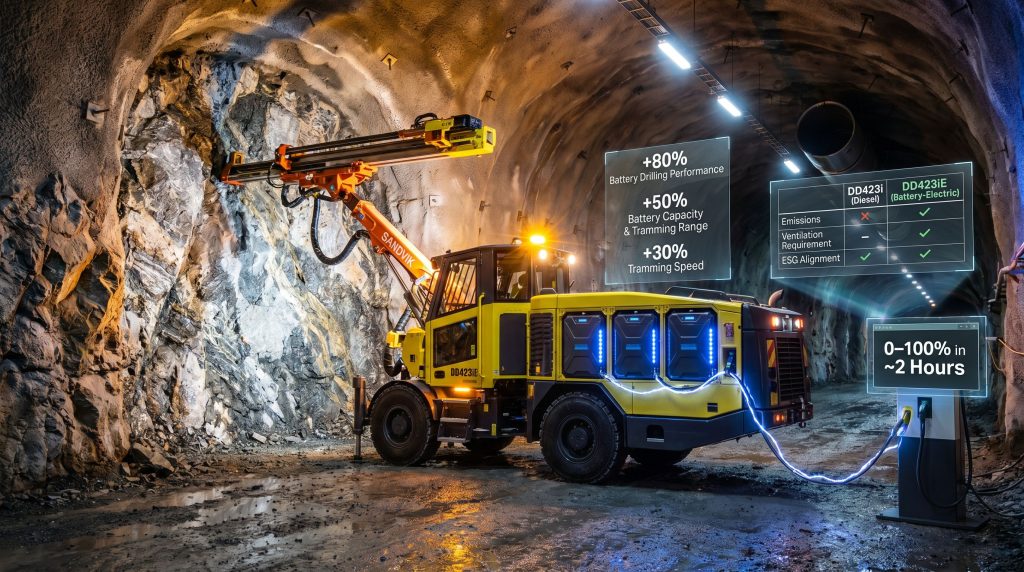
The headline performance numbers for the Sandvik DD423iE battery drill are substantial and worth examining in context:
- 80% improvement in battery drilling performance relative to its battery-electric predecessor, which translates directly into greater face advance per shift
- 50% increase in battery capacity and tramming range, enabling the machine to operate across deeper, more complex development headings without range anxiety-driven interruptions
- 30% faster tramming speed, making the DD423iE the quickest machine in Sandvik's underground drilling portfolio
| Performance Category | DD423iE Improvement |
|---|---|
| Battery drilling performance | +80% |
| Battery capacity and tramming range | +50% |
| Tramming speed | +30% |
| Full charge time (while drilling) | ~2 hours (0-100%) |
| Charging power increase vs. predecessor | >3x |
The tramming speed figure deserves particular attention. Development drilling operations are not simply about the time the drill bit is in contact with rock. A significant portion of each shift is consumed by tramming between faces, setting up, and repositioning. Faster tramming compresses this non-drilling time, effectively increasing the productive drilling fraction of every shift without requiring any change to drilling parameters.
Charging Performance as a Structural Advantage
The most operationally disruptive aspect of first-generation battery underground equipment was the charging dead time problem. Machines that required dedicated charging windows, whether at underground charging bays or surface facilities, introduced rigid scheduling constraints that diesel operations had never faced. A machine that could not charge while working was, in practical terms, a machine with a finite working window that had to be planned around rather than integrated into continuous production flow.
The DD423iE eliminates this constraint through on-board charging capability that delivers a full 0 to 100 percent state of charge in approximately two hours while the machine is actively drilling. This is made possible by charging power that exceeds three times the output of the previous battery drill generation. The mining electrification shift underway across the sector makes this kind of practical innovation increasingly critical to operations worldwide.
The ability to charge while drilling effectively decouples battery state of charge from production scheduling. Mine planners no longer need to structure shift rotations around charging windows. The machine's energy status becomes a background consideration rather than a primary scheduling constraint.
This is not a minor operational convenience. It is a fundamental change in how battery-electric development drills can be integrated into continuous development programs, and it is arguably the single most important design decision in the DD423iE's architecture.
Field Validation: What the Kittilä Mine Trial Reveals
Why Arctic Operating Conditions Matter as a Benchmark
The DD423iE's field validation at Agnico Eagle Finland's Kittilä mine was a deliberate choice of a demanding proving ground. Kittilä is one of Western Europe's largest gold mines, operating in subarctic Finland where ambient temperatures impose additional stress on battery thermal management systems. Underground development at Kittilä involves geologically complex, high-intensity drilling programs that push equipment harder than many other operating environments.
Battery chemistry performance is temperature-sensitive. LFP cells, while more thermally stable than alternatives, still experience capacity and power delivery variations across temperature ranges. Validating the DD423iE under Kittilä's conditions provided meaningful assurance that the machine's performance specifications are achievable in real-world underground environments rather than controlled laboratory conditions.
Third-party operational validation at a live production mine is increasingly becoming a non-negotiable commercial requirement in the underground equipment procurement process. Mine operators investing in capital equipment at this price point need empirical evidence, not manufacturer-supplied test data alone, that performance claims translate to their specific operating environments.
Translating Trial Data Into Mine-Site Business Cases
The ventilation cost reduction potential of transitioning from diesel to battery-electric development drills is where the financial case becomes most compelling, particularly for deep underground operations. The mining decarbonisation benefits extend well beyond emissions optics and into hard operational savings.
Diesel development drills produce exhaust gases, including nitrogen oxides and particulates, that must be diluted to safe concentrations through forced ventilation. Regulatory standards in most major mining jurisdictions specify minimum airflow volumes per kilowatt of diesel power operating underground. As diesel fleets grow and mines deepen, the ventilation requirement compounds, and the energy cost of maintaining compliant airflow escalates.
Scenario Analysis: An underground operation running three diesel development drills in a single-level heading system could potentially reduce ventilation energy costs by 20 to 35 percent by transitioning to battery-electric equivalents, based on industry benchmarks for diesel exhaust dilution requirements. Actual savings are highly site-specific and depend on mine depth, airflow circuit design, shift utilisation rates, and local electricity pricing. This should be treated as an indicative range rather than a guaranteed outcome.
Beyond ventilation, battery-electric development drills reduce the thermal load imposed on underground environments, which becomes significant in deep mines where geothermal gradients elevate ambient temperatures. Lower thermal loading reduces the cooling requirement, adding another layer of operational cost reduction that is rarely captured in simplified total cost of ownership comparisons.
The Total Cost of Ownership Case: Beyond the Sticker Price
Fuel Volatility and Diesel Dependency Risk
Underground mining operations that run diesel-heavy fleets carry an embedded commodity price risk that rarely appears in equipment procurement analysis. Diesel fuel pricing is correlated with crude oil markets, which have demonstrated volatility cycles of 40 to 60 percent within single calendar years during periods of geopolitical disruption. A mine operating 10 to 15 diesel development drills across multiple levels faces meaningful exposure to this input cost variability across a project's multi-decade life.
Battery-electric development drills substitute electricity for diesel, and while electricity prices are not immune to volatility, they are generally less prone to sudden step-change increases. In addition, they are increasingly sourced from renewable energy in mining operations pursuing decarbonisation targets. For operations with access to hydroelectric or solar-backed grid power, this substitution represents a genuine reduction in long-run cost uncertainty.
Electric Drivetrain Maintenance Profiles Over a 10-Year Asset Life
Electric drivetrains have significantly fewer moving parts than diesel powertrains. There are no fuel injectors, turbochargers, exhaust after-treatment systems, or multi-speed transmissions to maintain. Routine maintenance intervals for electric machines tend to be longer, and the failure modes are generally more predictable, which supports better planned maintenance scheduling and reduces unplanned downtime risk.
Over a 10-year asset life, the maintenance cost differential between electric and diesel underground drills can be substantial. While electric machines carry a higher upfront capital cost, the lifecycle cost comparison becomes increasingly favourable as diesel maintenance costs and fuel expenditure accumulate. This aligns closely with the broader mining energy transition towards lower-operating-cost electric fleets.
DD423iE vs. Diesel DD423i: Choosing the Right Platform
| Comparison Dimension | DD423i (Diesel) | DD423iE (Battery-Electric) |
|---|---|---|
| Primary energy source | Diesel | LFP battery (x3) |
| Underground emissions | Diesel exhaust | Zero direct emissions |
| Ventilation requirement | High | Significantly reduced |
| Tramming speed advantage | Baseline | +30% vs. battery predecessor |
| Charging method | Refuelling | On-board while drilling (~2 hrs) |
| ESG alignment | Moderate | High |
| Maintenance complexity | Higher | Lower |
| Fuel cost exposure | High volatility | Lower, grid-dependent |
The diesel DD423i remains the pragmatic choice for remote surface-access operations without reliable grid power infrastructure, or for sites where establishing underground electrical distribution for high-power charging would require capital investment that outweighs the electrification benefit within the project's mine life.
The battery-electric DD423iE, however, delivers superior total cost of ownership in deep mines with high ventilation costs, operations with ESG-mandated electrification timelines, and sites where electrical infrastructure is already in place or planned as part of a broader fleet electrification programme. Consequently, procurement teams should model both scenarios thoroughly before committing.
The next major ASX story will hit our subscribers first
The Broader Market Shift: Development Drills as the Electrification Entry Point
Why Development Drills Come First in Fleet Electrification Sequencing
Underground mining electrification rarely happens all at once. Fleet electrification programmes typically sequence equipment categories based on a combination of factors: the maturity of available electric alternatives, the magnitude of ventilation cost reduction achievable, and the operational criticality of the machine class.
Development drills are frequently the first category targeted because they operate in the most confined heading environments where diesel exhaust concentrations are highest, and where ventilation dilution requirements are most operationally limiting. Successfully validating a battery-electric development drill at an operating mine creates a reference case that accelerates confidence in electrifying adjacent equipment categories. For instance, zero-emissions mining fleets encompassing loaders, haul trucks, and bolters all benefit from the operational knowledge generated by early development drill deployments.
This sequencing dynamic means that the DD423iE's commercial success has implications beyond Sandvik's development drill product line. Each operating installation that validates the machine's performance against diesel benchmarks makes the broader underground electrification conversation easier to have with mine operators who remain cautious about departing from proven diesel technology. According to mining-technology.com's coverage of the DD423i launch, automation integration is also advancing in parallel, further strengthening the case for next-generation platforms.
Infrastructure Considerations That Are Often Underestimated
Underground electrical infrastructure for high-power charging is a more complex undertaking than surface installations. Cable sizing for charging power levels exceeding previous generations, underground substation placement, trailing cable management during machine movement, and protection systems for underground electrical distribution all require careful engineering.
Mines transitioning to battery-electric fleets need to assess their underground power distribution capacity early in the planning process, ideally during feasibility study, rather than discovering infrastructure constraints after equipment procurement commitments have been made. The DD423iE's on-board charging architecture, which allows charging during drilling rather than requiring fixed bay infrastructure, partially mitigates this challenge by reducing peak demand loading on the underground distribution system.
Frequently Asked Questions: Sandvik DD423iE Battery Drill
What is the Sandvik DD423iE?
The Sandvik DD423iE battery drill is a battery-electric underground development drill built on the mechanical platform established by the diesel DD423i. It is the second machine in Sandvik's next-generation development drilling lineup and is engineered to deliver high-productivity face advance with zero direct underground emissions.
How long does it take to charge the DD423iE?
The machine achieves a full charge from zero to 100 percent in approximately two hours while actively drilling underground, using charging power more than triple that of its predecessor generation. This eliminates the need for dedicated out-of-production charging windows.
What battery chemistry does the DD423iE use?
Three lithium iron phosphate battery units power the machine. LFP chemistry was selected for its superior thermal stability, extended cycle life, and suitability for the confined, poorly ventilated environments characteristic of underground development headings.
What are the key performance improvements of the DD423iE?
- 80% improvement in battery drilling performance vs. battery-electric predecessor
- 50% increase in battery capacity and tramming range
- 30% increase in tramming speed, making it Sandvik's fastest underground drill
- 34.5% greater drilling coverage area vs. prior generation
- 48% improved cross-cut performance
- 55% increase in operator visibility
Where was the DD423iE field tested?
Operational validation was conducted at Agnico Eagle Finland's Kittilä mine in subarctic Finland, confirming performance under the demanding geological and temperature conditions of a live underground production environment.
How does the DD423iE support mine decarbonisation programmes?
By eliminating diesel combustion during underground development drilling, the DD423iE removes direct Scope 1 emissions from that activity, reduces mandatory ventilation airflow volumes, lowers underground thermal loading, and supports mine operators' ESG commitments. The machine does not require external policy support or designation to deliver these operational benefits; the economics of ventilation cost reduction and fuel displacement provide a standalone financial case in many underground environments.
Key Takeaways for Mine Operators and Equipment Decision Makers
The Sandvik DD423iE battery drill represents a maturation of underground battery-electric technology that addresses the core objections that previously slowed adoption:
- Performance parity concern: Addressed by an 80% improvement in battery drilling performance and inherited mechanical gains from the diesel platform
- Charging dead time concern: Addressed by two-hour full-charge capability while the machine is actively drilling
- Range limitation concern: Addressed by a 50% increase in battery capacity and tramming range
- Thermal and safety concern: Addressed through LFP chemistry selection and integrated safety monitoring systems
- Training and standardisation concern: Addressed through platform continuity with the diesel DD423i
The field validation programme at Kittilä adds the empirical credibility that procurement decisions of this magnitude require. For underground operations evaluating their development drilling fleet strategy, the DD423iE's specification set makes the total cost of ownership comparison with diesel alternatives a genuinely competitive calculation rather than a values-driven aspiration.
Disclaimer: Performance figures cited in this article are based on manufacturer-reported specifications and field validation data as published. Ventilation cost reduction scenarios are indicative only and should not be used as the basis for financial decisions without site-specific engineering analysis. Readers should conduct independent due diligence appropriate to their operating context.
Want to Stay Ahead of the Next Major Mining Discovery?
Discovery Alert's proprietary Discovery IQ model delivers real-time alerts on significant ASX mineral discoveries, transforming complex mineral data into actionable investment insights for both short-term traders and long-term investors. Explore how historic discoveries have generated substantial returns on Discovery Alert's dedicated discoveries page, and begin your 14-day free trial today to position yourself ahead of the broader market.