
July 21, 2026
When the Workforce Clock Runs Out: How Demographic Pressure Is Redrawing North American Mining's Labor Map
Every major industrial sector eventually confronts a demographic reckoning. For Canadian mining, that moment has arrived with uncomfortable clarity. Decades of underinvestment in technical education, combined with an aging cohort of experienced underground operators approaching the end of their careers, have converged into a workforce emergency that domestic hiring pipelines simply cannot resolve alone. The industry's response to this crisis is now pointing south, specifically toward the silver-rich highlands of Zacatecas, Mexico, where a younger, deeply experienced, and structurally compatible mining workforce exists in significant numbers.
Understanding why Canada turns to Zacatecas miners requires unpacking both sides of a labour equation that has been building for years — on one side a structural demographic collapse in Canadian mining talent, and on the other a Mexican workforce rich in precisely the underground skills Canadian contractors need most urgently. The broader North American mining trends shaping this moment make the cross-border dynamic all the more significant.
When big ASX news breaks, our subscribers know first
Canada's Underground Skills Emergency: More Than Just a Numbers Problem
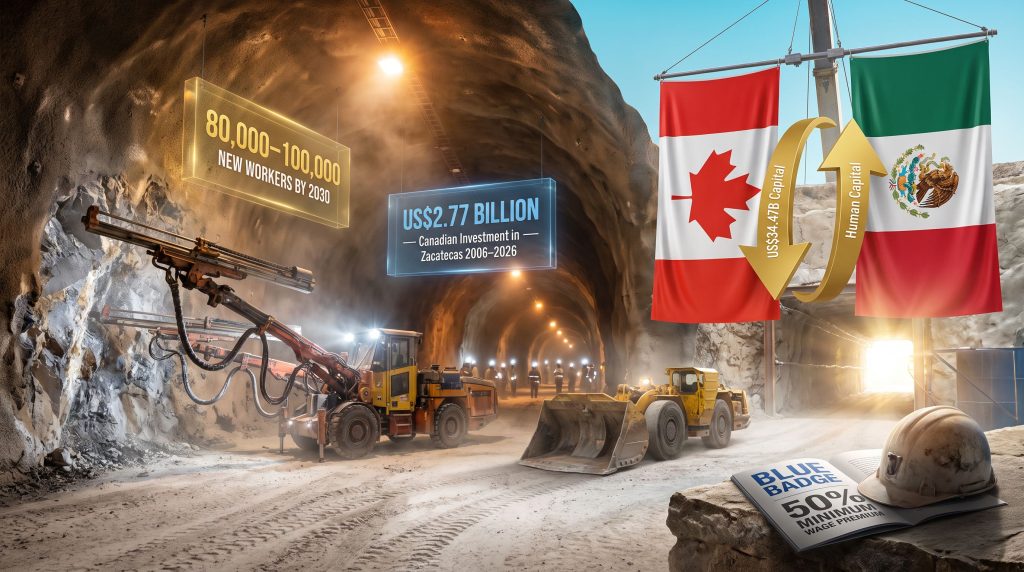
The most commonly cited figure in this conversation is the projected shortfall of 80,000 to 100,000 mining workers that Canada will need to onboard by 2030. However, framing this purely as a headcount problem misses the deeper operational crisis embedded within those numbers.
Canadian mining is not simply losing bodies. It is losing something far harder to replace: the accumulated technical intuition of veteran underground miners who have spent careers operating in confined, high-risk environments where mistakes carry irreversible consequences. This is what industry insiders have begun calling the "gray tsunami" — a generational wave of retirements set to wash decades of embedded knowledge out of the sector simultaneously.
Compounding the retirement pressure is a collapse in the educational pipeline feeding into it. The number of mining engineering graduates from Canadian institutions has declined by nearly 50% in recent years, meaning the sector is experiencing simultaneous demand-side growth and supply-side contraction — a particularly punishing combination for any labour market.
Why Underground Expertise Is Uniquely Difficult to Replicate
Not all mining roles carry equal replacement risk. Underground operations represent the most acute pressure point because they demand a specific and narrow set of competencies that take years to develop safely. The equipment involved — including jumbos, Alimaks, Stopemates, bolters, scoops, and haul trucks — is highly specialised. Proficiency does not come from a training course; it accumulates through supervised operational experience in live underground environments.
Safety certification requirements in Canadian mines create an additional barrier to rapid workforce substitution. A surface miner cannot simply be redeployed underground, and an inexperienced operator cannot be rushed through certification without exposing crews to unacceptable risk. This is precisely why the underground skills gap is not a problem that more aggressive domestic recruitment alone can solve in any realistic timeframe. Understanding the full mining investment landscape helps contextualise just how urgent this bottleneck has become.
The Strategic Logic Behind Targeting Zacatecas Specifically
Mexico's national mining workforce numbers approximately 265,000 people, roughly four times the scale of Canada's mining labour pool. The average age of that workforce sits at approximately 39 years, offering a generationally younger talent base compared to Canada's ageing demographic profile. However, these aggregate figures only partially explain why Zacatecas specifically has emerged as the focal point for Canadian cross-border recruitment.
Zacatecas is Mexico's foremost silver-producing state and carries an institutional culture built around underground mining operations. The technical vocabulary, the safety instincts, the equipment familiarity, the operational discipline that Canadian contractors require — these are embedded into the professional identity of Zacatecas miners in ways that cannot be replicated by drawing from a surface-mining region. The alignment between what Canadian underground contractors need and what Zacatecas workers already know is unusually precise.
The Capital-Labor Paradox: Money Goes South, Talent Goes North
The Canada-Zacatecas relationship has historically been understood through the lens of investment flows. Canadian companies have committed approximately US$34.47 billion to Mexico's mining sector between 1999 and 2024, making Canada the single largest source of foreign mining investment in the country. Within Zacatecas specifically, Canadian direct investment from 2006 to 2026 totalled US$2.77 billion, exceeding U.S. investment in the same period and region.
Flagship Canadian-backed developments in the state include the Mina de San Nicolás, a joint venture between Agnico Eagle and Teck Resources. The state's Canadian investment profile deepened further in early 2026 when Pan American Silver acquired MAG Silver's 44% stake in the Juanicipio mine for US$2.1 billion, adding another high-profile silver asset to Canada's Zacatecas portfolio.
What has now emerged is a bilateral resource dynamic that inverts traditional expectations. Canadian financial capital flows southward into Mexican mining projects while skilled Mexican labour is simultaneously being recruited northward into Canadian operations. This two-directional exchange — driven less by policy design than by intersecting economic necessity on both sides of the border — also reflects broader mining industry consolidation reshaping how companies structure their operations internationally.
Inside the Blue Badge Program: Architecture, Incentives, and Early Performance
Dumas Mining, operating as part of the STRACON group with approximately 15 years of presence in Mexico, launched the Blue Badge programme to formalise and scale this cross-border talent recruitment. The company currently employs approximately 1,000 workers, with roughly 60% of Mexican nationality, reflecting an already-established cross-border employment culture that predates the formal programme.
The initiative was formally presented at the 2026 International Mining Meeting (RIM) held in Zacatecas, where Dumas maintains administrative operations and a service workshop near the airport.
Programme Metrics at a Glance
| Metric | Detail |
|---|---|
| Programme launch date | January 2026 |
| Initial placement location | Timmins, Ontario |
| Workers active within six months | Approximately 10 |
| Minimum wage premium vs. Mexico | At least 50% above equivalent local wages |
| Income growth potential | Potential to more than double earnings within a short period |
| Work permit duration | Approximately 2 to 3 years per cycle |
| Long-term pathway | Permanent residency support for qualifying participants |
| Initial hiring target | Approximately 100 participants, with no stated ceiling |
The pilot phase exceeded internal projections. Beginning with a single worker placed in Timmins in January 2026, the programme reached approximately 10 active Mexican employees across multiple Canadian roles within six months. Dumas has made clear that demand is effectively open-ended, constrained in practice only by the availability of certified, English-proficient candidates.
The Language Barrier: The Programme's Most Significant Bottleneck
Mid-to-advanced English proficiency is a non-negotiable prerequisite for participation. This is not a bureaucratic formality. Underground mining environments operate on precise verbal communication between operators, supervisors, and safety crews. A language gap in that context is a safety liability that cannot be mitigated through goodwill or experience alone.
Dumas has responded by offering English language training and exploring formal educational partnerships to build a pipeline of language-ready candidates. The speed at which these preparation pathways can be scaled will largely determine how quickly the programme can move from its initial 100-participant target toward the genuinely open-ended demand the company has described.
The Competing Demand Problem: Zacatecas Needs Its Own Workers Too
The strategic tension at the heart of this story is rarely discussed directly but deserves careful examination. Zacatecas authorities have secured commitments exceeding US$6.5 billion in short-term mining investment, anchored significantly by Canadian-backed projects. A substantial portion of the approximately US$7 billion in Mexican mining projects currently awaiting regulatory permits is concentrated in this same state.
When those permits eventually clear, those projects will require experienced underground crews to move forward. The same workers that Dumas and other Canadian contractors are actively recruiting northward are precisely the workforce that Zacatecas-based projects will need to activate their own pipelines. Furthermore, sound mining risk management frameworks suggest that this competing demand dynamic warrants serious attention from both operators and investors.
Critical Tension: Canada turns to Zacatecas miners at precisely the moment when Mexico's most significant domestic mining investment pipeline depends on retaining that same workforce. If regulatory friction persists, Canada accelerates the depletion of a talent pool that Mexico's own capital-intensive projects cannot afford to lose.
This dynamic is not theoretical. According to ManpowerGroup's 2026 workforce survey, 67% of Mexican employers already report difficulty filling technical and operational roles. Skilled labour shortages are consistently ranked among the top operational risks for mining and metals companies active in Mexico in 2026. Permit delays and regulatory friction have suppressed near-term formal hiring domestically, making international opportunities comparatively more attractive to experienced workers — and inadvertently accelerating the very outflow that Mexico's stalled projects can least afford.
Diplomatic Engagement: How Government-Level Attention Is Shaping the Relationship
The bilateral dimension of this labour story extends beyond corporate recruitment strategies. Canadian Ambassador Cameron MacKay attended the 2026 International Mining Meeting in Zacatecas, signalling sustained engagement at the diplomatic level. MacKay's meeting with Zacatecas Governor David Monreal in June 2026 confirmed both governments' intent to deepen investment ties, advance technology transfer, and strengthen value chains within the state.
The areas of bilateral cooperation currently under development include:
- Technology transfer initiatives to elevate operational standards across Mexican mining projects
- Workforce training partnerships to build English-language and technical competency pipelines
- Value chain integration strategies connecting Canadian contractors with Mexican suppliers and service providers
- Joint frameworks supporting workers seeking long-term cross-border mobility pathways
These discussions position Zacatecas as a strategically relevant partner for Canada's mining sector, with cooperation extending well beyond individual company recruitment programmes into broader frameworks for shared capacity development.
The next major ASX story will hit our subscribers first
Labour Rights and Social Licence: The Fault Lines Beneath the Partnership
Any comprehensive analysis of the Canada-Zacatecas mining relationship must account for the unresolved social and labour governance tensions operating beneath the headline investment and recruitment narratives.
A USMCA labour panel found serious labour rights violations at the Camino Rojo mine, operated by Canadian firm Orla Mining Ltd., including documented instances of threats and coercion against workers attempting to exercise union rights. As reported by the United Steelworkers, Mexican workers faced assaults and death threats for attempting to unionise at the Canadian-owned operation — a troubling indicator of governance gaps at the operational level.
Separately, 46 families were displaced by mining operations in La Colorada, Zacatecas, with ongoing community demands for land restitution and accountability. In early 2026, Al Jazeera reported that five employees of a Canadian mine were found dead in Mexico, intensifying security-related scrutiny across the sector considerably.
Investor Note: Social licence failures and labour rights controversies in Zacatecas carry direct reputational and operational risk for Canadian mining companies. ESG-focused institutional investors and USMCA enforcement bodies are increasingly attentive to these dimensions of cross-border mining relationships, and the Camino Rojo panel ruling demonstrates these mechanisms are actively deployed — not merely theoretical.
Three Scenarios for North America's Mining Labour Future
The trajectory of the Canada-Zacatecas labour relationship will be shaped by several interacting variables over the next three to five years. Three plausible pathways are worth mapping:
Scenario 1: Structured Bilateral Partnership
Mexico accelerates permitting, retains experienced workers domestically while formalising a managed cross-border mobility framework. Both countries benefit from coordinated labour flows, shared technical capacity, and a division of roles that supports investment pipelines on both sides of the border.
Scenario 2: Accelerating Brain Drain
Regulatory delays in Mexico persist, Canadian wages continue attracting the most qualified workers northward, and Zacatecas faces a skills deficit that delays its own investment pipeline. Mexico's most mining-intensive state loses the workforce base needed to activate the projects already financed.
Scenario 3: Institutionalised Workforce Mobility
Cross-border labour movement becomes normalised and embedded within USMCA's broader economic architecture. Workers cycle between Canadian and Mexican operations across their careers, creating a genuinely integrated North American mining labour market with bidirectional wage and skills development.
Key Indicators to Monitor
- Mexico's permitting clearance rate for stalled mining projects through 2026 and 2027
- Expansion pace of English language training and certification programmes targeting Zacatecas workers
- USMCA labour panel rulings and their influence on Canadian operator conduct in Mexico
- Dumas Mining's Blue Badge enrolment trajectory beyond the initial 100-participant target
- Canadian temporary foreign worker permit approvals for skilled underground mining roles
Investors tracking the junior mining risks and rewards in this space will find these indicators particularly useful in assessing near-term exposure across the Canada-Mexico corridor.
Frequently Asked Questions
What is the Blue Badge programme and who is eligible?
The Blue Badge initiative is a structured cross-border recruitment programme operated by Dumas Mining, part of the STRACON group, targeting experienced underground miners from Zacatecas. Eligible candidates must hold certifications in specialised underground equipment operation, demonstrate mid-to-advanced English proficiency, and meet Canadian mining safety compliance standards. The programme is currently scaling toward an initial target of approximately 100 participants with no stated upper limit.
How much more can Mexican miners earn by working in Canada?
Participants in the Blue Badge programme can expect to earn a minimum of 50% more than equivalent roles pay in Mexico, with the realistic potential to more than double their income over the duration of a placement cycle. Work permits run approximately two to three years, with longer-term pathways to permanent residency available for qualifying individuals.
Why is Zacatecas specifically targeted for underground mining recruitment?
Zacatecas carries decades of institutional underground mining experience built around Mexico's premier silver-producing industry. This aligns directly with the underground specialisation that Canadian contractors need most urgently — where surface-to-underground retraining is not a viable short-term substitute. Existing Canadian capital investment in the state also creates established operational relationships that facilitate cross-border recruitment.
What risks does Mexico face if this talent outflow accelerates?
Mexico faces a compounding structural risk. Regulatory delays are already suppressing domestic hiring across the sector. If permit bottlenecks continue while Canadian recruitment accelerates, Zacatecas could face a skills deficit precisely when its US$6.5 billion plus investment pipeline requires experienced crews to proceed — creating a feedback loop where delayed projects lose the workforce capacity needed to eventually activate them.
Is the Canada-Mexico mining labour relationship governed by formal agreements?
No dedicated bilateral labour mobility framework currently exists for the mining sector specifically. However, the USMCA provides a broader trade architecture within which labour standards and enforcement mechanisms apply. The Camino Rojo labour panel ruling demonstrates that these mechanisms are actively used to address cross-border labour governance issues, and their application is likely to expand as cross-border employment in the sector grows.
Disclaimer: This article contains forward-looking scenarios and projections based on current industry data, workforce surveys, and observable trends. These scenarios are analytical in nature and do not constitute financial or investment advice. Investment decisions should be made with reference to professional financial guidance and independent due diligence.
Want to Track the ASX Mining Discoveries That Could Reshape North America's Resource Landscape?
As demographic pressures and cross-border labour dynamics reshape global mining operations, Discovery Alert's proprietary Discovery IQ model delivers real-time alerts on significant ASX mineral discoveries — instantly translating complex data across 30-plus commodities into clear, actionable insights for investors at every level. Explore how historic discoveries have generated extraordinary returns and begin your 14-day free trial today to position yourself ahead of the market.