
July 20, 2026
The Governance Architecture Shaping the UK's Most Contested Energy Decision
Offshore energy policy rarely captures public attention in granular detail. Most observers track the headline positions, the political slogans, and the protest imagery. What gets far less scrutiny is the intricate legal, regulatory, and procedural scaffolding that actually determines whether a field gets approved, delayed, or permanently shelved. In the case of the UK's North Sea, that scaffolding is now the central drama, and understanding it is essential to making sense of why the UK prime minister backs North Sea oil and gas projects is a far more complicated story than it first appears.
When big ASX news breaks, our subscribers know first
Labour's North Sea Policy: What It Actually Prohibits and What It Doesn't
When Labour entered government in 2024, its manifesto commitment on North Sea energy was framed in clear terms: no new offshore exploration licences. The previous Conservative administration had authorised roughly 100 new North Sea licences in July 2023, a decision framed by then-Prime Minister Rishi Sunak as consistent with the UK's net-zero pathway. Labour's position was a deliberate break from that approach.
However, the specific language of that commitment has become the subject of significant legal and political parsing in 2026. The distinction that now governs the entire debate is this:
- New exploration licences are what Labour pledged not to issue, and that commitment remains in place
- Development approvals for fields already licensed under the previous government occupy an entirely different regulatory category
- Government legal advisers have reportedly concluded that approving development of already-licensed fields does not constitute the issuance of a new licence
Policy Clarity Note: Conflating exploration licensing with development approval for pre-existing licences is one of the most common mischaracterisations in public debate on this topic. The two involve different legal instruments, different regulatory processes, and different precedents under UK energy law.
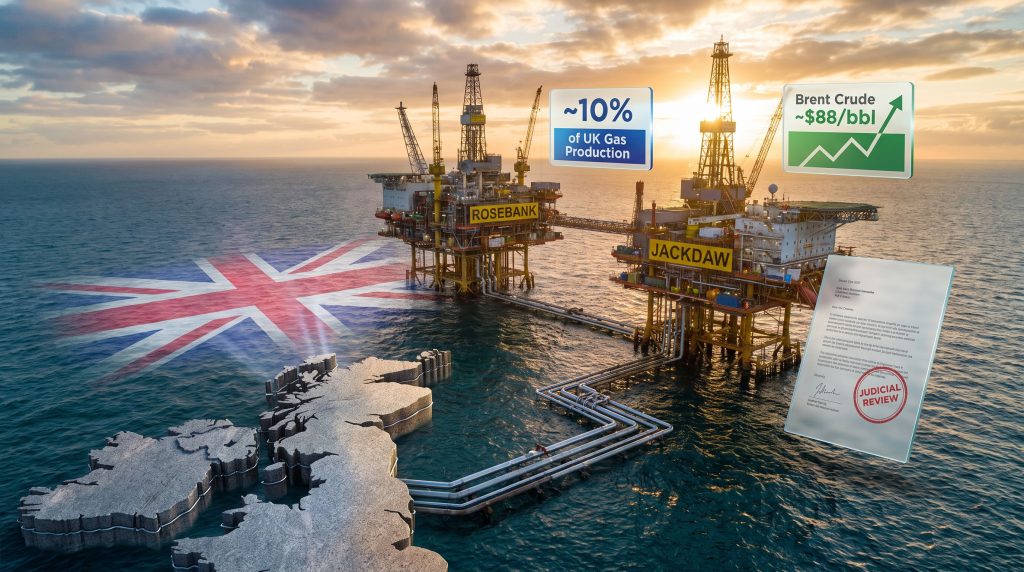
This distinction is not merely semantic. It is the entire basis on which incoming Prime Minister Andy Burnham's team has asked the civil service to examine pathways toward approving drilling activity at the Rosebank oil field and the Jackdaw gas field, both operated through Adura, the joint venture formed by Shell and Equinor to combine their respective North Sea operations.
Understanding Tie-Backs: The Technical Mechanism at the Heart of North Sea Expansion
Alongside the Rosebank and Jackdaw decisions, the Burnham government is reportedly examining an expansion of tie-back drilling, and this mechanism deserves detailed explanation because it is poorly understood outside the industry.
A tie-back is a subsurface drilling arrangement that connects production from a new or adjacent reservoir zone to infrastructure that already exists on the seabed or at surface. In practical terms, it means operators can access additional hydrocarbon volumes without constructing entirely new platforms or pipelines.
The regulatory significance of tie-backs is substantial:
- They are classified as development activity rather than exploration, which means they do not trigger the threshold for a new exploration licence
- Because the infrastructure connection is to existing facilities, the environmental footprint is demonstrably smaller than greenfield development
- They represent a technically and commercially efficient way to slow the production decline curve on maturing North Sea assets
- Crucially, they sit within a policy grey zone that Labour's manifesto commitment did not explicitly address
For investors and industry observers, tie-backs are among the most capital-efficient tools available in a mature basin like the UK Continental Shelf. This is particularly relevant given ongoing discussions around the North West Shelf extension and how mature offshore basins globally are navigating incremental production strategies. The primary infrastructure buildout in the UK occurred decades ago, and incremental production can be achieved at relatively low per-barrel cost.
The Legal Status of Rosebank and Jackdaw: Why Previous Approvals Failed
Both fields received regulatory consent under the Conservative government, and both had those consents overturned through judicial review. The legal basis for those rulings centred on environmental impact assessment deficiencies, specifically the failure to adequately account for downstream combustion emissions, known in climate accounting as Scope 3 emissions.
This is a technically significant point that many commentaries gloss over. Scope 3 emissions are those generated not by the production facility itself, but by the end-use combustion of the extracted hydrocarbons. UK courts, applying standards increasingly influenced by European climate jurisprudence, ruled that consent processes must incorporate a credible assessment of these downstream emissions to be legally valid.
The practical consequence is that any new consent process must satisfy a considerably higher evidential bar than the original approvals did.
| Field | Operator | Current Status | Legal Hurdle |
|---|---|---|---|
| Rosebank | Adura (Shell/Equinor) | Public consultation launched July 2026 | Scope 3 emissions assessment required |
| Jackdaw | Adura (Shell/Equinor) | Public consultation launched July 2026 | Scope 3 emissions assessment required |
The courts also required that any renewed consent process must:
- Satisfy procedural requirements for public participation under UK and international environmental law
- Demonstrate alignment with the UK's legally binding carbon budget obligations under the Climate Change Act
- Account for Scope 3 combustion emissions in the environmental impact assessment
- Withstand scrutiny from a judiciary that has demonstrated increasing willingness to apply climate law rigorously
Legal Process Warning: Even with full political backing from the incoming Burnham administration, neither Rosebank nor Jackdaw can receive formal approval until the public consultations launched in July 2026 have run their full course. Any approval issued before that process concludes would itself be legally vulnerable. The realistic timeline for a legally durable project sanction extends into 2027 at the earliest.
The Energy Security Case: Production Volumes, Jobs, and Jet Fuel
Proponents of approving both developments, including trade unions, Scottish Labour parliamentary members, and the energy industry, advance their case primarily through an energy security framework.
Adura has indicated that the two fields together carry substantial production significance for the UK:
- Rosebank is projected to contribute approximately 10% of UK Continental Shelf oil output, representing a meaningful contribution to slowing the structural decline in domestic production
- Together, Rosebank and Jackdaw could supply approximately 10% of the UK's domestic gas production
- Both developments are expected to improve the availability of refined products, with Rosebank specifically cited for its potential contribution to jet fuel supply, which has faced sustained pressure in European markets
The economic case extends beyond volumetric production metrics. Adura has stated that combined development of both fields could sustain thousands of direct and indirect jobs, including apprenticeships within the UK supply chain. Businesses across the country are reportedly already engaged in preparatory work, meaning delay or cancellation carries real economic costs that extend well beyond the fields themselves.
Furthermore, there is a less-discussed dimension to the Rosebank production profile worth noting. The field's oil is classified as a light, waxy crude, which creates specific refinery configuration requirements. Not all UK or European refineries are optimally configured to process it, which means the downstream value chain involves considerations beyond simple volume, including product slate optimisation and refinery compatibility planning.
Geopolitical Context: Why Timing Matters More Than Usual
The North Sea policy debate is unfolding against a backdrop of acute global energy market stress. The broader geopolitical risk landscape is influencing energy decisions well beyond the UK, as escalating conflict in the Middle East has pushed Brent crude toward the $88 per barrel range as of mid-July 2026. Concerns about disruption to Strait of Hormuz transit routes have tightened LNG markets significantly, with Asian LNG spot prices surging and the IEA publicly warning that the global energy system has limited time to absorb further supply shocks.
The ongoing oil price rally and oil market volatility driven by trade tensions have added further urgency to the UK's domestic production deliberations. For the UK specifically, this context matters in several concrete ways:
- The UK is a net energy importer, meaning global price spikes flow directly into domestic energy costs
- North Sea production has declined precipitously from its late-1990s peak, increasing the country's structural exposure to import-market volatility
- Domestically produced hydrocarbons carry a lower geopolitical risk premium than spot market procurement during periods of supply disruption
- The jet fuel supply concern is particularly salient given European aviation's limited ability to quickly diversify procurement channels
How the UK Compares to European Peers on Offshore Policy
| Country | Current Offshore Policy | Primary Driver |
|---|---|---|
| United Kingdom | No new licences; existing fields under review | Net-zero commitment vs. energy security tension |
| Norway | Active licensing; state-managed through Equinor | Sovereign wealth fund model; managed depletion |
| Netherlands | Phasing down Groningen; limited offshore activity | Seismic subsidence risk and climate targets |
| Denmark | Committed to ending production by 2050 | Climate leadership positioning |
| Germany | Dependent on LNG imports; minimal domestic offshore | Post-Nord Stream energy restructuring |
Norway's approach is instructive for understanding what managed North Sea production looks like at scale. Through Equinor and its predecessor Statoil, Norway has maintained active licensing while using petroleum revenues to build the world's largest sovereign wealth fund. The UK never replicated this model, which means the fiscal legacy of North Sea production has been structurally different, and the political arguments for continued extraction operate in a different historical context.
The next major ASX story will hit our subscribers first
The Political Fault Lines Within Labour
The North Sea decision has exposed a genuine ideological fracture within the Labour Party that intersects geography, economic interest, and climate ideology. Consequently, the question of whether the UK prime minister backs North Sea oil and gas projects in a meaningful and durable way depends heavily on how these internal tensions are resolved.
Voices favouring approval include:
- Scottish Labour MPs, for whom North Sea employment and supply chain activity represents direct constituency interest
- Trade unions, with Unite's General Secretary having previously characterised the ban on new licences as politically damaging to Labour's working-class support base
- Chancellor Rachel Reeves, who publicly expressed support for exploration at both Rosebank and Jackdaw as recently as April 2026
Voices opposing approval include:
- Former Energy Secretary Ed Miliband, who consistently argued that any expansion of North Sea fossil fuel activity was incompatible with net-zero commitments
- Environmental groups, which are widely expected to mount fresh judicial review proceedings against any formal consent decision
- Climate-focused Labour members, who view the manifesto commitment on licensing as a foundational position that should not be eroded through definitional manoeuvring
In addition, the policy impact on resource projects seen in other major economies serves as a cautionary example of how political shifts can rapidly reshape the regulatory environment for energy developers.
Investor and Analyst Observation: The most consequential single decision Burnham will make on North Sea policy is not the approval itself, but his choice of Energy Secretary. The ministerial appointment will signal whether the government intends to robustly defend any future consent decisions in court, or whether it will adopt a more hedged posture that leaves approvals legally exposed.
What the Regulatory Timeline Actually Looks Like
For those tracking the progression of these projects, the sequential decision points are as follows:
- Public consultations complete – both fields entered consultation in July 2026; standard consultation periods typically run several weeks to months
- Energy Secretary appointment – Burnham has indicated he will not name ministers until he formally takes office; this appointment determines policy execution
- Updated environmental impact assessments – revised assessments must satisfy the Scope 3 emissions standards established by court rulings
- Formal consent decision – the Secretary of State for Energy issues a new development consent that must be legally defensible
- Post-approval legal challenge – environmental organisations are expected to file judicial review applications against any consent that is granted
- Project sanction – assuming consents survive legal challenge, operators can proceed to final investment decision and development execution
The gap between step four and step six is where significant uncertainty persists. Legal challenges in the UK planning and environmental law sphere can extend timelines by years. There is no guarantee that even a procedurally careful consent process will survive judicial scrutiny given how the courts have approached climate accountability in recent years. Industry analysts note that Starmer's exit has materially altered the political calculus, potentially opening the door for a more pragmatic North Sea strategy under Burnham.
Frequently Asked Questions
Is the UK issuing new North Sea oil and gas licences in 2026?
No. Labour's commitment not to issue new exploration licences remains in place. The current debate concerns development approvals for fields that were already licensed under the previous Conservative government.
What is Adura and who owns it?
Adura is a joint venture formed by Shell and Equinor to consolidate their respective North Sea upstream operations. It operates both the Rosebank oil field and the Jackdaw gas field.
Why were previous approvals for Rosebank and Jackdaw overturned?
Courts ruled that the original consent processes were legally deficient because they failed to adequately assess downstream combustion emissions, classified as Scope 3 under carbon accounting frameworks. Any new consent process must address this evidentiary gap.
How much domestic production could these fields contribute?
Adura has stated that Rosebank alone could supply approximately 10% of UK Continental Shelf oil output, while together Rosebank and Jackdaw could contribute around 10% of the UK's domestic gas production. These figures underscore precisely why the UK prime minister backs North Sea oil and gas projects as a matter of energy security rather than political expediency.
What is a tie-back and why does it matter politically?
A tie-back connects new subsurface production zones to existing offshore infrastructure. Because it is categorised as development rather than exploration activity, it does not require a new exploration licence, making it a viable pathway for incremental production growth that does not technically conflict with Labour's manifesto commitment.
This article is provided for informational purposes only and does not constitute investment advice or a recommendation to buy or sell any security. Forward-looking statements, regulatory timelines, and production estimates involve inherent uncertainty and may differ materially from outcomes. Readers should conduct their own due diligence and consult qualified advisers before making any investment decisions.
Want to Track the Next Major Resource Discovery Before the Market Does?
Discovery Alert's proprietary Discovery IQ model scans ASX announcements in real time, instantly identifying significant mineral discoveries and translating complex data into actionable investment insights — explore the historic returns major discoveries have delivered and begin your 14-day free trial at Discovery Alert to position yourself ahead of the broader market.