July 20, 2026
Africa's Refining Paradox: Crude-Rich, Fuel-Poor
Across West Africa, a structural contradiction has persisted for decades. Nations sitting atop some of the world's most significant offshore oil reserves continue to import the vast majority of the fuel their populations consume. This is not a resource problem. It is a refining capacity problem, compounded by the chronic inability of regional governments to translate extraction wealth into downstream industrial infrastructure.
Ghana's proposed Jomoro Petroleum Hub was conceived as a direct answer to this contradiction. At a projected total investment of $60 billion across three development phases, it represents the most ambitious attempt yet to shift West Africa from raw crude exporter to refined product supplier. However, nearly two years after the project's formal launch, construction has not begun. The reason is neither a lack of investor interest nor a shortage of engineering readiness. It is a governance failure of a remarkably specific and avoidable kind: the government has not paid the people whose land it took.
Understanding why this deadlock persists, and what it would take to resolve it, requires looking beyond headlines and into the mechanics of large-scale land acquisition, community relations, and the political economy of infrastructure financing in sub-Saharan Africa. In addition, the geopolitical landscape of metals and mining across the continent provides crucial context for how resource governance failures play out at scale.
When big ASX news breaks, our subscribers know first
The Scale and Strategic Logic of the Jomoro Complex
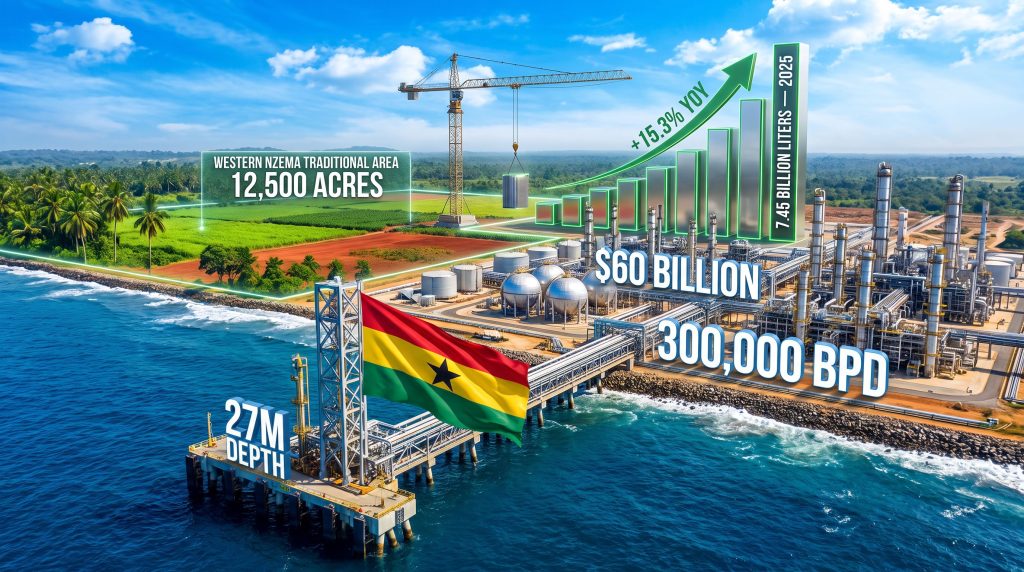
The Jomoro site, situated in Ghana's Western Region, was not chosen arbitrarily. Its 27-meter coastal water depth is the defining physical attribute that separates it from Ghana's existing refining location at the Port of Tema, where available draft is limited to just 16 meters. That difference is commercially decisive. Very Large Crude Carriers (VLCCs) and Ultra Large Crude Carriers (ULCCs), the vessels that make intercontinental crude trade economically viable at scale, require deep-water access that Tema simply cannot provide.
The Petroleum Hub Development Corporation (PHDC), the entity tasked with developing the complex, has built the entire regional supply thesis around this geographic advantage. A facility that can receive the largest tankers in the global fleet is not merely a domestic refinery. It is a potential continental distribution anchor. Furthermore, understanding oil futures and global energy dynamics helps contextualise why a project of this nature carries such strategic weight.
The Phase One specifications reflect that ambition:
| Component | Specification |
|---|---|
| Crude Refining Capacity | 300,000 barrels per day |
| Petrochemical Plant Capacity | 90,000 barrels per day |
| Storage Infrastructure | 3 million cubic meters |
| Marine Terminal | Deep-water facility (27m depth) |
| Estimated Construction Period | 5 years |
| Total Project Investment (All Phases) | $60 billion |
Phase One alone would represent one of the largest single-phase energy infrastructure commitments ever attempted on the African continent. The sequential three-phase structure is designed so that Phase One establishes the foundational refining and export platform upon which subsequent phases layer additional capacity and complexity.
A framework agreement formalising the project's structure was signed in June 2024 between the Ghanaian government and a consortium of local and international companies. The signing positioned Jomoro as a centrepiece of Ghana's industrial development narrative.
Ghana Jomoro Petroleum Hub Land Compensation Delay: The Core Obstruction
At the Ghana International Petroleum Conference (GhIPCON) in July 2026, PHDC Chief Operations and Technical Officer Kwabena Owusu Abrokwa confirmed that initial contracts with construction parties have already been executed. The project is, in the language of project finance, contractually ready. What it lacks is administrative clearance to proceed, and that clearance depends entirely on resolving unpaid land compensation obligations.
The Ghana Jomoro Petroleum Hub land compensation delay traces back to a decision made, and then effectively abandoned, by the previous Akufo-Addo administration. In 2022, the government compulsorily acquired 20,000 acres in the Western Nzema Traditional Area to establish the project footprint. A commitment of GH¢250 million was made to compensate affected landowners and traditional chiefs. That money was never disbursed. Crucially, the allocation was never included in Ghana's 2024 National Budget, meaning the disbursement mechanism collapsed before a single payment reached a single landowner.
The consequences of that failure have compounded significantly:
| Compensation Milestone | Amount | Status |
|---|---|---|
| Original promise (Akufo-Addo administration) | GH¢250 million | Never disbursed |
| PHDC's revised funding request | GH¢300 million | Pending government approval |
| Estimated full acquisition cost (revised land area) | GH¢800-900 million (~US$100 million) | Not yet secured |
The escalation from GH¢250 million to GH¢800-900 million reflects multiple compounding factors: Ghana's currency depreciation over the intervening period, revised land valuations based on the corrected project footprint, and the administrative costs of restarting an acquisition process from a weakened legal position. According to the PHDC, GH¢300 million is needed urgently to finalise the land deal and unblock project progress.
PHDC has proposed structuring the compensation as four tranches spread over four years, potentially drawing on a combination of direct government appropriation and private-sector securitisation arrangements tied to future project revenues. Neither pathway has been formally confirmed as the chosen mechanism as of mid-2026.
Why the Land Footprint Changed, and What That Reveals
The reduction in project land area from 20,000 acres to approximately 12,500 acres (5,000 hectares) was not a voluntary scaling decision. Communities within the Western Nzema Traditional Area submitted formal petitions challenging the scope of acquisition, citing environmental concerns and the permanent loss of ancestral lands. Those petitions were substantive enough to achieve a 38% reduction in the project's physical footprint.
This is a detail worth dwelling on. Community opposition did not merely delay the project. It materially reshaped it. That outcome carries a broader lesson for infrastructure developers operating in West Africa: organised, well-articulated community resistance has real and measurable consequences for project scope and cost. Consequently, african mining finance trends increasingly reflect investor appetite for robust community engagement frameworks before capital is committed.
A new Declaration of Intent covering the revised 5,000-hectare area was published in April 2026, formally restarting the land acquisition process under a corrected legal framework. The PHDC's original process had been procedurally undermined by its inability to demonstrate compensation capability to courts and regulatory bodies, a failure that has left lasting marks on the project's credibility with affected communities.
The Human Dimension: Communities Bearing the Uncertainty
The governance failure at the centre of the Ghana Jomoro Petroleum Hub land compensation delay is not an abstraction. Residents of communities within the project zone have reported receiving no concrete compensation offers, no relocation timelines, and no formal communication about the practical implications of their displacement. Elderly community members with generational ties to the land describe sustained anxiety about losing heritage property with no financial recourse in sight.
What makes this social dimension particularly significant from a project risk perspective is its durability. Trust, once broken through the mechanism of compulsory acquisition without payment, does not recover quickly. Even a well-funded and well-structured compensation rollout will face entrenched scepticism that a straightforward financial transaction cannot easily dissolve. Local chiefs are actively seeking clarity on what compensation will look like and when it will materialise.
A compensation process arriving years late, from an administration different from the one that made the original promise, will require more than money to succeed. It will require transparent disbursement mechanisms, independent verification, and sustained community-facing engagement that directly addresses the concerns raised in prior petitions.
The PHDC's four-tranche payment proposal, while structurally reasonable, has not yet been accompanied by any publicly confirmed community communication strategy. That gap represents a secondary risk layer that could complicate even a fully funded compensation effort.
What the Mahama Administration Has Committed
President John Mahama, who assumed office in January 2025, has publicly committed to resolving the outstanding land acquisition issues. PHDC CEO Dr. Tony Aubynn has indicated that the President regards resolution of the compensation impasse as a priority, with a stated intent to initiate payments and unblock construction.
The fiscal challenge is real. Committing GH¢800-900 million in land compensation against a backdrop of constrained public finances requires either a supplementary budget allocation, a private financing arrangement, or some combination of both. Neither option is without complexity. Securitisation against future project revenues depends on investor confidence in the project's eventual delivery, which itself depends on resolving the compensation impasse, creating a circularity that requires external capital or political will to break.
Abrokwa's statement at GhIPCON that Phase One construction could begin before the end of 2026 remains contingent on this resolution. The contractual readiness of the project means that once compensation is settled, the pathway to construction commencement is relatively clear.
The Demand Backdrop: Why Delay Has a Measurable Cost
The urgency of resolving the Ghana Jomoro Petroleum Hub land compensation delay is sharpened considerably by the demand trajectory that Ghana's own fuel market is exhibiting. According to the Chamber of Oil Marketing Companies (COMAC) annual report published in April 2026, Ghana's domestic fuel consumption reached 7.45 billion liters in 2025, representing a 15.3% year-on-year increase from 2024.
That growth rate is not a statistical anomaly. It reflects a structural acceleration in fuel demand driven by economic activity, population growth, and expanding vehicle ownership across the region. Furthermore, the importance of oil to the global economy underscores why West Africa's continued import dependency is so economically damaging. The continent as a whole currently imports more than 90% of its refined fuel requirements, despite holding substantial crude oil reserves.
| Metric | Current Status |
|---|---|
| West Africa fuel import dependency | Over 90% of total demand |
| Ghana fuel consumption (2025) | 7.45 billion liters |
| Year-on-year consumption growth | +15.3% (2024-2025) |
| Jomoro Phase 1 refining capacity | 300,000 bpd |
| Existing Tema refinery water depth | 16 meters |
| Jomoro coastal water depth | 27 meters |
A functioning Jomoro Hub would not eliminate West Africa's import dependence overnight. However, it would redirect a substantial portion of the refining margin value currently captured by foreign processors back into the regional economy. Every year of delay extends the period during which that value extraction continues unchallenged.
The next major ASX story will hit our subscribers first
Investor Confidence and the Reputational Stakes
Beyond the immediate economics, the Ghana Jomoro Petroleum Hub land compensation delay carries a longer-range reputational cost that is harder to quantify but equally consequential. A project announced with considerable political momentum in June 2024, positioned as a flagship of national industrial policy, and still unable to break ground nearly two years later tells a particular story to international energy investors assessing West Africa's project execution risk.
That story is not simply about one delayed project. It raises questions about governance continuity across political administrations, the reliability of sovereign commitments made during one electoral cycle, and the institutional capacity of state-linked entities to manage large-scale land acquisition processes. For instance, similar challenges around sovereign commitment and project delivery have influenced Pakistan's mineral investment landscape, demonstrating that this is a global pattern, not a uniquely Ghanaian problem. Ghana's ability to attract the foreign capital required for Phases Two and Three depends substantially on demonstrating that Phase One can be delivered on a credible timeline.
The path forward requires the Mahama government to resolve several interrelated challenges simultaneously:
- Secure compensation funding totalling GH¢800-900 million through a confirmed and credible mechanism.
- Disburse payments transparently with independent verification to rebuild community trust.
- Implement a community engagement strategy that addresses the specific concerns raised in prior petitions, not just the financial obligations.
- Maintain consortium confidence by delivering a construction commencement date that partners and financiers can plan around.
- Reform land acquisition governance to prevent the same procedural failure from compromising future infrastructure projects at this scale.
Frequently Asked Questions
What is the Jomoro Petroleum Hub?
The Jomoro Petroleum Hub is a planned $60 billion integrated oil refining and petrochemical complex in Ghana's Western Region. It is designed to include a 300,000-barrel-per-day refinery, a 90,000-barrel-per-day petrochemical plant, 3 million cubic meters of storage capacity, and a deep-water marine terminal, developed across three sequential phases.
Why has construction on the Jomoro Petroleum Hub not started?
Construction has not commenced because the Ghanaian government has not paid compensation to landowners whose property was compulsorily acquired for the project. The previous administration committed GH¢250 million for this purpose but failed to disburse any funds, partly because the allocation was omitted from the 2024 National Budget.
How much will land compensation cost?
Estimates have escalated substantially. The original commitment was GH¢250 million. The PHDC's revised request stands at GH¢300 million, while the estimated full acquisition cost for the corrected land area now sits between GH¢800 million and GH¢900 million, equivalent to approximately US$100 million.
When could construction begin?
As of July 2026, PHDC officials have indicated that Phase One construction could commence before the end of 2026, subject to the completion of the land compensation process. Initial construction contracts have already been signed.
What is the strategic advantage of the Jomoro location?
The Jomoro site offers a 27-meter coastal water depth, compared to 16 meters at the Port of Tema. This depth enables the facility to accommodate the world's largest crude tankers, making large-scale imports and continental-scale refined product exports operationally feasible in a way that Ghana's existing refining infrastructure cannot support.
Ready to Identify the Next Major Resource Opportunity Before the Market Does?
Africa's resource governance story is still being written — and the investors who act on emerging mineral discoveries earliest stand to benefit most. Discovery Alert's proprietary Discovery IQ model scans ASX announcements in real time, transforming complex resource data into actionable insights the moment significant discoveries are announced. Begin your 14-day free trial today and explore Discovery Alert's discoveries page to see how major mineral finds have historically delivered extraordinary returns.