July 20, 2026
Why Regulatory Architecture Determines Iron Ore Project Outcomes Before a Single Tonne Is Mined
In resource development, the distance between a viable deposit and a producing mine is rarely defined by geology alone. The more decisive variable is the regulatory and consent framework that must be navigated before development equipment arrives on site. This reality shapes investment timelines, capital allocation decisions, and ultimately the competitive positioning of junior and mid-tier miners across Western Australia's iron ore landscape.
The Fenix Resources Beebyn-W10 iron ore mine approval, granted in July 2026, illustrates this dynamic with unusual clarity. Three separate regulatory instruments, issued by two distinct government agencies, were required before a single tonne of ore could legally be extracted from a deposit sitting immediately adjacent to an already-operating mine. Understanding why that process matters, and what it unlocks, reveals a great deal about how mid-tier iron ore development actually works in Western Australia's Mid-West region.
When big ASX news breaks, our subscribers know first
The Three-Layer Approval Structure and What Each Instrument Authorises
Western Australia's mining approval system operates through parallel regulatory pathways rather than a single consolidated consent mechanism. For Beebyn-W10, that meant satisfying requirements across two separate agencies before development could proceed.
| Approval Instrument | Issuing Agency | What It Authorises |
|---|---|---|
| Mining Development and Closure Proposal | DEMIRS | Physical development and eventual rehabilitation of the mine site |
| Native Vegetation Clearing Permit | DEMIRS | Land clearing within the Environmental Protection Act 1986 framework |
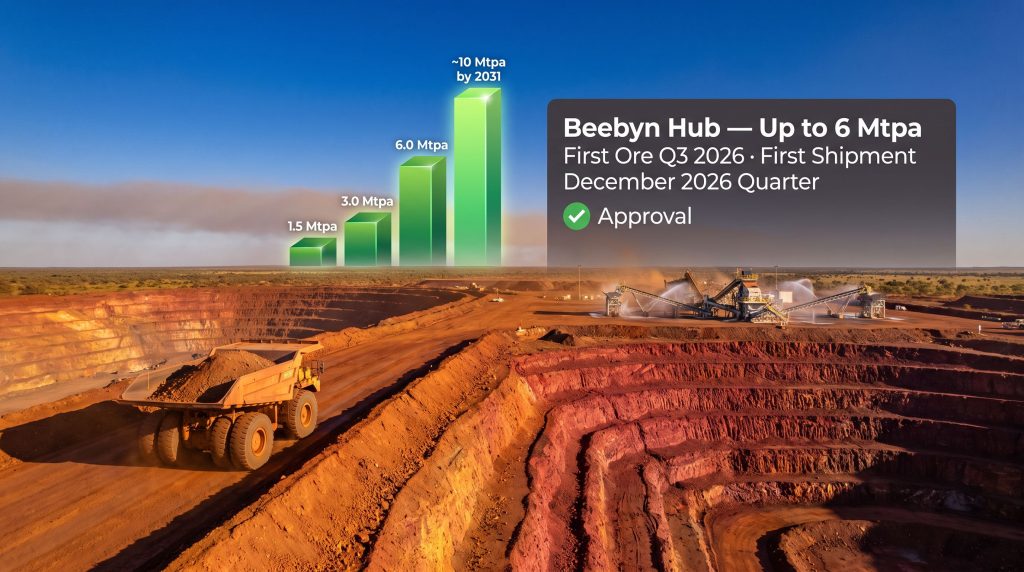
| Prescribed Premises Works Licence | DWEP | Combined Beebyn Hub operational capacity of up to 6 Mtpa |
The Prescribed Premises Works Licence is particularly significant from an operational planning perspective. By covering the combined Beebyn Hub output at up to 6 million tonnes per annum (Mtpa), the licence effectively absorbs Beebyn-W10's future production volumes without requiring a separate environmental licensing process. This is a meaningful structural advantage: the regulatory ceiling has already been established, removing one of the most common sources of expansion delay for growing mining operations.
Why WA's Dual-Agency Model Creates Complexity
Unlike some Australian jurisdictions that consolidate mining approvals through a single assessment pathway, Western Australia's system requires proponents to satisfy both DEMIRS and the Department of Water and Environmental Protection (DWEP) through separate processes that must be completed in parallel. Many experienced operators understand that permitting over grade is frequently the decisive factor in determining whether a viable deposit becomes a producing mine. The Native Vegetation Clearing Permit, governed by the Environmental Protection Act 1986, reflects obligations that apply regardless of a project's scale or economic significance.
For operations in the Mid-West, where native vegetation management intersects with pastoral land use and biodiversity obligations, this permit represents a substantive environmental assessment, not a procedural formality.
Native Title and Cultural Heritage: The Consent Framework That Cannot Be Bypassed
The Beebyn-W10 site falls within the Wajarri Yamaji People Native Title Claim area, making Indigenous consent a legal prerequisite rather than a discretionary consultation step. Under Australia's Native Title Act 1993, mining proponents must either negotiate an agreement with registered native title claimants or proceed through the formal Right to Negotiate process before mining leases can be granted. This is a binding legal obligation, and the consequences of non-compliance extend well beyond reputational risk.
The distinction between a letter of consent, a Cultural Heritage Agreement, and a Deed of Covenant represents a graduated framework of formalisation, each stage providing progressively greater legal certainty for both the mining company and the Traditional Owners.
Fenix has secured a letter of consent from the Wajarri Yamaji People to commence mining at Beebyn-W10, with that consent operating under the terms of an existing Cultural Heritage Agreement (CHA). Negotiations toward a more formalised Deed of Covenant are ongoing.
Understanding the Three-Stage Consent Progression
| Agreement Stage | Current Status | Practical Significance |
|---|---|---|
| Letter of Consent | Secured | Minimum legal threshold enabling commencement |
| Cultural Heritage Agreement | In place (existing framework) | Defines heritage survey obligations, site avoidance, and community arrangements |
| Deed of Covenant (formalised) | Under active negotiation | Provides long-term operational certainty and formalised benefit-sharing |
A Cultural Heritage Agreement typically establishes the procedural architecture for how a mining company operates within areas of cultural significance. This includes heritage survey requirements before ground disturbance, site avoidance protocols for identified sacred or significant locations, and often employment, training, or community benefit provisions for Traditional Owner groups. The progression from letter of consent to a fully executed Deed of Covenant is consistent with evolving best practice in WA's Mid-West mining corridor.
The Beebyn Hub: Why Shared Infrastructure Changes the Economics of Expansion
One of the less widely understood advantages of Beebyn-W10 is that its physical contiguity with the operating Beebyn-W11 pit fundamentally changes the capital intensity of bringing it into production. In greenfield mining, a new operation must establish its own haul road networks, processing facilities, camp infrastructure, and power supply. At Beebyn-W10, however, none of that is required.
The Beebyn Hub model, combining the two contiguous open pits, allows shared crushing capacity, shared logistics infrastructure, and a single operational footprint. This is precisely why the combined production target of up to 6 Mtpa can be achieved without the capital expenditure profile that a standalone 6 Mtpa greenfield operation would demand. Furthermore, Australia's iron ore advantages in terms of established export infrastructure and proximity to Asian markets make this hub model even more commercially compelling.
Production Scaling Roadmap for the Beebyn Hub
| Development Phase | Operations Active | Target Output | Expected Timing |
|---|---|---|---|
| Current | Beebyn-W11 | 1.5 Mtpa | Operational since June 2025 |
| Near-term | W11 expansion + W10 ramp-up | 3.0 Mtpa (W11) + W10 contribution | Q3 to Q4 2026 |
| Medium-term | Full Beebyn Hub | Up to 6.0 Mtpa combined | By 2027 |
| Long-term | Full Weld Range Project | ~10 Mtpa | Target by 2031 |
The expansion of Beebyn-W11 from 1.5 Mtpa to 3.0 Mtpa as part of the same capital programme further illustrates the hub model's efficiency logic. Expanding crushing capacity at an existing operation carries a substantially lower cost-per-tonne than constructing equivalent capacity from scratch, and the operational learning curve associated with running the W11 site is directly transferable to W10.
Production Timeline: What First Ore and First Shipment Actually Mean
The Fenix Resources Beebyn-W10 iron ore mine approval positions ore production to commence during the third quarter of calendar year 2026, with first shipments expected in the December 2026 quarter. The gap between these two milestones is not an oversight in planning; it reflects a deliberate operational sequence common to Direct Shipping Ore (DSO) producers.
DSO operations require stockpile accumulation to ensure sufficient volume and grade consistency before export consignments can be assembled. Logistics coordination through established Mid-West export pathways, including rail and port scheduling, adds further lead time between first ore and first shipment.
How the Timeline Compares to Earlier Guidance
| Milestone | Prior Guidance | Achieved or Revised Outcome |
|---|---|---|
| Full regulatory approvals | Expected by June 2026 | Achieved July 2026 |
| Mining commencement | FY27 (from July 2026 onward) | Q3 CY2026 |
| First ore shipment | FY27 broadly | December 2026 quarter |
The modest timing shift on approvals, landing in July rather than June 2026, has not materially disrupted the production calendar. The three-year production plan anchored to the FY2028 financial year remains structurally intact.
DSO Iron Ore and the Mid-West Market Niche
Understanding why Beebyn-W10 and the broader Weld Range Project occupy a specific and defensible market position requires familiarity with how Direct Shipping Ore differs from beneficiated iron ore products. DSO is ore extracted, crushed, screened, and shipped without requiring concentration or pelletisation. It is economically attractive when ore grades are sufficiently high to meet steelmaker specifications without further processing.
Mid-West WA DSO operations typically produce products that serve specific steelmaking niches, particularly in Asian markets seeking alternatives to high-volume Pilbara-grade material. In addition, understanding the full range of iron ore types and deposits helps contextualise why DSO from the Mid-West occupies a distinct and valuable position within the broader supply chain. The Mid-West region has historically been characterised by smaller, higher-cost operations, which makes the Beebyn Hub's 6 Mtpa target a genuinely significant competitive threshold.
How the Beebyn Hub Scale Compares to WA's Iron Ore Landscape
| Production Scale | Producer Classification | Illustrative Examples |
|---|---|---|
| Under 2 Mtpa | Junior or niche producer | Early-stage Mid-West DSO operations |
| 2 to 10 Mtpa | Mid-tier producer | Beebyn Hub target; selected Mid-West peers |
| Above 50 Mtpa | Major producer | BHP, Rio Tinto, Fortescue (Pilbara operations) |
At 6 Mtpa, the Beebyn Hub crosses the threshold from niche to genuinely mid-tier. This matters for offtake negotiations, port access, and the economics of dedicated rail capacity, all of which tend to improve materially as volumes cross the multi-million-tonne scale. Consequently, the demand outlook is also supported by the evolving China steel and iron ore market, where mid-tier DSO suppliers are increasingly sought after as steelmakers diversify their supply sources.
The next major ASX story will hit our subscribers first
The Weld Range Project: Long-Term Tenure and the DFS Pipeline
The broader Weld Range Project context provides the strategic lens through which the Fenix Resources Beebyn-W10 iron ore mine approval should be evaluated. Fenix secured a 30-year exclusive right to mine and export from the Weld Range Project in September 2025, a tenure structure that extends well beyond the operational life required to justify significant capital investment.
A December 2025 scoping study materially expanded the project's ambition, outlining:
- A production growth pathway from the current approximately 1.5 Mtpa base to around 10 Mtpa by 2031
- An operational life extending to 2042, representing roughly a 16-year mine life from the current period
- A Definitive Feasibility Study (DFS) expected to be completed by the end of 2026, which will convert scoping-level estimates into bankable project parameters
The DFS completion is the next critical value inflection point. Scoping studies establish conceptual viability; a DFS provides the technical and economic rigour that underpins debt financing, major offtake agreements, and institutional investment. The gap between scoping-study economics and DFS-quality estimates is frequently where project economics are validated or revised. An independent analyst assessment has outlined a clear path from 6 Mtpa to 10 Mtpa, reinforcing the credibility of Fenix's long-range expansion strategy.
Fenix's Three-Year Plan: Four Operational Pillars
The FY2026 to FY2028 production plan is structured around four interdependent objectives:
- Activating Beebyn-W10 to expand the ore resource base feeding the Beebyn Hub
- Scaling Beebyn-W11 from 1.5 Mtpa to 3.0 Mtpa through expanded crushing infrastructure
- Achieving combined hub output of 6.0 Mtpa by 2027 under the existing Prescribed Premises Works Licence
- Completing the DFS to provide the technical foundation for the longer-range 10 Mtpa expansion case
Each of these pillars is sequentially dependent: W10's activation feeds hub volume growth, hub volume growth justifies expanded infrastructure, and expanded infrastructure underpins the DFS economics for the full Weld Range expansion.
Frequently Asked Questions: Fenix Resources Beebyn-W10 Iron Ore Mine Approval
What regulatory instruments were granted for Beebyn-W10?
Three separate approvals were required: a Mining Development and Closure Proposal and a Native Vegetation Clearing Permit, both issued by DEMIRS, and a Prescribed Premises Works Licence from the Department of Water and Environmental Protection. Together, these instruments authorise development, land clearing, and combined Beebyn Hub operations at up to 6 Mtpa.
Is Beebyn-W10 a standalone mine or part of a larger operation?
Beebyn-W10 is a separate open-pit deposit with its own mining lease and approval instruments, but it is operationally integrated with the adjacent Beebyn-W11 mine as part of the Beebyn Hub. The two pits share infrastructure, processing capacity, and an overarching environmental licence.
What is the Wajarri Yamaji People's legal role in the Beebyn-W10 project?
The Wajarri Yamaji People hold a registered Native Title Claim over the area encompassing Beebyn-W10. Their consent is a binding legal requirement under the Native Title Act 1993. Fenix has secured a letter of consent tied to an existing Cultural Heritage Agreement, with a more formalised Deed of Covenant currently under negotiation.
When will Beebyn-W10 begin producing ore and generating export revenue?
Ore production is targeted to commence during the third quarter of calendar year 2026, with first shipments expected in the December 2026 quarter. The lag between production start and first shipment reflects the time required for stockpile accumulation and logistics coordination.
What is the long-term production target for the Weld Range Project?
The December 2025 scoping study outlined a pathway to approximately 10 Mtpa by 2031, with operations extending through to 2042. A Definitive Feasibility Study, expected by end of 2026, will provide the bankable technical parameters required to advance toward that target.
How significant is Fenix's 30-year tenure over the Weld Range Project?
The exclusive 30-year right to mine and export, secured in September 2025, provides exceptional long-term certainty for capital planning and offtake negotiations. In an industry where tenure uncertainty frequently constrains investment appetite, a 30-year horizon reduces one of the most material project-level risks.
Key Milestones: Where the Beebyn-W10 Approval Positions Fenix Resources
- Full regulatory clearance achieved across three instruments from two separate government agencies
- Indigenous consent framework secured under existing Cultural Heritage Agreement, with Deed of Covenant formalisation ongoing
- Ore production from Beebyn-W10 commencing Q3 2026, with first shipments in the December 2026 quarter
- Combined Beebyn Hub capacity of up to 6 Mtpa now operationally unlocked
- Three-year production plan to FY2028 fully activated across all four strategic pillars
- Long-term 10 Mtpa expansion pathway supported by 30-year tenure and a DFS expected by end of 2026
This article is intended for informational purposes only and does not constitute financial or investment advice. Forward-looking statements regarding production timelines, capacity targets, and project economics are based on publicly available company announcements and scoping-level studies. Actual outcomes may differ materially from projections. Readers should conduct their own due diligence before making any investment decisions.
Want to Track the Next Major Iron Ore Discovery Before the Market Moves?
Discovery Alert's proprietary Discovery IQ model delivers real-time alerts on significant ASX mineral discoveries — transforming complex geological and regulatory data into actionable investment insights the moment they're announced. Explore historic examples of exceptional discovery returns and begin your 14-day free trial today to position yourself ahead of the broader market.