July 20, 2026
The Hidden Bottleneck Inside the Global Energy Transition
Battery storage technology has quietly become the defining constraint of the clean energy era. Governments and utilities have committed to unprecedented volumes of wind and solar capacity, yet the infrastructure required to bank that energy overnight, across cloud cover, or through seasonal low-generation periods remains chronically underdeveloped. The uncomfortable reality facing grid planners across Europe is that the dominant storage chemistry — lithium-ion — was engineered for portable electronics and electric vehicles, not for the multi-hour discharge profiles that industrial grids and critical infrastructure genuinely require.
This structural mismatch is precisely the opening that alternative electrochemical platforms have been working toward for years. And in mid-2026, that theoretical opportunity crossed into physical reality with the launch of the Offgrid Energy Labs zinc-bromine battery plant in the UK, a pilot production facility in Hook, Hampshire that represents a genuinely novel entry point into the long-duration energy storage market.
When big ASX news breaks, our subscribers know first
Why Lithium-Ion Cannot Carry the Full Load
The core limitation of lithium-ion technology in grid applications is not cost or energy density — it is duration. Most commercial lithium-ion battery energy storage systems (BESS) are designed for two to four hours of discharge, optimised around the daily arbitrage window between low overnight electricity prices and afternoon demand peaks.
Grid operators tasked with managing renewable-heavy networks need something fundamentally different. When wind generation drops across a two-day low-pressure system, or when solar output collapses through winter, what the grid actually requires is six to sixteen hours of continuous discharge capability — the threshold that energy storage engineers define as long-duration energy storage (LDES). That window maps onto the real-world mismatch between when clean energy is generated and when it is consumed.
Beyond duration, the materials underpinning lithium-ion batteries carry their own systemic risks. The three critical input commodities — lithium, cobalt, and nickel — are extracted from a narrow band of geographies, creating supply chain exposures that have become increasingly visible to European energy policymakers. Furthermore, the battery raw materials market has highlighted these vulnerabilities following the commodity market disruptions of 2022 and 2023.
| Material | Primary Producer | UK Import Risk | Price Volatility (2020–2025) |
|---|---|---|---|
| Lithium | Australia / Chile | High | Extreme |
| Cobalt | DRC | Very High | High |
| Nickel | Indonesia / Russia | High | Moderate–High |
| Zinc | Global (abundant) | Low | Low |
| Bromine | Global (abundant) | Low | Low |
The contrast with zinc and bromine is stark. Both materials are produced across geographically diverse global sources, carry relatively stable price histories, and face no comparable geopolitical concentration risk. This raw material profile has made zinc-bromine chemistry an increasingly serious subject of research and commercialisation interest across European energy technology circles.
What Zinc-Bromine Batteries Actually Do: The Chemistry Explained
The Electrochemical Cycle
Zinc-bromine batteries belong to the flow battery family, meaning energy is stored in liquid electrolyte solutions rather than in solid electrode materials. During charging, zinc is deposited onto electrodes while bromine is generated at the opposing electrode. When the system discharges, these reactions reverse: the zinc dissolves back into the electrolyte while the bromine is reduced, driving an electrical current through the external circuit.
The working fluid is a water-based electrolyte, and this single characteristic has profound safety implications. Unlike the organic solvent electrolytes used in lithium-ion cells, water-based systems are intrinsically non-flammable. There is no electrochemical mechanism capable of producing the thermal runaway cascades that have made large-scale lithium-ion installations a persistent concern for fire engineers, insurers, and planning authorities.
Key Technical Insight: Thermal runaway in lithium-ion systems is not a manufacturing defect — it is a property of the chemistry itself. Under certain conditions, including overcharge, mechanical damage, or excessive heat, the exothermic reactions within a lithium-ion cell become self-sustaining and impossible to interrupt without external intervention. Zinc-bromine systems using aqueous electrolytes do not possess the electrochemical conditions required for this failure mode to occur.
The ZincGel Platform: What Makes It Different
Conventional zinc-bromine flow batteries have existed in research settings for decades, but two persistent technical challenges limited their commercial viability: zinc dendrite formation (needle-like zinc deposits that can short-circuit cells over repeated cycles) and bromine crossover (bromine migrating through the membrane to the zinc side, reducing efficiency and creating safety concerns).
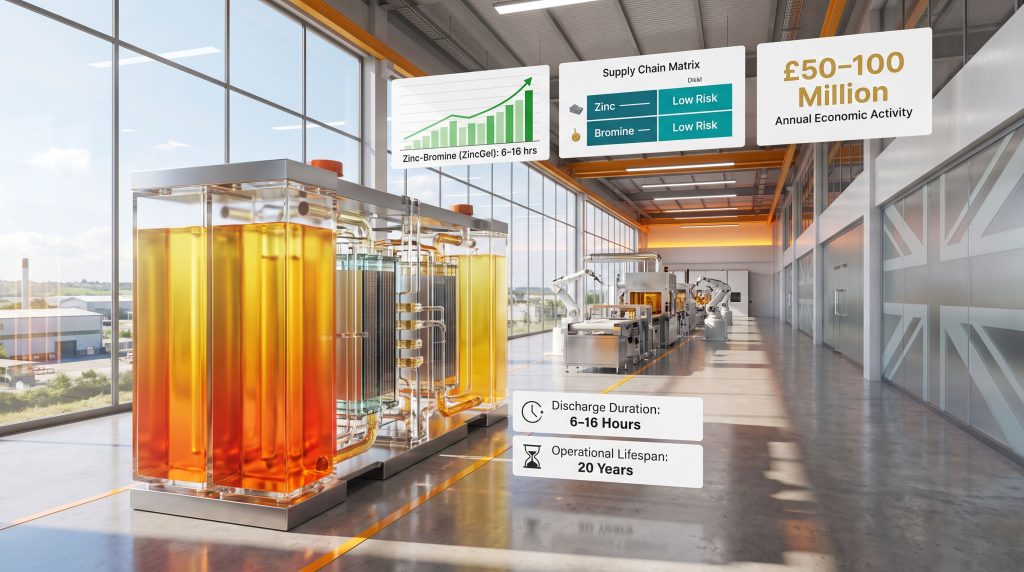
Offgrid Energy Labs' proprietary ZincGel platform addresses both limitations through a gel-phase electrolyte modification. By transitioning the electrolyte from a purely liquid phase to a gel matrix, the system constrains zinc deposition geometry during charging and limits bromine mobility across the cell. The practical result is a platform that achieves energy efficiency in the range of 80 to 90% relative to conventional lithium-ion equivalents, while targeting an operational service life of 20 years and a discharge window of 6 to 16 hours per daily cycle.
How Zinc-Bromine Stacks Up Against Competing Long-Duration Technologies
| Technology | Duration Range | Flammability Risk | Key Materials | Approximate Lifespan |
|---|---|---|---|---|
| Lithium-Ion (LFP) | 2–4 hours | Moderate | Lithium, Iron, Phosphate | 10–15 years |
| Vanadium Redox Flow | 4–12 hours | Low | Vanadium | 20+ years |
| Zinc-Bromine (ZincGel) | 6–16 hours | None (non-flammable) | Zinc, Bromine | 20 years |
| Iron-Air | 100+ hours | Very Low | Iron | 20+ years |
| Compressed Air (CAES) | Hours–Days | None | — | 30+ years |
The table reveals something that straightforward cost-per-kWh comparisons often obscure: zinc-bromine occupies a distinct market position rather than competing head-to-head with lithium-ion. Its duration range fills the gap between short-duration lithium systems and the highly capital-intensive multi-day storage options like iron-air or compressed air, making it a compelling fit for the daily renewable balancing problem that grid operators urgently need to solve.
Inside the Hook, Hampshire Facility
From Noida to Hampshire: The Technology Transfer Story
The ZincGel platform originated at the Indian Institute of Technology Kanpur, one of India's premier technical universities, where the foundational electrochemical research was conducted from approximately 2018 onward. Offgrid Energy Labs subsequently commercialised the platform from its headquarters in Noida, Uttar Pradesh, before executing what the company describes as its first international manufacturing expansion with the Hook facility.
This origin story carries significance beyond corporate biography. IIT Kanpur's electrochemistry research programmes have historically operated at the boundary between academic rigour and applied industrial chemistry, and the progression from that institutional environment to a physical UK production line represents a meaningful validation of the underlying science. The technology transfer model Offgrid Energy Labs employed differs from conventional licensing arrangements, as the company has retained ownership of the manufacturing process rather than franchising production to a third-party operator.
Pilot Line to Gigafactory: Understanding the Production Ramp
The Hook facility currently operates a 10 MWh pilot production line. It is important to understand precisely what this means and what it does not mean. A pilot manufacturing line is not a scaled-down version of a finished factory — it is a process validation environment where manufacturing parameters, quality control protocols, and throughput efficiencies are tested and optimised before significant capital is committed to full-scale capacity.
The distinction matters for anyone assessing the commercial trajectory of the facility. Key milestones to understand in the ramp-up pathway include:
- Pilot line validation — confirming that the ZincGel chemistry performs consistently in a manufacturing environment, not just a laboratory.
- Process optimisation — identifying and eliminating yield losses, energy inefficiencies, and material waste at small scale before they are amplified.
- Customer qualification — generating certified production samples for anchor customers to conduct their own independent performance testing.
- Capital raise and capacity expansion — using validated production data to support the fundraising required for the projected scale-up toward 10 GWh per year annual output.
At full projected capacity, the facility is estimated to generate annual economic activity of £50 to £100 million and support 30 to 60 UK businesses across the supply chain.
The $15 Million Series A: Reading the Investor Signals
Offgrid Energy Labs closed a $15 million Series A funding round in late 2025 to finance the Hampshire facility build-out. Capital allocation priorities included manufacturing equipment procurement, facility fit-out, regulatory compliance infrastructure, and initial workforce development.
The composition of the investor group carries analytical weight that extends beyond the headline figure. Archean Chemical Industries, a leading bromide producer, participated as a lead investor. This is an unusual capital structure for an early-stage battery technology company, and its implications deserve careful consideration.
Strategic Observation: When a raw material supplier takes an equity position in a downstream technology company that consumes its primary product, the investment functions simultaneously as a commercial commitment, a supply security arrangement, and a market validation signal. Archean's participation effectively pre-answers one of the most common investor questions about zinc-bromine scale-up: whether sufficient, competitively priced bromine supply can be secured at manufacturing volumes. The answer, embedded in the investor register, is yes.
This form of vertical integration through equity, where a supplier becomes a shareholder rather than merely a vendor, is a relatively uncommon but strategically powerful financing structure for emerging battery manufacturers. It reduces input cost volatility in ways that financial-only investors cannot replicate, and it creates aligned incentives between the material supplier and the technology developer to solve manufacturing challenges collaboratively rather than transactionally. In the broader context of the battery metals investment landscape, such structures signal a maturing approach to supply chain risk management.
Target Applications: Where ZincGel Has Decisive Advantages
Critical Infrastructure: Hospitals and Data Centres
The non-flammable chemistry of ZincGel is not merely a safety selling point — it is a procurement differentiator in regulated environments. Hospitals and data centres operate under fire safety frameworks that impose significant additional requirements and costs on lithium-ion battery installations within or adjacent to occupied buildings. Planning permissions are harder to obtain, insurance premiums are higher, and co-location restrictions limit where systems can be physically placed.
Zinc-bromine systems sidestep these constraints structurally rather than through engineering workarounds. The 20-year service life also aligns naturally with the long-term capital investment cycles typical of healthcare and digital infrastructure, reducing the replacement cost burden that shorter-lived lithium systems impose over the same period.
Renewable Integration: Solving the Solar Evening Mismatch
The six-to-sixteen-hour discharge window maps with near-perfect precision onto the central intermittency challenge of solar-dominated grids. Solar generation peaks between 10am and 3pm across UK latitudes in summer months, while residential and commercial electricity demand peaks between 5pm and 9pm. A 10 MWh ZincGel installation paired with a 5 MW solar array could absorb midday generation surplus and discharge it through the evening demand peak, effectively converting an intermittent generation asset into a predictable, dispatchable power source.
This capability grows increasingly valuable as solar penetration rises and the midday oversupply problem intensifies — a dynamic already visible in markets like California and South Australia that have reached high solar penetration levels ahead of the UK.
Net-Zero Industrial Sites
Behind-the-meter storage applications at industrial and commercial facilities targeting Scope 1 and Scope 2 emissions reductions represent a third compelling market. Peak demand charge avoidance alone can generate significant returns at sites with high and variable electricity draw. When layered with grid export revenue during periods of high wholesale prices, the economics of long-duration storage at industrial sites become increasingly compelling as carbon pricing mechanisms mature. Consequently, critical minerals demand for alternative chemistries like zinc-bromine is expected to rise in parallel with these industrial decarbonisation trends.
The next major ASX story will hit our subscribers first
Environmental Profile: The Carbon Footprint Argument
Offgrid Energy Labs has cited a 50% lower manufacturing carbon footprint relative to lithium gigafactories as a key differentiator for the ZincGel platform. The basis for this claim lies primarily in the materials extraction and processing phase. Lithium extraction — whether from brine evaporation ponds in South America or hard-rock spodumene mining in Australia — is an energy-intensive process with significant land and water use implications.
Furthermore, shifts in the global lithium market have brought increased scrutiny to cobalt refining, which carries its own environmental and human rights burdens. Zinc and bromine extraction, by comparison, involves mature, relatively lower-impact industrial processes. Zinc is largely recovered as a byproduct of lead and copper mining, and bromine is commercially extracted from seawater and brine deposits using well-established industrial methods.
It is important to note that lifecycle analysis methodology varies significantly between studies, and independent third-party verification of the 50% reduction claim would be required before it could be used as the basis for procurement decisions. Buyers and investors should request full lifecycle assessment documentation when evaluating environmental performance claims for any battery technology.
Frequently Asked Questions
What is a zinc-bromine battery and how does it work?
A zinc-bromine battery stores energy through reversible electrochemical reactions between zinc and bromine in a water-based electrolyte. During charging, zinc deposits onto electrodes while bromine is generated at the other electrode. Discharging reverses the process, releasing stored energy as electrical current. The water-based electrolyte makes the system non-flammable, distinguishing it fundamentally from lithium-ion chemistries.
How does ZincGel differ from a standard zinc-bromine flow battery?
The ZincGel platform uses a gel-phase electrolyte modification that addresses the two main failure modes of conventional zinc-bromine designs: zinc dendrite formation and bromine crossover. These improvements extend cycle stability and improve safety, enabling the 20-year operational lifespan that the platform targets.
Where is the Offgrid Energy Labs zinc-bromine battery plant in the UK located?
The facility is located in Hook, Hampshire, and began operations in mid-2026 as the company's first international manufacturing site outside its Noida, India headquarters.
What is the production capacity of the Hook facility?
The current pilot production line has a capacity of 10 MWh. The company's projected full-scale target is 10 GWh per year, representing a scaling factor of approximately one thousand times the current pilot output.
Is zinc-bromine battery technology safe for use near sensitive infrastructure?
The water-based electrolyte chemistry is inherently non-flammable and does not support thermal runaway. This property simplifies permitting, reduces insurance costs, and removes co-location restrictions that apply to lithium-ion systems in sensitive environments such as hospitals, schools, and densely populated areas.
How does zinc-bromine compare to lithium-ion in cost and performance?
ZincGel achieves energy efficiency of 80 to 90% relative to lithium-ion equivalents. While upfront cost-per-kWh may currently favour mature lithium-ion chemistries, the 20-year lifespan, lower insurance and permitting costs, and six-to-sixteen-hour discharge duration improve total cost of ownership calculations for LDES-specific applications. In addition, advances in direct lithium extraction may eventually narrow the cost gap, making competitive dynamics across storage chemistries increasingly fluid.
What markets is Offgrid Energy Labs targeting?
Primary target verticals are grid-scale renewable integration, critical infrastructure resilience (hospitals, data centres), and net-zero industrial and commercial sites pursuing behind-the-meter storage strategies.
What the Hook Facility Signals for the LDES Sector
The transition from laboratory validation to pilot manufacturing is the single most capital-intensive and strategically consequential milestone in battery technology development. Many promising chemistries have demonstrated excellent performance in controlled research environments but failed to survive the process engineering challenges of consistent, scalable production. The Offgrid Energy Labs zinc-bromine battery plant in the UK is therefore not simply a manufacturing announcement — it is a proof-of-manufacturability milestone that opens the door to anchor customer engagement, independent third-party qualification testing, and the production data required to support a Series B capital raise.
For the broader European BESS procurement market, the emergence of a commercially active zinc-bromine manufacturer introduces a new dimension into what has been a largely binary conversation between lithium-ion and vanadium redox flow technologies. Procurement officers and grid developers now have a third credible option to evaluate for the six-to-sixteen-hour duration segment, one with a distinct safety profile, a differentiated supply chain, and a service life that aligns with long-term infrastructure investment horizons.
Key milestones that observers and potential customers should monitor over the coming 18 to 24 months include:
- First anchor customer contract announcements and the sectors they represent
- Production ramp data demonstrating yield consistency from the pilot line
- Independent third-party performance and safety certification
- Potential Series B capital raise and its scale relative to the 10 GWh per year target
- Any announced expansion of manufacturing footprint within the UK or into additional European markets
This article is intended for informational purposes only and does not constitute financial or investment advice. Forward-looking statements regarding production capacity, economic impact, and commercial milestones are based on company projections and have not been independently verified. Readers should conduct their own due diligence before making any investment or procurement decisions.
Want to Track the Next Big Mineral Discovery Powering the Energy Transition?
As demand for alternative battery chemistries like zinc-bromine accelerates the hunt for critical minerals, Discovery Alert's proprietary Discovery IQ model delivers real-time ASX alerts the moment significant mineral discoveries are announced — explore historic discovery returns on the dedicated discoveries page and begin your 14-day free trial to position yourself ahead of the market.