
July 19, 2026
The Hidden Complexity Behind a Planned Refinery Shutdown
Large-scale petroleum refining is one of the few industrial sectors where stopping work is almost as technically demanding as running it. The process of safely isolating, inspecting, and recommissioning a high-throughput refinery unit involves hundreds of coordinated decisions, enormous capital outlay, and workforce mobilisation on a scale that rivals small construction projects. For communities, fuel distributors, and energy planners across Atlantic Canada and the US Northeast, understanding what happens during a major refinery turnaround is not merely academic — it has real implications for regional fuel availability, labour markets, and long-term energy infrastructure resilience.
The upcoming Irving Oil refinery turnaround in New Brunswick is a case study in how modern refining facilities manage their asset lifecycles while minimising disruption to the markets they serve. Furthermore, it offers a window into the broader pressures shaping Canada's energy transition and the capital commitments required to sustain critical refining infrastructure.
When big ASX news breaks, our subscribers know first
What a Refinery Turnaround Actually Means
The term turnaround is often misunderstood outside the petroleum industry. It does not refer to a complete plant shutdown. Rather, it describes a coordinated, phased maintenance programme in which individual processing units are progressively taken offline, inspected, repaired, upgraded, and returned to service in a planned sequence.
This approach allows other sections of the facility to continue operating throughout the maintenance window, which is critical for a refinery supplying fuel to millions of consumers across multiple provinces and US states.
Refineries typically schedule two turnaround windows per year:
- Spring turnarounds tend to be shorter in scope, targeting specific units identified during winter operations
- Fall turnarounds are generally more extensive, running longer and attracting higher capital investment to prepare the facility for peak winter fuel demand
The fall window is strategically timed to complete upgrades and inspections before the surge in heating oil and diesel demand that characterises Atlantic Canadian and New England winters. A turnaround that concludes in mid-November positions the refinery to operate at full capacity precisely when regional demand is highest.
Spring vs. Fall Turnaround: Key Differences
| Attribute | Spring Turnaround | Fall Turnaround |
|---|---|---|
| Typical Duration | 3 to 5 weeks | Up to 60 days |
| Scope | Targeted unit maintenance | Broader multi-unit overhaul |
| Capital Investment | Lower | Higher |
| Strategic Driver | Post-winter repair | Pre-winter readiness |
| Workforce Mobilisation | Moderate | Extensive |
Canada's Largest Refinery: Scale, Reach, and Responsibility
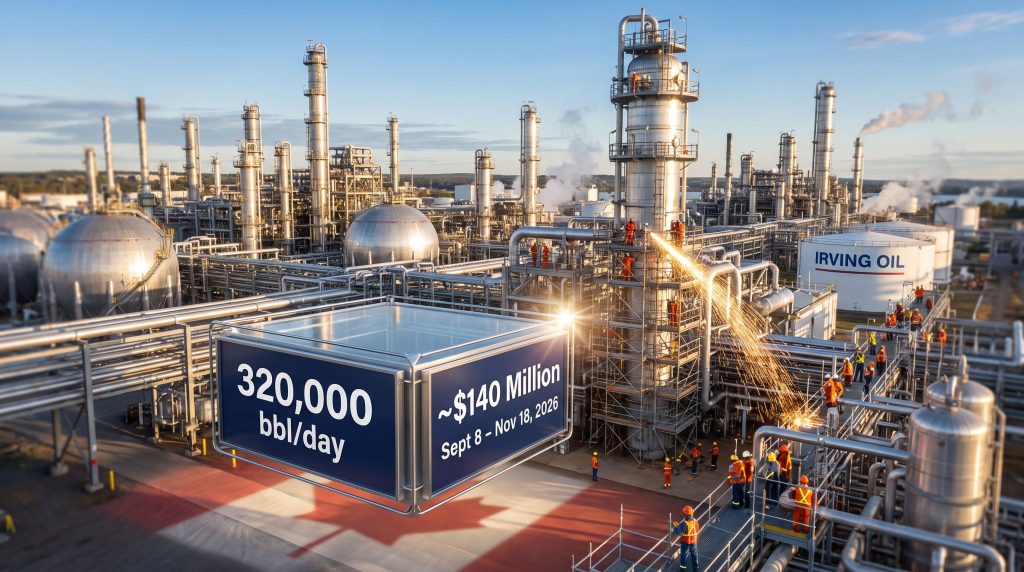
The Irving Oil facility in Saint John, New Brunswick, processes 320,000 barrels of crude oil per day, making it the largest single refinery by throughput in Canada. That scale alone places it in a different operational category from most North American refineries and creates a maintenance challenge that requires months of planning before a single unit is taken offline.
The refinery's geographic position is equally significant. It supplies refined petroleum products, including gasoline, diesel, jet fuel, and heating oil, to consumers across New Brunswick, Nova Scotia, Prince Edward Island, Newfoundland, and a substantial portion of the US Northeast corridor. That cross-border supply role means any operational disruption carries implications well beyond New Brunswick's provincial boundaries. These dynamics closely mirror the energy export challenges that other major refining nations continue to navigate.
How Saint John Compares to Other Canadian Refineries
| Refinery | Location | Approximate Capacity (bbl/day) | Operator |
|---|---|---|---|
| Saint John | New Brunswick | 320,000 | Irving Oil |
| Strathcona | Alberta | ~200,000 | Imperial Oil |
| Nanticoke | Ontario | ~100,000 | Various |
| Sarnia | Ontario | ~85,000 | Imperial Oil |
Note: Capacity figures are approximate and intended for comparative context only.
The gap between Saint John and Canada's second-largest refinery is substantial. That scale advantage translates directly into maintenance complexity: more processing units, more piping networks, more instrumentation systems, and a significantly larger workforce requirement during turnaround periods.
The 2026 Fall Turnaround: Schedule, Scope, and Investment
The Irving Oil refinery turnaround in New Brunswick is scheduled to begin on September 8, 2026, with the active mechanical work phase running from September 11 through November 8, 2026. The full stream-to-stream project, encompassing the progressive restart and recommissioning of all affected units, is expected to conclude by November 18, 2026.
The total project window spans approximately 70 days from initiation to full throughput restoration, with the core mechanical phase covering roughly 60 days of intensive on-site activity.
The scope of work across this window includes infrastructure replacement, equipment upgrades, and systematic inspections of piping networks and critical processing units. These activities mirror the scope of the previous year's turnaround, which carried a price tag of approximately $40 million in private maintenance capital. The 2026 fall turnaround is consistent with that investment level.
Step-by-Step: How the Turnaround Unfolds
-
Pre-Turnaround Planning (6 to 18 months prior): Scope is defined, contractors are procured, materials and replacement parts are ordered, and safety protocols are established well in advance of the shutdown window.
-
Pre-Shutdown Preparation: In the weeks before September 8, the refinery builds product inventory to buffer regional supply during reduced throughput, initiates unit isolation procedures, and completes workforce mobilisation and site induction for all incoming contractors.
-
Stream-to-Stream Commencement (September 8): Throughput is progressively reduced as targeted units are taken offline in a controlled, sequenced manner.
-
Mechanical Work Phase (September 11 to November 8): Active inspection, repair, replacement, and upgrade activity is conducted across all identified units by a combined workforce of permanent staff and contracted tradespeople.
-
Recommissioning and Testing: Units are restarted one by one, with leak testing, instrumentation calibration, and safety verification completed before each unit returns to live service.
-
Stream-to-Stream Completion (November 18): Full throughput is restored and the refinery returns to normal operating capacity ahead of the peak winter demand season.
What the $40 Million Covers
A maintenance investment at this scale spans multiple categories of work:
- Piping inspections: Ultrasonic thickness testing, corrosion mapping, and weld integrity verification across extensive pipe networks
- Pressure vessel inspection: Internal examination of reactors, heat exchangers, and separators that operate under extreme conditions year-round
- Rotating equipment overhaul: Maintenance of pumps, compressors, and turbines that drive refinery throughput
- Instrumentation and control systems: Replacement and calibration of sensors, safety interlocks, and process control hardware
- Structural and civil work: Scaffolding erection, insulation replacement, and structural integrity assessments
Workforce Mobilisation: A Regional Economic Event
Beyond the mechanical scope, the 2026 fall turnaround represents a significant short-term economic mobilisation for the Saint John region. Approximately 300 additional skilled tradespeople are engaged for the project duration, drawn from around 60 contracting companies with a strong preference for firms based in New Brunswick and Atlantic Canada more broadly.
The trades involved typically include pipefitters, welders, instrumentation technicians, millwrights, scaffolders, riggers, and specialised inspection personnel. For a period of roughly two months, these workers inject spending into local accommodation, transport, food service, and retail sectors in and around Saint John.
This pattern repeats with each turnaround cycle, reinforcing Irving Oil's position as one of the most significant private economic drivers in Atlantic Canada, not just through its permanent workforce but through the contractor ecosystem it sustains.
The Concurrent $100 Million FCCU Upgrade
Running alongside the fall turnaround is a separate and significantly larger capital project: a $100 million upgrade to the refinery's Fluid Catalytic Cracking Unit (FCCU), which commenced in June 2026.
Understanding the FCCU's Role
The Fluid Catalytic Cracking Unit is widely regarded as the most strategically important processing unit in a complex petroleum refinery. Its function is to convert heavier, lower-value crude oil fractions — residues that would otherwise be difficult to sell — into higher-value light products including gasoline, diesel, and petrochemical feedstocks.
FCCU performance directly determines a refinery's conversion rate, which is the proportion of crude oil input that can be upgraded into premium-priced products. A higher conversion rate translates to better margin per barrel, which is why refiners regard FCCU investment as capital allocation with a direct return on margin rather than simply a maintenance cost. This logic is broadly consistent with how global energy markets are responding to shifting demand, as reflected in current natural gas price trends and the pressure they place on refinery economics.
An FCCU upgrade of this scale is not routine maintenance. It reflects a deliberate strategic decision to improve the refinery's product yield profile and competitive margin position over the medium to long term.
Combined 2026 Capital Deployment at a Glance
| Project | Investment | Commencement | Completion |
|---|---|---|---|
| Fall Turnaround | ~$40 million | September 8, 2026 | November 18, 2026 |
| FCCU Upgrade | $100 million | June 2026 | TBC |
| Combined Total | ~$140 million |
The combined capital deployment of approximately $140 million within a single operational year is a meaningful indicator of Irving Oil's long-term reinvestment strategy at the Saint John facility.
The next major ASX story will hit our subscribers first
Supply Implications for Atlantic Canada and the US Northeast
The phased structure of the turnaround is specifically designed to limit supply disruption. Because individual processing units are isolated and serviced in sequence rather than simultaneously, the refinery maintains partial throughput throughout the project window.
However, the pre-turnaround inventory build is a critical component of supply chain management during this period. Refineries of this scale typically accumulate additional product stocks in the weeks before a turnaround commences, creating a buffer that distributors and retailers can draw on during the reduced-throughput period.
For downstream distributors operating in the US Northeast, the September-to-November timing intersects with the annual ramp-up in heating oil demand. Experienced distributors in this market typically carry elevated inventory positions entering the fall season to manage exposure to any supply variability from Canadian refining operations. In addition, the broader LNG supply outlook for the region adds further context to how energy planners are hedging against potential shortfalls during the turnaround window.
Turnaround Track Record and Naming Conventions
One lesser-known aspect of Irving Oil's turnaround culture is its practice of assigning project names to each maintenance event. Previous cycles have carried names such as Operation Ram, Operation Falcon, and Operation Eastern Screech Owl, a tradition that reflects a project management philosophy centred on workforce identity and operational accountability.
Named projects have defined leadership structures, clear accountability chains, and measurable completion milestones, all of which contribute to the consistent execution track record the Saint John facility has maintained across multiple turnaround cycles. Consequently, this structured approach has earned the facility a strong reputation among regional energy planners and downstream distributors alike. It also aligns with the more transparent reporting frameworks now emerging around the LNG import tax structure and similar regulatory developments in global energy markets.
2025 vs. 2026 Turnaround Comparison
| Attribute | 2025 Turnaround | 2026 Turnaround |
|---|---|---|
| Timing | September to November | September 8 to November 18 |
| Duration | ~2 months | ~60 days mechanical / 70 days total |
| Investment | ~$40 million | ~$40 million |
| Concurrent Projects | Not publicly confirmed | $100M FCCU upgrade |
| Additional Workforce | ~300 contractors | ~300 contractors (60 companies) |
The year-on-year consistency in turnaround investment and scope points to a structured asset lifecycle management programme rather than reactive maintenance. This kind of scheduled, capital-consistent approach is characteristic of facilities with long operational horizons and significant reinvestment commitments. For further context on how major North American refining assets are benchmarked globally, the Canadian Association of Petroleum Producers publishes useful comparative data on refinery operations and capital investment trends across the sector.
Frequently Asked Questions: Irving Oil Refinery Turnaround 2026
When does the 2026 Irving Oil refinery turnaround in New Brunswick start?
The fall turnaround begins on September 8, 2026, with the mechanical work phase commencing on September 11.
How long does the turnaround last?
The project runs for approximately two months, with full stream-to-stream completion expected by November 18, 2026.
Does the refinery shut down completely?
No. The Saint John refinery operates on a phased basis throughout the turnaround, with individual units taken offline in sequence while other sections continue to produce. This phased model is broadly consistent with best practices in refinery maintenance documented by major energy agencies.
What is the cost of the 2026 turnaround?
The fall turnaround represents approximately $40 million in private capital investment, consistent with the prior year's event.
What is the FCCU upgrade and why does it matter?
The $100 million FCCU upgrade, which began in June 2026, improves the refinery's ability to convert heavier crude fractions into high-value products like gasoline and diesel. It is a separate strategic capital project running concurrently with the turnaround.
How many workers are involved?
Approximately 300 skilled tradespeople from 60 contracting companies, drawn primarily from New Brunswick and Atlantic Canada, are engaged for the turnaround period.
Key Metrics Summary
| Metric | Value |
|---|---|
| Refinery Capacity | 320,000 barrels per day |
| Turnaround Start Date | September 8, 2026 |
| Mechanical Work Window | September 11 to November 8, 2026 |
| Full Completion Date | November 18, 2026 |
| Turnaround Investment | ~$40 million |
| Concurrent FCCU Upgrade | $100 million |
| Combined 2026 Capital Deployment | ~$140 million |
| Additional Workforce | ~300 skilled tradespeople |
| Contracting Companies | ~60 firms |
Disclaimer: This article contains forward-looking schedule and investment information based on publicly available sources. Actual timelines, costs, and operational outcomes may differ from those described. This content is intended for informational purposes only and does not constitute financial or investment advice.
Want to Stay Ahead of Major Resource and Energy Investment Opportunities?
Discovery Alert's proprietary Discovery IQ model delivers real-time alerts on significant ASX mineral discoveries, instantly translating complex resource data into actionable investment insights for both short-term traders and long-term investors. Explore how historic mineral discoveries have generated substantial returns by visiting Discovery Alert's dedicated discoveries page, and begin your 14-day free trial today to position yourself ahead of the broader market.