July 18, 2026
The Infrastructure Gap at the Heart of a Resource Giant
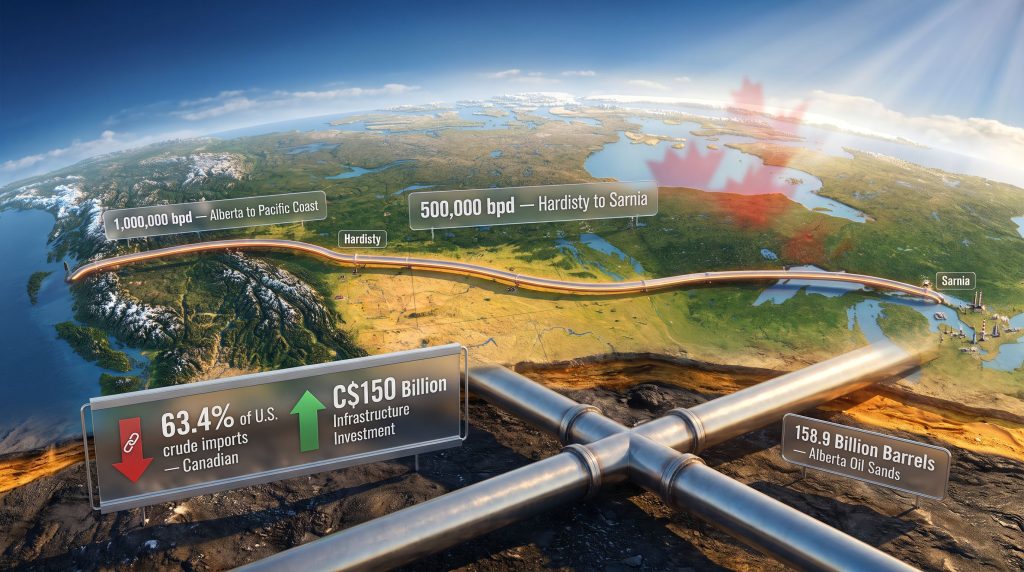
Few contradictions in global energy are as striking as Canada's position in the oil market. Canada new oil pipeline to cut reliance on U.S. oil routes has become one of the defining policy debates of 2026. The country holds approximately 158.9 billion barrels of proven oil reserves, concentrated overwhelmingly in Alberta's oil sands, placing it among the top three reserve holders on the planet. Yet despite this extraordinary resource base, Canada has long operated as a logistical dependent, routing a significant share of its crude through foreign infrastructure before it reaches refineries or export terminals.
This is not a theoretical vulnerability. It is a structural feature baked into decades of infrastructure decisions that prioritised the path of least resistance over the logic of sovereign control. The question now being asked in Ottawa and Edmonton is whether the political will finally exists to correct it, and whether these new pipeline plans represent a genuine turning point or another chapter in a long history of ambitious proposals that stalled before breaking ground.
When big ASX news breaks, our subscribers know first
Why the U.S. Routing Problem Has Become Untenable
The Numbers That Define Canada's Exposure
Canadian crude accounted for approximately 63.4% of all U.S. crude oil imports in 2025, a figure that reflects both the depth of bilateral energy integration and the degree to which Canada's export model has become structurally entangled with American refining infrastructure. This arrangement functions smoothly under normal conditions, but it creates a chokepoint that sits entirely outside Canadian jurisdiction. Furthermore, the US-Canada trade war has made this vulnerability considerably more visible to policymakers.
The eastern supply chain provides the clearest illustration of the problem. Roughly 50% of Ontario's oil imports currently travel through a pipeline corridor that crosses U.S. territory, meaning a foreign state government holds de facto influence over a significant portion of one of Canada's most industrialised provinces. This is not a hypothetical scenario. The state of Michigan previously threatened to shut down the cross-border Line 5 pipeline corridor, a move that would have severed Alberta crude from Ontario's refining and petrochemical sector.
That episode exposed the fragility of an arrangement that had been treated as routine infrastructure policy. Questions around Canada oil security have consequently moved from academic discussion to urgent political priority.
The Michigan Line 5 dispute is a frequently underappreciated inflection point in Canadian energy history. It demonstrated that the bilateral energy relationship, while deeply mutually dependent, contains leverage points that can be activated by sub-national actors responding to domestic political pressures rather than federal energy policy.
The Midwest Refinery Lock-In: A Lesser-Known Structural Detail
One dimension of this dependency that rarely features in mainstream coverage is the degree to which U.S. Midwest refineries have been physically reconfigured over decades to process Canadian heavy crude, specifically the bitumen-derived grades that flow from Alberta's oil sands. These refineries invested in specialised coking and upgrading equipment calibrated for high-density, high-sulphur feedstocks.
This creates a form of mutual lock-in: Canada needs U.S. refining capacity, while U.S. Midwest refiners have limited flexibility to substitute away from Canadian heavy crude without major capital expenditure. While it provides Canada with a degree of pricing floor in that market, it also means Canadian producers are effectively captive to a single buyer bloc for the majority of their output, accepting pricing that reflects a lack of competition rather than global market value.
Canada's New Oil Pipeline Framework: Two Corridors, Two Objectives
The Eastern Corridor: Hardisty to Sarnia
The proposed eastern pipeline is a 3,300-kilometre domestic route beginning in Hardisty, Alberta, and terminating in Sarnia, Ontario, traversing Saskatchewan, Manitoba, and northern Ontario along the way. Its defining characteristic is that it remains entirely within Canadian territory, which is the central strategic innovation compared to the existing cross-border arrangement. As reported by CTV News, premiers Danielle Smith and Doug Ford jointly announced the cross-Canada corridor proposal, underscoring its cross-partisan political support.
| Feature | Specification |
|---|---|
| Route Length | Approximately 3,300 kilometres |
| Starting Point | Hardisty, Alberta |
| Endpoint | Sarnia, Ontario |
| Provinces Traversed | Alberta, Saskatchewan, Manitoba, Northern Ontario |
| Initial Capacity | Up to 500,000 barrels per day |
| Expansion Potential | Scalable to 800,000 bpd |
| Future Extension | Potential Atlantic coast link for European export access |
Sarnia's selection as the terminus is not incidental. It functions as Canada's most significant refining and petrochemical processing hub, making it the logical anchor for a domestic crude supply chain. Ontario's Energy Minister Stephen Lecce made the strategic rationale explicit, noting that half of Ontario's oil imports currently pass through a U.S. pipeline corridor, and that a fully domestic route connecting Alberta crude to Sarnia represented a matter of national self-determination rather than purely commercial infrastructure planning.
The Western Corridor: Alberta to Pacific Tidewater
The western corridor addresses a different strategic objective: breaking into Asian export markets and eliminating the dependence on U.S. Gulf Coast routes for international crude sales. According to Reuters, the Alberta-to-Pacific route represents one of the most ambitious infrastructure commitments in Canada's recent history.
| Feature | Specification |
|---|---|
| Planned Capacity | Up to 1 million barrels per day |
| Route | Alberta oil sands to southwest British Columbia |
| Ownership Structure | Federal government and Alberta government (public anchor) |
| Private Partner | Pembina Pipeline Corp, initial 10% stake with option to reach 20% |
| Financing Model | Public-private partnership, no direct taxpayer construction funding |
| Construction Approval Target | September 1, 2027 |
| First Oil Target | 2033 |
| Projected Employment | Up to 140,000 jobs across construction and operations |
The route largely follows the existing Trans Mountain corridor, which provides a meaningful advantage: existing environmental assessments, right-of-way documentation, and regulatory precedent that can reduce approval complexity relative to an entirely greenfield alignment. Prime Minister Mark Carney announced the broader framework during a July 2026 visit to Alberta, accompanying it with a commitment of C$150 billion in combined Alberta and British Columbia infrastructure investment, spanning pipelines, Vancouver port expansion, and new power infrastructure for a proposed LNG terminal. The Carney energy strategy has been central to framing these corridors as complementary rather than competing priorities.
The Political Architecture That Makes This Attempt Different
Why Previous Proposals Collapsed
This is not the first time Canada has debated a fully domestic transcontinental pipeline. Earlier iterations were proposed over the past decade and subsequently abandoned under the weight of three converging forces:
- Indigenous community opposition, particularly from coastal First Nations groups whose concerns centred on marine oil spill risks and the potential dissolution of the tanker-loading moratorium on British Columbia's north coast.
- Internal political resistance, including from within the federal government itself. Former Environment Minister Steven Guilbeault publicly indicated he would resign from cabinet if the original pipeline proposal proceeded, illustrating the depth of the internal conflict.
- Industry hesitation, with oil companies reluctant to publicly champion proposals that would attract sustained environmental and activist opposition, creating reputational exposure without guaranteed regulatory outcomes.
What Has Structurally Shifted in 2026
Several political variables have moved in ways that did not hold in previous cycles:
- The tanker moratorium stays in place. The federal ban on loading or unloading oil from vessels along British Columbia's north coast remains intact under the new proposal. This single concession appears to have been the decisive factor in shifting British Columbia's political posture.
- British Columbia's premier is not opposing the project. Premier David Eby indicated the new agreement contains robust safeguards and that the province would be fairly compensated for any environmental risk associated with new pipeline capacity.
- Coastal First Nations response is conditional but not hostile. Marilyn Slett, president of the Coastal First Nations, acknowledged the preservation of the tanker ban as a positive signal while reaffirming that the ecological and cultural integrity of the coastline remains non-negotiable.
- Indigenous equity participation is now structural. Carney committed to a meaningful ownership stake for Indigenous communities as a foundational element rather than an afterthought, with formal consultations to begin immediately.
Indigenous equity participation in energy infrastructure is increasingly recognised as a condition for social licence rather than an optional add-on. Projects that have succeeded in building durable community relationships in Canada have generally moved toward co-ownership structures rather than consultation-only frameworks.
Eastern vs. Western Corridor: Comparing Strategic Priorities
| Dimension | Eastern Corridor (Hardisty to Sarnia) | Western Corridor (Alberta to Pacific Coast) |
|---|---|---|
| Primary Purpose | Domestic energy security; eliminate U.S. routing dependency | Export diversification; access Asian markets |
| Key Beneficiary | Ontario refineries and petrochemical sector | Alberta oil sands producers |
| Initial Capacity | 500,000 bpd | 1,000,000 bpd |
| Operational Timeline | Subject to regulatory processes | First oil targeted 2033 |
| Primary Political Stakeholder | Ontario, Saskatchewan, Manitoba | British Columbia, Coastal First Nations |
| Primary Risk Factor | Political and regulatory approvals | Environmental opposition, tanker ban navigation |
| Future Expansion | Potential Atlantic coast extension | Asian market pricing premium |
The Financial Case, the Cautionary Precedent, and the Environmental Debate
Trans Mountain as the Unavoidable Reference Point
No analysis of Canadian pipeline ambition can ignore the Trans Mountain expansion. The project is now considered strategically critical infrastructure, yet it experienced significant cost overruns, and the trajectory toward financial recovery for public investors remains uncertain. This precedent matters because it establishes a realistic baseline for what large-scale Canadian pipeline development actually costs and how timelines behave in practice.
Key investor-relevant lessons from Trans Mountain:
- Cost overruns are structurally probable, not exceptional, in projects of this geographic and regulatory complexity.
- Timeline slippage is the norm. Projects that target a specific operational date routinely encounter delays through legal challenges, consultation requirements, and engineering revisions.
- Strategic value and financial return are separable outcomes. A pipeline can become indispensable infrastructure while still delivering uncertain returns on the public capital invested in building it.
The Market Diversification Premium
One underappreciated financial argument for Pacific tidewater access is the pricing differential it could unlock. Alberta heavy crude, specifically Western Canadian Select, has historically traded at a significant discount to WTI and Brent benchmarks. This discount reflects, in part, the limited number of buyers available to landlocked Alberta producers.
Access to Asian markets, where demand for heavy crude feedstocks from buyers in South Korea, Japan, and China creates genuine competition for supply, could compress that discount materially over time. Consequently, the broader question of oil trade geopolitics is directly shaping how investors and policymakers are assessing the long-term value of Pacific tidewater access.
The Environmental and Climate Counterarguments
The opposition case rests on several interconnected arguments:
- Committing to new fossil fuel pipeline infrastructure over a multi-decade operational horizon creates tension with Canada's stated emissions reduction commitments and could complicate the country's relationships with international climate partners.
- Pipeline construction through ecologically sensitive northern terrain and near coastal zones carries long-term environmental liability that standard financial modelling may not fully price, particularly if regulatory standards tighten over the operational life of the asset.
- Some analysts argue that optimising and expanding existing pipeline infrastructure could deliver comparable strategic benefits at lower capital cost and reduced political complexity, making the scale of the new build an open question.
The next major ASX story will hit our subscribers first
Scenario Analysis: Three Pathways to 2033 and Beyond
Scenario 1: Full Build-Out by 2033. Both corridors proceed on schedule. Canada establishes sovereign east-west crude routing, Pacific tidewater access opens competitive Asian pricing for Alberta producers, and Canada's negotiating leverage with the United States on energy trade is materially strengthened. The 140,000 jobs projected across construction and operational phases materialise, and the equity participation model for Indigenous communities creates durable social licence. The broader implications for Canadian energy exports would be transformative, unlocking pricing competition that has been structurally absent for decades.
Scenario 2: Eastern-First Partial Completion. Regulatory and environmental challenges delay or scale back the western corridor. The Hardisty-to-Sarnia route proceeds as the more politically tractable project, delivering domestic energy security for Ontario while Pacific access remains a longer-term ambition. This outcome would represent meaningful progress without resolving the export diversification problem.
Scenario 3: Repeated Delay Cycle. Legal challenges and unresolved consultation processes extend timelines significantly beyond 2033, echoing the Trans Mountain experience. The projects remain strategically important in policy documents while making limited operational progress, leaving Canada's dependence on U.S. routing largely intact.
Disclaimer: The scenarios presented above are analytical projections based on publicly available information and historical precedents. They do not constitute investment advice. Pipeline development timelines, costs, and political outcomes are subject to significant uncertainty and may differ materially from any projections discussed here.
Frequently Asked Questions: Canada's New Oil Pipeline
What is the purpose of Canada's new oil pipeline?
The proposed network serves two distinct objectives. The eastern corridor from Hardisty to Sarnia eliminates Canada's dependence on U.S. territory for moving Alberta crude to Ontario's refining hub. The western corridor targets Pacific tidewater access to open Canadian oil to Asian export markets and reduce reliance on U.S. Gulf Coast refining routes. In both cases, the Canada new oil pipeline to cut reliance on U.S. oil routes framing captures the core strategic logic.
How much oil will the new Canadian pipeline carry?
The eastern corridor is designed for an initial capacity of 500,000 barrels per day, with provisions to scale to 800,000 bpd. The western Pacific corridor is planned for 1 million barrels per day.
When will Canada's new pipeline be operational?
The western corridor is targeting construction approval by September 1, 2027, with first oil targeted for 2033. The eastern corridor timeline remains subject to ongoing regulatory and consultation processes.
How is the pipeline being financed?
The Carney government announced C$150 billion in combined Alberta and British Columbia infrastructure investment. The western corridor is structured as a public-private partnership with no direct taxpayer construction funding. Pembina Pipeline Corp holds a 10% equity stake with an option to increase that position to 20%.
Will Indigenous communities hold equity in the pipeline?
Prime Minister Carney committed to a meaningful ownership stake for Indigenous communities as a foundational element of the project structure, with formal consultations commencing immediately. This represents a structural shift from prior proposals that engaged First Nations primarily through consultation rather than equity participation.
Why did previous Canadian pipeline proposals fail?
Earlier proposals collapsed under the combined weight of Indigenous community opposition centred on marine oil spill risks, environmental and political resistance from within the federal government, and industry reluctance to publicly support projects facing sustained activist opposition. However, several of those structural barriers have now shifted, making the current iteration of Canada new oil pipeline to cut reliance on U.S. oil routes arguably the most viable attempt to date.
Want to Stay Ahead of the Next Major Resource Discovery?
Discovery Alert's proprietary Discovery IQ model scans ASX announcements in real time, instantly identifying significant mineral discoveries across more than 30 commodities and turning complex data into actionable investment insights — explore historic discoveries that generated extraordinary returns and begin your 14-day free trial today to secure your market-leading edge.