July 20, 2026
The Invisible Bottleneck Reshaping Critical Mineral Development
Every major mining operation on earth shares one constraint that rarely appears in investor presentations or commodity forecasts: water. Before a single tonne of copper, lithium, or rare earth concentrate reaches a smelter, enormous volumes of water have been consumed, contaminated, or permanently altered. As critical minerals demand accelerates through the energy transition, the industry's hydrological limitations are becoming a structural ceiling on production capacity rather than a manageable operational variable.
This tension between mineral demand and water scarcity has quietly become one of the most consequential dynamics in the resources sector. It is the context within which the 2026 Mining Water Tech Pilot Program participants take on particular significance, not just as a cohort of promising startups, but as early signals of where mining's next wave of operational innovation is heading.
When big ASX news breaks, our subscribers know first
Water Stress as a Strategic Risk in Modern Mining
Mining is among the most water-intensive industrial activities on earth. Processes such as hydrometallurgical leaching, flotation, dust suppression, and tailings management all require substantial water inputs. Yet the deposits being developed today are increasingly located in arid, semi-arid, or ecologically sensitive regions where freshwater availability is declining and regulatory scrutiny is intensifying.
Four compounding pressures are forcing the industry to treat water innovation as a strategic priority rather than an environmental compliance exercise:
- Physical water scarcity in key mining regions including the Atacama Desert, the American Southwest, and parts of southern Africa is reducing available freshwater allocations for new projects.
- Regulatory tightening around mine-influenced water discharge is raising the cost and complexity of tailings management and effluent treatment globally.
- Social licence erosion linked to water-related environmental incidents is delaying project approvals and increasing community opposition at exploration and development stages.
- The critical mineral supply imperative is compressing development timelines, creating pressure to solve water constraints faster than traditional incremental R&D allows.
Historically, the mining industry has been slow to adopt externally developed water technologies. The gap between laboratory proof-of-concept and field-scale deployment has been wide, expensive to cross, and poorly supported by existing accelerator or venture models. This is precisely the structural problem the Mining Water Tech Pilot Pathway Program was designed to address.
What the Mining Water Tech Pilot Pathway Program Actually Does
The Mining Water Tech Pilot Pathway Program is a structured initiative co-led by Current, a nonprofit water innovation hub based in the Great Lakes region, and Nomadic Venture Partners, an early-stage venture capital firm. Its core purpose is to reduce the friction between early-stage water technology development and real-world deployment within mining environments. Furthermore, renewable mining solutions are increasingly being integrated alongside water innovation to address the sector's broader operational challenges.
Critically, the program operates on an equity-free basis, meaning participating companies retain full ownership of their intellectual property and cap table throughout the engagement. This design choice reflects a deliberate orientation toward technology de-risking rather than equity extraction, which is particularly meaningful for startups navigating Series A and seed-stage funding rounds where dilution has long-term compounding consequences.
The program is supported in part by the U.S. Economic Development Administration's Build to Scale Program and is aligned with the goals of the NSF Great Lakes RENEW Engine, led by Current. The RENEW Engine operates under a framework focused on recovering critical elements, nutrients, energy, and water from industrial waste streams, a mission that maps directly onto the challenges facing mineral processing operations.
How Program Structure Creates Real Deployment Pathways
Unlike conventional accelerators that emphasise pitch competitions and investor introductions, this program is structured around direct technical engagement between founders and operating mining companies. The 2026 cohort benefits from the involvement of Rio Tinto's Copper R&D team, whose members engage directly with participating founders to provide technical perspective, operational insight, and potential pathways toward future pilot opportunities.
This is a meaningful architectural distinction. Most early-stage water technology companies struggle not because their science is flawed, but because they lack access to the specific operational parameters, site constraints, and procurement realities that determine whether a technology is viable at industrial scale. Structured founder-to-industry engagement addresses this gap in ways that passive sponsorship arrangements cannot.
2026 Mining Water Tech Pilot Program Participants: Five Companies Across Four Domains
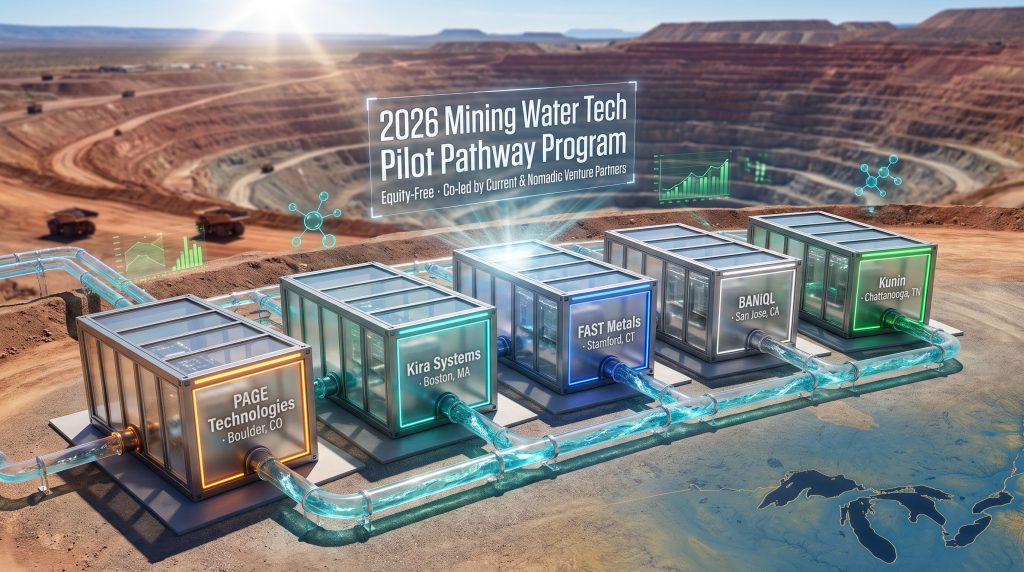
The 2026 cohort represents an expansion from the three-company inaugural 2025 program, both in scale and in the breadth of technology domains addressed. The five selected companies collectively span real-time sensing, thermal separation, tailings extraction, hydrometallurgical efficiency, and ion-exchange recovery. Details of the full cohort announcement are available directly from Nomadic Venture Partners.
| Company | Location | Core Technology | Primary Outputs |
|---|---|---|---|
| PAGE Technologies | Boulder, Colorado | Distributed water quality sensing | Real-time digitally integrated monitoring data |
| Kira Systems | Boston, Massachusetts | Heat-pump humidification-dehumidification | Clean distillate + concentrated metal brine or solid |
| FAST Metals | Stamford, Connecticut | Patented chemical tailings extraction | Iron, aluminum, titanium, scandium, REEs |
| BANiQL | San Jose, California | Selective closed-loop leaching | Multi-cycle pregnant leach solution reuse |
| Kunin | Chattanooga, Tennessee | Electrospun nanofiber ion exchange | Scandium, gallium, germanium, REEs, PGMs |
PAGE Technologies: Building the Data Layer for Mine Water Management
Water management decisions in mining have traditionally relied on periodic sampling, a model that is increasingly inadequate for the pace and complexity of modern operations. PAGE Technologies addresses this gap with a distributed sensing architecture that enables high-frequency, lower-cost water quality monitoring across a site.
The integration of hardware and software into a digitally connected network means that operators can move from reactive water management to predictive, data-driven process control. This has direct implications for regulatory compliance monitoring, where real-time visibility into effluent quality can reduce both violation risk and the cost of remediation.
Kira Systems: Turning Thermal Engineering Into a Metal Recovery Tool
Kira Systems deploys a software-defined heat-pump humidification-dehumidification (HDH) process, a thermal separation approach that simultaneously addresses two distinct operational problems. The system produces clean distillate suitable for direct reuse within site operations, while concentrating dissolved metals into a recoverable brine or solid stream.
The copper recovery dimension of this technology is strategically significant. With copper supply chains under sustained pressure from declining ore grades and extended project development timelines, technologies that recover additional copper from process water streams represent incremental supply that doesn't require new mine development. This dual-output model — clean water plus metal concentrate — is a compelling value proposition for operations seeking to justify capital expenditure on water treatment infrastructure.
FAST Metals: Redefining the Economic Status of Mine Tailings
Mine tailings represent one of the industry's most intractable problems: vast volumes of processed waste that carry both environmental liability and, increasingly, overlooked economic value. FAST Metals uses a proprietary patented chemical process to extract iron, aluminum, titanium, scandium, and other rare earth elements from toxic tailings streams including red mud, a particularly problematic byproduct of aluminum refining.
Considering the broader picture of natural capital in mining, the reframing of tailings from liability to resource is not merely an environmental narrative. It reflects a genuine shift in the economics of critical mineral supply, where secondary and tertiary recovery from waste streams is becoming commercially competitive as primary ore grades decline globally.
Scandium, one of FAST Metals' target elements, is a metal of growing strategic importance for aluminium alloys used in aerospace and defence applications. Global scandium supply is heavily concentrated and fragile, making domestic recovery pathways from existing waste streams a compelling supply chain diversification strategy.
BANiQL: Closing the Loop in Hydrometallurgical Processing
In conventional heap leaching and vat leaching operations, the pregnant leach solution (PLS) — the metal-bearing liquid extracted from ore — is typically processed once before the spent solution is managed as an effluent stream requiring treatment and disposal. BANiQL's selective leaching platform enables PLS to be reused across multiple processing cycles, fundamentally changing the freshwater economics of hydrometallurgical operations.
The implications extend beyond water savings. In water-stressed mining jurisdictions, the ability to minimise freshwater intake through closed-loop process design can be the determining factor in whether a project receives and maintains its operating permits. BANiQL's effluent recycling architecture directly addresses one of the most common triggers for community and regulatory opposition to mining operations.
Kunin: Extracting Strategic Value From the Margins of the Process Stream
Kunin's electrospun nanofiber ion-exchange platform targets metals that exist at very low concentrations in aqueous process streams — concentrations so low that conventional recovery methods have historically been uneconomical. The technology's selectivity allows it to capture scandium, gallium, germanium, rare earth elements, and platinum group metals (PGMs) from streams that would otherwise be discharged or treated as waste.
This is commercially significant for several reasons. Gallium and germanium, both targeted by the Kunin platform, are critical to semiconductor manufacturing and have seen significant supply chain scrutiny following Chinese export restriction announcements. PGMs remain essential to catalytic converter production and emerging hydrogen fuel cell technology. The ability to recover these materials as a secondary revenue stream from existing process water circuits positions Kunin at an intersection of water management and critical mineral supply strategy.
The Four Priority Technology Areas and Why They Form a Complete System
The program's four focus areas are deliberately constructed to address the full water lifecycle within a mining operation rather than any single point in the process chain.
- Mine water treatment addresses the challenge of contaminated water generated by mining activities, including acid mine drainage and metal-laden seepage.
- Real-time sensing and monitoring provides the data infrastructure necessary for informed operational decisions and regulatory compliance.
- Water efficiency and freshwater reduction targets intake minimisation through closed-loop design and process optimisation.
- Resource recovery from waste streams converts treatment outputs from cost centres into revenue-generating material streams.
No single technology in this cohort addresses all four domains simultaneously. The diversity of the participant portfolio is deliberate, reflecting the reality that solving mining's water challenge requires a portfolio of complementary innovations rather than a single breakthrough technology. In addition, the mining decarbonisation benefits associated with reduced water processing loads are increasingly factored into operational planning across the sector.
What Rio Tinto's Involvement Signals About Industry Posture
The expansion of the program in 2026 to include Rio Tinto's Copper R&D team as an active technical partner — rather than a financial sponsor — reflects a broader shift in how large mining companies are approaching early-stage technology engagement. Rather than waiting for technologies to reach commercial readiness before entering procurement discussions, Rio Tinto's model involves direct technical collaboration with founders at the pre-pilot stage.
Rio Tinto's General Manager of Innovation and Technology Systems has indicated that water is viewed as one of the most critical challenges facing the mining sector as copper and critical minerals and energy security concerns continue to grow, and that advancing practical, scalable solutions requires early engagement with emerging technology developers. This framing positions the program not as philanthropic support for innovation, but as a strategic instrument for building Rio Tinto's future technology pipeline.
For participating startups, access to Rio Tinto's technical team provides something that most venture-backed technology companies struggle to obtain at early stages: direct exposure to the operational realities, tolerance thresholds, and decision-making processes of a major mining operator.
The next major ASX story will hit our subscribers first
Frequently Asked Questions About the Mining Water Tech Pilot Program
What types of companies are eligible for the Mining Water Tech Pilot Program?
The program targets early-stage companies developing water technology solutions applicable to mining environments. Eligible technologies span treatment, sensing, efficiency, and resource recovery domains.
Is the Mining Water Tech Pilot Program equity-free?
Yes. The program is structured on an equity-free basis, allowing participating companies to retain full ownership of their intellectual property and equity position throughout their participation.
How does the program connect startups with mining industry operators?
Through direct technical engagement with partners such as Rio Tinto's Copper R&D team. This is structured interaction rather than networking, with the explicit potential for select companies to progress toward pilot project opportunities.
What is the NSF Great Lakes RENEW Engine?
It is a regional innovation initiative led by Current that focuses on recovering critical elements, nutrients, energy, and water from industrial waste streams, with a particular emphasis on strengthening domestic critical mineral supply chains.
What critical minerals are targeted through the 2026 cohort's recovery technologies?
The 2026 Mining Water Tech Pilot Program participants collectively target copper, scandium, gallium, germanium, rare earth elements, platinum group metals, titanium, aluminum, and iron across their respective recovery platforms.
How does the program differ from a traditional mining accelerator?
The primary distinction lies in structured industry engagement. Rather than pitch competitions or passive investor introductions, this program connects founders directly with the technical teams of operating mining companies, creating realistic pathways toward deployment.
Key Structural Takeaways From the 2026 Cohort
- Water efficiency and metal recovery are converging into single-system solutions, with Kira Systems and BANiQL both demonstrating that treating water and recovering value are not separate problems.
- Tailings reframing is accelerating as FAST Metals and Kunin both treat legacy waste streams as viable primary sources of strategic metals, a positioning that would have been commercially marginal a decade ago.
- Digital water intelligence is foundational, with PAGE Technologies reflecting the industry's growing recognition that process control, compliance, and efficiency all depend on continuous data rather than periodic manual sampling.
- Closed-loop process design is moving from aspiration to operational expectation, with zero-liquid-discharge architectures becoming a baseline requirement rather than a premium differentiator in water-stressed jurisdictions.
- Co-development is replacing passive procurement as the dominant model for large miners engaging with early-stage technology, a trend that the Rio Tinto partnership exemplifies and that is likely to accelerate as the gap between mineral demand growth and operational innovation widens.
Readers seeking additional coverage of water innovation and sustainability developments across the mining sector can find ongoing reporting at Global Mining Review.
Want to Know Which ASX Mining Companies Are Solving the Next Big Operational Bottleneck?
Discovery Alert's proprietary Discovery IQ model scans ASX announcements in real time, instantly identifying significant mineral discoveries across copper, rare earths, and other critical commodities — the same sectors driving demand for the water innovations reshaping modern mining. Explore historic discoveries and their market returns to understand the scale of opportunity, then begin your 14-day free trial at Discovery Alert to position yourself ahead of the market.