June 22, 2026
The Productivity Problem Underground Mining Has Never Fully Solved
Underground hard rock mining operations face a constraint that surface mines simply do not: everything competes for the same corridor. Personnel, ore trucks, supply vehicles, and maintenance equipment all share a single ramp network that functions as the circulatory system of the entire operation. When that system gets congested, the financial consequences compound quickly.
The conventional response to this problem has been scheduling discipline and shift management. However, these are human solutions to what is increasingly being recognised as an engineering problem. The mine ramp is a physical bottleneck, and no amount of scheduling optimisation fully resolves the underlying conflict between ore haulage and material supply logistics.
This is precisely the problem that the ARLYX autonomous underground mine utility vehicle has been engineered to solve, and the way it approaches that solution reveals a broader shift in how the mining industry is beginning to think about underground productivity.
When big ASX news breaks, our subscribers know first
Redefining Underground Logistics: The Engineering Case for Autonomy
For decades, underground material transport has relied on personnel-operated vehicles to move consumables from surface stockpiles to active mining faces. Rock bolts, ground support mesh, steel piping, shotcrete supplies, tools, and maintenance equipment must all make their way underground continuously to sustain production. In a typical hard rock mine, this creates a persistent scheduling tension.
During production shifts, the ramp is fully committed to ore haulage. Introducing material supply vehicles into that flow creates queuing, slows haulage cycle times, and directly reduces the number of ore loads completed per shift. Furthermore, during blasting periods, when all personnel and vehicles must be withdrawn from active zones, the ramp sits idle while the mine waits for re-entry clearance.
Automation in mining has advanced considerably, and autonomous electric platforms are now being engineered specifically to exploit that idle window. The financial case for doing so is substantial.
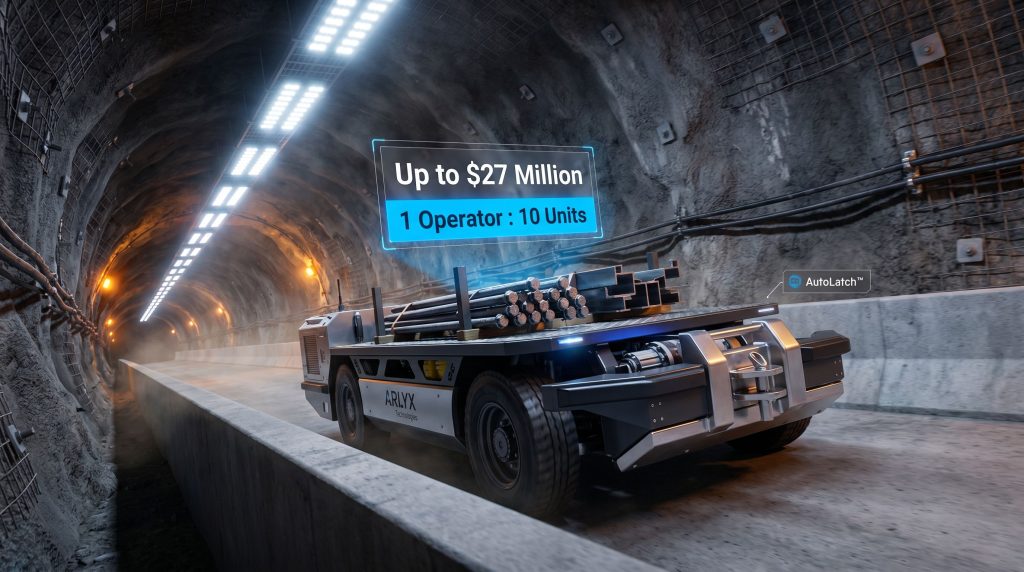
The ARLYX autonomous underground mine utility vehicle, developed by Québec-based ARLYX Technologies, is a purpose-built electric platform designed to operate during blasting periods without any human presence in the hazard zone. By moving material logistics into those previously unproductive windows, the system effectively creates additional productive capacity within the existing shift structure.
The estimated financial impact of this reallocation is significant: by enabling one additional ore load per day through ramp optimisation alone, ARLYX Technologies projects productivity gains of up to $27 million annually per operation.
These figures are estimates provided by ARLYX Technologies and should be evaluated against site-specific operational variables. Individual results will vary depending on mine configuration, ore value, and logistics structure.
How the ARLYX Platform Works: Architecture and Core Capabilities
Purpose-Built Design for Underground Environments
A critical distinction worth understanding is the difference between a purpose-built autonomous underground vehicle and a surface machine that has been retrofitted with autonomous control systems. The ARLYX platform was engineered from the ground up for underground deployment, which fundamentally changes its design priorities.
Underground mine environments present engineering challenges that surface conditions do not: restricted tunnel clearances, ramp gradients that change direction frequently, limited ventilation capacity, high humidity, dust loading, and the constant presence of heavy vehicles in confined spaces. A platform designed natively for these conditions will consequently perform differently to one adapted after the fact.
The ARLYX vehicle features a fully electric drivetrain, which is particularly relevant for underground operations. Battery-electric vehicles underground generate no exhaust emissions, directly reducing the ventilation requirements that represent one of the largest ongoing operating costs in deep underground mines. The mining electrification shift has made this even more relevant, as ventilation in hard rock mines can account for 30 to 50 percent of total energy consumption according to industry benchmarks.
AutoLatch: Autonomous Load Handling Without Human Intervention
The proprietary AutoLatch™ system is one of the more technically significant elements of the ARLYX platform. This module enables the vehicle to autonomously engage, transport, and release payloads of up to 5,000 kg per cycle without requiring any human operator to be physically present at the load or unload point.
This capability is important because it removes the final remaining human touchpoint in the underground logistics chain. Without automated load handling, autonomous transport vehicles still require personnel at each end of the journey to attach and detach loads. The AutoLatch system, however, eliminates that requirement entirely, enabling true end-to-end autonomous material delivery.
Connectivity Architecture: Infrastructure-Agnostic Integration
One of the more practical barriers to deploying autonomous underground equipment has historically been communication infrastructure. Many autonomous systems require proprietary networks or significant capital investment in connectivity upgrades before deployment is possible.
The ARLYX platform takes a deliberately different approach through full infrastructure agnosticism:
| Communication Protocol | ARLYX Compatibility |
|---|---|
| LTE | Supported |
| 5G | Supported |
| Wi-Fi | Supported |
| Radio | Supported |
This compatibility across all standard underground communication protocols means mine operators can deploy the ARLYX system using whatever network infrastructure is already in place. The platform integrates with existing mine communication systems rather than requiring them to be replaced or supplemented, which directly reduces the capital expenditure and implementation lead time associated with deployment.
The IoT-enabled architecture is supported by specialists across both robotics and connected systems, providing mines with full-stack capability from connectivity and software through to on-site operational support. In addition, data-driven mining operations are increasingly reliant on this kind of seamless integration to maximise efficiency across the board.
What the ARLYX Carries: Material Scope and Modular Expansion
Standard Underground Consumables
In its primary configuration as a material carrier, the ARLYX autonomous underground mine utility vehicle is designed to transport the full spectrum of high-frequency underground consumables:
- Rock bolts and ground support hardware
- Steel pipes and structural components
- Concrete and shotcrete materials
- Tools, spare parts, and maintenance equipment
- Cables, hoses, and utility materials
These are the materials that must reach active mining faces continuously. A production stope cannot install ground support without rock bolts, cannot blast without explosive accessories, and cannot maintain equipment without spare parts. Material shortfalls at the face directly translate into production delays, making logistics reliability a genuine productivity variable.
Modular Applications: A Platform That Grows With Operations
Beyond material handling, the ARLYX platform is being developed as a modular base system capable of supporting multiple specialised functions through application-specific modules. Planned expansion includes:
- Fire suppression modules for autonomous emergency response
- Dust control systems for continuous airborne particulate management
- Ore transport configuration for direct integration into production haulage
- Inspection and mapping tools for geotechnical and infrastructure monitoring
- Surveillance and rescue capability for personnel safety and emergency operations
The modular design philosophy means a single fleet investment can be progressively expanded across multiple operational functions, reducing the total number of specialised underground vehicles required and improving the return profile on the initial capital outlay.
The Safety Case: Moving Toward Zero-Entry Mining
Why Personnel Exposure Underground Remains a Critical Risk
Underground mining consistently ranks among the highest-risk industrial occupations globally. Blasting zones, ground instability, confined haulage corridors, and the physical demands of operating heavy equipment in restricted spaces create persistent exposure risks that evolve throughout the life of an operation.
The industry's long-term safety trajectory has been moving toward progressive reduction of human presence in active hazard zones. Regulations in multiple jurisdictions are increasingly formalising requirements for remote operation of certain underground functions, and the technology capable of fulfilling those requirements is now commercially available.
How the ARLYX System Addresses Human Exposure
The ARLYX autonomous underground mine utility vehicle is explicitly designed to operate in place of personnel-operated vehicles in hazardous underground areas. Its ability to continue logistics cycles throughout blasting periods means no workers need to remain in the blast zone to maintain material supply continuity.
The remote supervision model further amplifies this safety benefit: a single teleoperator can manage up to 10 ARLYX units simultaneously from a surface control station or underground refuge location. This ratio fundamentally changes the labour model for underground logistics, replacing high-exposure manual driving roles with lower-exposure supervision functions.
ARLYX Technologies CEO Michael Simard has described the company's objective as making the zero-entry mine a reality, where technology absorbs the operational risks rather than personnel. This framing reflects a broader philosophical shift in the industry, recognising that the goal is not simply to make underground work safer but to progressively remove humans from the most dangerous zones entirely.
Workforce Implications: New Roles, Different Risks
A common concern around autonomous underground equipment is workforce displacement. The teleoperator model provides a partial answer to that concern. Rather than eliminating roles, the 1:10 supervision ratio creates a new category of skilled underground technology operators whose working conditions are substantially safer than those of the personnel they replace in the field.
Reduced underground personnel numbers also carry direct financial implications for mine operators through lower incident probability, reduced compensation liability, and decreased insurance exposure. AI-powered mining efficiency tools are increasingly complementing these autonomous systems, further reinforcing the case for integrated technology-driven operations.
Competitive Context: Where Purpose-Built Autonomous Platforms Fit
The autonomous underground mining equipment market is at an inflection point. Several major original equipment manufacturers have introduced semi-autonomous or remotely operated underground machines over the past decade, but most of these solutions have been developed by adapting existing equipment designs rather than building natively autonomous platforms.
| Capability | Purpose-Built Autonomous Platform | Retrofitted Conventional Vehicle |
|---|---|---|
| Underground design optimisation | Native engineering | Post-manufacture adaptation |
| Electric drivetrain | Standard | Variable across models |
| Autonomous capability | Integrated from design stage | Added after original manufacture |
| Modular application expansion | Designed-in from the start | Structurally limited |
| Connectivity agnosticism | Full protocol support | Typically partial |
| Ventilation footprint | Minimal (zero emissions) | Depends on drivetrain type |
ARLYX Technologies is positioned within the Québec mining technology ecosystem, a region with deep institutional expertise in underground hard rock mining and a well-established supply chain for mining equipment development. The company's full-stack approach, covering connectivity, software, and on-site support, distinguishes it from hardware-only vendors that leave integration challenges to the mine operator.
The next major ASX story will hit our subscribers first
Deploying ARLYX: A Phased Integration Approach
Integrating autonomous underground vehicles into an existing operation is not a plug-and-play exercise. A structured deployment sequence, consequently, reduces risk and maximises the value of the investment.
Phase 1: Infrastructure and Site Assessment
- Audit existing underground communication systems to confirm LTE, 5G, Wi-Fi, or radio availability
- Map ramp layouts, tunnel clearances, and material staging locations for vehicle routing compatibility
- Identify blast scheduling windows where ARLYX logistics cycles can be inserted
Phase 2: Fleet Sizing and Operator Configuration
- Determine the number of units required based on material volume, shift structure, and face count
- Establish teleoperator workstation configuration for multi-vehicle supervision up to the 10-unit limit
Phase 3: Operational Schedule Integration
- Align ARLYX logistics cycles with existing blast timing to maximise ramp availability for ore trucks
- Integrate vehicle management software with mine operations planning systems
Phase 4: Modular Expansion Planning
- Identify secondary applications from the modular library that match operational priorities
- Develop a long-term fleet roadmap aligned with production growth and evolving safety requirements
Frequently Asked Questions About the ARLYX Autonomous Underground Mine Utility Vehicle
What payload capacity does the ARLYX vehicle support?
The ARLYX platform, equipped with the AutoLatch™ module, is rated to handle payloads of up to 5,000 kg per cycle, covering the full range of standard underground consumables and equipment categories through autonomous load and unload operations.
Can ARLYX operate during blasting windows?
Yes. Continuous operation during blasting periods is one of the platform's primary productivity contributions. Material logistics continue without interruption while ore haulage equipment and personnel are withdrawn from the blast zone, converting previously idle time into productive transport cycles.
How many units can one operator supervise simultaneously?
A single teleoperator can manage up to 10 ARLYX units at once, substantially improving labour efficiency in underground logistics compared to the one-driver-per-vehicle model of conventional operations.
Does ARLYX require proprietary communication infrastructure?
No. The platform is fully infrastructure-agnostic and compatible with LTE, 5G, Wi-Fi, and radio networks, meaning mines can deploy the technology using existing communication systems without additional network investment.
What is the estimated financial return from deployment?
ARLYX Technologies estimates that ramp optimisation enabled by the platform can generate up to $27 million in annual productivity gains at the operation level, derived from the addition of one extra ore load per day made possible by freeing the ramp from material supply traffic during production shifts. These are company estimates and are subject to site-specific variables.
The Larger Shift: Autonomous Vehicles and the Future of Underground Operations
The ARLYX autonomous underground mine utility vehicle is not an isolated product development. It is, in fact, one expression of a broader structural transformation in how underground mines are designed to function.
The convergence of battery-electric drivetrains, IoT connectivity, robotics, and remote supervision technology has created the conditions for a genuinely different model of underground mine logistics — one in which the physical separation of human workers from hazard zones is not just a safety aspiration but an engineered outcome. Furthermore, clean energy in mining is accelerating the adoption of zero-emission platforms like ARLYX, reinforcing both the operational and environmental case for electrified autonomous fleets.
For mine operators evaluating autonomous underground equipment, the key considerations extend beyond the hardware itself:
- The ventilation cost reduction from zero-emission electric fleets is a long-term operating cost benefit that compounds over the life of mine
- The 1:10 operator-to-vehicle ratio changes workforce planning assumptions for underground logistics functions
- The modular platform architecture converts an equipment purchase into a long-term infrastructure investment capable of evolving across multiple operational functions
- The $27 million annual productivity estimate repositions autonomous underground vehicles from a safety expenditure to a financially material operational upgrade
As underground mines go deeper, as labour costs continue to rise, and as safety frameworks in major mining jurisdictions become more stringent, the economics of autonomous underground logistics will only improve. Platforms engineered natively for that environment, rather than adapted from surface machines, are likely to define the competitive standard for underground material handling through the late 2020s and beyond.
Readers seeking broader context on autonomous underground mining equipment and the operational technology transforming the global mining industry can explore ongoing coverage at Engineering & Mining Journal [https://www.e-mj.com], which provides regular equipment profiles and operational technology analysis across all major mining jurisdictions.
Want to Know Which ASX Mining Companies Are Embracing the Next Wave of Discovery?
Discovery Alert's proprietary Discovery IQ model scans ASX announcements in real time, delivering instant alerts on significant mineral discoveries so investors can act before the broader market catches on — explore historic discovery outcomes that demonstrate just how transformative early positioning can be, and begin your 14-day free trial at Discovery Alert to gain an immediate market edge.