June 15, 2026
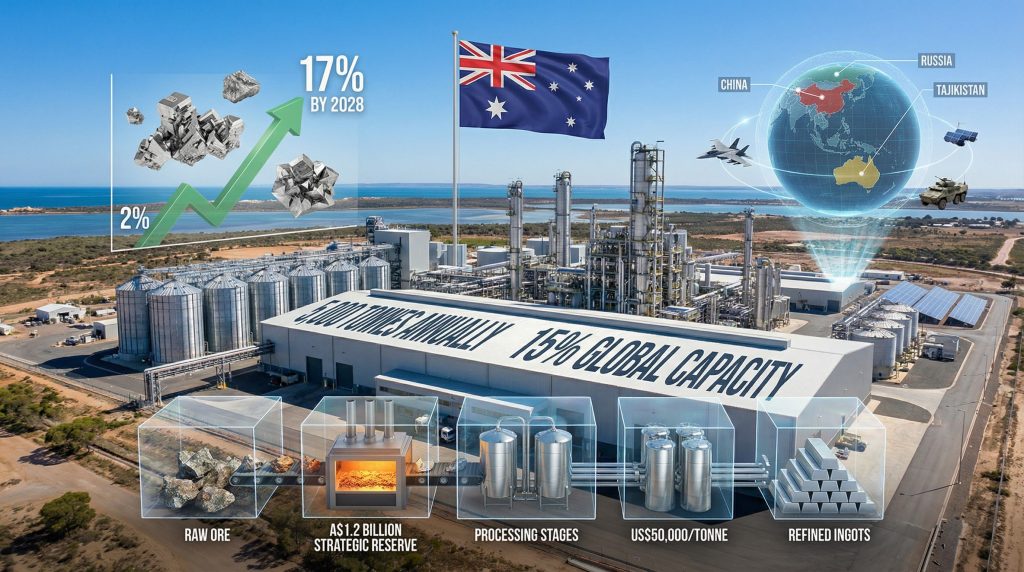
Australia's antimony supply chain transformation represents more than a simple commodity market shift—it demonstrates how democratic nations can rebuild strategic resource independence when authoritarian suppliers weaponise critical minerals. With antimony prices surging to unprecedented levels near US$50,000 per tonne following China's complete export ban in December 2025, Australia has rapidly evolved from a minor producer to a potential supplier of 15% of global demand.
This metamorphosis reflects deeper structural changes in how Western nations approach resource security, moving beyond traditional mining models toward integrated mine-to-metal sovereignty. The urgency of this transformation becomes clear when considering that for over a decade, China, Russia, and Tajikistan collectively controlled more than 90% of worldwide antimony production, creating vulnerabilities that defence contractors and technology companies can no longer ignore.
Australia's emergence as a critical antimony supplier fundamentally reshapes global resource geopolitics. Unlike traditional resource dependencies, antimony represents what industry analysts describe as a potential single point of failure for contemporary military systems, making supply chain diversification a national security imperative for allied nations.
Australia's Rise in Global Antimony Markets
The scale of Australia's antimony supply chain transformation becomes evident through specific production milestones and infrastructure investments. Nyrstar's Port Pirie multi-metals facility in South Australia currently scales up to reach an annual capacity of 5,000 tonnes, representing approximately 15% of the global market and effectively substituting the entire volume of antimony that the United States previously sourced from China.
This production capacity represents a dramatic departure from Australia's historical position as a minor player in global antimony markets. The nation's baseline production of approximately 2,200 tonnes annually positions it for a potential market share expansion from roughly 2% to 17% by 2028, fundamentally altering the competitive landscape.
Current Market Dynamics:
- Price volatility: Antimony currently trades near US$50,000 per tonne
- Supply concentration risk: Three nations previously controlled 90% of production
- Strategic stockpile demand: US Defense Logistics Agency issued replenishment tenders in February 2026
- Processing capacity: Port Pirie facility scaling to meet 15% of global demand
The timing of Australia's market entry coincides with unprecedented supply disruptions. China implemented a complete export ban on antimony to the United States in December 2025, creating acute shortages that defence contractors and technology manufacturers struggled to address through existing supply chains.
Furthermore, this strategic antimony move demonstrates how resource security has become intertwined with geopolitical strategy. The transformation is part of a broader critical minerals energy transition that Western nations are pursuing to reduce dependence on authoritarian suppliers.
Regional Competitive Analysis:
| Country | 2023 Production (tonnes) | Market Share | Supply Chain Risk |
|---|---|---|---|
| China | 65,000 | 65% | Export restrictions |
| Russia | 18,000 | 18% | Sanctions impact |
| Tajikistan | 15,000 | 15% | Infrastructure constraints |
| Australia | 2,200 | 2% | Stable democracy |
Australia's competitive advantage extends beyond political stability to include established mining infrastructure, proximity to Asia-Pacific markets, and existing relationships with Western defence contractors. The strategic importance of these relationships becomes apparent when considering antimony's role in military applications.
When big ASX news breaks, our subscribers know first
Integrated Processing Economics and Value Creation
Australia's shift toward mine-to-metal integration fundamentally changes the economics of antimony production by capturing downstream value rather than exporting raw materials. According to government announcements, "Mining alone does not create supply chain security—smelting, refining, and conversion into critical metals ensures Australia can play a strategic role for itself and its allies."
The Port Pirie facility demonstrates this integrated approach through its transition from lead smelting operations to antimony metal production. The accelerated scaling of Nyrstar's production was facilitated by the construction of pilot and demonstration plants, supported by both the Australian and South Australian governments, enabling projects like Hillgrove to be positioned as sovereign assets rather than purely commercial operations.
Economic Value Capture Comparison:
| Processing Model | Value Capture | Supply Chain Control | Employment Impact |
|---|---|---|---|
| Raw material export | 15-20% of final price | Limited sovereignty | Basic extraction jobs |
| Integrated processing | 80-90% of final price | Full value chain control | Advanced manufacturing roles |
The Hillgrove project, operated by Larvotto Resources, targets annual production of 5,000 tonnes of antimony alongside 40,000 ounces of gold equivalent. The project's negative all-in sustaining costs of approximately -$2,000 per ounce after byproduct credits demonstrate the financial viability of integrated antimony operations when gold recovery provides additional revenue streams.
Infrastructure Investment Requirements:
- Processing technology: Specialised antimony refining equipment installation
- Quality control: Defence-grade specifications laboratory facilities
- Logistics: Secure transport systems for strategic minerals
- Environmental: Compliance systems for expanded processing operations
The construction timeline for antimony processing facilities benefits from existing infrastructure. Port Pirie's transition leveraged established smelting capabilities, enabling an accelerated 8-month construction period for pilot and demonstration plants rather than the multi-year timelines typically required for greenfield processing facilities.
Government support mechanisms fundamentally alter project economics through the A$1.2 billion Critical Minerals Strategic Reserve. This federal programme provides direct offtake agreements, export finance expansion for allied nation sales, and priority access guarantees for domestic defence contractors, reducing market risk for antimony producers.
In addition, this transformation reflects the broader mining industry evolution where traditional extraction models are being replaced by integrated value chains that prioritise strategic autonomy over pure cost efficiency.
Critical Applications in Defence and Technology Systems
Antimony's strategic importance derives from its irreplaceable role in three core defence applications where no effective substitutes exist. In munitions, antimony functions as the primary hardening agent for lead in bullets and armour-piercing rounds, providing structural integrity necessary for high-velocity impact that conventional ammunition cannot achieve without this additive.
The metal serves as an essential component in infrared sensors, night-vision goggles, and laser-guided triggers, making it critical for modern military targeting systems. Additionally, antimony trioxide functions as a mandatory additive for fire-resistant coatings on naval vessels, aircraft, and military uniforms, where its flame-suppressing properties cannot be replicated by alternative materials.
Defence Application Specifications:
- Munitions hardening: Primary additive for armour-piercing ammunition
- Infrared systems: Component in night-vision and laser-guidance systems
- Fire-resistant coatings: Mandatory naval and aircraft protection systems
The United States Defense Logistics Agency issued tenders in February 2026 to replenish the US National Defense Stockpile, with Australian antimony being prioritised under the US-Australia Critical Minerals Framework. This represents concrete demand signals from official government procurement channels rather than speculative commercial interest.
Beyond traditional military applications, antimony demonstrates increasing importance in energy storage technologies. Next-generation liquid metal batteries, such as those being developed by Ambri, employ calcium-antimony chemistry that offers advantages over lithium-ion alternatives including lower costs, no fire risk, and lifespans exceeding 20 years suitable for stabilising national power grids.
Emerging Technology Applications:
- Long-duration energy storage: Calcium-antimony battery chemistry
- Solar glass production: Sodium antimonate clarifying agents
- Grid stabilisation: 20+ year lifespan battery systems
- Semiconductor manufacturing: Specialised antimony compounds
The intersection of defence and technology applications creates inelastic demand patterns where price sensitivity remains low due to performance requirements and regulatory mandates. Military contractors cannot substitute antimony in critical applications, while energy storage developers require specific metallurgical properties that alternative materials cannot provide.
"Australia's federal government's A$1.2 billion Critical Minerals Strategic Reserve aims to ensure that domestic defence contractors, such as Thales Australia, maintain priority access to domestically processed antimony."
This critical minerals pivot represents a fundamental shift in how democratic nations approach resource security, particularly for materials with dual-use applications across defence and civilian sectors.
Government Policy Framework and Strategic Reserves
Australia's A$1.2 billion Critical Minerals Strategic Reserve represents unprecedented government backing for antimony development, fundamentally altering project economics and risk profiles through direct intervention in supply chain security. This policy framework positions mining projects as sovereign assets rather than purely commercial operations, creating new financing and operational paradigms.
The strategic reserve operates through multiple mechanisms designed to ensure domestic supply chain resilience while supporting allied nations. Direct offtake agreements with government reserves provide guaranteed revenue streams for producers, while export finance expansion facilitates sales to trusted international partners under established diplomatic frameworks.
Policy Implementation Mechanisms:
- Direct offtake agreements: Government purchase guarantees for domestic production
- Export finance expansion: Facilitated sales to allied nations
- Priority access guarantees: Domestic defence contractor supply protection
- Fast-track permitting: Accelerated approval processes for strategic mineral projects
The US-Australia Critical Minerals Framework creates bilateral supply chain security agreements that prioritise Australian antimony for US National Defense Stockpile replenishment. This represents a significant departure from traditional commodity trading relationships toward strategic resource partnerships between democratic allies.
Under this framework, Australian producers gain preferential access to US defence contracts while the United States secures reliable supplies from politically stable sources. The Defense Logistics Agency's February 2026 tenders specifically target Australian suppliers, demonstrating how government policy translates into concrete commercial opportunities.
International Cooperation Benefits:
- Preferential contracting: Priority consideration for US defence procurement
- Supply chain security: Guaranteed access for critical military applications
- Diplomatic leverage: Resource partnerships strengthening bilateral relations
- Technology sharing: Collaborative development of processing capabilities
The collaborative approach between federal and state governments accelerated project development timelines through coordinated support for pilot and demonstration plants. This model enables private companies to access public sector resources while maintaining commercial operational structures, reducing both development risk and capital requirements.
Fast-track permitting processes specifically designed for strategic mineral projects eliminate traditional regulatory delays that could compromise supply chain security objectives. Environmental compliance remains mandatory, but approval timelines align with national security priorities rather than standard commercial development schedules.
However, the success of these policies depends on coordination with international partners, particularly the EU critical minerals facility which aims to diversify European supply chains away from Chinese dependence.
Infrastructure Development and Processing Capabilities
Australia's antimony supply chain transformation leverages existing infrastructure while building specialised processing capabilities that distinguish the nation from traditional raw material exporters. Port Pirie's multi-metals facility demonstrates how established smelting operations can transition to strategic mineral processing through targeted investments rather than complete facility reconstruction.
The facility's evolution from lead smelting to antimony metal production required specialised equipment installation and quality control systems capable of meeting defence-grade specifications. These technical requirements exceed standard commercial processing standards, demanding precision manufacturing capabilities and comprehensive testing protocols.
Infrastructure Asset Utilisation:
- Existing facilities: Port Pirie multi-metals smelting infrastructure
- Transportation networks: Established rail and port logistics systems
- Power supply: South Australia's renewable energy grid integration
- Labour force: Experienced metallurgical processing workforce
Hillgrove mine's $150 million existing infrastructure base provides operational foundations that can be repurposed for expanded antimony processing. This existing capital deployment reduces the total investment required for scaled production while accelerating project development timelines compared to greenfield operations.
The Costerfield operation contributes operational experience in antimony processing that informs best practices across Australia's emerging antimony sector. Knowledge transfer between established operations and new facilities accelerates learning curves while reducing technical risks associated with processing scale-up.
Technical Processing Requirements:
- Refining equipment: Specialised antimony metal production systems
- Quality laboratories: Defence-grade specification testing capabilities
- Environmental systems: Processing expansion compliance infrastructure
- Security protocols: Strategic mineral handling and transportation procedures
Secure logistics systems for strategic mineral transport represent new infrastructure requirements distinct from standard commodity shipping. These systems must accommodate security protocols, tracking requirements, and destination restrictions that commercial mining operations typically do not encounter.
Environmental compliance systems for expanded processing operations require updated permitting and monitoring capabilities that address antimony-specific processing requirements. While leveraging existing environmental management frameworks, antimony processing presents distinct technical challenges requiring specialised expertise.
What Are the Key Infrastructure Challenges?
The primary challenges include scaling demonstration plant technologies to commercial production volumes whilst maintaining defence-grade quality specifications. Furthermore, developing secure logistics networks for strategic mineral transport requires investment in tracking systems and security protocols that exceed standard mining industry practices.
Competitive Analysis and Market Position
Australia's competitive position in global antimony markets strengthens as traditional suppliers face geopolitical constraints and production challenges that appear structural rather than cyclical. The concentration of supply among China, Russia, and Tajikistan created vulnerabilities that became critical weaknesses when export restrictions disrupted established trading relationships.
China's export ban implementation in December 2025 represents more than temporary trade policy—it demonstrates how authoritarian governments can weaponise critical mineral exports for geopolitical leverage. This reality forces Western industries to reassess supply chain security and prioritise sources from democratic allies even at higher costs.
Global Supply Chain Comparison:
| Supplier | Production Capacity | Political Risk Assessment | Processing Infrastructure | Allied Access |
|---|---|---|---|---|
| China | 65,000 tonnes | Export restrictions | Advanced capabilities | Restricted |
| Russia | 18,000 tonnes | International sanctions | Limited capacity | Blocked |
| Tajikistan | 15,000 tonnes | Infrastructure constraints | Basic processing | Unreliable |
| Australia | 5,000 tonnes (scaling) | Stable democracy | Developing rapidly | Guaranteed |
Australia's competitive advantages extend beyond political stability to include technological capabilities, environmental standards, and established relationships with Western defence contractors. These factors create premium value propositions that justify higher production costs relative to authoritarian suppliers.
The integrated mine-to-metal approach positions Australia differently from traditional raw material exporters by capturing downstream processing margins and ensuring supply chain control. This strategy reduces dependence on foreign processing capabilities whilst building domestic expertise in critical mineral value chains.
Competitive Differentiation Factors:
- Supply chain security: Democratic governance ensures reliable access
- Quality standards: Defence-grade processing capabilities
- Environmental compliance: Sustainable production methods
- Technology partnership: Collaborative development with allied nations
Russia's sanctions impact eliminates a significant supplier from Western supply chains, creating market share opportunities for democratic alternatives. Tajikistan's infrastructure constraints limit production expansion capabilities, whilst China's export restrictions remove the dominant supplier from key markets.
Australia's market entry timing coincides with structural supply deficits that appear permanent rather than temporary. Defence spending growth among allied nations drives inelastic demand, whilst energy transition applications expand total market size beyond traditional antimony consumption patterns.
Consequently, antimony supply chain security has become a critical factor in procurement decisions, with Western buyers prioritising reliable sources over cost considerations.
The next major ASX story will hit our subscribers first
Investment Dynamics and Financial Analysis
Australia's antimony supply chain transformation creates multiple investment opportunities across the value chain, from resource development through processing technology to strategic stockpiling arrangements. The convergence of government policy support, supply chain disruption, and expanding applications generates investment themes with both defensive and growth characteristics.
Resource development investments focus on projects like Hillgrove and Costerfield, where existing infrastructure and established operations provide lower-risk expansion opportunities compared to greenfield development. These projects benefit from government backing through the Critical Minerals Strategic Reserve whilst accessing premium pricing driven by supply shortages.
Investment Opportunity Categories:
- Resource expansion: Hillgrove and Costerfield production scaling
- Processing infrastructure: Antimony refining equipment and facilities
- Government partnerships: Strategic reserve offtake agreements
- Technology applications: Energy storage and defence contractor relationships
Processing technology investments capture higher margins through value-added manufacturing whilst building capabilities that extend beyond antimony to other critical minerals. Nyrstar's examination of bismuth and tellurium processing at Port Pirie alongside germanium at Hobart Zinc Works demonstrates portfolio expansion potential.
Market price dynamics support investment economics through sustained premium pricing driven by structural supply deficits. Current trading levels near US$50,000 per tonne represent unprecedented pricing that reflects genuine scarcity rather than speculative trading, providing sustainable economic foundations for project development.
Financial Performance Indicators:
- Antimony prices: US$50,000 per tonne (historical highs)
- Production costs: Negative AISC after byproduct credits
- Government backing: A$1.2 billion strategic reserve support
- Market demand: Defence spending growth plus energy storage expansion
Strategic partnerships with government entities create investment structures distinct from traditional commodity investments. Direct offtake agreements with strategic reserves provide revenue certainty, whilst priority access guarantees for defence contractors ensure market access regardless of commercial competition.
Long-term structural demand drivers include defence spending increases among allied nations and energy storage deployment for grid stabilisation. These applications create inelastic demand patterns where performance requirements outweigh price sensitivity, supporting premium valuations for secure suppliers.
How Do Government Guarantees Affect Investment Risk?
Government offtake agreements and strategic reserve backing fundamentally reduce market risk by providing guaranteed revenue streams independent of commodity price volatility. However, investors must consider the trade-off between government backing and commercial flexibility, as strategic partnerships may limit export opportunities to certain jurisdictions.
Risk Assessment and Strategic Challenges
Australia's antimony supply chain transformation faces technical, market, and operational risks that require careful management to ensure successful implementation. Processing technology scale-up represents the primary technical challenge, as demonstration plant capabilities must expand to commercial production volumes whilst maintaining defence-grade quality specifications.
Quality specifications for defence applications demand precision manufacturing that exceeds standard commercial processing requirements. Military contractors cannot accept material variations that might be acceptable for industrial applications, requiring comprehensive quality control systems and batch-to-batch consistency that increases operational complexity.
Primary Risk Categories:
- Technical scaling: Demonstration to commercial production transitions
- Quality control: Defence-grade specification maintenance
- Environmental compliance: Expanded operations regulatory requirements
- Workforce development: Specialised antimony processing expertise
Market risks include potential Chinese supply resumption that could destabilise pricing and demand patterns. Whilst current export restrictions appear policy-driven rather than temporary, geopolitical developments could alter supply availability and pricing dynamics in ways that challenge Australian project economics.
Alternative technology development represents a longer-term risk where substitute materials or processing methods could reduce antimony demand in key applications. However, the metal's unique metallurgical properties in defence applications make substitution unlikely in the medium term.
Risk Mitigation Strategies:
- Government partnerships: Strategic reserve backing reduces market risk
- Long-term contracts: Allied nation offtake agreements provide revenue stability
- Technology development: Processing capability advancement maintains competitive advantage
- Portfolio diversification: Multiple application markets reduce demand concentration
Currency and commodity price fluctuations create standard mining sector risks that antimony projects must manage through hedging strategies and financial planning. However, the strategic nature of antimony demand provides some protection from typical commodity cycle volatility.
Environmental compliance for expanded processing operations requires ongoing investment in monitoring systems and emission controls. Whilst leveraging existing environmental management frameworks, antimony processing presents unique technical challenges requiring specialised expertise and equipment.
Skilled workforce development represents a critical success factor as antimony processing requires metallurgical expertise that differs from traditional mining operations. Training programmes and technology transfer agreements with international partners help build necessary capabilities whilst reducing dependence on imported expertise.
Future Implications for Global Resource Security
Australia's antimony supply chain transformation extends beyond a single commodity to demonstrate how democratic nations can rebuild strategic resource independence through coordinated policy, investment, and industrial development. The success of this model influences broader critical minerals strategies and resource security architecture for allied nations.
The integrated mine-to-metal approach serves as a template for other strategic minerals where supply chain vulnerabilities exist. Lithium, rare earths, and cobalt present similar challenges where authoritarian suppliers dominate production whilst democratic nations possess reserves but lack processing capabilities.
Strategic Model Replication Potential:
- Lithium processing: Battery-grade material production sovereignty
- Rare earth separation: Advanced materials processing independence
- Cobalt refining: Electric vehicle supply chain security
- Critical minerals portfolio: Comprehensive resource security strategy
Enhanced Australia-US strategic partnership through critical minerals frameworks creates precedents for resource-based alliances that strengthen democratic supply chains. These partnerships extend beyond commercial relationships to encompass technology sharing, joint development, and coordinated stockpiling strategies.
The proof-of-concept value of Australia's antimony success influences investment flows toward similar projects in other democratic nations. Canada, the United States, and European countries possess critical mineral reserves that could support comparable mine-to-metal sovereignty initiatives with appropriate policy support.
Scenario Projections for 2028:
- Base case: Australia achieves 15% global antimony market share through Port Pirie scaling
- Optimistic scenario: Expanded processing captures 25% share with technology leadership
- Conservative scenario: Maintains 10% share despite competitive pressures from alternative suppliers
Reduced Western dependence on authoritarian suppliers represents the strategic objective underlying Australia's antimony supply chain transformation. Success in this single commodity demonstrates the feasibility of broader supply chain restructuring that enhances national security whilst building industrial capabilities.
The replication of Australia's model across multiple critical minerals could fundamentally alter global resource trade patterns, shifting from efficiency-based supply chains to security-based partnerships among democratic allies. This transformation prioritises supply reliability over cost optimisation, creating new economic relationships.
Australia's antimony supply chain transformation ultimately redefines how democratic nations approach resource security, moving beyond traditional free-market mechanisms toward strategic industrial policy that integrates national security considerations with economic development objectives. This model provides a framework for other nations seeking to rebuild strategic resource independence in an era of increasing geopolitical competition.
Looking to Capitalise on Australia's Critical Minerals Transformation?
Australia's emergence as a vital antimony supplier demonstrates how strategic mineral discoveries can reshape entire supply chains and create substantial investment opportunities. Discovery Alert's proprietary Discovery IQ model delivers real-time alerts on significant ASX mineral discoveries, empowering subscribers to identify these transformative opportunities before they reach mainstream attention—begin your 14-day free trial today and position yourself ahead of the market.