June 13, 2026
The Hidden Resource Beneath the Aluminium Industry's Biggest Problem
Every industrial system eventually confronts the cost of its own outputs. For the aluminium sector, that reckoning has arrived in the form of billions of tonnes of alkaline residue sitting in engineered storage ponds across six continents. What was once treated as an unavoidable disposal challenge is now attracting serious attention from metallurgists, critical mineral strategists, and industrial policymakers alike. The question is no longer whether red mud in the aluminium industry holds recoverable value. The question is how quickly the economics and technology can align to unlock it.
When big ASX news breaks, our subscribers know first
What Is Red Mud and How Does It Form?
The Bayer Process and Its Unavoidable Byproduct
Red mud, also called bauxite residue, is the insoluble material left behind when bauxite ore is processed into alumina through the Bayer Process. First developed in 1888, this method remains the dominant refining pathway for aluminium production worldwide. Bauxite is digested in a hot, pressurised caustic soda solution, which dissolves the aluminium-bearing minerals and leaves behind everything that will not react, including iron oxides, silica, titanium compounds, and trace concentrations of rare and critical minerals.
The iron oxide content is what gives the residue its characteristic rust-red colour. However, composition varies considerably depending on the geological origin of the bauxite feedstock. Australian refineries processing gibbsitic bauxite tend to produce residues with lower iron concentrations, while Indian and African sources yield significantly richer iron fractions. This geographic variability is not merely a technical footnote. It directly determines which recovery pathways are viable at any given site.
Chemistry That Complicates Everything
The caustic environment of the Bayer Process leaves its mark on the residue. Red mud carries a pH typically ranging between 10 and 13, making it corrosive and ecologically hazardous in an unmodified state. The sodium hydroxide embedded in its structure means that direct land application or construction use requires substantial pre-treatment to neutralise alkalinity. This pre-treatment step remains one of the most significant cost barriers to large-scale reuse.
Furthermore, trace concentrations of naturally occurring radioactive materials, primarily thorium and uranium, complicate regulatory approvals for construction applications in certain jurisdictions. Although these concentrations are generally low, they vary across bauxite sources and add a layer of compliance complexity that slows commercialisation timelines.
The Scale Problem: A Waste Stream Unlike Any Other
| Metric | Estimate |
|---|---|
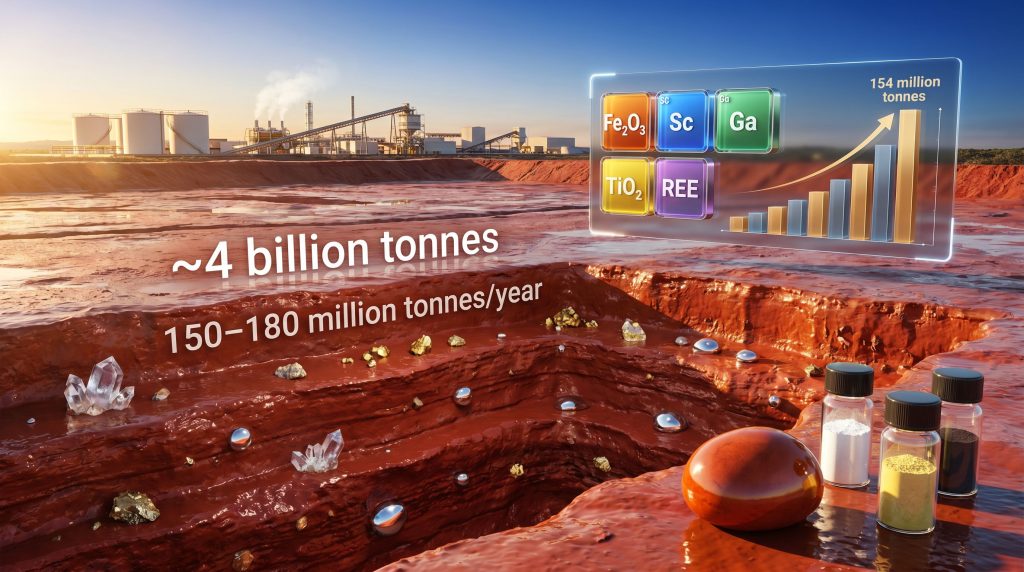
| Annual red mud generation (global) | 150 to 180 million tonnes per year |
| Red mud produced per tonne of alumina | 1.0 to 1.5 tonnes |
| Red mud produced per tonne of aluminium | 2 to 4 tonnes (full process accounting) |
| Cumulative global stockpile | approximately 4 billion tonnes |
| pH range of red mud | 10 to 13 |
| Global alumina output (2025) | approximately 154 million tonnes |
With annual alumina production at approximately 154 million tonnes in 2025, annual residue generation has already exceeded 175 million tonnes. The cumulative global stockpile now sits at an estimated 4 billion tonnes, representing one of the largest concentrations of secondary mineral material on Earth. Unlike most mining waste, this material is already concentrated, already excavated, and already sitting at surface level, requiring no underground development to access. Understanding global bauxite production trends helps contextualise just how rapidly this stockpile continues to grow.
Why Has Management of This Residue Been So Problematic?
Physical and Environmental Hazards
Red mud presents a challenging combination of physical properties. It is fine-grained and behaves as a slurry during disposal, requiring carefully engineered containment infrastructure. Over time, stored residue consolidates but retains moisture and residual alkalinity. Containment failures, even partial ones, can release large volumes of highly alkaline material into surrounding environments with severe consequences for soil chemistry, groundwater quality, and aquatic ecosystems.
Documented Failures and the Cost of Complacency
The risks associated with inadequate containment are not hypothetical. Two events stand out in the modern history of red mud management:
-
Ajka, Hungary (2010): A containment wall failure at an alumina refinery released approximately 1 million cubic metres of red mud slurry. The material contaminated rivers and agricultural land across a wide area, caused multiple fatalities, and resulted in long-term ecological damage to the Marcal and Raba rivers. The event prompted regulatory reassessment of residue storage standards across the European Union.
-
China (2012): A secondary containment breach highlighted systemic vulnerabilities in residue storage infrastructure across high-throughput refining regions, raising concerns about the adequacy of monitoring and remediation frameworks in rapidly expanding alumina markets.
These incidents illustrate a core tension: the infrastructure required to safely contain billions of tonnes of alkaline residue indefinitely is both expensive and imperfect. Consequently, the long-term liability of permanent storage has become a growing argument in favour of processing and reuse.
True Storage Costs Are Often Underestimated
Refinery operators rarely account for the full lifecycle cost of red mud management when calculating alumina production economics. Infrastructure maintenance, liner replacement, monitoring, regulatory compliance, and eventual site remediation accumulate over decades. Some industry analysts estimate that the true long-term cost of residue disposal substantially exceeds the direct operational expenditure recorded in annual accounts. This hidden liability is one reason why the economics of recovery are being reassessed with fresh urgency.
What Valuable Minerals Does Red Mud Actually Contain?
Compositional Variability Across Geographies
| Component | Typical Range | Notable Regional Data |
|---|---|---|
| Iron oxide (Fe₂O₃) | 28.5% to 56.9% | Australian refineries approximately 28.5%; Damanjodi, India approximately 53% |
| Alumina (Al₂O₃) | 15% to 24% | Varies by bauxite feedstock quality |
| Silica (SiO₂) | 3% to 20% | Influences downstream cement usability |
| Titanium dioxide (TiO₂) | 2% to 8% | Strategic pigment and aerospace material |
| Scandium | Trace to significant | Critical mineral in multiple jurisdictions |
| Gallium | Trace | Semiconductor and defence supply chain relevance |
| Rare earth elements | Variable | Lanthanum, cerium, and neodymium commonly detected |
The composition of red mud is not uniform, and this variability is commercially significant. Bauxite sourced from lateritic deposits typically yields residues with higher rare earth element concentrations, while karst-derived bauxites from Mediterranean and Caribbean regions often produce residues richer in titanium and iron. Understanding the source geology is therefore the first analytical step in any credible recovery feasibility study.
Critical Minerals Embedded at Scale
While iron oxide dominates by volume, it is the trace and minor critical mineral fractions that are generating the most investor and policy interest. Scandium is perhaps the most strategically compelling. Present at concentrations typically ranging from 50 to 150 parts per million across most bauxite residue stockpiles, scandium is a lightweight metal that significantly improves the strength and weldability of aluminium alloys. Its primary commercial application is in aluminium-scandium alloys used in aerospace structures, cycling components, and solid oxide fuel cell electrodes.
Gallium is another mineral of growing strategic relevance. Historically a byproduct of the Bayer Process itself, gallium is critical to semiconductor manufacturing, solar panel production, and military electronics. Bauxite residue contains residual gallium concentrations that could complement broader gallium supply chains for Western nations seeking to reduce dependence on concentrated offshore sources.
Rare earth elements, including lanthanum, cerium, and neodymium, are present in variable concentrations across red mud stockpiles globally. While their concentrations are generally lower than in dedicated rare earth deposits, the sheer volume of accumulated residue means the absolute quantities are substantial. A lateritic bauxite residue containing even 500 parts per million of total rare earth oxides, applied across a stockpile of several hundred million tonnes, represents a meaningful secondary resource.
The strategic significance of bauxite residue as a secondary mineral source is increasingly well understood: nations with large alumina refining industries and decades of accumulated stockpiles hold potential domestic access to critical materials that would otherwise require greenfield mining or international procurement from geopolitically sensitive suppliers.
How Does Red Mud Fit Into Critical Mineral Supply Chains?
The Geopolitical Dimension
China currently controls a dominant share of global rare earth processing capacity and has historically supplied a large proportion of the world's refined gallium. This concentration of supply chain control has prompted significant policy responses from governments across North America, Europe, and the Indo-Pacific. The appeal of bauxite residue as a domestic critical mineral source lies in the fact that it bypasses the need for new greenfield exploration, permitting, and mine development. The material is already above ground, already characterised in many cases, and co-located with existing refinery infrastructure.
In addition, the broader context of rare earth supply chains makes bauxite residue recovery even more strategically attractive, particularly for nations seeking to diversify sourcing away from geopolitically concentrated suppliers.
Scandium's Outsized Importance
Scandium occupies a unique position in the critical minerals landscape. Annual global production has historically sat below 25 tonnes, making it one of the scarcest commercially traded metals by volume. Yet its industrial importance is disproportionate to its production scale. Adding as little as 0.1 to 0.4 percent scandium to aluminium alloys can increase yield strength by up to 40 percent and dramatically improve resistance to heat and fatigue. This makes aluminium-scandium alloys attractive across aerospace, defence, and advanced manufacturing sectors.
Because scandium occurs naturally in many bauxite deposits and concentrates in the residue during alumina refining, red mud in the aluminium industry represents one of the largest potential scandium sources outside of primary scandium-bearing minerals. The question of whether bauxite residue-derived scandium can reach commercial purity and volume at competitive cost is now being answered through an expanding body of pilot-scale and early commercial projects.
Technologies Being Applied to Extract Value
Hydrometallurgical Pathways
Acid leaching is the most widely studied recovery method for critical minerals from red mud. In this approach, sulphuric or hydrochloric acid is used to dissolve target minerals from the residue matrix. Selective extraction techniques, including solvent extraction and ion exchange, are then used to isolate individual elements from the resulting leachate. This pathway is particularly effective for scandium, rare earth elements, and alumina recovery.
Step-by-Step Scandium Recovery from Bauxite Residue
-
Alkaline pre-treatment dissolves silica and alumina fractions, reducing unwanted gangue in the leach solution
-
Acid digestion using dilute sulphuric acid releases scandium and rare earth ions into aqueous solution
-
Solvent extraction using selective organic extractants isolates scandium from competing elements such as iron and titanium
-
Ion exchange polishing refines the concentrate and removes residual impurities
-
Precipitation and calcination converts the purified solution into scandium oxide powder
-
Final refining brings the product to aerospace-grade purity, typically greater than 99.9 percent Sc₂O₃
Pyrometallurgical and Emerging Methods
| Recovery Method | Target Output | Commercialisation Stage |
|---|---|---|
| Acid leaching (hydromet) | Scandium, REEs, alumina | Pilot to early commercial |
| Reductive smelting (pyromet) | Iron, pig iron, titanium slag | Commercial in select regions |
| Bioleaching | REEs, aluminium | Laboratory to pilot |
| CO₂ mineralisation | Carbon credits, neutralised residue | Pilot stage |
| Cement and construction integration | Supplementary cementitious material | Commercially active |
Reductive smelting has achieved commercial scale in parts of Europe and Asia, where red mud is processed in electric arc furnaces to produce pig iron and a titanium-enriched slag. Bioleaching, which uses acid-producing microorganisms to mobilise target metals, remains at an early experimental stage but offers the theoretical advantage of lower energy consumption and reduced chemical inputs. Carbon dioxide mineralisation, in which CO₂ reacts with the alkaline residue to form stable carbonates, simultaneously neutralises the pH hazard and generates a potential carbon credit revenue stream, though this approach has not yet reached commercial scale.
The next major ASX story will hit our subscribers first
Commercial Applications and Their Readiness
| Application | Commercial Readiness | Volume Potential | Value per Tonne |
|---|---|---|---|
| Cement additive | High | Very high | Low to moderate |
| Iron and steel feedstock | Moderate to high | High | Moderate |
| Scandium oxide | Moderate | Low | Very high |
| REE concentrate | Low to moderate | Low to moderate | High |
| Soil amendment | High | Moderate | Low |
| CO₂ sequestration | Low | High (potential) | Moderate, credit-based |
The highest-volume reuse pathway currently active is the incorporation of red mud as a supplementary cementitious material or as a partial replacement for clay in brick and tile manufacturing. This pathway benefits from proximity to construction markets and requires relatively minimal processing beyond drying and pH adjustment. Iron-rich residues from high-Fe₂O₃ refineries are also being evaluated as iron ore feedstock substitutes, particularly in regions where iron ore logistics costs are high.
The Multi-Revenue Model That Changes the Economics
The following scenario is illustrative and is intended to demonstrate integrated processing logic, not to represent any specific project, company, or guaranteed outcome.
Assume a mid-scale processing facility handling 500,000 tonnes of legacy red mud stockpile annually:
-
Iron recovery at 40 percent Fe₂O₃ content yields approximately 200,000 tonnes of iron-rich concentrate
-
Scandium recovery at 100 parts per million concentration yields approximately 50 tonnes of scandium oxide equivalent
-
Cement co-product integration reduces disposal liability costs by an estimated 30 to 40 percent
-
Carbon credit revenue from CO₂ mineralisation of alkaline residue provides an additional income stream
The critical insight here is that no single output stream needs to carry the economics alone. A diversified revenue model, drawing simultaneously from iron, critical mineral concentrates, construction materials, and carbon offsets, can shift the business case from marginal to viable even before scandium prices are factored in fully.
Barriers That Still Need to Be Overcome
Alkalinity Neutralisation Costs
Pre-treatment to reduce pH from above 12 to levels safe for downstream processing or direct reuse remains a significant cost centre. Approaches include CO₂ injection, acid washing, and seawater neutralisation, each with different cost and infrastructure profiles. Without economical neutralisation, many downstream applications remain inaccessible.
Radioactive Trace Elements
As noted earlier, naturally occurring radioactive materials in red mud add regulatory complexity to construction and agricultural applications. Jurisdictions differ considerably in their thresholds and approval frameworks, meaning a reuse pathway that is regulatory-compliant in one country may face restrictions in another.
Compositional Inconsistency
Unlike a conventional ore deposit where grade and mineralogy can be characterised through systematic drilling, a red mud stockpile may contain material accumulated over decades from multiple bauxite sources. This stratification creates compositional heterogeneity that complicates process design and makes consistent product quality harder to guarantee.
Infrastructure Mismatch
Many of the world's largest red mud storage areas are located in regional or coastal refinery settings that are distant from downstream processing markets. Transporting large volumes of processed residue to steel mills, cement plants, or chemical facilities adds logistical cost and complexity that can undermine the economics of otherwise attractive recovery pathways.
Frequently Asked Questions About Red Mud
What exactly is red mud and where does it come from?
Red mud is the insoluble residue remaining after bauxite ore has been processed into alumina using the Bayer Process. It takes its colour from high concentrations of iron oxide and is generated at every alumina refinery in the world.
Is red mud radioactive?
Red mud contains trace concentrations of naturally occurring radioactive materials, including thorium and uranium, inherited from the bauxite ore. Concentrations vary by source region and are generally considered low, but they are subject to regulatory scrutiny, particularly for construction applications.
How much red mud is produced globally each year?
Current estimates indicate between 150 and 180 million tonnes of red mud are generated annually, with the 2025 figure likely exceeding 175 million tonnes given global alumina output levels.
Can red mud be made safe for construction use?
Yes, with appropriate pre-treatment. Neutralisation of pH to acceptable levels and, where required, testing and management of radioactive trace elements, can render red mud suitable for use as a cement additive, road base material, or brick manufacturing input. Commercial applications of this kind are already active in several countries.
What critical minerals can be recovered from red mud?
The most commercially significant critical minerals in red mud include scandium, gallium, and rare earth elements such as lanthanum, cerium, and neodymium. Titanium dioxide fractions also have strategic industrial value. The rising critical minerals demand driven by the global energy transition is making these recoverable materials increasingly important.
Which countries produce the most red mud?
China, Australia, Brazil, India, and Jamaica are among the largest generators of bauxite residue, reflecting their positions as major alumina refining nations.
What is the difference between red mud and bauxite residue?
The terms are used interchangeably. Bauxite residue is the technically preferred term used in regulatory and scientific contexts, while red mud is the commonly used colloquial name derived from the material's colour and consistency.
Is red mud recovery commercially profitable today?
Profitability depends heavily on residue composition, processing technology selected, local market conditions for output products, and access to co-product revenue streams. Cement and iron recovery applications are approaching commercial viability at scale. Scandium and rare earth recovery remains capital-intensive but is progressing through pilot and early commercial phases. Aluminium industry leaders are increasingly investing in feasibility studies to determine where viable recovery economics can be established.
Rethinking Waste at Industrial Scale
A Circular Resource Framework in Development
The traditional approach to red mud management has followed a linear logic: produce alumina, generate residue, contain residue indefinitely. That model is being challenged from multiple directions simultaneously. Regulatory pressure on storage liability, tightening environmental standards for legacy sites, and the growing economic value of materials locked within the residue are collectively making the case for a circular approach. Furthermore, recent research into sustainable reuse pathways reinforces that red mud can become an input to new industrial processes rather than an endpoint in itself.
What Full Utilisation Would Mean
If the global aluminium industry were to process a meaningful proportion of its annual red mud generation rather than store it, the implications would extend well beyond waste reduction. Domestic supply of scandium, gallium, and rare earth elements would increase materially in countries that currently have no primary production of these materials. Iron feedstock would become available to steel producers from a non-traditional source. And the long-term liability embedded in decades of accumulated storage would begin to be systematically retired.
None of this happens overnight, and significant technical, economic, and regulatory challenges remain. However, the directional shift is now clear. The 4 billion tonne global red mud stockpile and the 150 plus million tonnes added annually are no longer being evaluated solely as a problem to be managed. They are being assessed as a resource to be developed.
The convergence of critical mineral demand growth, regulatory pressure on industrial waste, and improving extraction technology is transforming bauxite residue from a decades-old liability into what may become one of the most significant secondary mineral opportunities of the coming decade. The aluminium industry, which created the stockpile, may also be the industry best positioned to monetise it.
This article is intended for informational and educational purposes only. It does not constitute financial, investment, or technical advice. Readers should conduct their own due diligence before making any investment or commercial decisions related to red mud processing or critical mineral recovery.
Want to Stay Ahead of the Next Major Critical Mineral Discovery?
Discovery Alert's proprietary Discovery IQ model delivers real-time alerts on significant ASX mineral discoveries — including critical minerals like scandium, gallium, and rare earth elements — instantly translating complex data into actionable investment insights for both new and experienced investors. Explore how historic mineral discoveries have generated substantial returns and begin your 14-day free trial today to position yourself ahead of the broader market.