
May 10, 2026
What Does Australia's $1.2 Billion Critical Minerals Reserve Mean for Global Supply Chain Security?
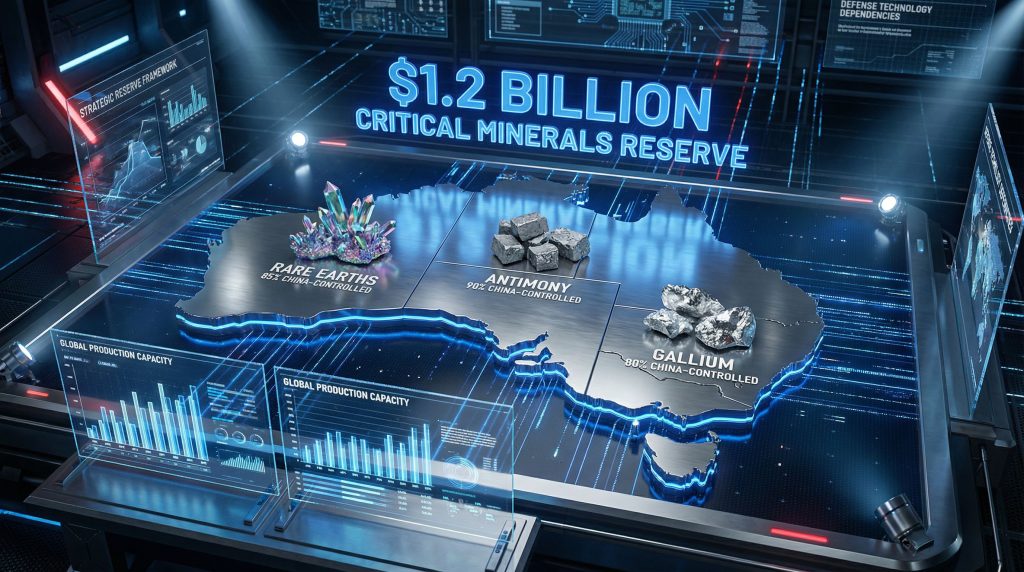
Strategic resource stockpiling has emerged as a cornerstone of national security policy across developed economies, yet few initiatives match the geopolitical significance of Australia's newly announced $1.2 billion critical minerals strategic reserve. This unprecedented investment signals a fundamental shift in how democratic nations approach supply chain resilience for materials essential to defence, telecommunications, and clean energy infrastructure.
The reserve framework addresses growing vulnerabilities in global supply chains where single-nation dominance creates systemic risks for allied economies. Furthermore, China currently controls between 80-90% of global production for critical rare earth elements, creating strategic dependencies that extend far beyond commercial considerations into national security infrastructure.
When big ASX news breaks, our subscribers know first
Strategic Reserve Framework and Implementation Timeline
The reserve operates through a government-backed procurement system designed to provide counter-cyclical market support during supply disruptions. This mechanism functions as both a strategic stockpile and a market stabilisation tool, with the government purchasing materials during periods of abundant supply and releasing them when shortages threaten allied nation requirements.
Implementation is projected to reach full operational capacity by late 2026, contingent upon legislative changes expanding government agency procurement authorities. Moreover, the framework requires coordination between Treasury, the Department of Resources, and Australia's Export Finance and Insurance Corporation to establish purchasing protocols and storage infrastructure.
The operational model draws from established strategic reserve precedents, particularly the U.S. Strategic Petroleum Reserve. In addition, it adapts procurement mechanisms for solid mineral commodities with varying storage requirements and degradation considerations.
Target Minerals and Their Defence Applications
Seven rare earth elements form the core of Australia's strategic priorities, each representing critical dependencies in defence and technology applications. The critical minerals strategy encompasses materials where alternative sources remain severely limited.
Dysprosium powers permanent magnets in guided missile systems and advanced fighter aircraft engines, with 85% of global supply concentrated under Chinese control. Consequently, alternative magnetic materials lack the temperature stability required for military specifications.
Terbium enables radiation-hardened electronics and military-grade LED systems essential for battlefield communications infrastructure, with 90% of production originating from Chinese sources.
Yttrium supports laser targeting systems and medical imaging equipment for forward surgical teams, representing 80% Chinese supply concentration with limited substitution possibilities for precision applications.
Beyond rare earths, however, the reserve encompasses antimony for flame retardants in military textiles and ammunition production, plus gallium for semiconductor manufacturing in radar systems and missile guidance electronics.
Geopolitical Implications for US-China Trade Relations
Australia's reserve initiative represents a significant escalation in supply chain diversification efforts among democratic allies. The programme explicitly designates the United States, Japan, South Korea, Canada, and the United Kingdom as primary beneficiaries, creating formal supply partnerships that bypass Chinese intermediaries.
This strategic positioning transforms Australia from a raw material exporter into a critical node in allied defence supply chains. Furthermore, the reserve framework enables coordinated responses to potential export restrictions or supply disruptions originating from geopolitically unstable regions.
Chinese policymakers are likely to view the initiative as economic containment, potentially accelerating development of alternative supply sources or implementing retaliatory measures against Australian mineral exports. However, China's own strategic mineral dependencies may limit aggressive responses.
How Will the Critical Minerals Strategic Reserve Reshape Australia's Mining Sector?
The $1.2 billion investment creates unprecedented government backing for domestic critical minerals production, fundamentally altering investment risk profiles for mining companies targeting strategic materials. This financial commitment provides demand certainty that traditional commercial markets cannot guarantee, particularly for minerals with volatile pricing and limited end-user diversity.
Domestic Production Incentives and Investment Flows
The reserve framework operates as a demand aggregation mechanism, consolidating allied nation requirements into coordinated procurement contracts. This structure reduces market risk for domestic producers by establishing predictable offtake volumes and government-backed purchasing commitments.
Investment Risk Reduction Benefits:
- Government contract certainty enabling project finance
- Price floor mechanisms protecting against market volatility
- Reduced dependence on volatile spot markets
- Long-term supply agreements with allied governments
Australian mining companies can now access project financing based on government purchase agreements rather than speculative commodity price projections. This fundamental shift enables development of deposits previously considered economically marginal due to market uncertainty.
The stable political environment, competitive royalty structures, and favourable government policies position Australia advantageously against other mining jurisdictions competing for strategic materials investment capital.
Export Finance Agency Powers and Market Mechanisms
Australia's Export Finance and Insurance Corporation gains expanded authorities to provide specialised financing for critical minerals projects. These enhanced powers include loan guarantees, direct lending facilities, and risk insurance products tailored to strategic materials development.
The financing framework prioritises projects meeting technical, geopolitical, and environmental standards demanded by international defence partners. Consequently, this creates quality thresholds that elevate baseline standards for participating Australian projects while ensuring supply chain integrity for allied nations.
Key Market Mechanisms:
- Counter-cyclical purchasing protocols
- Price discovery systems supporting production viability
- Quality certification requirements for defence applications
- Allied nation procurement coordination systems
Legislative Requirements for Reserve Operations
Parliamentary approval is required for expanded government agency authorities managing reserve procurement and operations. The legislative framework must address procurement protocols, budget allocation methodologies, and governance structures for strategic stockpile management.
Proposed legislation establishes quality standards, storage requirements, and distribution protocols ensuring reserves meet allied nation specifications during supply emergencies. Moreover, these regulatory requirements create compliance frameworks that participating mining companies must navigate while providing operational certainty for long-term planning.
Which Critical Minerals Are Prioritised Under Australia's New Reserve Strategy?
The reserve framework targets materials where Chinese supply dominance creates unacceptable strategic vulnerabilities for democratic allies. Priority selection reflects both supply concentration risks and irreplaceability in defence, telecommunications, and clean energy applications, similar to initiatives within the european crm facility.
Rare Earth Elements: Strategic Value and Supply Vulnerabilities
Australia's strategic reserve encompasses seven rare earth elements currently subject to Chinese export restrictions, representing comprehensive coverage of materials essential for advanced military systems and civilian infrastructure.
| Critical Rare Earth Elements Under Chinese Export Restrictions |
|---|
| Element |
| Dysprosium |
| Terbium |
| Yttrium |
| Scandium |
| Samarium |
| Gadolinium |
| Lutetium |
Dysprosium Applications in Defence Systems:
High-temperature permanent magnets for hypersonic weapon systems require dysprosium's unique magnetic properties at extreme operating temperatures. No alternative materials match performance specifications for U.S. Air Force F-35 fighter maintenance and production requirements, highlighting the need for defense critical minerals security.
Terbium's Critical Role in Military Electronics:
Radiation-hardened electronics depend on terbium-based components for reliable operation in nuclear environments. Military-grade LED systems achieving specific wavelengths for battlefield communications rely on terbium phosphors with no commercially viable substitutes.
Yttrium in Precision Military Applications:
Laser targeting systems require yttrium-based crystals for precision-guided munitions. In addition, advanced thermal barrier coatings incorporating yttrium protect jet engines operating under extreme conditions, with replacement materials still under development.
Antimony and Gallium: Defence Technology Dependencies
Antimony Strategic Importance:
Flame retardants for military textiles and vehicle interiors require antimony compounds meeting strict safety specifications. Furthermore, ammunition production utilising lead-antimony alloys depends on consistent supply for defence manufacturing continuity, supported by recent developments in strategic antimony loan programmes.
Australia possesses significant identified antimony resources despite minimal current active production. The strategic reserve framework provides incentives for developing these deposits to serve domestic defence requirements and allied nation partnerships.
Gallium's Semiconductor Applications:
Advanced radar systems, missile guidance electronics, and communications equipment depend on gallium-based semiconductors. The material's unique properties enable 5G and emerging 6G telecommunications infrastructure essential for modern military communications.
Current Australian gallium production operates only through byproduct recovery, with substantial untapped potential identified across multiple deposit types. The reserve programme incentivises investment in dedicated gallium extraction and processing capabilities.
Processing Capabilities vs. Raw Material Extraction
The reserve strategy emphasises high-purity heavy rare earth oxides rather than raw ore concentrates. This specification requires sophisticated processing capabilities that distinguish Australian production from generic commodity supply sources.
Processing Requirements for Defence Applications:
- 99.9% minimum purity standards for critical elements
- Specialised separation techniques for individual rare earth isolation
- Quality certification protocols meeting defence contractor specifications
- Contamination control preventing foreign material inclusion
Clay-based rare earth deposits offer processing advantages over traditional hard-rock mining through simplified extraction methodologies and reduced environmental impact. These geological characteristics enable economic production of high-purity concentrates meeting defence-grade specifications.
The strategic reserve creates a government-backed floor for domestic critical minerals pricing while providing counter-cyclical market support during supply disruptions. This mechanism reduces investment risk for mining companies while ensuring strategic stockpile availability for national security applications.
What Are the Economic Implications of a $1.2 Billion Strategic Reserve Investment?
The strategic reserve investment fundamentally alters critical minerals market dynamics by introducing government participation as both purchaser and supplier. This intervention creates price stability mechanisms that benefit domestic producers while providing supply security for allied nations during geopolitical disruptions.
Market Stabilisation Mechanisms and Price Discovery
Government procurement operates through counter-cyclical purchasing protocols, accumulating inventory during periods of market oversupply and releasing materials when shortages threaten allied supply chains. This mechanism smooths price volatility that historically discouraged investment in critical minerals projects.
Price Discovery Benefits:
- Transparent government purchasing at market prices eliminates speculation
- Consistent demand signals enable long-term production planning
- Reduced price volatility attracts institutional investment capital
- Market confidence from government participation as reliable buyer
The reserve framework establishes minimum purchase commitments that provide revenue certainty for domestic producers. These agreements enable project financing based on government contracts rather than speculative commodity price projections, fundamentally reducing investment risk.
Revenue Models: Buy-Low, Sell-High Government Operations
The strategic reserve operates as a commercial entity generating returns through timing market cycles. Government purchases during low-price periods and strategic releases during supply emergencies create revenue streams supporting reserve operations while serving national security objectives.
Operational Revenue Streams:
- Purchase price arbitrage between acquisition and release phases
- Storage and processing fees charged to allied nation purchasers
- Premium pricing during supply emergency releases
- Interest earnings on reserve capital during accumulation periods
This business model ensures the reserve becomes self-sustaining rather than requiring ongoing government subsidisation. Successful operations could generate surplus revenues supporting expanded strategic stockpiling programmes for additional critical materials.
Impact on ASX-Listed Critical Minerals Companies
Australian Stock Exchange-listed companies with critical minerals exposure experience immediate benefits from reserve announcement through reduced investment uncertainty and expanded market opportunities. Government purchasing commitments create tangible value propositions for institutional and retail investors.
Stock Market Implications:
- Reduced commodity price volatility improves earnings predictability
- Government contracts enable debt financing at favourable terms
- Strategic partnership opportunities with allied nation purchasers
- ESG compliance advantages from supporting national security objectives
Mining companies meeting reserve procurement standards gain competitive advantages through government endorsement and quality certification. These credentials facilitate international partnerships and enhance access to allied nation markets previously dominated by Chinese suppliers.
The next major ASX story will hit our subscribers first
How Does Australia's Reserve Compare to Global Critical Minerals Strategies?
Democratic nations worldwide are developing strategic mineral stockpiling programmes responding to supply chain vulnerabilities exposed during recent geopolitical tensions. Australia's $1.2 billion commitment represents one of the most comprehensive approaches to critical minerals security among allied economies.
US Strategic Petroleum Reserve Model vs. Minerals Stockpiling
The United States maintains approximately 380 million barrels in its Strategic Petroleum Reserve, providing 30-40 days of emergency supply during complete import disruptions. Australia's critical minerals reserve adapts this concept for solid commodities with different storage requirements and longer-term strategic applications.
Key Differences Between Petroleum and Minerals Reserves:
- Petroleum requires specialised storage facilities; minerals need controlled atmosphere warehousing
- Oil degrades over time; most critical minerals remain stable with proper storage
- Petroleum serves civilian and military applications; critical minerals primarily support defence and technology
- Oil markets have established pricing mechanisms; critical minerals lack transparent price discovery
The U.S. Defense Production Act authorises government intervention in critical minerals markets, but lacks dedicated funding comparable to Australia's $1.2 billion commitment. American approaches focus on loan guarantees and tax incentives rather than direct government purchasing.
European Union Critical Raw Materials Act Comparison
The European Union's Critical Raw Materials Act establishes procurement targets and domestic processing requirements, but relies primarily on private sector development rather than government stockpiling. EU strategies emphasise recycling and substitution research over strategic reserve accumulation.
EU vs. Australian Approaches:
- EU focuses on supply chain resilience through diversification; Australia emphasises strategic stockpiling
- European initiatives prioritise recycling and circular economy principles; Australia targets primary production
- EU regulations mandate private sector compliance; Australia provides government financial backing
- European strategies span multiple member nations; Australia implements unified national approach
Japan and South Korea Supply Chain Diversification Efforts
Japan and South Korea, both heavily dependent on Chinese critical minerals, are developing bilateral partnerships with resource-rich nations rather than building domestic strategic reserves. These approaches complement Australia's stockpiling strategy by creating secure demand channels for allied nation supply, supporting energy transition security objectives.
Northeast Asian Strategies:
- Long-term purchase agreements with Australian and Canadian producers
- Joint venture investments in overseas mining projects
- Technology sharing agreements for processing capabilities
- Government financing for supply chain infrastructure development
What Are the Technical Challenges in Building a Critical Minerals Reserve?
Strategic stockpiling of critical minerals presents unique technical challenges compared to traditional commodity reserves. Material properties, purity requirements, and storage conditions vary significantly across different elements, requiring specialised infrastructure and handling protocols.
Storage and Degradation Considerations for Different Minerals
Rare earth elements maintain stability under controlled atmospheric conditions but require protection from moisture and contamination that could compromise purity specifications. Storage facilities must accommodate varying chemical properties and prevent cross-contamination between different elements.
Technical Storage Requirements:
- Controlled atmosphere warehousing preventing oxidation
- Temperature and humidity monitoring systems
- Segregated storage preventing elemental contamination
- Regular quality testing ensuring purity maintenance over time
Antimony and gallium present different storage challenges due to their metallic properties and potential for environmental interaction. Proper storage protocols ensure materials retain defence-grade specifications throughout extended stockpiling periods.
Quality Standards and Purity Requirements
Defence applications demand specific purity standards often exceeding 99.9% for critical elements. These requirements necessitate sophisticated analytical capabilities and quality assurance protocols ensuring stockpiled materials meet end-user specifications.
Quality Assurance Protocols:
- Incoming material certification from approved suppliers
- Random sampling and independent laboratory verification
- Chain of custody documentation for traceability
- Regular inventory audits confirming material integrity
Processing capabilities must maintain separation standards preventing contamination during handling and transportation. Quality control systems ensure strategic reserves deliver materials meeting the precise specifications required for defence and technology applications.
Logistics Infrastructure for Strategic Distribution
Emergency distribution systems require rapid deployment capabilities connecting storage facilities to end-users during supply disruptions. Logistics infrastructure must accommodate secure transportation of sensitive materials to defence contractors and allied nation recipients.
Transportation networks need redundancy ensuring distribution continuity during various emergency scenarios. Strategic positioning of storage facilities provides geographic distribution reducing single-point-of-failure risks while maintaining secure access for authorised personnel.
Which Australian Mining Projects Could Benefit Most from Reserve Procurement?
The strategic reserve framework creates immediate opportunities for Australian mining companies with advanced critical minerals projects meeting government procurement standards. Projects demonstrating technical capability, resource quality, and operational readiness stand to benefit most from government purchasing commitments.
Heavy Rare Earth Clay Deposits in Western Australia
Clay-based heavy rare earth deposits offer significant advantages over traditional hard-rock mining through simplified processing requirements and reduced environmental impact. These geological characteristics enable economic extraction of high-purity rare earth concentrates suitable for defence applications.
The North Stanmore Project represents Australia's most advanced heavy rare earth clay development, encompassing all seven elements under Chinese export restrictions. This comprehensive mineral suite positions the project as uniquely valuable for strategic reserve procurement and allied nation supply agreements.
North Stanmore Strategic Advantages:
- Complete heavy rare earth element portfolio in single deposit
- Clay-based geology enabling simplified processing
- High-grade mineralisation reducing extraction costs
- Established infrastructure access supporting commercial development
Antimony Projects and Strategic Metal Diversification
Australia possesses significant antimony resources across multiple states, despite minimal current production. The strategic reserve framework incentivises development of these deposits to serve domestic defence requirements while reducing dependence on Chinese antimony exports.
Recent exploration programmes have identified substantial antimony-gold mineralisation suitable for commercial development. Government purchasing commitments through the strategic reserve provide revenue certainty enabling project financing and construction timelines meeting strategic objectives.
Processing Facility Development Incentives
The reserve strategy emphasises processed materials rather than raw ore exports, creating incentives for domestic processing capability development. Government procurement preferences for Australian-processed materials support value-added manufacturing while ensuring supply chain security.
Processing Development Benefits:
- Higher-value product sales compared to raw ore exports
- Employment creation in regional processing facilities
- Technical expertise development supporting industry growth
- Reduced transportation costs for government procurement
| Australian Critical Minerals Production Capacity |
|---|
| Mineral Category |
| Heavy Rare Earths |
| Antimony |
| Gallium |
What Role Will Allied Nations Play in Australia's Critical Minerals Strategy?
Allied nation participation extends beyond purchasing agreements to encompass technology sharing, joint investment programmes, and coordinated supply chain development. These partnerships create integrated strategic materials networks reducing collective dependence on geopolitically unstable suppliers.
US-Australia Critical Minerals Partnership Framework
The United States and Australia have established comprehensive partnership frameworks covering investment, technology transfer, and procurement coordination for critical minerals development. These agreements facilitate joint ventures between American technology companies and Australian mining operations.
Partnership Components:
- Joint research and development programmes for processing technologies
- Shared financing mechanisms for strategic minerals projects
- Coordinated stockpiling strategies preventing market disruptions
- Technology transfer agreements supporting domestic processing capabilities
American defence contractors gain secure access to Australian critical minerals through government-to-government agreements, whilst Australian companies access U.S. technology and investment capital for project development.
AUKUS Technology Sharing and Supply Chain Integration
The AUKUS partnership between Australia, the United Kingdom, and the United States includes critical minerals supply chain integration supporting advanced defence technology development. Submarine and hypersonic weapons programmes require secure access to Australian rare earth elements and strategic metals.
Technology sharing agreements enable Australian companies to access advanced processing techniques while providing AUKUS partners with supply chain security for defence manufacturing. These arrangements create strategic interdependencies supporting long-term allied cooperation.
Five Eyes Intelligence Sharing on Resource Security
Intelligence cooperation through the Five Eyes partnership includes monitoring global critical minerals supply chains and identifying potential disruption risks. This information sharing supports strategic planning and early warning systems for supply emergencies, as highlighted by recent analysis in the Capital Brief report.
Intelligence Cooperation Areas:
- Global supply chain monitoring and risk assessment
- Foreign investment screening in critical minerals sectors
- Technology transfer restrictions preventing sensitive capability loss
- Market manipulation detection and countermeasure coordination
How Will China Respond to Australia's Strategic Reserve Initiative?
Chinese policymakers are likely to interpret Australia's strategic reserve as economic containment requiring strategic responses. However, China's own critical minerals dependencies and economic interests in Australia may limit aggressive retaliation while encouraging alternative supply development.
Potential Export Restriction Escalations
China could expand export restrictions beyond current rare earth controls to include broader categories of critical minerals. Recent restrictions on gallium and germanium exports demonstrate willingness to weaponise supply chain dependencies for geopolitical objectives.
Potential Chinese Responses:
- Expanded rare earth export quotas and licensing requirements
- Quality and purity specifications disadvantaging non-Chinese purchasers
- Price manipulation through state-controlled enterprise coordination
- Investment restrictions in overseas critical minerals projects
However, escalating export restrictions risk accelerating Western supply chain diversification efforts while damaging Chinese commercial interests in Australia's broader mineral exports including iron ore and coal.
Alternative Supply Chain Development by Beijing
China is likely to accelerate development of alternative critical minerals sources through Belt and Road Initiative investments and bilateral partnerships with resource-rich developing nations. These efforts aim to reduce strategic reliance on Australian and other Western-aligned suppliers.
African rare earth developments in Burundi, Tanzania, and Madagascar receive increasing Chinese investment supporting processing capabilities and transportation infrastructure. These projects could eventually provide alternative supplies reducing Chinese dependence on Australian strategic reserves.
Economic Warfare Scenarios and Mitigation Strategies
Economic warfare scenarios involving critical minerals could include coordinated supply disruptions, market manipulation, or technology transfer restrictions targeting Australian companies. Mitigation strategies require allied coordination and diverse supplier networks.
Risk Mitigation Approaches:
- Multiple supplier diversification reducing single-source dependencies
- Strategic stockpiling providing emergency supply buffers
- Technology protection preventing sensitive capability transfers
- Allied cooperation creating collective response mechanisms
Australia's strategic reserve provides buffer capacity enabling responses to Chinese economic pressure while maintaining supply commitments to allied nations during extended disruptions.
What Are the Long-Term Implications for Global Critical Minerals Markets?
Australia's strategic reserve initiative represents a fundamental shift toward government intervention in critical minerals markets, establishing precedents other nations will likely follow. This evolution creates new market dynamics balancing commercial operations with strategic security considerations.
Price Volatility Reduction Through Strategic Stockpiling
Government participation as both major purchaser and supplier creates price stabilisation mechanisms reducing the extreme volatility historically characterising critical minerals markets. More predictable pricing supports increased private investment in production capacity and processing infrastructure.
Market Stability Benefits:
- Reduced price speculation through transparent government participation
- Consistent demand signals supporting long-term capacity investment
- Emergency supply capabilities preventing shortage-driven price spikes
- Investment confidence from government market intervention
Strategic reserves operated by multiple allied nations could coordinate releases during supply emergencies, preventing market manipulation by hostile suppliers while maintaining price stability for end-users.
Investment Capital Flows into Alternative Supply Sources
The reserve framework demonstrates government commitment to supporting domestic critical minerals production, attracting institutional investment capital previously deterred by market volatility and supply chain risks. Financial markets recognise strategic minerals as essential infrastructure investments supported by government policy, as detailed in the Smart Company analysis.
Investment Attraction Factors:
- Government purchasing commitments reducing demand uncertainty
- Strategic importance supporting policy stability over political cycles
- ESG alignment through supply chain security and allied cooperation
- Technology development opportunities in processing and extraction
Pension funds, sovereign wealth funds, and institutional investors can evaluate critical minerals projects based on government contract certainty rather than speculative commodity price projections.
Technology Innovation Incentives for Mineral Processing
Strategic reserves emphasising high-purity processed materials create market incentives for processing technology development. Advanced separation techniques, purification methods, and quality control systems become commercially viable through government procurement commitments.
Research and development programmes supported by allied nations accelerate innovation in critical minerals processing while maintaining technological leadership over potential adversaries. These advances support both strategic objectives and commercial competitiveness in global markets.
Frequently Asked Questions:
When will Australia's Critical Minerals Strategic Reserve become operational?
The reserve is expected to become fully operational by the end of 2026, following necessary legislative changes to expand government agency powers and establish procurement protocols.
Which countries will have access to Australia's strategic mineral reserves?
Primary access will be provided to key allies including the United States, Japan, South Korea, Canada, and the United Kingdom through established partnership frameworks and government-to-government agreements.
How will the reserve impact critical minerals pricing in global markets?
The reserve is designed to provide market stabilisation during supply disruptions while creating price discovery mechanisms that support domestic production viability. Government participation should reduce price volatility while maintaining competitive market conditions.
What quality standards will the reserve maintain for stockpiled materials?
The reserve will maintain defence-grade purity standards, typically exceeding 99.9% for critical elements, with comprehensive quality assurance protocols ensuring materials meet end-user specifications throughout storage periods.
How does Australia's reserve compare to other nations' strategic stockpiling programmes?
Australia's $1.2 billion commitment represents one of the most comprehensive critical minerals stockpiling programmes among democratic allies, emphasising government purchasing and strategic partnerships rather than regulatory mandates alone.
Ready to Discover the Next Major ASX Mineral Breakthrough?
Australia's $1.2 billion strategic reserve creates unprecedented opportunities for ASX-listed critical minerals companies, with government backing providing demand certainty that transforms investment risk profiles. Discovery Alert's proprietary Discovery IQ model delivers real-time alerts on significant ASX mineral discoveries, empowering subscribers to identify actionable opportunities in this rapidly evolving strategic minerals landscape before the broader market catches on.