
May 16, 2026
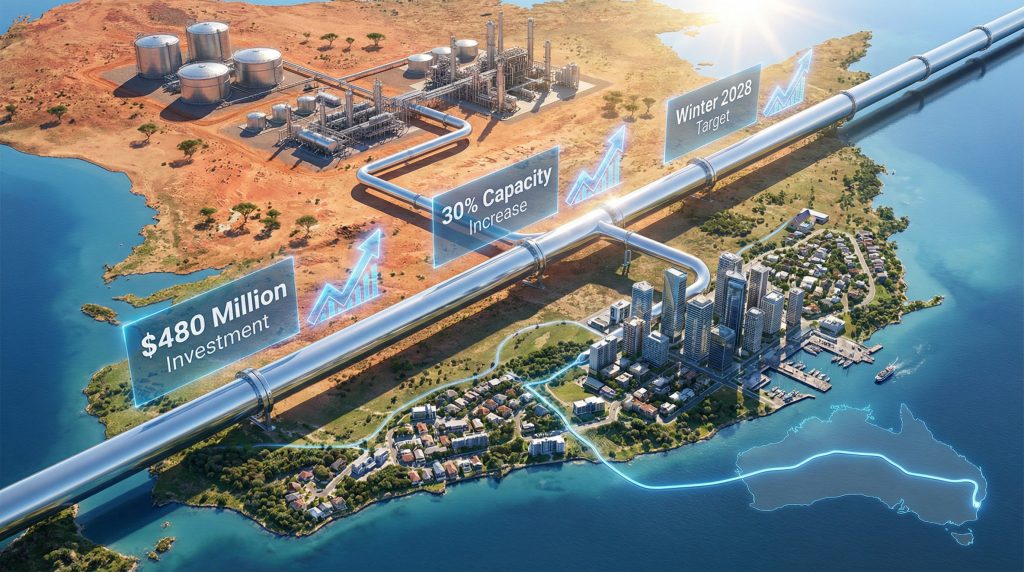
Australia's energy sector faces an unprecedented challenge as massive infrastructure investments signal a fundamental shift in how the nation balances domestic supply security with its position as a global LNG powerhouse. The current pipeline capacity constraints represent more than temporary operational hurdles—they expose systemic weaknesses in energy infrastructure planning that could determine Australia's industrial competitiveness for decades to come.
Recent infrastructure expansion announcements highlight the scale of transformation required to prevent Australia from becoming a net energy importer despite its vast domestic reserves. This paradox stems from geographic misalignment between resource abundance and consumption centres, creating transport bottlenecks that threaten both energy security and economic stability.
Understanding the $480 Million Strategic Response to Infrastructure Deficits
The scale of recent infrastructure commitments reflects industry recognition that traditional market mechanisms may be insufficient to address looming supply-demand imbalances. APA east coast gas expansion represents the largest single investment in transport capacity expansion in over a decade, signalling a strategic repositioning ahead of projected market shortfalls.
Investment Structure and Capital Deployment Timeline
The comprehensive expansion programme divides into two distinct phases designed to optimise capital deployment while minimising customer cost impacts:
- Stage 3A Development: $260 million committed for immediate capacity expansion targeting winter 2028 delivery
- Stage 3B Pre-Development: $220 million allocated for procurement and early works beyond 2028
- Total System Enhancement: 30% increase in north-to-south transport capability
- Funding Mechanism: Corporate balance sheet capacity avoiding external financing requirements
- Return Framework: Projected returns exceeding established company hurdle rates
According to APA Group's February 2026 announcement, these investments form part of a broader $3 billion organic growth pipeline, indicating multiple expansion projects planned across the network. The staged approach reflects sophisticated demand forecasting that anticipates capacity requirements while managing capital raising strategies timing.
Strategic Market Positioning Through Infrastructure Leadership
The expansion creates significant competitive advantages beyond immediate capacity increases. Furthermore, infrastructure operators gain enhanced regulatory relationships through major capital commitments, positioning them as essential stakeholders in policy discussions around domestic gas reservation and energy security frameworks.
Market Leadership Benefits Include:
- Capacity Dominance: Controlling critical transport infrastructure during supply shortfall periods
- Revenue Diversification: Multiple customer segments reducing concentration risk
- Regulatory Influence: Enhanced policy engagement capacity through infrastructure criticality
- Growth Platform: Foundation for additional expansion phases as demand evolves
When big ASX news breaks, our subscribers know first
Geographic Supply-Demand Asymmetry: The Root Cause of Infrastructure Strain
Australia's energy challenge originates from fundamental geographic constraints that create inherent transport capacity requirements. Northern regions contain vast conventional and unconventional gas reserves, while southern consumption centres experience acute seasonal demand variations that exceed average pipeline utilisation rates.
Reserve Distribution and Production Capacity Analysis
Northern Australian basins concentrate the majority of proven and probable gas reserves across multiple geological formations:
- Carnarvon Basin: Major conventional reserves supporting current LNG export operations
- Browse Basin: Significant undeveloped reserves awaiting infrastructure connections
- Timor Sea Fields: Mature production regions with established infrastructure
- Beetaloo Basin: Emerging unconventional resources requiring development investment
These northern reserves contrast sharply with southern market consumption patterns, where industrial users, power generation facilities, and residential heating create concentrated demand during winter months. However, the seasonal compression effect amplifies transport capacity requirements beyond annual averages, creating acute bottlenecks during peak periods.
Infrastructure Evolution and Capacity Constraints
Previous expansion phases increased system capacity by approximately 25% between 2023-2024, demonstrating both the scale of demand growth and the ongoing nature of infrastructure transformation requirements. Nevertheless, projected demand growth continues to exceed planned capacity additions without complementary policy interventions.
Transport Capacity Challenges:
- Seasonal Volatility: Winter demand spikes creating acute transport pressure
- Export Competition: LNG terminals competing for identical gas sources
- Geographic Distance: Extended pipeline routes increasing transport complexity
- Multiple Demand Centres: Various consumption regions requiring flexible routing capabilities
The Energy Security Paradox: Infrastructure Solutions vs. Policy Requirements
Australia faces the unusual prospect of potentially importing LNG despite ranking among the world's three largest exporters—a scenario that highlights critical gaps between infrastructure capacity and policy frameworks. This paradox reflects the disconnect between resource abundance and domestic market access rather than fundamental supply scarcity.
Domestic Gas Reservation Policy Integration
Infrastructure expansion alone cannot resolve projected shortfalls without complementary policy mechanisms that ensure adequate volumes flow into domestic markets. APA's leadership emphasises that pipeline capacity will not constrain supply solutions, but policy intervention remains critical for upstream investment certainty.
The reservation policy framework requires federal government implementation to create investment signals for gas producers while ensuring transport infrastructure capacity aligns with domestic market requirements. In addition, without this policy coordination, infrastructure investments risk becoming stranded assets if upstream supply development proves insufficient.
International Comparative Analysis
Australia's approach can be benchmarked against other major LNG exporters managing similar domestic-export balance challenges:
| Country | Domestic Policy Approach | Export Strategy | Market Integration |
|---|---|---|---|
| United States | Market-driven domestic priority | Competitive export growth | Regional pipeline networks |
| Qatar | Integrated planning framework | State-coordinated exports | Centralised allocation |
| Canada | Provincial jurisdiction complexity | Federal export approvals | Interprovincial coordination challenges |
| Australia | State-federal policy gaps | Market-driven exports | Infrastructure capacity constraints |
This comparison reveals Australia's unique challenge of balancing state-federal jurisdiction complexities with market-driven export commitments while maintaining domestic supply security through infrastructure investment rather than regulatory reservation mechanisms.
Financial Architecture and Market Positioning Strategy
The investment structure demonstrates sophisticated capital allocation designed to maximise returns while minimising customer cost impacts and maintaining balance sheet flexibility for future expansion phases.
Return Framework and Investment Metrics
| Investment Component | Capital Allocation | Funding Source | Strategic Objective |
|---|---|---|---|
| Stage 3A Capacity | $260 million | Balance sheet capacity | Winter 2028 delivery |
| Stage 3B Development | $220 million | Internal resources | Post-2028 expansion |
| Total Programme | $480 million | Corporate funding | Market leadership |
The investment targeting returns above company hurdle rates indicates confidence in long-term demand growth and pricing power through infrastructure scarcity. Corporate funding through existing balance sheet capacity avoids external financing costs while maintaining financial flexibility for additional expansion phases within the broader $3 billion growth pipeline.
Competitive Positioning and Revenue Diversification
Infrastructure expansion creates multiple revenue enhancement opportunities beyond immediate capacity increases:
- Customer Base Expansion: Access to previously capacity-constrained markets
- Contract Duration Extension: Long-term agreements providing revenue certainty
- Pricing Power Enhancement: Transport scarcity supporting rate optimisation
- Service Differentiation: Reliability and flexibility commanding premium pricing
Multi-Segment Market Impact Analysis
The expansion affects different consumer segments through distinct mechanisms, from residential heating reliability to industrial competitiveness and power generation flexibility.
Residential and Commercial Sector Benefits
Enhanced transport capacity directly addresses winter supply security concerns that have created uncertainty around heating costs and availability during peak demand periods. Furthermore, improved system redundancy provides service reliability benefits while transport efficiency gains may moderate cost increases from upstream price pressures.
Key Residential Impact Areas:
- Winter Supply Certainty: Reduced shortage risk during heating season peaks
- Cost Moderation Potential: Transport efficiency offsetting upstream price pressure
- Service Reliability Enhancement: System redundancy improving supply consistency
Industrial User Competitiveness Enhancement
Energy-intensive industries require reliable, affordable gas supply for manufacturing competitiveness, particularly in sectors like fertiliser production, petrochemicals, and heavy manufacturing where gas represents a significant input cost component.
Infrastructure expansion provides investment confidence for long-term industrial planning by reducing supply uncertainty that has constrained expansion decisions. Consequently, manufacturing facilities can proceed with capacity investments knowing transport bottlenecks will not constrain future operations.
Power Generation Sector Strategic Flexibility
Gas-fired power generation serves critical grid stability functions as renewable energy deployment accelerates, providing backup generation during renewable output variability and peak load management capabilities during high demand periods.
Enhanced pipeline capacity ensures power generation facilities can access gas supplies during critical grid stability periods, supporting renewable energy integration while maintaining electricity system reliability during transition phases.
Infrastructure Investment Transformation Signals Across the Industry
The scale and timing of these infrastructure commitments reflect broader industry recognition that traditional supply-demand balancing mechanisms may prove insufficient for future market conditions without proactive capacity development.
Capital Allocation Trend Shifts
Major infrastructure investments represent a strategic pivot toward domestic infrastructure enhancement over export capacity expansion, signalling industry concerns about domestic market access challenges affecting long-term commercial viability. These developments mirror broader energy transition challenges facing resource-dependent economies globally.
Industry-Wide Transformation Indicators:
- Domestic Infrastructure Priority: Capital shifting from export to domestic transport capacity
- Policy Advocacy Intensification: Enhanced industry engagement on reservation frameworks
- Technology Integration: Smart pipeline systems and demand management capabilities
- Environmental Performance: Efficiency improvements reducing emission intensity
Competitive Landscape Evolution and Market Dynamics
Large-scale infrastructure investments create substantial barriers to entry while potentially reshaping competitive dynamics between pipeline operators, gas producers, and end-user customers through enhanced market concentration in transport services.
Established operators with existing pipeline networks gain significant advantages from capacity expansion investments, as new entrants face prohibitive capital requirements and regulatory approval complexities for alternative transport infrastructure development.
The next major ASX story will hit our subscribers first
Strategic Scenario Analysis: Alternative Development Pathways
Multiple scenarios could emerge from current infrastructure investment decisions, depending on policy coordination, upstream investment responses, and international market conditions affecting Australia's energy sector development trajectory.
What Happens with Integrated Success Through Policy-Infrastructure Alignment?
If domestic gas reservation policies coordinate effectively with infrastructure expansion, Australia could achieve energy security objectives while maintaining competitive LNG export positions and supporting industrial sector expansion.
Success Pathway Indicators:
- Stable Domestic Pricing: Reservation policy providing cost certainty
- Export Growth Continuity: Infrastructure supporting both domestic and export markets
- Industrial Expansion: Manufacturing sector confidence driving investment
- Energy Transition Support: Gas infrastructure facilitating renewable integration
What Are the Infrastructure-Policy Misalignment Challenges?
Without effective policy coordination, infrastructure expansion alone may prove insufficient to address projected supply shortfalls, potentially creating stranded asset risks and continued market imbalances. This aligns with broader energy exports challenges facing Australian resource sectors.
Challenge Indicators:
- Persistent Supply-Demand Gaps: Infrastructure capacity exceeding available gas supplies
- Import Dependency Development: LNG import terminals becoming necessary despite domestic reserves
- Industrial Competitiveness Decline: Manufacturing sectors relocating to lower-cost jurisdictions
- Asset Utilisation Underperformance: Pipeline investments generating suboptimal returns
Market-Driven Resolution Through Price Signals
Market mechanisms could potentially drive upstream investment and supply development without direct policy intervention, relying on price signals to balance domestic and export demand allocation. However, this approach must contend with volatile natural gas trends affecting long-term investment decisions.
Market Resolution Variables:
- Price Signal Effectiveness: Domestic-export price differentials driving upstream investment
- International Market Conditions: Global LNG demand affecting export revenue optimisation
- Technology Cost Reductions: Upstream development economics improving through innovation
- Alternative Energy Adoption: Renewable deployment rates affecting gas demand growth
Global Context and Strategic Energy Independence Positioning
Australia's infrastructure investment approach represents a distinctive model among major LNG exporters, emphasising market-driven solutions with infrastructure capacity expansion while other exporters rely more heavily on regulatory reservation mechanisms or state-controlled allocation systems.
International Energy Security Benchmarking
Comparative analysis reveals different approaches to balancing domestic energy security with export revenue optimisation across major gas-producing nations:
- United States Model: Domestic market priority supported by abundant shale production
- Qatar Strategy: Integrated domestic-export planning through state coordination
- Russian Approach: State-controlled allocation prioritising domestic industrial needs
- Canadian Framework: Regional market integration challenges affecting national coordination
Australia's infrastructure-focused approach attempts to achieve energy security through capacity expansion rather than regulatory intervention, representing a unique model that balances market mechanisms with strategic infrastructure investment.
Energy Independence Through Infrastructure Resilience
The investment strategy positions Australia to maintain energy independence while preserving international market participation, contrasting with approaches that prioritise domestic allocation through regulatory mechanisms that may constrain export flexibility. Furthermore, this strategy must consider evolving natural gas forecasts that influence global competitiveness.
Infrastructure resilience provides strategic advantages during international supply disruptions or geopolitical tensions affecting global energy markets, ensuring domestic supply security without compromising export revenue generation capabilities.
Critical Monitoring Framework for Stakeholder Assessment
Success measurement requires comprehensive monitoring across multiple performance dimensions, from capacity utilisation rates to policy development progress and upstream investment responses.
Key Performance Indicators and Success Metrics
Capacity and Utilisation Monitoring:
- Pipeline Utilisation Rates: Measuring actual versus projected demand realisation
- Transport Cost Differentials: North-south price spread changes indicating capacity effectiveness
- Service Reliability Metrics: System availability during peak demand periods
- Customer Satisfaction Indicators: Service quality and pricing competitiveness measures
Policy Development and Regulatory Response Tracking
Infrastructure investment effectiveness depends significantly on complementary policy development, particularly around domestic gas reservation frameworks and upstream investment incentives.
Policy Coordination Indicators:
- Reservation Policy Progress: Federal government implementation timeline and framework details
- Upstream Investment Response: New project commitments following infrastructure expansion
- Regulatory Approval Efficiency: Project development timeline improvements
- Stakeholder Engagement Quality: Industry-government coordination effectiveness
Risk Factor Assessment and Mitigation Strategies
Multiple risk factors could affect investment success, requiring continuous monitoring and adaptive management strategies to optimise outcomes across changing market conditions.
| Risk Category | Specific Factors | Monitoring Metrics | Mitigation Approaches |
|---|---|---|---|
| Regulatory | Policy implementation delays | Government announcement timelines | Industry advocacy coordination |
| Market | Demand growth variations | Consumption trend analysis | Flexible capacity management |
| Technology | Alternative energy adoption | Renewable deployment rates | Service diversification strategies |
| International | Global LNG market volatility | Export price differentials | Contract portfolio optimisation |
The comprehensive infrastructure investment represents a strategic approach to Australia's energy future that positions infrastructure development as the foundation for energy security, industrial competitiveness, and export revenue sustainability. Success ultimately depends on coordination between infrastructure capacity, policy frameworks, and market mechanisms to create sustainable balance between domestic energy requirements and international market opportunities.
Disclaimer: This analysis contains forward-looking statements and projections based on current market conditions and announced investment plans. Actual outcomes may vary significantly due to policy changes, market conditions, regulatory decisions, and other factors beyond current forecasting capabilities. Investment decisions should consider multiple scenario outcomes and professional financial advice.
Looking to Capitalise on Australia's Energy Infrastructure Transformation?
Discovery Alert's proprietary Discovery IQ model delivers real-time notifications on significant ASX mineral discoveries, helping investors identify actionable opportunities across Australia's evolving energy and resources landscape before the broader market responds. Begin your 14-day free trial today and gain the market-leading edge needed to navigate Australia's infrastructure investment surge.