August 25, 2026
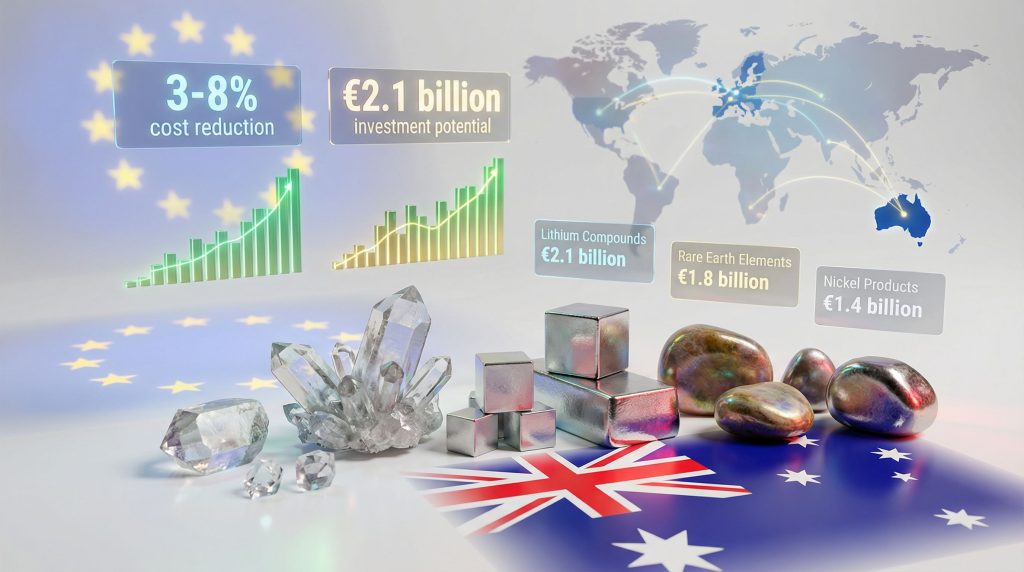
The Australia-European Union free trade agreement represents a pivotal development in global critical minerals strategy, addressing unprecedented vulnerabilities across strategic material supply chains. This comprehensive framework eliminates tariffs on lithium, rare earths, antimony, nickel, cobalt, copper, and uranium, fundamentally reshaping how advanced economies secure essential resources for technological transitions and manufacturing competitiveness.
The convergence of geopolitical tensions, technological transitions, and resource nationalism has fundamentally altered how nations approach strategic material security. This evolving landscape has catalysed new forms of economic partnerships that prioritise supply chain resilience alongside commercial efficiency, marking a departure from purely market-driven resource allocation models toward strategic resource diplomacy.
Reshaping Critical Minerals Trade Architecture
The Australia-European Union free trade agreement represents a paradigm shift in how developed economies structure strategic resource partnerships. By eliminating tariffs across lithium, rare earths, antimony, nickel, cobalt, copper, and uranium categories, this framework creates preferential trading conditions that extend far beyond conventional commercial arrangements.
Core Trade Liberalisation Elements:
- Complete tariff elimination across critical mineral classifications
- Streamlined investment protocols for cross-border capital deployment
- Regulatory harmonisation for technical standards and qualifications
- Enhanced intellectual property protections for collaborative technology development
The agreement's scope encompasses not merely raw material exports but extends throughout the entire value chain, from initial extraction through advanced processing and manufacturing applications. This comprehensive approach addresses historical vulnerabilities where raw material access failed to guarantee processed material security.
Industry analysis from the Minerals Council of Australia indicates that removing trade barriers would improve Australia's competitive positioning while supporting predictable commercial relationships with European strategic partners. Furthermore, the framework emphasises long-term supply security over short-term price optimisation, reflecting broader shifts in resource market dynamics.
Investment Certainty and Capital Mobilisation
European capital deployment in Australian critical minerals projects requires regulatory predictability spanning decade-long development cycles. The agreement establishes frameworks that enable institutional investors to commit resources with greater confidence in long-term project viability.
Key Investment Protection Mechanisms:
- Standardised environmental assessment procedures
- Mutual recognition of professional engineering qualifications
- Protected intellectual property sharing arrangements
- Dispute resolution frameworks for cross-border investments
The Department of Foreign Affairs and Trade emphasises that these provisions would enhance investment certainty while unlocking greater European Union participation in Australian mining projects, downstream processing facilities, and integrated supply chain development.
When big ASX news breaks, our subscribers know first
Economic Impact Assessment and Competitive Positioning
Tariff elimination creates immediate cost advantages for Australian producers accessing European markets, while European companies gain preferential investment access to high-grade mineral deposits. This bilateral benefit structure incentivises long-term strategic partnerships over transactional commodity relationships.
Projected Market Impact Analysis:
| Mineral Category | Market Access Improvement | Investment Flow Potential |
|---|---|---|
| Lithium Processing | Enhanced processing margins | Significant European capital interest |
| Rare Earth Refining | Reduced import dependency | Technology transfer opportunities |
| Battery Metal Integration | Vertical integration benefits | Supply chain localisation incentives |
| Strategic Reserve Development | Security of supply assurance | Government-backed financing potential |
The agreement positions Australian producers to capture additional value from European markets while European manufacturers secure priority access to critical materials with predictable pricing mechanisms. This mutual advantage structure creates sustainable competitive positioning that extends beyond simple resource extraction.
Market analysts suggest that preferential access could moderate price volatility for critical minerals whilst encouraging investment in additional production capacity. Consequently, this benefits downstream manufacturers and end-consumers globally through more stable supply conditions.
Technology Transfer and Innovation Collaboration
Joint technology development initiatives between Australian mining operations and European advanced manufacturing companies represent a strategic component of the agreement's long-term value proposition. These partnerships focus on sustainable extraction methods, advanced processing technologies, and circular economy applications.
Priority Technology Development Areas:
- Direct lithium extraction from brine and hard rock sources
- Rare earth element separation and purification advancement
- Battery material recycling and recovery systems
- Carbon-neutral mining operation technologies
- Automated mineral processing and quality control systems
The framework incorporates intellectual property protections and technology sharing mechanisms aimed at supporting innovation across critical minerals energy security and defence-related supply chains. This approach enables both regions to maintain technological leadership while reducing dependence on external technology providers.
Supply Chain Diversification and Risk Mitigation
Current global critical minerals supply chains exhibit dangerous concentration patterns, with single regions controlling dominant market positions across multiple essential materials. However, the Australia-EU partnership creates alternative supply pathways that reduce European dependence on geopolitically unstable production centres.
Regional Supply Concentration Challenges:
"European manufacturers previously faced supply chain risks where significant portions of lithium processing, rare earth refining, and cobalt processing occurred in regions with elevated geopolitical risk profiles, creating systemic vulnerabilities for advanced manufacturing sectors."
The agreement directly supports EU raw materials supply diversification objectives by creating preferential access to Australian resources while maintaining high environmental and social governance standards throughout the supply chain.
EU Strategic Diversification Targets:
- 10% critical mineral processing capacity within allied nations by 2030
- 25% demand satisfaction through recycling and circular economy initiatives
- Reduced import dependence from single-source suppliers for strategic materials
- Enhanced supply chain resilience through geographic diversification
Professional Services and Skills Mobility
Mutual recognition of qualifications enables more efficient deployment of specialised expertise across both regions, addressing critical skills shortages in mining engineering, metallurgy, and environmental management that often constrain project development timelines.
The Minerals Council of Australia noted that professional services provisions would improve workforce mobility and strengthen industrial capability. In addition, this facilitates more efficient deployment of engineering, technical, and specialist skills across integrated supply chains.
Skills Integration Benefits:
- Accelerated project development through expert knowledge sharing
- Reduced training and certification costs for international assignments
- Enhanced technology transfer through personnel mobility
- Strengthened industrial capability across both regions
Environmental and Social Governance Integration
The trade framework incorporates comprehensive environmental and social governance standards, including Indigenous rights recognition and sustainable mining practice requirements. These provisions ensure that expanded trade volumes align with responsible development principles.
ESG Framework Components:
- Indigenous community consultation and benefit-sharing protocols
- Environmental impact assessment and continuous monitoring requirements
- Worker safety standards and community development obligations
- Biodiversity protection and land rehabilitation commitments
- Water management and waste minimisation standards
The agreement's environmental provisions reflect evolving expectations for responsible mining practices. Furthermore, this ensures that supply chain security objectives align with sustainability commitments, addressing growing investor and consumer demands for ethically sourced critical materials.
Regulatory Harmonisation and Standards Alignment
Streamlined regulatory processes reduce compliance costs and development timelines for cross-border projects while maintaining rigorous safety and environmental standards. This harmonisation enables more efficient capital deployment and project execution across both regions.
For instance, the framework establishes mutual recognition of technical standards and assessment procedures, reducing duplicative regulatory processes that historically increased project costs and development timelines for international mining ventures.
Market Dynamics and Pricing Implications
Preferential market access creates structural advantages for Australia-EU trade relationships while potentially influencing global critical minerals pricing patterns. Increased supply security and reduced transaction costs between these regions could moderate price volatility whilst encouraging additional production capacity investment.
Competitive Market Positioning:
- Australian producers gain cost advantages over non-FTA competitors
- European companies secure priority access to high-quality mineral supplies
- Reduced price volatility through long-term supply agreements
- Enhanced investment returns through preferential market access
The Minerals Council of Australia emphasised that the EU trade deal for Australian critical minerals would play a key role in diversifying supply chains and reducing reliance on concentrated or higher-risk supply sources. However, geopolitical trade impacts continue to influence global commodity markets significantly.
Long-Term Contract Structures and Price Stability
The agreement enables development of long-term supply contracts that provide price predictability for both producers and consumers while ensuring adequate returns to justify continued investment in production capacity expansion.
These structured relationships move beyond traditional spot market transactions toward strategic partnerships that align producer and consumer interests. Consequently, this creates more stable market conditions for critical minerals sectors across extended time horizons.
Strategic Implications for Global Resource Security
The Australia-EU partnership establishes a template for resource security agreements between developed economies, potentially influencing similar frameworks between other resource-rich nations and major consuming regions. This evolution could fundamentally reshape global commodity trade patterns.
Broader Strategic Considerations:
- Potential framework expansion to include additional critical mineral categories
- Integration with broader Indo-Pacific economic cooperation initiatives
- Development of joint strategic reserves for enhanced supply security
- Evolution toward comprehensive resource security alliance structures
The agreement's success may catalyse similar partnerships globally, creating a network of strategic resource relationships that prioritise supply chain resilience alongside commercial efficiency. Moreover, this reflects the ongoing mining industry evolution toward more integrated and strategic partnerships.
Geopolitical Realignment and Resource Diplomacy
Traditional commodity markets operated primarily on price-based competition with limited consideration of geopolitical factors. The Australia-EU framework represents a shift toward resource diplomacy where strategic partnerships create preferred trading relationships based on shared values and long-term security objectives.
This evolution reflects broader recognition that critical minerals access represents a strategic vulnerability requiring policy intervention beyond conventional market mechanisms. According to CNBC analysis, the agreement demonstrates how trade policy can address supply chain security while maintaining competitive market dynamics amid global trade tensions.
The next major ASX story will hit our subscribers first
Implementation Challenges and Success Factors
Despite strategic benefits, successful implementation requires addressing infrastructure constraints, regulatory harmonisation complexities, and ensuring adequate skilled workforce development to support expanded production and processing capacity.
Critical Implementation Requirements:
- Infrastructure development for increased transport and processing capacity
- Regulatory coordination between Australian and EU administrative systems
- Skilled workforce development to support expanded operations
- Technology transfer facilitation and intellectual property protection
- Community engagement and Indigenous rights recognition processes
The Minerals Council of Australia indicated that the sector would continue working with governments to ensure the agreement delivered practical outcomes for industry participants. Furthermore, this includes addressing implementation challenges as they emerge throughout the process.
Monitoring and Performance Assessment
Long-term success requires establishing measurable performance indicators for supply chain security, investment flows, technology transfer effectiveness, and environmental compliance across integrated operations.
Regular assessment mechanisms will enable policy adjustments to optimise the agreement's benefits while addressing unforeseen challenges that may emerge during implementation phases. For instance, this includes monitoring trade volumes, investment levels, and supply chain resilience metrics.
Future Evolution and Strategic Expansion
The Australia-EU framework may expand beyond its current scope to include additional mineral categories, processing stages, and strategic partners as global supply chain security concerns evolve. This potential expansion reflects the agreement's role as a foundational element in broader resource security architecture.
Potential Development Pathways:
- Integration with existing security partnerships and defence cooperation frameworks
- Expansion to include additional critical materials and advanced manufacturing applications
- Development of joint research and development initiatives for next-generation technologies
- Creation of strategic reserve systems for enhanced supply security
- Extension of partnership frameworks to include additional allied nations
The agreement's influence on global trade patterns may extend well beyond bilateral Australia-EU relationships. However, it potentially reshapes how nations approach resource security in increasingly complex geopolitical environments.
This comprehensive trade framework represents more than a bilateral commercial arrangement; it establishes a new paradigm for strategic resource partnerships between developed economies. By integrating market access benefits with investment certainty and technology collaboration, the EU trade deal for Australian critical minerals creates sustainable competitive advantages while enhancing global supply chain resilience.
The framework's success will likely influence similar partnerships worldwide, potentially reshaping how nations approach critical minerals security and strategic resource management. For industry participants, this creates opportunities for long-term value creation through strategic positioning in newly integrated supply chains that prioritise security alongside profitability.
Ready to Capitalise on Critical Minerals Market Opportunities?
Discovery Alert's proprietary Discovery IQ model delivers real-time alerts on significant ASX mineral discoveries, instantly empowering subscribers to identify actionable opportunities in lithium, rare earths, and other critical minerals ahead of the broader market. Understand why historic discoveries can generate substantial returns by exploring major mineral finds that have delivered exceptional market outcomes, then begin your 14-day free trial today to position yourself ahead of the market.