August 1, 2026
The Intelligence Gap That Changes Washington's Iran Calculus
Global energy markets have a long history of pricing certainty into conflicts that are anything but certain. From the Arab oil embargoes of the 1970s to the Gulf War tanker disruptions of the late 1980s, commodity traders and geopolitical strategists alike have repeatedly discovered that coercive economic tools rarely produce outcomes as clean or as swift as their architects anticipate. The US-Iran confrontation unfolding through the first half of 2026 is proving no different, and a leaked intelligence assessment is now forcing a fundamental reassessment of how much leverage Washington actually holds.
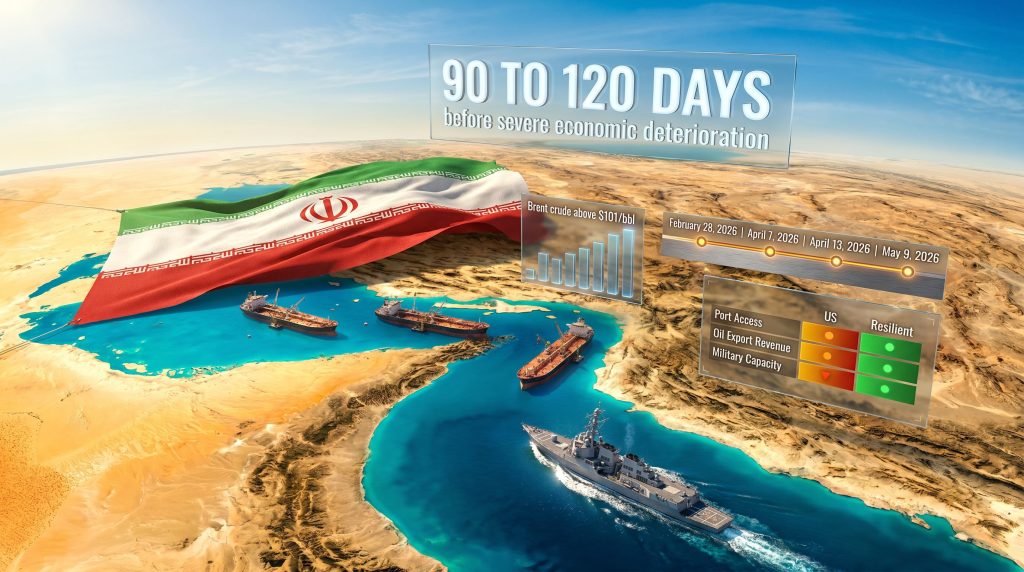
A CIA analysis circulated in May 2026 concluded that Iran retains sufficient economic resilience to withstand a US naval blockade for roughly three to four months, or approximately 90 to 120 days, before experiencing severe deterioration in its domestic economy. Reported initially by The Washington Post and confirmed by a US official familiar with the assessment's contents, the finding directly challenges the narrative that the blockade is producing immediate, decisive pressure on Tehran.
Notably, a senior US intelligence official pushed back publicly against the report's characterisation, asserting that the blockade is generating real and compounding economic damage, severing trade, compressing revenues, and accelerating what they described as systemic economic breakdown. The contradiction between these two positions is not merely bureaucratic infighting. It reflects a genuine strategic uncertainty about whether coercion through naval interdiction can produce the desired political outcomes within a timeframe that remains politically viable for Washington.
When big ASX news breaks, our subscribers know first
From Airstrikes to Blockade: How the Conflict Escalated
Understanding the Iran naval blockade CIA report requires understanding the sequence of events that produced the current confrontation. The conflict originated with joint US-Israeli airstrikes across Iranian territory on February 28, 2026, triggering a chain of retaliatory measures that progressively shut down one of the world's most critical maritime corridors.
In response to those strikes, Iran moved to restrict non-Iranian commercial shipping through the Strait of Hormuz, a waterway that had previously facilitated the transit of approximately one-fifth of global oil supply. The economic and logistical consequences of that closure reverberated immediately across global energy markets, insurance pricing structures, and tanker routing decisions. Furthermore, these geopolitical trade tensions have had wide-ranging implications well beyond the immediate region.
Washington formally imposed its naval blockade targeting Iranian ports and oil export infrastructure on April 13, 2026, escalating the confrontation into a sustained maritime standoff. A ceasefire was announced on April 7, 2026, raising expectations of a diplomatic off-ramp, but it quickly came under strain. Trump's announcement of Project Freedom, a naval escort mission designed to reopen the strait to commercial shipping, provoked sharp Iranian condemnation and was paused within 48 hours under pressure. Tehran formally accused Washington of breaching ceasefire terms, citing US strikes on Iranian commercial vessels.
Conflict Timeline at a Glance
| Date | Event |
|---|---|
| February 28, 2026 | Joint US-Israeli airstrikes initiate the conflict |
| April 7, 2026 | Fragile ceasefire announced |
| April 13, 2026 | US naval blockade formally imposed on Iranian ports |
| May 8, 2026 | US military strikes two Iran-linked vessels near an Iranian port |
| May 9, 2026 | UAE intercepts two ballistic missiles and three Iranian drones |
| May 9, 2026 | CIA assessment surfaces via The Washington Post; Treasury sanctions announced |
By May 8 and 9, 2026, sporadic clashes between US naval forces and Iranian vessels were resuming in and around the Strait of Hormuz, with Iran's semi-official Fars news agency confirming multiple engagements. Iran's Mehr news agency reported that a US Navy strike on an Iranian commercial vessel resulted in one crew member killed, ten wounded, and four missing. The UAE, which hosts US military installations and has therefore become a recurring target, reported its air defence systems intercepting two ballistic missiles and three drones from Iran on May 9, leaving three civilians with moderate injuries.
Why Iran Can Absorb More Pressure Than Washington Anticipated
The 90 to 120 day endurance window identified in the CIA assessment is not the product of improvised resilience. Tehran has spent years constructing parallel trade and financial infrastructure specifically designed to function outside the reach of Western maritime controls and sanctions on oil trading architecture. That preparation is now proving its worth under blockade conditions.
Iran's ability to maintain economic activity under blockade pressure rests on several interlocking mechanisms:
-
Floating Storage Operations – Iranian tankers have been repurposed as offshore oil storage vessels, decoupling production rates from the immediate need to export. This allows Tehran to continue extracting oil and hold it in reserve rather than accepting zero revenue from stranded production.
-
Deliberate Production Throttling – By reducing extraction rates, Iran preserves well integrity and extends the productive life of reserves during a period when export capacity is constrained.
-
Overland Trade Corridors – Rail-based oil transfer routes through Central Asia provide an alternative pathway to market that bypasses maritime chokepoints entirely. These corridors have been developed progressively over years of sanctions exposure.
-
Covert Ship-to-Ship Transfers – Satellite tracking has documented offshore transfers between vessels in international waters, enabling Iranian crude to change ownership and documentation outside the visible supply chain.
-
Underground Military Reconstitution – Satellite imagery has confirmed the reopening of subterranean missile production and storage facilities, complicating US assessments of the rate at which Iranian military capacity is being degraded.
Iran's sanctions evasion infrastructure is not a crisis-response improvisation. It is a systematically constructed parallel economy built across more than a decade of Western pressure, and the 2026 blockade is encountering that infrastructure at full operational maturity.
The military dimension reinforces this picture. Contrary to early assumptions that a sustained US and Israeli strike campaign would rapidly exhaust Iranian military stockpiles, available assessments suggest Tehran retains approximately 70 to 75 percent of its pre-conflict ballistic missile and mobile launcher inventories. Shahed-series drone production reportedly continues through smuggled components sourced via intermediary networks.
Iran's Estimated Military Asset Retention (May 2026)
| Military Asset | Estimated Remaining Capacity |
|---|---|
| Mobile Missile Launchers | ~75% of pre-conflict inventory |
| Ballistic Missile Arsenal | ~70% of pre-conflict stockpile |
| Shahed Drone Production | Ongoing via smuggled components |
These figures are significant because the original US blockade strategy appeared to rest partly on an assumption that military depletion and economic exhaustion would converge within a short window, producing rapid Iranian capitulation. The CIA assessment suggests that convergence is considerably further away than anticipated.
On May 9, 2026, the US Treasury moved to address the supply chain sustaining Iranian drone production by sanctioning 10 individuals and companies, including several entities based in China and Hong Kong, for facilitating the supply of weapons components and raw materials to Iran's military. Treasury also issued explicit warnings regarding potential secondary sanctions on foreign financial institutions, including Chinese independent refineries known in the industry as teapot refiners, which have historically served as a structural bypass for Western oil sanctions.
The Strait of Hormuz and the Global Energy Equation
Before the conflict began, the Strait of Hormuz was the single most consequential maritime chokepoint in global energy supply, responsible for the transit of roughly 20 percent of worldwide oil supply. Iran's restriction of non-Iranian shipping through the waterway has not simply disrupted a trade route. It has restructured the economics of global energy transport. Consequently, the trade war impact on oil prices has become an increasingly pressing concern for energy analysts worldwide.
The immediate market response has been telling. As of May 9, 2026, Brent and WTI futures were trading above $101 per barrel, even as prices had declined more than 6 percent over the preceding week. That combination — elevated spot prices alongside a weekly correction — reflects a market caught between structural supply disruption anxiety and short-term uncertainty about whether the situation escalates or de-escalates. It is a paradox characteristic of geopolitical risk pricing: markets acknowledging disruption without yet fully pricing in its worst-case scenarios.
Historical Strait of Hormuz Disruptions: A Comparative Perspective
| Event | Duration | Approximate Oil Price Impact | Estimated Supply % Affected |
|---|---|---|---|
| Tanker War (1984-1988) | Approximately 4 years | Moderate, cyclical | 10 to 15% of transit |
| 2019 Tanker Attacks | Several weeks | Approximately 5% spot spike | Minimal sustained disruption |
| 2026 US-Iran Conflict | Ongoing, 3+ months | Above $101 per barrel | Approximately 20% restricted |
The 2026 disruption is distinct from its predecessors in scale and duration. The 1984 to 1988 Tanker War involved sustained but ultimately manageable disruptions to a smaller share of global supply. The 2019 tanker attacks produced a brief pricing spike that markets absorbed within weeks. The current blockade is combining a larger share of restricted supply with a longer duration and the additional complication of an active US-Iranian military standoff that shows no clear resolution timeline.
Beyond headline crude prices, the closure has generated cascading effects across commercial shipping insurance, vessel routing decisions, and refinery procurement strategies across Asia. War risk insurance premiums for tankers transiting or approaching the region have risen substantially, adding structural costs to global energy supply chains that persist regardless of where spot oil prices trade on any given day. For a broader perspective on these dynamics, the oil price volatility guide offers useful context on how markets respond to sustained geopolitical disruption.
Diplomacy and Sanctions: Washington's Contradictory Posture
The US is simultaneously pursuing two tracks that create visible strategic tensions: active diplomatic engagement and escalating economic pressure.
On the diplomatic front, Secretary of State Marco Rubio stated in Rome on May 9 that Washington was awaiting Tehran's formal response to a US peace proposal that would serve as the precondition for broader negotiations, including discussions about Iran's nuclear programme. Iran's foreign ministry confirmed deliberations were ongoing but had not delivered a formal response by mid-afternoon Washington time on that date.
At the same time, the Treasury sanctions announcement targeting Chinese and Hong Kong-linked entities arrived just days before a planned Trump-Xi summit in Beijing. The strategic tension embedded in that timing is considerable. Washington is simultaneously designating Chinese entities for sanctions violations and pursuing high-level bilateral engagement with Beijing, sending contradictory signals to a partner whose cooperation is structurally necessary for any meaningful tightening of the economic pressure on Tehran.
The simultaneous imposition of sanctions targeting Chinese entities and the scheduling of a Trump-Xi summit creates a visible contradiction in US foreign policy posture, one that Beijing is unlikely to overlook at the negotiating table.
Rubio's public challenge to Italian and European allies in Rome added another layer of complexity. Speaking after his meeting with Italian Prime Minister Giorgia Meloni, the Secretary questioned why allied nations were declining to support Washington's efforts to reopen the strait, framing the normalisation of Iranian control over an international waterway as a precedent with global implications extending far beyond the current conflict.
The allied cohesion problem matters strategically because a blockade's long-term effectiveness depends partly on whether the international community treats it as legitimate. European hesitancy signals that the consensus underpinning the pressure campaign may be narrower than Washington's public posture suggests.
Assessing the Blockade: What Works and What Does Not
Any honest evaluation of the Iran naval blockade CIA report requires holding two competing assessments simultaneously rather than defaulting to either triumphalism or defeatism.
The case that the blockade is generating real damage:
- Iranian oil export revenues are materially compressed by restricted port access
- The inability to freely transit the strait imposes ongoing logistical and financial costs
- Compounding effects over time may degrade economic resilience that currently appears robust
- Military strikes have forced production and logistics adjustments that carry real costs
The case that the blockade faces structural limits:
- The 90 to 120 day endurance window demonstrates that Tehran anticipated and prepared for this scenario
- Overland corridors, floating storage, and covert maritime transfers provide a meaningful revenue floor
- Chinese refinery demand for sanctioned Iranian crude creates a persistent structural bypass that secondary sanctions warnings alone may not close
- Military asset retention rates of 70 to 75 percent undermine the rapid-depletion theory that underpinned early blockade strategy
Blockade Effectiveness: A Framework Assessment
| Effectiveness Dimension | US Position | Iran's Counter-Measure |
|---|---|---|
| Port Access | Blocked via naval presence | Floating storage deployed |
| Oil Export Revenue | Severely reduced | Smuggling corridors partially compensate |
| Military Capacity | Degraded but not eliminated | 70-75% of key inventories retained |
| Diplomatic Leverage | Constrained by 90-day window | Negotiating from position of partial resilience |
| Allied Support | Fraying, Europe hesitant | China providing structural economic lifeline |
The historical precedent for naval blockades as instruments of decisive economic coercion is mixed at best. The 1980s CIA analyses of blockade effectiveness in various conflict scenarios consistently found that determined state actors with pre-built alternative supply networks were far more difficult to coerce through maritime interdiction than models based on simple trade disruption suggested. Iran in 2026 fits that profile closely.
The next major ASX story will hit our subscribers first
Three Scenarios for the Road Ahead
The next 60 to 90 days represent the critical window in which the trajectory of this standoff will become clearer. Three broad scenarios frame the range of outcomes.
Scenario 1: Negotiated Settlement Before the Endurance Window Closes
Tehran delivers a formal response to the US peace proposal, both sides agree to a structured freeze, and preliminary nuclear programme discussions begin. A partial reopening of the Strait of Hormuz would likely follow, with Brent crude prices correcting toward the $80 to $85 per barrel range as supply risk premiums unwind.
Scenario 2: Blockade Extends Beyond the CIA's Endurance Threshold
Iran's smuggling buffers and floating storage capacity are gradually exhausted after 90 to 120 days, generating internal economic pressure that translates into political strain on the clerical establishment. Oil prices remain elevated, shipping insurance premiums sustain, and Asian energy supply chains continue rerouting at significant logistical cost.
Scenario 3: Escalation Into Broader Regional Conflict
A major Iranian strike on UAE infrastructure or US naval assets, or renewed Israeli engagement, forces Gulf Cooperation Council states to abandon neutrality. Under this scenario, analysts have flagged the potential for Brent crude to spike above $120 per barrel, with cascading disruption across global LNG supply chains and heightened recession risk in import-dependent economies.
What the Iran Naval Blockade CIA Report Actually Reveals
The strategic significance of the Iran naval blockade CIA report lies not in the specific number of days it identifies, but in what that number implies about the architecture of coercion available to Washington. A 90 to 120 day endurance window means the blockade is a time-constrained instrument, not an inexorable one. Iran's resilience is structural and pre-planned, built on a decade or more of deliberate sanctions evasion infrastructure development. Chinese refinery demand provides a persistent economic floor that Treasury warnings alone have not yet closed.
Simultaneously, the diplomatic track remains open but fragile. Rubio's Rome statement confirmed active engagement, while Tehran's delayed response reflects calculated patience rather than indifference. The Trump-Xi summit adds a further complicating variable: whether Washington can simultaneously squeeze Chinese intermediaries and secure Beijing's broader geopolitical cooperation remains genuinely uncertain.
What is not uncertain is that the Strait of Hormuz remains the world's most consequential energy chokepoint, that its partial closure is already sustaining Brent crude above $101 per barrel, and that the next several weeks will determine whether this conflict finds a diplomatic exit or enters a more dangerous phase.
This article draws on reporting from Reuters and The Economic Times (ET EnergyWorld, May 9, 2026). All pricing data, diplomatic statements, and military incident details reflect the information available as of that publication date. Forward-looking scenarios involve inherent uncertainty and should not be treated as predictive assessments. Readers are encouraged to consult current reporting from Reuters, The Washington Post, and the International Energy Agency for the most recent developments.
Want to Know Which ASX Stocks Could Benefit From the Next Major Commodity Disruption?
When geopolitical shocks like the Strait of Hormuz closure send oil above $101 per barrel, the ripple effects reach far beyond crude markets — and Discovery Alert's proprietary Discovery IQ model scans ASX announcements in real time, instantly identifying mineral discovery opportunities across more than 30 commodities before the broader market catches on. Explore how historic discoveries have generated substantial returns and begin your 14-day free trial at Discovery Alert to position yourself ahead of the next major market shift.