June 13, 2026
The Hidden Vulnerability Beneath Australia's Resource Wealth
There is a striking contradiction at the heart of Australian energy policy. The Australia fuel reserves crisis and Strait of Hormuz blockage sits at the centre of this contradiction: a nation that sits atop enormous reserves of coal, natural gas, lithium, and uranium somehow finds itself among the most exposed developed economies in the world when it comes to liquid fuel security. This is not a new development, nor is it the result of a single policy failure. It is the accumulated consequence of two decades of decisions that prioritised cost efficiency over strategic resilience.
Understanding this vulnerability requires looking not at what Australia produces, but at what it cannot produce fast enough when the global supply chain fractures.
When big ASX news breaks, our subscribers know first
From Eight Refineries to Two: The Industrial Retreat That Left Australia Exposed
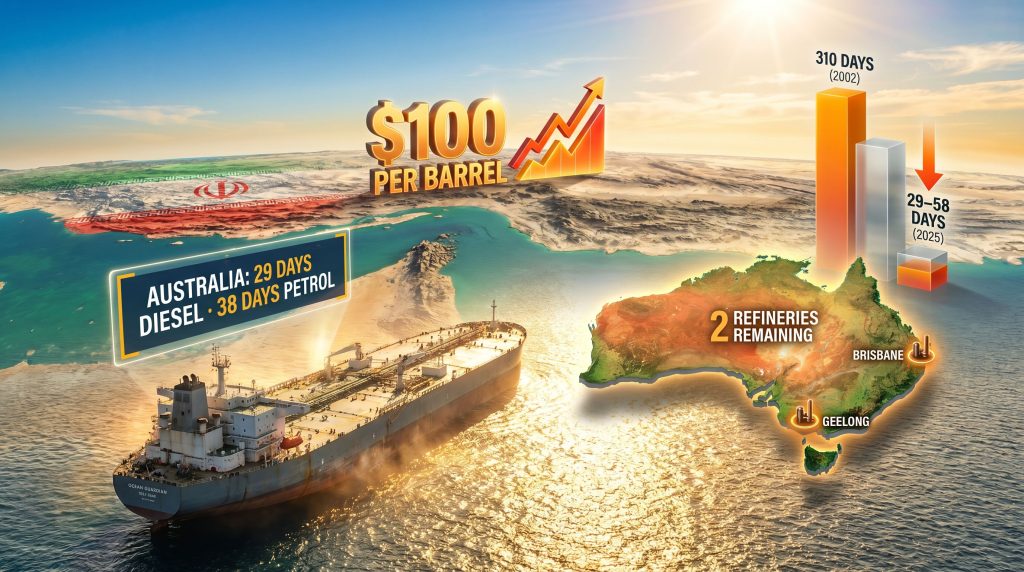
The scale of Australia's refining contraction over the past two decades is difficult to overstate. In 2005, Australia operated eight functioning petroleum refineries, providing a meaningful domestic buffer against international supply disruptions. Today, that number has collapsed to just two: one in Brisbane and one in Geelong. Together, these facilities account for roughly 20% of Australia's liquid fuel requirements. The remaining 80% is imported from refining hubs across Singapore, Malaysia, Taiwan, and South Korea.
The logic behind this contraction was purely economic. Asian refining capacity was cheaper, more efficient, and scalable in ways that ageing Australian infrastructure could not match. Successive governments allowed the domestic industry to wind down without building alternative resilience measures. The result is a supply chain that stretches thousands of kilometres across contested maritime corridors, with almost no onshore redundancy to absorb disruption.
What makes this particularly acute is that even the two remaining domestic refineries are not self-sufficient. Both depend on imported crude oil to operate. This means that in a genuine supply crisis, domestic refining capacity offers no meaningful insulation from the international market.
| Year | Operating Refineries | Approximate Reserve Coverage |
|---|---|---|
| 2002 | 8+ | ~310 days |
| 2005 | 8 | Declining |
| 2012 | Reducing | Below IEA 90-day benchmark |
| 2025 | 2 (Brisbane & Geelong) | 29 to 58 days (estimated) |
What Australia's Actual Fuel Reserves Look Like Right Now
As a member of the International Energy Agency (IEA), Australia carries a treaty obligation to maintain a minimum of 90 days of fuel reserves. The IEA's average across its 31 members sits at approximately 130 days. Australia has never met the 90-day threshold. Not once. The compliance failure stretches back to at least 2012, spanning three Coalition governments and two Labor governments, without meaningful structural correction from either side of politics.
The current figures are stark:
- Petrol: approximately 38 days of reserve coverage
- Diesel: approximately 29 days of reserve coverage
- Jet fuel: approximately 30 days of reserve coverage
However, the headline numbers are arguably more flattering than reality warrants. A significant portion of what Australia counts as its reserve includes fuel still aboard tankers in mid-voyage. Some of those vessels are now transiting waters that marine insurers have reclassified as active conflict zones. If Australia needed to replenish its reserves today, the logistics chain from Singapore refining through to Australian port delivery would consume an additional 30 to 40 days. The practical available buffer is therefore materially lower than official figures suggest.
In 2002, Australia held approximately 310 days of fuel reserves. By 2012, that figure had fallen below the IEA minimum and has never recovered. A Senate inquiry conducted in 2014 to 2015 specifically flagged that counting fuel in transit as part of a strategic reserve was not energy security but rather a form of optimistic accounting. That warning went unaddressed, and more than a decade later, the same structural gap remains.
Furthermore, as noted by the ASPI Strategist, Australia's fuel vulnerability is layered across multiple systemic weaknesses, making it particularly difficult to address through any single policy intervention.
Australia is the only one of the IEA's 31 member nations that has never held the required 90-day minimum fuel reserve. This is not a recent failure. It is a systemic one that has persisted through five successive governments.
The Strait of Hormuz and Why a Distant Waterway Determines Australian Pump Prices
The Strait of Hormuz is the narrow passage between Iran and the Arabian Peninsula through which approximately one-quarter of all global seaborne oil trade flows. It is the primary export corridor for Persian Gulf crude oil, feeding refineries across Asia, Europe, and the Americas. For Australia, the connection is indirect but structurally critical: the fuel that arrives at Australian ports is largely refined in Singapore and neighbouring Asian hubs using crude oil that originated in the Persian Gulf and transited the strait.
A disruption at this chokepoint therefore does not need to directly target Australian shipping to affect Australian fuel prices and supply. It simply needs to raise the cost and complexity of crude oil access for the Asian refineries that supply Australia's import dependency. The US-China trade war impacts on regional trade flows have further complicated the geopolitical backdrop against which this crisis is unfolding.
The disruption that crystallised this risk involved a US naval blockade of the Strait of Hormuz following the breakdown of diplomatic negotiations with Iran. While Iran subsequently signalled a willingness to engage on reopening arrangements, the blockade of Iranian ports remained in place pending a durable political agreement. The resulting uncertainty triggered several cascading effects:
- Marine insurers withdrew coverage from carriers operating through the strait
- Tanker operators began diverting routes, adding weeks to delivery timelines
- Spot crude oil prices breached the $100 per barrel threshold
- Freight cost escalation began flowing through to consumer goods pricing globally
The particularly dangerous element for Australia was not just the price spike but the insurance withdrawal. Ships attempting to transit the region were being turned back not by Iranian forces but by the effective closure of the commercial insurance market for that corridor. Without insurance, commercial operators cannot move. Without movement, refineries cannot receive crude. Without crude, refined fuel cannot reach Australian ports.
How a Fuel Price Shock Transmits Through the Australian Economy
The economic impact of sustained fuel price elevation does not operate in isolation. It propagates through interconnected cost structures across the entire economy in a sequence that becomes increasingly difficult to reverse the longer it runs.
The transmission sequence works as follows:
- Pump prices rise immediately as wholesale input costs increase and are passed through by major fuel retailers
- Transport and logistics costs escalate, affecting freight, agriculture, mining, and manufacturing simultaneously
- Food prices increase, with the National Farmers Federation indicating that prolonged fuel supply stress could push food prices up by as much as 50%
- Airfares and manufactured goods prices rise as aviation fuel and industrial diesel costs are absorbed into business operating expenses
- Corporate cost bases expand, triggering profit warnings from ASX-listed companies across multiple sectors
- Wage pressure builds as workers seek compensation for a higher cost of living
- Inflation becomes entrenched once wage growth embeds into the system, because price increases become self-reinforcing and structurally persistent
The critical distinction here is between transient and entrenched inflation. A short-duration oil shock produces a temporary CPI spike that central banks can look through. A sustained disruption lasting six months or more risks embedding inflation into wage expectations, a condition that becomes extremely difficult for monetary policy to reverse without inflicting significant economic pain.
Fuel and energy costs represent approximately 3 to 3.5% of Australia's CPI basket directly. However, their indirect influence through food pricing, transport, manufacturing input costs, and services is substantially larger. The concern from the Reserve Bank of Australia is not the immediate arithmetic impact of higher pump prices. It is the second-order effect: once workers start demanding and receiving higher wages to compensate for a higher cost of living, the inflation dynamic becomes self-sustaining.
The danger is not the price spike itself. It is when higher costs start feeding into wages and wages start feeding back into prices. Once that cycle begins, monetary policy faces a far more difficult task than simply waiting for oil prices to normalise.
The RBA's Dilemma: Rates, Recession, and the Stagflation Scenario
The Reserve Bank of Australia moved pre-emptively on interest rates to prevent inflationary expectations from becoming unanchored. Further tightening in response to entrenched fuel-driven inflation would compound pressure on mortgage holders, suppress consumer spending, and constrain business investment simultaneously. An oil price rally driven by geopolitical uncertainty makes the RBA's task considerably more complex.
The current market expectation is for two rate rises in 2025. If oil prices remain elevated for six months or longer and inflation becomes embedded through wage growth, the scenario shifts significantly.
| Disruption Duration | RBA Response | Market Impact |
|---|---|---|
| Under 3 months | Hold or modest adjustment | Limited lasting economic damage |
| 3 to 6 months | 1 to 2 rate increases | Consumer spending contraction |
| 6 months or longer | 3 or more rate rises across 2025 to 2026 | Recession risk, broad ASX downturn |
The worst-case pathway is a stagflationary environment: an economy simultaneously experiencing recession and elevated inflation. This is the scenario where consumers are being compressed by higher mortgage repayments, higher grocery costs, and higher fuel prices all at once, while corporate earnings are declining and the stock market is pricing in deteriorating fundamentals. It is the scenario that every central bank seeks to avoid above all others, because the conventional tools of monetary policy are poorly suited to addressing both problems at the same time.
The next major ASX story will hit our subscribers first
Emergency Policy Responses: What Has Been Deployed and What It Cannot Fix
The government's immediate response to the supply disruption included several measures deployed in relatively quick succession:
- Fuel excise reduction, temporarily lowering the tax component of pump prices
- Strategic reserve release of approximately 762 million litres of petrol and diesel from government holdings
- Fuel quality standard adjustment, lowering sulphur content thresholds to expand the range of importable fuel grades and widen the potential supplier pool
Each of these responses addresses a symptom rather than the underlying structural condition. The reserve release alleviates immediate supply pressure but does not rebuild the buffer that was drawn down. The excise cut reduces consumer-facing prices but has no effect on the wholesale dynamics driving the cost increase. The fuel standard adjustment expands import options but introduces potential compatibility concerns for modern vehicle engines calibrated to tighter specifications.
None of these measures resolves Australia's fundamental dependency on foreign refining capacity. None of them addresses the chronic non-compliance with IEA reserve obligations that has persisted for over a decade. Consequently, they are the tools of crisis management, not structural reform, and their deployment underscores how unprepared the underlying system was for exactly the kind of shock that multiple defence and energy white papers had explicitly warned about.
It is also worth noting that the NRMA's analysis of Australia's fuel supply chain highlights the degree to which Australia's import dependency creates compounding logistical risks that emergency measures cannot fully offset. When petrol station forecourts ran temporarily dry in some locations, this was not a function of the Strait of Hormuz situation depleting Australian supply. It was a panic-buying response. Actual available fuel in Australia was not critically constrained at that point. The concern is what happens if the disruption persists long enough for available reserves to be genuinely drawn down.
What This Means for the ASX and Australian Investors
The Australian sharemarket's exposure to a sustained oil price shock and potential recession is concentrated in its two largest sectors, which together represent approximately 50% of total ASX market capitalisation. With the ASX under commodity pressure, the structural risks to equity portfolios are substantial.
Resources (approximately 25% of ASX market capitalisation)
- Cyclical demand sensitivity means a global recession scenario compresses commodity prices across the board
- Copper, lithium, and bulk materials face demand destruction if industrial activity contracts globally
- Energy producers may benefit in the short term from elevated oil prices but face significant demand risk if recession materialises
- Several resource sector exposures have already moved into technically overbought territory, reducing the margin of safety for new positions
Banking Sector (approximately 25% of ASX market capitalisation)
- Rising interest rates initially widen net interest margins, which appears positive for bank earnings in the short term
- However, sustained rate increases suppress mortgage demand, compress loan growth, and elevate default risk
- The primary earnings driver for Australian banks is residential mortgage growth, which contracts materially in a high-rate, low-confidence environment
- If rate rises extend through 2025 and into 2026, the medium-term earnings outlook for major banks deteriorates significantly
Consumer Discretionary
- Households simultaneously facing higher fuel costs, elevated grocery prices, and rising mortgage repayments have materially reduced discretionary spending capacity
- Retail-facing ASX companies are historically the first to issue profit warnings when consumer confidence deteriorates
- Several ASX-listed companies have already begun releasing profit warnings, a pattern that typically expands if the underlying cost pressure persists
Technology and AI Infrastructure
- Identified as a structurally more defensive theme with momentum that may persist through a recessionary cycle
- Global AI infrastructure investment continues to accelerate, with multi-billion dollar commitments being announced regularly across major technology platforms
- Less exposed to domestic economic cycles than resources, banking, or consumer sectors
- Represents one of the few enduring thematic positions that appears relatively insulated from the specific risks generated by the Strait of Hormuz disruption
Investor Positioning in a High-Uncertainty Environment
The conventional logic of rotating into defensive stocks to lose less money is insufficient framing for the current environment. In a high-inflation, rising-rate scenario, the primary objective shifts from relative outperformance to capital preservation. A sound investment strategy and asset allocation framework becomes essential to navigating this landscape.
Higher risk positions in the current environment:
- Speculative small-cap exposures
- Heavily leveraged property or acquisition strategies
- Overbought resource sector positions entered at elevated valuations
- Rate-sensitive growth stocks with long-duration earnings profiles
More resilient positioning:
- Term deposits, which benefit directly from the rising rate environment
- Cash and short-duration instruments that preserve optionality
- Global technology and AI infrastructure themes with structural demand drivers
- Reduced overall portfolio risk until the oil price trajectory and geopolitical resolution become clearer
The core discipline is not making large directional bets in either direction while the fundamental uncertainty around the Strait of Hormuz situation remains unresolved. The situation can shift on a single diplomatic development, a single military incident, or a single tweet from a head of government. That degree of binary uncertainty argues for restraint rather than conviction positioning.
Three Scenarios: How the Situation Could Evolve
Scenario One: Rapid Resolution (under six weeks)
The Strait of Hormuz reopens following a durable diplomatic agreement. Marine insurance coverage is restored and tanker operators resume normal routing. Oil prices retreat below $90 per barrel. The inflation spike proves transient, the RBA holds its rate settings, and the ASX recovers from its correction. No structural economic damage occurs, and the episode becomes a warning that was ultimately absorbed without lasting consequence.
Scenario Two: Prolonged Disruption (three to six months)
Partial shipping restoration occurs but ongoing insurance constraints continue to limit throughput. Oil stabilises in the $100 to $120 per barrel range. The RBA implements two to three rate increases. Consumer spending contracts materially. The ASX faces earnings downgrades across resources, banking, and consumer sectors. Food prices rise noticeably and wage pressure begins to build, though the inflationary dynamic has not yet fully embedded.
Scenario Three: Extended Crisis (six months or longer)
Full blockade or regional escalation persists beyond the six-month threshold. Oil reaches $130 to $150 per barrel and holds at that level. Inflation becomes entrenched through wage growth. The RBA is forced into an aggressive tightening cycle. Australia enters recession with simultaneously elevated inflation, a stagflationary environment. Fuel rationing becomes a genuine policy consideration, particularly for diesel, which is essential to agriculture, mining, and freight logistics. The ASX faces a broad-based de-rating, and superannuation balances come under significant pressure.
The Structural Reform Australia Has Avoided for Two Decades
The Australia fuel reserves crisis and Strait of Hormuz blockage have not created a new vulnerability. They have exposed one that already existed. Addressing it structurally rather than reactively would require a different order of policy commitment than anything attempted since reserve levels first fell below the IEA minimum.
In addition, Australia's resource and energy exports face compounding headwinds if domestic energy security weaknesses are not addressed alongside the trade disruptions generated by this crisis.
A genuine structural response would need to include:
- Rebuilding strategic reserve capacity to meet IEA obligations, targeting a minimum of 90 days of physically onshore fuel storage rather than including in-transit volumes in the calculation
- Establishing long-term bilateral supply agreements with allied nations to create more diversified and resilient import pathways
- Accelerating the transition to domestically produced energy sources, including renewables, green hydrogen, and electric transport infrastructure, to reduce liquid fuel dependency over the medium term
- Creating a bipartisan energy security framework that survives electoral cycles and prevents the policy neglect that has characterised the past two decades
The IEA average of 130 days of reserve coverage represents a reasonable benchmark for what Australia should be targeting. Given Australia's geographic isolation, the length of its maritime supply lines, and the concentration of its import sources in a region adjacent to geopolitical flashpoints, a case can be made that Australia's target should be above rather than at the 31-member average.
Key Takeaways for Australians Navigating the Current Environment
- Australia currently holds less than 40 days of physically available fuel reserves, well below the IEA's 90-day minimum and dramatically below the 310-day buffer held in 2002
- The Australia fuel reserves crisis and Strait of Hormuz blockage has exposed a structural energy security vulnerability that successive governments failed to address despite repeated, explicit warnings in defence and energy policy documents
- The economic risk is not the immediate price spike at the pump. It is the duration of the disruption and whether cost pressures become embedded in wages and broader price expectations
- If oil remains above $100 per barrel for six or more months, Australia faces a realistic path toward stagflation: simultaneous recession and entrenched inflation
- The ASX faces meaningful downside risk across its two largest sectors in a sustained disruption scenario, with resources and banking together representing approximately half of total market capitalisation
- For individual investors, the rational near-term posture emphasises capital preservation, reduced leverage, disciplined budgeting, and avoidance of high-conviction bets until the geopolitical situation clarifies
- Term deposit holders benefit from the rising rate environment. Mortgage holders face compounding pressure if rates rise further in response to entrenched inflation
- The situation retains genuine binary characteristics. It can improve rapidly with a single diplomatic breakthrough, or deteriorate rapidly with a single escalatory event. That uncertainty is itself a reason for positioning conservatism
This article is intended for informational and educational purposes only and does not constitute financial advice. The scenarios and forecasts presented involve inherent uncertainty and should not be relied upon as predictions of future market or economic outcomes. Readers should consult a qualified financial adviser before making investment decisions.
Want To Stay Ahead of ASX Opportunities Amid Market Volatility?
While navigating the economic uncertainty generated by Australia's fuel security vulnerabilities and rising commodity prices, Discovery Alert's proprietary Discovery IQ model delivers real-time alerts on significant ASX mineral discoveries, transforming complex market data into actionable investment insights — explore historic discoveries and their returns to understand the potential, then begin your 14-day free trial to position yourself ahead of the broader market.