August 6, 2026
When Nations Fail to Capitalise on Natural Wealth: The Architecture of a Missed Opportunity
Across modern economic history, few policy failures carry consequences as quietly devastating as the mismanagement of natural resource revenues. Unlike fiscal deficits or trade imbalances, which generate immediate political pressure, the compounding cost of undertaxing finite resources unfolds across decades, revealing itself gradually in eroded industrial capacity, diminished export diversity, and a narrowing economic base that becomes increasingly vulnerable to commodity price cycles. This is not an abstract concern for developing economies alone. It is a structural challenge that sits at the heart of the Australia gas tax inquiry currently underway in Canberra.
Understanding why this debate matters requires stepping back from the immediate political noise and examining the underlying mechanics of how resource wealth is created, captured, and redistributed, and what happens when each stage of that process is managed poorly.
When big ASX news breaks, our subscribers know first
What the Australia Gas Tax Inquiry Actually Examines
The Select Committee on the Taxation of Gas Resources was formally constituted on 30 March 2026, through a Senate resolution. Public submissions closed on 13 April 2026, with hearings ongoing through April. The inquiry carries a reporting deadline of 7 May 2026, a timeline that is politically significant given its proximity to the federal budget cycle and its potential to inform, or embarrass, fiscal decision-making.
The committee's terms of reference are deliberately broad. They encompass:
- The current tax treatment of oil and gas resources under Australian law
- The impact of Middle East energy tensions on LNG pricing and Australian export revenues
- International taxation models and comparative reform alternatives
- Proposed uses for any additional revenue collected, including direct cost-of-living relief for households
The inquiry has drawn submissions and testimony from a wide spectrum of participants, including economists and former senior policymakers presenting structural reform arguments, LNG producers including Woodside, Chevron, and Shell defending existing arrangements, and independent economic researchers arguing Australians receive a disproportionately small share of resource rents generated from their collectively owned natural wealth.
Shell has reportedly funded an advertising campaign valued between $1 million and $5 million to defend industry profit structures throughout the inquiry period, illustrating the scale of commercial interests engaged in shaping public and political opinion on the outcome.
Why it matters: The inquiry reflects a convergence of public pressure, global energy market volatility following Middle East tensions, and longstanding structural concerns about how Australia captures value from finite, non-renewable natural resources. The compressed reporting timeline creates a narrow but real policy window for substantive reform recommendations.
How Australia's Gas Tax Regime Currently Functions
The Petroleum Resource Rent Tax: A Mechanism Under Scrutiny
Australia's primary upstream taxation tool for oil and gas is the Petroleum Resource Rent Tax, or PRRT, a profit-based levy applied to upstream extraction activities. In theory, a profit-based tax is considered economically superior to royalty-based systems because it aligns government revenue collection with actual project profitability, preserving investment incentives during low-margin periods.
In practice, however, the PRRT has been significantly constrained by two structural features: high deductibility thresholds that allow extensive cost recovery before tax liability is triggered, and an "uplift rate" system that allows deductible costs to grow in value over time when projects are not yet generating taxable profit. The combined effect has been to reduce effective tax rates well below headline rates for many of Australia's largest LNG projects.
The result is a system where LNG producers operating some of the world's largest export facilities have paid limited PRRT relative to the scale of revenues those facilities generate. Furthermore, Australia's resource export challenges compound this issue, as the structural tension between export volume and domestic revenue capture continues to widen.
What Taxes Do Gas Companies Currently Pay?
| Tax Mechanism | Description | Key Limitation |
|---|---|---|
| Petroleum Resource Rent Tax (PRRT) | Profit-based levy on upstream extraction | High deductibility thresholds and uplift rates significantly reduce effective rates |
| Company Tax (30%) | Standard corporate income tax | Subject to standard deductions and transfer pricing arrangements |
| Royalties (State-level) | Varies by jurisdiction and resource | Inconsistent application; not uniformly applied to LNG exports |
| Export Levies | Not currently applied | A 25% rate has been debated but rejected by the federal government |
The absence of any export levy mechanism represents one of the central points of contention in the Australia gas tax inquiry. While the government maintains that existing tax contributions already represent tens of billions of dollars annually, critics argue that the effective rate achieved through these combined mechanisms falls materially short of what comparable resource-rich nations collect.
Australia's Economic Complexity Problem and the Gas Tax Connection
A High-Income Country With a Developing-Economy Export Profile
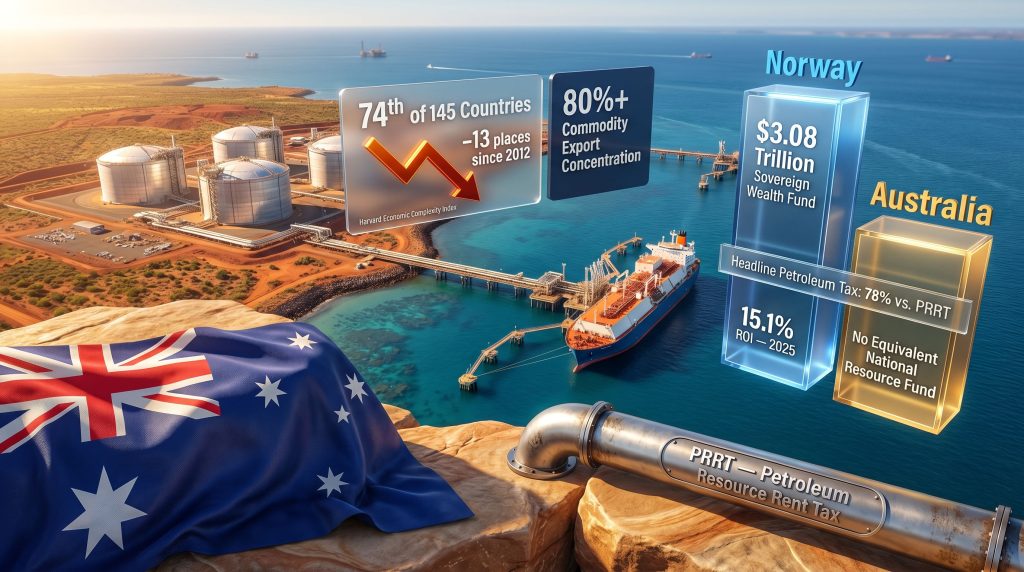
One of the most striking data points to emerge from the Australia gas tax inquiry context is Australia's position on Harvard University's Economic Complexity Index. As of 2026, Australia ranks 74th out of 145 countries, making it the second-lowest ranked nation among OECD members. Since 2012, Australia has fallen 13 places in those rankings.
The implications of this ranking extend well beyond academic interest. Economic complexity measures the diversity and sophistication of a country's productive capabilities through the range and technical intensity of goods it exports. Low complexity signals vulnerability: an economy dependent on a narrow set of commodity exports faces higher exposure to price volatility, supply disruptions, and long-run terms of trade deterioration.
United Nations Trade and Development data from its report "The State of Commodity Dependence 2025" confirms that commodity exports account for more than 80 percent of Australia's national merchandise export value, a concentration ratio directly comparable to resource-dependent economies across Africa and South America.
The paradox: Australia maintains one of the highest per-capita GDP levels in the world, yet its productive structure resembles that of nations typically classified as having structural development constraints. High income and economic resilience are not the same thing, and Australia's commodity dependence illustrates that gap clearly.
The Dutch Disease Dynamic: Exchange Rate Damage That Outlasted the Boom
The mechanics of commodity boom-driven economic distortion are well understood in development economics under the framework known as "Dutch Disease," named for the structural damage the Netherlands experienced following natural gas discoveries in the 1960s. As capital floods into resource extraction sectors, demand for local currency rises, appreciating the real exchange rate and systematically undermining the price competitiveness of every other tradable sector.
Former Treasury Secretary Ken Henry, who testified before the inquiry on approximately 22 April 2026, provided a precise quantification of this effect in the Australian context. The early 2000s mining investment surge triggered a 70 percent appreciation in Australia's real exchange rate. More significantly, as of 2026, the real exchange rate still sits 50 percent above pre-boom levels, suggesting the distortion has become structural rather than cyclical.
The employment impact compounds this picture. Despite the enormous scale of mining investment and extraction activity over this period, mining's share of the national labour force increased only marginally. The economy absorbed the exchange rate pain of a resource boom without capturing proportionate employment or productive diversification benefits.
Henry characterised this as a fundamental economic management failure, questioning what Australians ultimately received from the boom beyond higher volumes of natural resources extracted from the national balance sheet by multinational companies.
The Case For Reforming Australia's Gas Tax
Hundreds of Billions in Foregone Public Revenue
Ken Henry's testimony to the inquiry presented perhaps the most arresting quantification of the revenue gap. In his assessment, Australia could have collected hundreds of billions of dollars in additional public revenue had natural resources been taxed appropriately during the early stages of the mining boom. He argued that reinvesting those revenues into non-mining sectors could have sustained international competitiveness across the subsequent 16 years.
This is not merely a historical grievance. The structural logic applies continuously: each year that finite natural resources are extracted and exported under an undertaxation regime represents a permanent, unrecoverable transfer of national wealth away from Australian citizens as collective resource owners.
Henry connected this fiscal argument to something deeper: democratic legitimacy. He argued that persistent failure to tax natural resources appropriately was eroding public trust in democratic institutions, and that politicians continuing this pattern would further damage Australians' faith in their political system. This framing elevates resource taxation from a technical fiscal debate to a question of systemic institutional credibility.
The Intergenerational Equity Dimension
The intergenerational equity argument adds a temporal dimension to the public revenue case. Finite natural resources represent a one-time drawdown on the national balance sheet. Once extracted, they cannot be recovered. Undertaxation therefore transfers wealth not just from present Australian citizens to multinational shareholders, but from future generations who will inherit a depleted resource base and a less competitive economy.
Independent MP Allegra Spender has proposed a 25 percent export levy on LNG revenues as a structural correction mechanism, framing it as a means of ensuring Australians receive a fair share of wealth generated from resources they collectively own. In addition, the broader mining commodity outlook suggests that reform windows may narrow as global energy markets shift over the coming decade.
Australia's Climate Accountability Gap
Henry also raised the ethical dimension of fossil fuel export policy. Australia ranks among the top three fossil fuel exporters globally, yet under the Paris Agreement framework, the carbon embedded in exported fossil fuels is not counted in Australia's national emissions accounting. The combustion of those fuels, wherever it occurs, contributes significantly to global greenhouse gas emissions.
This creates a structural accountability asymmetry: Australia captures the economic benefit of fossil fuel exports while the emissions consequences are attributed to importing nations. Henry characterised continuing to overlook this reality as an ethical failure. Consequently, Australia's critical minerals strategy becomes increasingly relevant as a potential counterbalance to this fossil fuel dependency.
The Case Against Changing the Gas Tax
Investment Deterrence and Long-Term Commitment Risk
The industry's primary argument centres on investment certainty. LNG producers note that their existing tax contributions already represent tens of billions of dollars annually, and that retrospective or materially higher taxation would undermine the confidence required to commit capital to long-duration, high-risk infrastructure projects.
This concern is not trivial. LNG projects require investment horizons measured in decades. Japanese utilities and other long-term offtakers committed to take-or-pay contracts under commercial conditions that existed years ago, when project viability was far from assured. Changing the taxation framework after projects are operational creates a credibility problem that extends beyond any single project to the broader question of Australia as an investment destination.
The Capital Risk Sharing Problem
Morningstar market analyst Lochlan Halloway circulated analysis to clients acknowledging legitimate arguments on both sides of the debate, while expressing scepticism toward any proposal claiming to extract materially more tax without creating disincentives to exploration and development.
Halloway noted that while Australia's resource endowment belongs to all Australians, who currently receive a smaller share of the windfall than countries like Norway or Qatar, most Australians did not invest capital or bear the project risk that built the gas industry. The parties who did, including Japanese utilities that committed to take-or-pay contracts when commercial viability was marginal at best, now face the prospect of renegotiated terms.
Halloway's conclusion was that adopting a model comparable to Norway's would require a much larger national conversation about whether Australian taxpayers should become the risk-bearing party in a capital-intensive, volatile commodity sector.
The next major ASX story will hit our subscribers first
How Australia Compares to International Resource Taxation Models
Norway vs. Australia: A Structural Comparison
The Norway comparison dominates international benchmarking discussions around the Australia gas tax inquiry, and for good reason. Norway's petroleum taxation framework has generated one of the most successful sovereign wealth accumulation programmes in economic history.
| Dimension | Norway | Australia |
|---|---|---|
| Headline petroleum tax rate | 78% | PRRT variable; effective rates significantly lower |
| State equity participation | Direct ownership stakes in petroleum fields | No direct equity participation |
| Sovereign wealth fund | $3.08 trillion Government Pension Fund Global | No equivalent national resource fund |
| 2025 fund return | $350 billion profit; 15.1% return on investment | Not applicable |
| Loss-refund mechanism | Yes; government absorbs proportional downside | No equivalent mechanism |
| State-owned energy company | Equinor (majority government-owned) | No equivalent |
| Investment neutrality design | Explicit; immediate deductions, loss refunds | Not structurally designed for neutrality |
The critical distinction that Halloway's analysis highlighted, and which is frequently lost in simplified comparisons, is that Norway's 78 percent headline tax rate functions because the Norwegian state is simultaneously an equity co-investor and risk-sharer, not merely a revenue collector. The Norwegian government holds direct ownership stakes in individual petroleum fields, covers its share of development costs, and receives a corresponding share of income.
Critical insight: Replicating Norway's headline tax rate without its accompanying structural architecture, including state equity participation, a loss-refund mechanism, and a state-owned energy company, would produce fundamentally different and likely counterproductive economic outcomes. The rate is not the model; the architecture is.
Norway's sovereign wealth fund, formally the Government Pension Fund Global, reported a $350 billion profit in 2025, representing a 15.1 percent return on investment against a fund valued at approximately $3.08 trillion. This performance illustrates the compounding intergenerational benefit of systematically reinvesting resource revenues into globally diversified financial assets.
Qatar, Canada, and the Spectrum of Resource Governance Models
Beyond Norway, the international landscape of resource taxation encompasses a wide spectrum from pure royalty systems to hybrid profit-sharing arrangements and direct state equity participation. Qatar's state-controlled LNG operations through QatarEnergy represent one extreme of the equity participation model, where the state captures value not just as a tax collector but as a commercial participant.
Canada operates a more decentralised model with province-level royalty frameworks running alongside federal corporate taxation, creating a different set of revenue capture incentives and intergovernmental dynamics. However, the energy transition challenges facing Canada also illustrate how resource-dependent economies must balance short-term fiscal pressures with longer-term structural reform.
The common thread among the most successful international models is that the state's relationship to resource extraction extends beyond passive taxation toward active participation in value creation and risk-sharing, a structural position Australia has never formally adopted.
Why the Resource Super Profits Tax Failed in 2010
A Well-Designed Policy Defeated by Political Execution
The 2010 Resource Super Profits Tax, designed by Ken Henry and introduced in then-Treasurer Wayne Swan's budget, represented a genuinely sophisticated attempt to resolve the investment neutrality problem that plagues most resource taxation debates. The mechanism was designed to tax mining profits above a threshold rate of return while simultaneously reducing the company tax rate, and crucially, it included a 40 percent loss-refund mechanism explicitly designed to ensure the government absorbed proportional downside risk alongside upside revenue.
This design addressed the fundamental objection that high resource taxation deters investment by ensuring that the government became, in effect, a financial co-participant in mining ventures rather than simply a higher-cost imposition on them.
The policy was abandoned following an aggressive industry campaign that contributed to significant political instability within the Labor government. The unresolved question that lingers into 2026 is whether the Resource Super Profits Tax was flawed in its design or whether the political execution failed to adequately communicate and defend a technically sound policy against well-funded opposition.
Henry, Wayne Swan, and aligned institutions including the Institute of Public Affairs were directly involved in the political contest that determined the outcome, and vested interests in the mining sector, aligned media, and market-oriented think tanks played a decisive role in shaping public opinion against the reform.
The 16-Year Shadow
The failure of the Resource Super Profits Tax continues to cast a long shadow over the 2026 Australia gas tax inquiry. The political risk calculus for any government revisiting resource rent reform remains shaped by the 2010 experience. Industry-funded advocacy, aligned media coverage, and the speed with which a complex policy can be reduced to simple anti-investment messaging have all been demonstrated to be powerful tools against resource taxation reform.
Whether the political economy of resource taxation has materially shifted in the intervening 16 years remains one of the central unanswered questions of the current inquiry.
The Federal Government's Current Position
Labor Rules Out New Gas Export Taxes
Prime Minister Anthony Albanese and Resources Minister Madeleine King have explicitly ruled out introducing new gas export taxes in the upcoming federal budget. The government's stated position is that existing tax arrangements are sufficient, that industry contributions are already substantial, and that Australia will not introduce taxes that would increase the cost of Australian gas to regional trading partners.
This commitment to trading partner relationships reflects Australia's long-standing LNG supply arrangements with Japan, South Korea, China, and other Asia-Pacific nations, and the diplomatic complexity of unilaterally altering the commercial terms underpinning those relationships. Furthermore, the decision to shelve increased gas taxation, at least for the current budget cycle, suggests that while the Australia gas tax inquiry may generate substantive recommendations, the political appetite for implementing them in the near term remains limited under the current administration.
Ross Garnaut's Fuel Security Alternative
A Policy Pathway That Avoids Directly Raising Export Costs
Economist Ross Garnaut, speaking at the Sorrento Writers' Festival in late April 2026, outlined an alternative policy approach that sidesteps the direct export tax impasse while still pursuing meaningful energy reform. Garnaut proposed a fuel security mechanism that would allocate annual quotas for imported fuel, with those quotas diminishing in number each year and sold through competitive auction.
The mechanism's design is market-based: the auction process allows commercial participants to determine the lowest-cost combination of locally produced fossil fuels and zero-carbon energy sources that meets Australia's energy self-sufficiency objectives. The key advantage is that it would not directly raise the cost of coal or gas exports to regional trading partners, addressing the government's stated constraint.
Garnaut's projected outcome is that most of the increased energy self-reliance would be achieved through accelerated electrification and biofuel adoption, with the relative cost competitiveness of green and fossil energy determining the market balance.
The Green Superpower Export Opportunity
Beyond domestic energy security, Garnaut argued that large-scale zero-carbon fuel exports could fundamentally diversify Australia's export base, providing more stable and sustainable energy supply relationships with Asia-Pacific trading partners as global decarbonisation accelerates. In this context, green iron production represents one promising avenue through which Australia could begin to build higher value-added export capabilities.
If realised, this pathway would also address Australia's economic complexity problem directly: transitioning from raw commodity exports to value-added clean energy products would improve Australia's position on the Harvard Economic Complexity Index over time, reducing the structural vulnerability that commodity dependence creates.
What Structural Reform Would Actually Require
Design Principles for an Investment-Neutral Resource Rent Framework
Drawing on the comparative international evidence and the technical design lessons of the 2010 Resource Super Profits Tax, an investment-neutral reformed resource rent framework for Australia would need to incorporate several core design features:
- Alignment of effective tax rates with actual economic rent captured, rather than headline rates undermined by excessive deductibility provisions
- Loss-refund or risk-sharing mechanisms that make the government a genuine financial co-participant in resource projects, absorbing downside proportionally
- A dedicated sovereign wealth or intergenerational fund for resource revenues, insulating them from short-term budget pressures
- Phased implementation with extended transition arrangements for existing project commitments, managing the investment certainty concern
The reinvestment dimension is equally critical. The international evidence suggests that the compounding benefit of resource rent reform comes not just from higher revenue collection, but from systematic reinvestment of those revenues into productivity-enhancing assets: education, infrastructure, research, and industrial diversification.
Key Takeaways: Australia's Gas Tax Debate in Context
| Theme | Key Data Point | Implication |
|---|---|---|
| Economic complexity ranking | 74th of 145 countries (Harvard, 2026) | Structural vulnerability to commodity price cycles |
| Commodity export concentration | 80%+ of merchandise exports are commodities | Comparable to developing-economy dependency ratios |
| Real exchange rate impact | 50% above pre-boom levels as of 2026 | Persistent competitiveness drag on all non-mining sectors |
| Norway sovereign wealth fund | $3.08T fund; $350B profit in 2025 (15.1% ROI) | Benchmark for intergenerational resource revenue management |
| Proposed export levy | 25% rate proposed by Allegra Spender | Rejected by federal government for 2026 budget |
| Inquiry reporting deadline | May 7, 2026 | Near-term policy window for reform recommendations |
| Resource Super Profits Tax | Proposed 2010; 40% loss-refund mechanism | Defeated by industry campaign; design question unresolved |
Frequently Asked Questions About the Australia Gas Tax Inquiry
What is the Petroleum Resource Rent Tax (PRRT)?
The PRRT is Australia's primary profit-based tax on upstream oil and gas extraction. It applies to revenues above a threshold rate of return, but high deductibility provisions and uplift rate mechanisms have historically resulted in effective tax rates well below headline levels for many LNG projects.
Why does Australia rank so low on the Economic Complexity Index?
Australia's economy is heavily concentrated in raw commodity exports, which occupy the low end of the value-added spectrum. With commodities comprising over 80 percent of merchandise export value, Australia's productive structure resembles that of developing commodity-export economies rather than advanced industrial nations, despite its high per-capita income.
What is the proposed 25% gas export tax?
Independent MP Allegra Spender and others have proposed a 25 percent export levy on LNG revenues as a mechanism to increase the public's share of resource rents. The federal government has explicitly rejected this proposal for the current budget cycle.
How does Norway's sovereign wealth fund work?
Norway's Government Pension Fund Global, valued at approximately $3.08 trillion, invests revenues from petroleum taxation and state equity participation into globally diversified financial assets. In 2025, it reported a profit of approximately $350 billion, representing a 15.1 percent return on investment.
What happened to the Resource Super Profits Tax?
Proposed in 2010 as part of the Henry Tax Review recommendations, the Resource Super Profits Tax was designed to levy a 40 percent charge on mining profits above a threshold return while providing a 40 percent loss-refund mechanism. It was abandoned following an intensive industry campaign and contributed to significant political instability within the Labor government at the time.
Will Australia introduce a new gas tax in 2026?
As of April 2026, the federal government has explicitly ruled out introducing new gas export taxes in the upcoming budget, citing existing industry tax contributions and commitments to regional trading partners.
This article is intended for informational and analytical purposes only. It does not constitute financial, investment, or legal advice. Readers should conduct independent research and seek professional advice before making decisions based on any information contained herein. Forward-looking statements, projections, and policy analysis involve inherent uncertainty and should be treated as indicative rather than definitive.
For additional reporting and analysis on the Australia gas tax inquiry, including coverage of Senate committee hearings and comparative international resource taxation models, see ABC News at abc.net.au.
Want To Know Which ASX Discoveries Are Generating Returns While Australia Debates Its Resource Wealth?
While policymakers wrestle with how Australia captures value from its natural resources, Discovery Alert's proprietary Discovery IQ model delivers real-time notifications the moment significant mineral discoveries are announced on the ASX, turning complex data across 30-plus commodities into clear, actionable insights for investors at every level. Explore historic examples of what major mineral discoveries have returned and begin your 14-day free trial today to ensure you are positioned ahead of the broader market.