July 8, 2026
The Demand Signal That Changes Everything for Uranium Markets
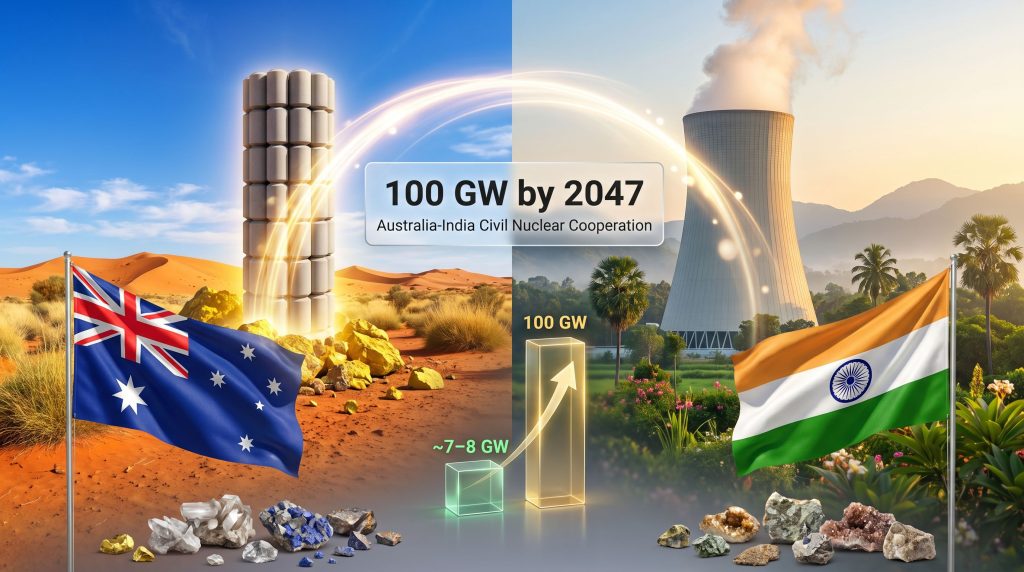
When a nation of 1.4 billion people formally commits to expanding its nuclear energy fleet by more than tenfold within two decades, the upstream consequences for global uranium supply chains are profound. India's target of 100 gigawatts of nuclear energy capacity by 2047 is not an aspiration buried in a policy document. It is a centrepiece of the country's energy security architecture, and it carries with it an implicit demand for nuclear fuel on a scale that few uranium-exporting nations are currently positioned to satisfy alone.
Australia sits at the intersection of this demand signal and its own urgent need to diversify trade relationships. The result is a bilateral dynamic that stretches well beyond a simple commodity deal. Australia India nuclear cooperation has evolved into a multi-layered strategic conversation spanning uranium supply, critical minerals, green hydrogen, and institutional capital investment, all unfolding against a backdrop of shifting Indo-Pacific geopolitics.
When big ASX news breaks, our subscribers know first
A Partnership Signed in 2014 That Is Only Now Finding Its Commercial Footing
The Australia-India Civil Nuclear Cooperation Agreement was signed in September 2014 and entered into force in 2015, establishing a legally binding framework for uranium exports. What made this agreement genuinely unprecedented was its recipient. India is not a signatory to the Nuclear Non-Proliferation Treaty (NPT), and for decades, Australia's uranium export policy was restricted exclusively to NPT member states.
India's path to becoming the first non-NPT nation eligible for Australian uranium exports required an earlier and equally significant diplomatic breakthrough. In 2008, the Nuclear Suppliers Group (NSG) granted India a landmark exemption, recognising that despite its non-NPT status, India had maintained a credible record of responsible nuclear stewardship. That exemption opened the door for bilateral civil nuclear agreements with major supplier nations, including the United States, France, Russia, Canada, and eventually Australia.
The Gap Between Agreement and Commercial Reality
A small, symbolic uranium shipment departed Australian shores for India in 2017, but this remained a token gesture rather than the beginning of a commercial supply relationship. For nearly a decade after the agreement entered into force, large-scale exports stalled. The reasons were layered:
- Safeguards complexity: Australia's legal framework requires robust end-use verification, and India's dual-use nuclear programme creates structural challenges for any supplier nation bound by non-proliferation obligations.
- India's separation plan: Under the terms of its NSG exemption, India designates specific reactors as civilian and others as part of its defence programme. Critics of the arrangement have long noted that this separation plan does not provide the same verification transparency as full NPT membership, creating genuine compliance uncertainty for Australian exporters.
- Domestic political dynamics in Australia: Uranium exports have historically been a politically sensitive issue within the Australian Labor Party, shaped by longstanding anti-nuclear sentiment and concerns raised by environmental advocacy groups.
As of mid-2026, both governments are actively working to move the relationship past these obstacles. Indian Prime Minister Narendra Modi, speaking at the Australia-India economic roadmap business event in Melbourne in July 2026, described the bilateral relationship as presenting historic opportunities for cooperation across nuclear energy, critical minerals, and green hydrogen. Modi also signalled India's interest in potential collaboration on low-carbon aluminium production, a sector where Australia's bauxite resources and processing expertise could complement India's expanding industrial ambitions.
Furthermore, the finalisation of a full commercial uranium supply agreement represents the single most consequential near-term milestone in the bilateral energy relationship, with long-term implications for uranium market dynamics.
What India's 100 GW Nuclear Target Actually Demands From Global Supply Chains
The scale of India's nuclear ambition deserves careful examination because the numbers are genuinely extraordinary. Current installed nuclear capacity in India sits at approximately 7 to 8 gigawatts. Reaching 100 GW by 2047 requires building out the equivalent of more than 12 times the current fleet over roughly 20 years, while simultaneously maintaining existing capacity.
| Metric | Current Status | 2047 Target |
|---|---|---|
| India's Installed Nuclear Capacity | ~7-8 GW | 100 GW |
| Required Expansion Multiple | Baseline | ~12-14x |
| Australian Uranium Exports to India | Minimal (post-2017 shipment) | Full commercial framework pending |
| IAEA Safeguards Framework | Established (2014-2015) | Ongoing compliance required |
This trajectory implies an enormous and sustained appetite for uranium imports. Australia holds approximately 28% of the world's known uranium reserves, making it one of the largest repositories of nuclear fuel on the planet. What distinguishes Australian uranium in the context of India's supply chain requirements is not just volume but also provenance. Australian uranium is extracted under stringent environmental and regulatory standards, offering India an ESG-compliant, politically stable supply source with low sovereign risk.
Why Supplier Diversification Is Central to India's Energy Security Doctrine
India's nuclear energy diplomacy reflects a broader strategic principle known as multi-directional energy engagement. India sources nuclear fuel and technology from Russia (including the operational Kudankulam reactor complex), France (the proposed Jaitapur plant), Canada (through historical CANDU reactor technology heritage), and the United States (under the 2008 US-India 123 Agreement). Adding Australia as a full commercial uranium supplier would further diversify India's fuel supply chain, reducing dependence on any single source.
This supplier diversification logic also works in reverse for uranium exporters. Shifts in uranium supply and demand globally mean that as India's nuclear fleet scales toward its 2047 target, the country will become one of the world's largest uranium import markets. Establishing a meaningful position in that market now constitutes a first-mover advantage for Australian producers that would be extremely difficult to replicate once supply relationships with competing nations are entrenched.
| Partnership | Agreement Type | Current Status | Key Structural Feature |
|---|---|---|---|
| Australia-India | Civil Nuclear Cooperation (2014) | Commercial deal pending | First non-NPT uranium recipient |
| US-India (123 Agreement) | Civil Nuclear Cooperation (2008) | Operational | Enabled NSG exemption |
| Russia-India (Kudankulam) | Reactor supply and fuel | Operational | Multiple reactors built or under construction |
| France-India | Civil Nuclear Agreement (2008) | Active | Jaitapur nuclear plant project |
| Canada-India | Nuclear Cooperation Agreement | Active | CANDU reactor technology heritage |
Unlike Russia and France, whose primary involvement in India's nuclear sector is through reactor construction and technology transfer, Australia's role is positioned upstream as a fuel supplier. This distinction matters strategically. Fuel supply relationships, once established, tend to be durable and long-term, whereas reactor technology partnerships are discrete project-based arrangements that may or may not continue after commissioning.
The Safeguards Problem: Why End-Use Verification Remains Unresolved
The central technical and legal obstacle to a full commercial uranium agreement is the end-use verification challenge. Australia's obligations under the Australian Radiation Protection and Nuclear Safety Act (ARPANSA) and its network of nuclear cooperation agreements require that Australian-origin uranium and any nuclear material derived from it remain within civilian nuclear infrastructure and cannot be redirected toward weapons or military applications.
India's nuclear programme is structured differently from that of NPT member states. It operates a separation plan that designates certain reactors and fuel cycle facilities as civilian, subject to IAEA safeguards, and others as outside civilian oversight. The practical difficulty is that uranium flows through a complex fuel cycle, and tracking Australian-origin material across multiple processing steps within this dual-use environment requires verification mechanisms that have proven technically and administratively difficult to implement at commercial scale.
The 2014 agreement established IAEA safeguards as the governing verification standard, consistent with India's Additional Protocol commitments. However, the gap between the agreement's legal architecture and its operational implementation has been the primary source of delay over the past decade. Resolving this gap without compromising Australia's non-proliferation obligations is the technical challenge that policymakers in both capitals are currently working to address.
Beyond Uranium: Critical Minerals, Green Hydrogen, and Institutional Capital
The Australia India nuclear cooperation framework encompasses far more than nuclear fuel alone. Three additional pillars are developing simultaneously, each with its own commercial and strategic logic.
Critical Minerals: The Supply Chain Diversification Imperative
Australia is a leading global producer of lithium, cobalt, rare earth elements, and manganese, all of which are foundational inputs for electric vehicle batteries, grid-scale energy storage, and renewable energy manufacturing. Consequently, India's Production Linked Incentive (PLI) schemes for advanced chemistry cell batteries and green hydrogen create structured domestic demand for exactly these materials.
China currently dominates the processing of most critical mineral categories, including rare earth refining, lithium chemical production, and cobalt processing. This concentration creates supply chain vulnerability for nations seeking to build out clean energy manufacturing. Broader considerations around critical minerals and energy security are central to this dynamic, and an Australia-India critical minerals partnership provides both countries with a direct diversification pathway that also has strategic resonance within the Quad security framework alongside the United States and Japan.
Green Hydrogen: A Complementary Trade Corridor
Both Australia and India have identified green hydrogen as a shared strategic priority. Australia is developing substantial green hydrogen production capacity, leveraging its renewable energy surplus from solar and wind. India's National Green Hydrogen Mission is building out domestic demand, with ambitious targets for green hydrogen consumption across industrial and transport applications.
The combination of Australian production capability and Indian demand creates the foundation for a potential new bilateral trade corridor in green hydrogen, one that would complement rather than compete with the nuclear fuel supply relationship. Joint infrastructure investment in hydrogen liquefaction, shipping, and port facilities could anchor this corridor commercially.
Institutional Capital: AustralianSuper's India Commitment
In July 2026, AustralianSuper, Australia's largest superannuation fund, announced a further commitment of A$500 million (approximately USD $347 million) to India's National Investment and Infrastructure Fund (NIIF). This investment reflects the structural attractiveness of Indian infrastructure assets for long-duration institutional capital. Indian infrastructure projects offer scale, government-backed revenue frameworks, and asset duration characteristics that align closely with the liability-matching requirements of large pension funds.
The institutional capital dimension of the Australia-India relationship is often underappreciated in discussions focused on commodities and energy policy. Long-duration capital commitments from entities like AustralianSuper create a separate and durable economic interdependence that reinforces the broader bilateral relationship regardless of the political cycle in either country.
India is currently Australia's fifth-largest trading partner, sitting behind China, Japan, the United States, and South Korea. The combination of nuclear fuel, critical minerals, green hydrogen, and infrastructure investment has the potential to substantially elevate India's position in Australia's trade hierarchy over the next decade.
Trade Diversification as a Structural Driver of Australia-India Engagement
Australia's motivation to deepen its relationship with India is also shaped by the recent turbulence in its relationship with China, its largest trading partner. Since 2020, diplomatic friction between Canberra and Beijing disrupted key Australian export categories including coal, wine, barley, and beef, exposing the risks of excessive trade concentration. While the bilateral relationship with China has partially stabilised, the episode accelerated a structural reassessment of Australia's trade diversification strategy.
India offers a combination of attributes that no other alternative partner fully replicates: scale, sustained growth trajectory, democratic governance, shared Quad membership, and a large and economically active diaspora of approximately one million people of Indian ancestry in Australia. This diaspora creates cultural and commercial bridges that reduce transaction costs and information asymmetry in bilateral investment, particularly for Australian businesses entering Indian markets for the first time.
The India-Australia Economic Cooperation and Trade Agreement (AI-ECTA), which entered into force in December 2022, reduced tariff barriers across a range of goods and services categories. In addition, emerging uranium market trends point toward increased demand from Indo-Pacific nations, creating a more favourable institutional framework for the commercial relationship to deepen across all sectors, including energy.
However, it is also worth noting that geopolitical developments such as the Russian uranium import ban imposed by the US Senate are reshaping global supply chains, further reinforcing the strategic value of Australia as a stable, allied uranium supplier to nations like India.
The next major ASX story will hit our subscribers first
Frequently Asked Questions: Australia India Nuclear Cooperation
Has Australia ever exported uranium to India?
A small, symbolic quantity of uranium was shipped from Australia to India in 2017, following the entry into force of the 2014 Civil Nuclear Cooperation Agreement. No large-scale commercial supply arrangement has been finalised as of mid-2026, with negotiations continuing.
Why is India not a member of the NPT?
India developed nuclear weapons outside the NPT framework and conducted its first nuclear test in 1974. As a result, it has never joined the treaty. India's voluntary moratorium on nuclear testing and its formal separation of civilian and military nuclear programmes led to the 2008 NSG exemption, which enabled nuclear trade with supplier nations including Australia.
What safeguards apply to Australian uranium exported to India?
All Australian-origin uranium supplied to India must remain within designated civilian nuclear facilities and be subject to IAEA safeguards verification. These conditions cannot be waived and are monitored through India's Additional Protocol commitments with the IAEA.
What is India's 100 GW nuclear target?
India has established a national goal to develop 100 gigawatts of nuclear energy capacity by 2047, the centenary of Indian independence. This requires expanding the current nuclear fleet by more than tenfold and represents one of the most ambitious nuclear energy programmes in the world.
How does the AI-ECTA support broader energy cooperation?
The AI-ECTA, in force since December 2022, established a broader bilateral trade and investment framework. While primarily covering tariff reductions on goods and services, it strengthened the institutional architecture that underpins energy, nuclear, and critical minerals cooperation between the two countries.
Disclaimer: This article contains forward-looking information regarding energy targets, trade projections, and bilateral negotiations. Such information is subject to change based on policy decisions, diplomatic developments, and commercial negotiations. Nothing in this article constitutes financial or investment advice.
Want to Track the Next Major ASX Mineral Discovery Before the Market Does?
As Australia's uranium and critical minerals sector gains momentum from transformative partnerships like the Australia-India nuclear cooperation framework, Discovery Alert's proprietary Discovery IQ model delivers real-time ASX mineral discovery alerts, turning complex resource data into actionable investment insights for both short-term traders and long-term investors — explore historic discovery returns on Discovery Alert's discoveries page and begin your 14-day free trial to position yourself ahead of the market.