July 8, 2026
The Global Uranium Deficit: Why Brazil's Resource Ambitions Are Arriving at the Right Time
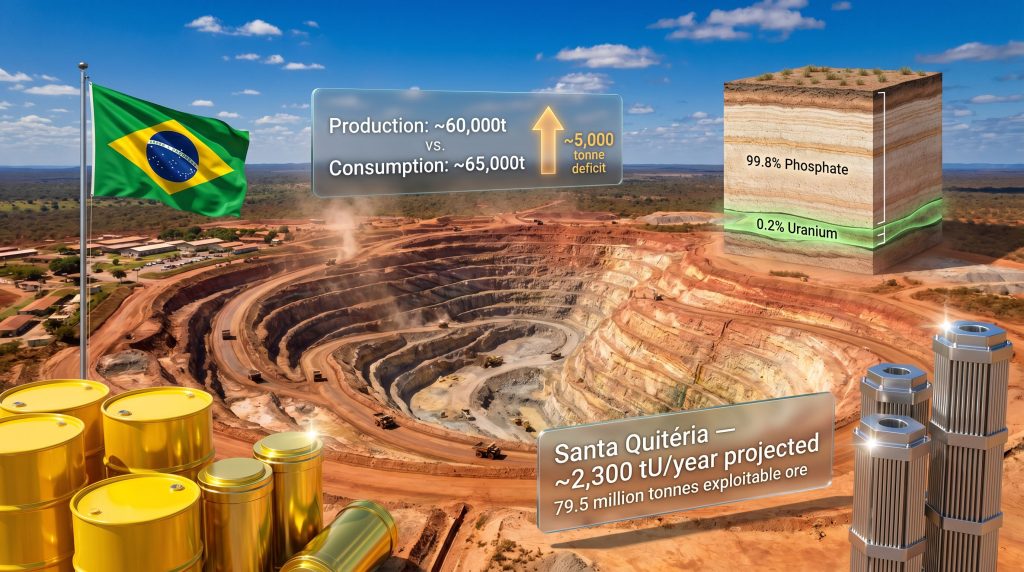
The global nuclear fuel cycle is under a quiet but intensifying strain. For the first time in decades, annual uranium consumption has overtaken annual production at a global scale, with the world burning through roughly 65,000 tonnes of uranium per year while mines collectively produce closer to 60,000 tonnes. That 5,000-tonne annual shortfall is currently being plugged by strategic reserves held by governments and nuclear utilities, but those stockpiles are finite. As reactor construction programmes accelerate across Asia, Eastern Europe, and North America, the structural case for new primary uranium supply has rarely been stronger.
Against this backdrop, the formation of Brazil's Brazil uranium working group carries significance well beyond its national borders. Brazil sits atop one of the world's great underdeveloped uranium endowments, yet its current mining output is a fraction of its geological potential. The working group's 90-day mandate to assess, map, and propose an expansion strategy represents a meaningful inflection point for a country that has long possessed the resources but not yet the production infrastructure to match its ambitions.
When big ASX news breaks, our subscribers know first
What the Brazil Uranium Working Group Is and Why It Was Created
The Conselho Nacional de Política Mineral (National Council for Mineral Policy) formally established the working group under the supervision of Brazil's Ministry of Mines and Energy. Its institutional composition is notably broad, bringing together multiple federal ministries, the Brazilian Navy, the Ministry of Defence, nuclear power operator Eletronuclear, and state-owned uranium producer Indústrias Nucleares do Brasil (INB).
The group has been assigned a 90-day operational window to complete four core deliverables:
- Assess the current state of uranium resource mapping and geological knowledge across Brazil
- Evaluate known reserves against both projected domestic demand and potential export capacity
- Propose concrete strategies for expanding resource information and exploration coverage
- Determine mineral production potential across both active operations and prospective development projects
The presence of defence institutions within this working group is not incidental. It reflects a long-standing Brazilian policy tradition of treating uranium as a matter of national sovereignty and security, rather than simply a commodity subject to standard mining regulation. Brazil's constitution restricts foreign ownership of uranium assets, and the involvement of the Navy and Ministry of Defence reinforces that the country views its nuclear fuel supply chain as a strategic capability. Furthermore, understanding the broader uranium supply challenges facing the global market helps explain why this institutional commitment carries such weight.
The inclusion of Brazil's Navy and Ministry of Defence in a minerals policy working group signals that uranium is treated as a sovereign asset, placing it in a different regulatory and strategic category than conventional mining commodities.
Brazil's Uranium Endowment: World-Class Reserves, Minimal Production
Understanding the urgency behind the working group's formation requires appreciating the scale of the gap between what Brazil holds in the ground and what it currently extracts. According to the World Nuclear Association, Brazil holds reasonably assured uranium resources of approximately 210,000 tonnes, placing it among the top six nations globally by uranium reserve endowment. Broader geological estimates put total reserves as high as 600,000 tonnes when inferred and speculative categories are included.
Yet Brazil's entire domestic uranium production flows from a single operating facility.
| Metric | Detail |
|---|---|
| Global uranium reserve ranking | Sixth largest globally |
| Reasonably assured resources | ~210,000 tonnes (World Nuclear Association) |
| Total estimated reserves (broader) | ~600,000 tonnes |
| Active uranium mines | One (Lagoa Real/Caetité) |
| Annual production capacity | ~340 tonnes of uranium (tU) |
| Known mine resources | 10,000 tU at 0.3% uranium grade |
| Mining history commencement | 1982 |
The contrast is striking. A country with potential reserves approaching 600,000 tonnes relies on a single mine producing just 340 tonnes per year. This is the geological and industrial reality the Brazil uranium working group has been assembled to address. In addition, the global uranium reserves picture globally underscores just how significant Brazil's underdeveloped endowment could be.
Why Low Production Doesn't Reflect Low Potential
Part of the explanation lies in Brazil's historical approach to uranium development. Intensive exploration during the 1970s and 1980s identified substantial resources, but the transition from discovery to production has been slow. This is due to a combination of constitutional constraints on foreign investment, environmental licensing complexity, and the relatively low uranium prices that characterised much of the 2000s and early 2010s.
The uranium price recovery since the early 2020s, combined with the global reactor build-out, has shifted this calculus materially. Brazil's geological inventory now represents a genuine strategic asset in a supply-constrained market. However, the uranium supply-demand volatility of recent years serves as a reminder that favourable conditions are not guaranteed to persist indefinitely.
Santa Quitéria: The Project That Could Transform Brazil's Nuclear Fuel Position
No single project is more central to Brazil's uranium expansion narrative than Santa Quitéria, located at the Fazenda Itataia site in the interior of Ceará state. The Itataia deposit holds the distinction of being the largest identified uranium reserve in Brazil, but its geological character sets it apart from conventional uranium projects in an important way.
The deposit is predominantly phosphate in composition, with the collophanite ore body running at approximately 99.8% phosphate and 0.2% uranium. This dual-commodity structure is not a disadvantage; it is arguably one of the project's most compelling economic features.
Santa Quitéria Key Resource Metrics
| Parameter | Estimated Figure |
|---|---|
| Total uranium endowment | ~142,200 tU |
| Exploitable ore reserves | 79.5 million tonnes |
| Phosphate grade | 11% P₂O₅ |
| Uranium grade | 0.0998% U₃O₈ |
| Total U₃O₈ equivalent | ~79,300 tonnes |
| Total P₂O₅ equivalent | ~8.9 million tonnes |
| Projected annual uranium output | ~2,300 tU per year |
| Projected annual phosphate fertiliser output | ~1.05 million tonnes |
| Projected dicalcium phosphate (animal feed) | ~220,000 tonnes per year |
The uranium co-recovery process from phosphate ores is technically well-established internationally, though it requires specific hydrometallurgical processing steps distinct from conventional uranium milling. The economic significance is considerable: phosphate fertiliser revenues provide a substantial revenue base that effectively cross-subsidises uranium production costs, making the project's economics more resilient to uranium price fluctuations than a standalone uranium mine would be.
This type of dual-commodity project economics is not widely understood by generalist investors. The uranium content essentially becomes a byproduct revenue stream layered on top of a fertiliser business, which has its own stable demand fundamentals tied to Brazil's enormous agricultural sector.
Regulatory Status and the Critical Path
Santa Quitéria's development remains contingent on progressing through Brazil's environmental licensing framework. IBAMA (the Brazilian Institute of Environment and Renewable Natural Resources) accepted the project for environmental review in March 2022, and it is currently advancing through the preliminary environmental licensing process.
Environmental licensing in Brazil operates across three sequential stages: preliminary licence (LP), installation licence (LI), and operating licence (LO). Santa Quitéria is in the preliminary stage, which means construction authorisation remains some distance away. The complexity of licensing a dual-commodity project with radioactive material components adds procedural layers beyond those applicable to conventional phosphate mining.
Regulatory timeline risk at Santa Quitéria should be treated as a genuine variable by any analyst or investor assessing Brazil's uranium production growth trajectory. IBAMA licensing processes for projects of this complexity have historically run longer than initially projected.
Pró-Urânio: Opening Brazil's Uranium Sector to Private Capital
In parallel with the working group's formation, the broader institutional architecture for uranium expansion has been taking shape through the Pró-Urânio programme, launched by INB in 2024. The programme's stated objective is to accelerate both the exploration of new deposits and the development timeline for known resources.
The structural innovation within Pró-Urânio lies in its financing model. BNDES (Brazil's National Bank for Economic and Social Development) has been designated as the vehicle for developing partnership models with private mining companies, representing a meaningful departure from the historically state-dominated approach to uranium development.
In December 2024, BNDES issued a Request for Information (RFI) to consulting firms interested in shaping the programme's private sector engagement framework. This process is a precursor to the formal structuring of public-private partnership agreements that could bring international mining capital and operational expertise into Brazilian uranium exploration for the first time at meaningful scale.
Key characteristics of the Pró-Urânio programme:
- Targets new deposit identification rather than simply expanding known resources
- Uses BNDES as a structural intermediary to bridge state ownership requirements and private capital
- Operates within Brazil's constitutional framework, which restricts outright foreign ownership of uranium assets
- Designed to compress exploration-to-development timelines by pre-positioning capital structures
The Enrichment Gap: A Structural Vulnerability Beneath the Surface
One dimension of Brazil's nuclear fuel strategy that receives less attention than mine development is the country's persistent dependency on foreign uranium enrichment services. Brazil commissioned a domestic uranium enrichment centre at Resende in Rio de Janeiro, with ambitions toward full self-sufficiency in fuel fabrication. However, the facility has scaled up more slowly than originally envisaged.
Approximately 95% of the uranium used in the Angra 1 and Angra 2 reactors is currently enriched outside Brazil, primarily by Urenco in Europe. This means that even if Brazil dramatically expands domestic mining output, the strategic vulnerability in its nuclear fuel supply chain will persist until enrichment capacity scales proportionally.
The working group's mandate to address upstream mining is therefore only one piece of a more complex puzzle. Without parallel investment in enrichment capacity, expanded domestic mining output would largely feed export markets rather than delivering true fuel cycle self-sufficiency. The uranium extraction methods employed upstream also influence how efficiently that material can be prepared for enrichment processing.
The next major ASX story will hit our subscribers first
International Partnerships and the Geopolitical Layer
Brazil's nuclear expansion ambitions are not being pursued in isolation. Nucleo Brasil Energia Participações (NBEPar) and Russia's Uranium One Group, a subsidiary of Rosatom, have established a joint venture framework targeting both uranium production growth and small modular reactor development. Floating SMR concepts have been under active consideration since mid-2024 as part of this collaboration.
Russia already supplies enriched uranium for the Angra plants, creating a pre-existing supply dependency that the joint venture framework extends and deepens. This positions Brazil in an interesting geopolitical space: simultaneously pursuing domestic self-sufficiency and deepening ties with the world's largest state-owned nuclear energy conglomerate.
This dual posture will attract scrutiny. Western nuclear supplier nations, particularly Urenco member states and US-aligned enrichment suppliers, will be watching the trajectory of Brazil's Russia relationship carefully as the country's nuclear programme scales. Consequently, the uranium market dynamics shaping these decisions extend well beyond economics alone.
The Global Supply Deficit: Why Brazil's Timing Is Strategically Significant
The macroeconomic context in which the Brazil uranium working group is operating deserves its own consideration.
| Global Uranium Metric | Current Figure |
|---|---|
| Annual global production | ~60,000 tonnes |
| Annual global consumption | ~65,000 tonnes |
| Annual supply shortfall | ~5,000 tonnes |
| Shortfall coverage mechanism | Strategic reserves |
The drivers of accelerating demand are multiple and overlapping:
- New large-scale reactor construction programmes in China, India, South Korea, and Eastern Europe
- SMR deployment pipelines in Western Europe and North America adding incremental future demand
- Life extension decisions at existing reactors reducing planned supply from decommissioned capacity
- Strategic reserve rebuilding programmes following years of drawdown
Brazil's reasonably assured resource base of 210,000+ tonnes positions it as a potentially significant future supplier to this tightening market. The working group's output could form the analytical foundation for a formal national uranium resource strategy with genuine export ambitions, not merely a domestic supply plan.
Three Scenarios for Brazil's Uranium Trajectory
Scenario 1: Accelerated Domestic Development
Santa Quitéria clears its environmental licensing hurdles and enters the construction phase. Pró-Urânio successfully attracts private mining capital through BNDES partnership structures. Brazil achieves meaningful production growth by the early 2030s, materially reducing dependence on imported uranium and building toward export capability.
Scenario 2: Geopolitically Aligned Expansion
The Uranium One joint venture deepens operationally, with Russian technical expertise accelerating project development timelines. SMR deployment creates additional domestic uranium demand, justifying upstream investment at scale. Enrichment capacity at Resende expands, reducing the 95% foreign enrichment dependency over time.
Scenario 3: Regulatory and Capital Constraints Delay Progress
IBAMA licensing for Santa Quitéria extends well beyond current projections. Private sector interest in Pró-Urânio partnerships fails to reach programme ambitions. Brazil remains reliant on a single operating mine and predominantly foreign enrichment services through the late 2020s, missing the current window of elevated uranium market conditions.
The 90-day working group mandate is best understood not as a resolution but as a starting mechanism. Its output will determine whether Brazil's uranium endowment transitions from geological inventory to industrial asset within the current decade.
Frequently Asked Questions: Brazil Uranium Working Group
What is the Brazil uranium working group?
The Brazil uranium working group is a formal body established by the Conselho Nacional de Política Mineral (National Council for Mineral Policy), operating under the Ministry of Mines and Energy. It has a 90-day mandate to assess uranium resource knowledge, evaluate production potential, and propose strategies for expanding Brazil's uranium exploration and mining capacity.
Who participates in the working group?
The group includes multiple federal government departments, the Brazilian Navy, the Ministry of Defence, nuclear power operator Eletronuclear, and INB.
How much uranium does Brazil currently produce?
Brazil's sole active uranium operation, the Lagoa Real/Caetité mine operated by INB, has an annual production capacity of approximately 340 tonnes of uranium.
What makes the Santa Quitéria project distinctive?
Its dual-commodity structure. The Itataia deposit is composed of approximately 99.8% phosphate and 0.2% uranium. Phosphate fertiliser revenues provide substantial economic support alongside uranium production, with projected annual outputs of 2,300 tU of uranium concentrate, 1.05 million tonnes of phosphate fertiliser, and 220,000 tonnes of dicalcium phosphate for animal feed.
What is Pró-Urânio?
Launched by INB in 2024, Pró-Urânio is a national programme to accelerate uranium exploration and deposit identification, using BNDES as a financing and partnership development vehicle to attract private sector participation.
Does Brazil have international uranium partnerships?
Yes. NBEPar and Russia's Uranium One Group (a Rosatom subsidiary) have formed a joint venture targeting both uranium production expansion and SMR development. Russia also currently supplies enriched uranium for Brazil's Angra reactors.
This article is intended for informational purposes only and does not constitute financial or investment advice. Forward-looking statements, scenario projections, and resource estimates referenced herein involve inherent uncertainty and should not be relied upon as guarantees of future outcomes. Readers should conduct independent research and consult qualified advisers before making investment decisions.
Want to Position Yourself Ahead of the Next Major Uranium Discovery?
Discovery Alert's proprietary Discovery IQ model scans ASX announcements in real time, delivering instant alerts on significant mineral discoveries — including uranium — so subscribers can identify actionable opportunities before the broader market reacts. Explore how historic mineral discoveries have generated substantial returns on Discovery Alert's dedicated discoveries page, and begin your 14-day free trial today to secure your market-leading advantage.