July 7, 2026
Africa's Nuclear Crossroads: Why Tanzania's Energy Gamble Could Reshape a Continent
Across sub-Saharan Africa, the energy access gap is not simply an inconvenience — it is a structural constraint on economic growth, industrial development, and human welfare. According to the International Energy Agency, more than 600 million people across Africa lack access to reliable electricity, and the majority of that deficit is concentrated in East and Central Africa. Renewable energy has made genuine inroads, but the intermittent nature of solar and wind generation creates a persistent problem: without dispatchable baseload power, grids remain fragile and industrial expansion remains constrained. It is within this context that the Tanzania nuclear power program IAEA approval process deserves serious analytical attention, not simply as a national milestone, but as a potential turning point for an entire region's energy architecture.
When big ASX news breaks, our subscribers know first
Understanding the IAEA's Nuclear Power Readiness Framework
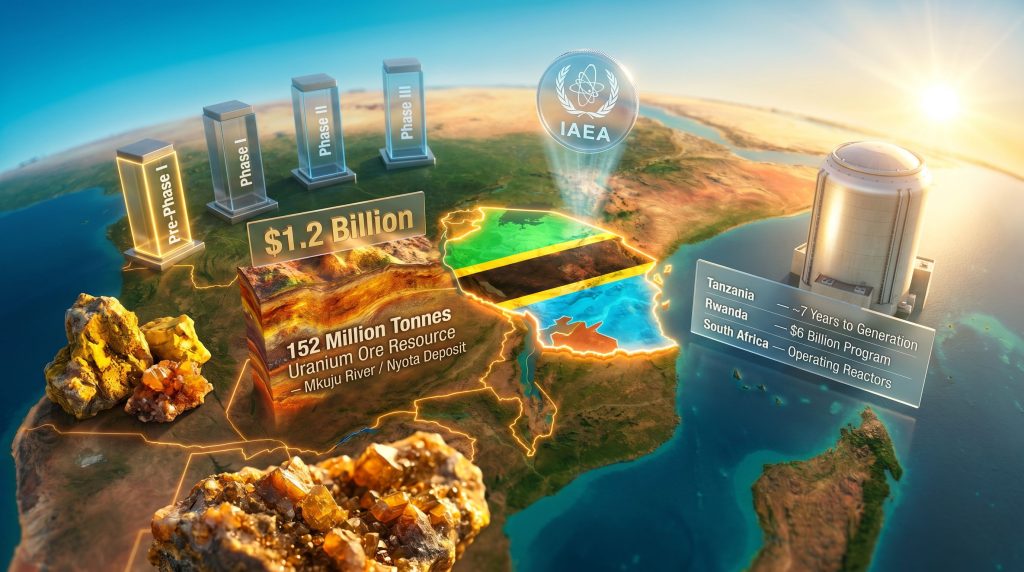
The path to civilian nuclear electricity is deliberately long and methodical. The International Atomic Energy Agency (IAEA) has developed a structured three-phase milestone framework that every aspiring nuclear nation must navigate before being authorised to generate nuclear power commercially. This framework addresses 19 key infrastructure conditions spanning legal architecture, regulatory independence, financing structures, human capital development, and public safety protocols.
The three phases can be understood as follows:
| Phase | Primary Focus | Key Requirements |
|---|---|---|
| Pre-Phase I | Preliminary Feasibility | Government commitment, stakeholder awareness, basic studies |
| Phase I | Infrastructure Foundation | Legal framework, independent regulatory authority, site studies |
| Phase II | Preparation for Construction | Contracting, detailed design, safety assessments |
| Phase III | Construction to Operation | Plant construction, commissioning, grid integration |
The framework is sequential and non-negotiable. No country can skip phases or pursue reactor construction before completing the preceding regulatory and institutional milestones. This design reflects hard lessons learned from early nuclear programs globally, where inadequate legal frameworks and underpowered regulatory bodies contributed to safety failures. Furthermore, the IAEA's nuclear infrastructure guidance makes clear that institutional readiness is every bit as important as technical capability.
Critical Distinction: Tanzania has completed its preliminary preparations and formally invited the IAEA to conduct a readiness evaluation. This assessment determines eligibility to enter Phase I only. It does not constitute approval to generate nuclear electricity, commence reactor construction, or begin site development. Official authorisation to operate a nuclear power program remains multiple phases and potentially more than a decade away from current status.
What "Readiness Assessment" Actually Means in Practice
A readiness assessment is a diagnostic exercise. IAEA experts examine whether a country's institutions, laws, human capital, and financing literacy are sufficiently mature to support the demands of Phase I. A positive outcome unlocks the right to begin formal Phase I work, which itself involves years of regulatory development, site studies, and capacity building before any construction-related activity can begin.
For Tanzania, a favourable outcome would represent a significant institutional validation, but investors and observers should understand clearly that it is the starting line, not the finish line, of what is a decade-long or longer development pathway.
Tanzania's Institutional and Legal Foundations
Tanzania is not entering this process without preparation. The Tanzania Atomic Energy Commission (TAEC) was established in 2003 under the Atomic Energy Act of the same year, giving the country more than two decades of institutional experience in nuclear regulation and safety oversight. This is a detail often overlooked in broad discussions of African nuclear ambitions: Tanzania's regulatory body predates the nuclear ambitions of many peer nations by years.
TAEC has spent those two decades building laboratory accreditation, participating in IAEA-supported training programs, and developing compliance frameworks aligned with international nuclear safety conventions. Tanzania is a signatory to the Treaty on the Non-Proliferation of Nuclear Weapons and has ratified the Comprehensive Nuclear-Test-Ban Treaty, both of which are prerequisites for serious IAEA engagement.
The TAEC Director General, Professor Najat Kassim Mohamed, publicly confirmed the invitation to the IAEA during the 50th Dar es Salaam International Trade Fair in July 2026. She emphasised that the program has been conducted in alignment with international safety standards at every stage and affirmed that public safety remains the program's highest operational priority — a message calibrated to address the significant public perception challenges that nuclear programs face in markets with limited prior exposure to the technology.
Tanzania's Uranium Resource Base: The Geological Advantage
One dimension that separates Tanzania from many other African nations pursuing nuclear energy is its domestic uranium resource base. Tanzania is not simply seeking to import reactor technology and fuel — it holds substantial in-ground uranium resources that create a potential strategic advantage in the long-term fuel supply chain. Indeed, understanding global uranium reserves helps contextualise just how significant Tanzania's position could become.
Key Data: The Nyota uranium deposit, located within the Mkuju River project in Tanzania's southern Ruvuma Region, contains an estimated 152 million tonnes of uranium ore resources, with the Mkuju area specifically holding approximately 36,000 tonnes of measured resources. These figures are sourced from Mantra Tanzania, a subsidiary of Rosatom, and represent one of the most significant uranium concentrations in sub-Saharan Africa.
To contextualise Tanzania's potential position within the African uranium landscape:
| Country | Regional Uranium Status | Notes |
|---|---|---|
| Namibia | Africa's Largest Producer | Home to Rössing and Husab mines |
| Niger | Africa's Second Largest | Significant reserves, subject to ongoing political uncertainty |
| Tanzania (Projected) | Potential Third Largest | Ruvuma Region deposits; development underway |
| South Africa | Established Producer | Uranium primarily extracted as a by-product of gold mining |
In July 2025, President Samia Suluhu Hassan inaugurated a pilot uranium processing plant at the Namtumbo site. Developers plan to begin construction of the main processing facility in 2026, with commissioning targeted for 2029. Mines Minister Anthony Mavunde stated during the inauguration ceremony that the development would position Tanzania as Africa's third-largest uranium producer behind Namibia and Niger.
The Processing Paradox: Export Raw, Import Refined
There is a technically important and commercially significant detail embedded in Tanzania's uranium strategy that is rarely discussed in mainstream coverage. Tanzania will not use its domestically mined uranium directly as nuclear fuel. The raw uranium concentrate will be exported — initially to Russia — for enrichment and fuel fabrication, then reimported as finished nuclear fuel assemblies for use in any future reactor.
This reflects the current global reality of uranium fuel supply chains. Enrichment and fuel fabrication capacity is concentrated in a small number of countries, including Russia, France, the United States, and China. Consequently, for Tanzania, this creates both a logistical dependency and a geopolitical consideration that will need to be managed carefully as the program matures — an issue that sits at the heart of broader uranium geopolitics playing out across multiple continents.
Russia's Rosatom and the Geopolitics of Nuclear Partnership
The $1.2 billion investment commitment underpinning the Mkuju River uranium project comes from Rosatom through its subsidiary Uranium One. This 20-year investment framework targets annual production of approximately 1,400 tonnes of uranium concentrate and is projected to create roughly 4,000 direct employment positions across mining, processing, and associated support functions.
Beyond the mining dimension, Rosatom Director General Alexey Likhachev indicated at the St. Petersburg International Economic Forum in June 2026 that the company could construct a nuclear power plant in Tanzania during the 2030s, contingent on the nuclear program achieving defined progress milestones. This conditional framing is important: Rosatom's reactor proposal is not a confirmed project but a forward-looking indication of commercial interest tied to regulatory progress.
Rosatom's engagement in Tanzania mirrors a broader pattern of Russian nuclear diplomacy across the African continent. Egypt, South Africa, Ethiopia, and Rwanda have all seen various stages of Rosatom engagement. The business model typically combines uranium development, reactor construction financing, long-term fuel supply agreements, and technical training — creating a comprehensive but heavily integrated partnership structure. The Namibia-Russia nuclear ties offer a particularly instructive parallel for understanding how these arrangements evolve in practice.
Geopolitical Note: For Tanzania, a deep Russian nuclear partnership carries both genuine infrastructure benefits and long-term strategic dependencies. Fuel supply chains, technical expertise, spare parts, and maintenance contracts can create multi-decade lock-in effects. Nations considering Russian reactor technology must weigh these structural dependencies against the financing and technology transfer advantages that Rosatom's integrated model offers, particularly in markets where Western nuclear vendors may not offer comparable financing flexibility.
Comparing Nuclear Partnership Models for African Nations
The choice of nuclear technology partner is arguably as consequential as the technology itself. Key dimensions across partnership models include:
- Financing flexibility: Russian and Chinese vendors often provide state-backed financing that Western vendors cannot match on comparable terms for developing markets
- Fuel supply dependency: Vendors who supply both reactor technology and fuel create integrated dependencies that can limit future procurement flexibility
- Technology transfer scope: Some partnership structures include more extensive local capacity building than others, affecting long-term national capability development
- Geopolitical alignment implications: Deep infrastructure partnerships with major powers carry alignment signals that can affect broader diplomatic and trade relationships
- Regulatory compatibility: Western-designed reactors typically align more directly with IAEA and Nuclear Regulatory Commission-derived frameworks, potentially streamlining some licensing processes
Tanzania's Realistic Timeline for Nuclear Electricity Generation
Tanzania's government projects that nuclear electricity generation could begin within approximately seven years of receiving a favourable IAEA readiness assessment. Understanding whether that timeline is credible requires mapping the full sequence of required actions:
- IAEA Readiness Assessment — Formal evaluation of Tanzania's preparedness to enter Phase I
- Phase I Clearance — Establishment of a fully independent nuclear regulatory authority and comprehensive legal framework
- Site Selection and Safety Studies — Geological, environmental, seismic, and population impact assessments for the proposed reactor location
- Technology and Contractor Agreements — Finalisation of reactor design, construction contracts, and financing arrangements
- Phase II Completion — Detailed engineering, safety case approval, and regulatory licensing
- Construction Phase — Typically requiring 5 to 7 years for reactor construction and commissioning, though delays are common globally
- Grid Integration and Commercial Operation — Connection to Tanzania's national electricity grid and commencement of commercial generation
The seven-year figure assumes no significant regulatory delays, no financing disruptions, no geopolitical complications affecting the Rosatom partnership, and smooth completion of each preceding phase. In practice, nuclear programs globally have a consistent history of timeline extension. The United Arab Emirates' Barakah plant, often cited as a model for emerging nuclear energy countries, took approximately 12 years from initial planning to first electricity generation.
Tanzania vs. Rwanda: East Africa's Competing Nuclear Timelines
| Metric | Tanzania | Rwanda |
|---|---|---|
| Current Phase | Pre-Phase I (Readiness Assessment Pending) | IAEA-Backed Program Approved |
| Program Value | TBD (reactor costs separate from $1.2B uranium project) | ~$6 billion |
| Primary Partner | Russia (Rosatom/Uranium One) | Under development |
| Regional Distinction | First in East and Central Africa at this stage | Central Africa nuclear pioneer |
| Target Generation Start | ~7 years post-positive assessment | Under development |
The next major ASX story will hit our subscribers first
How Tanzania's Energy Deficit Makes Nuclear Power a Strategic Imperative
Tanzania's electricity access rate has improved significantly over the past decade through rural electrification programs and grid expansion, however the country still faces substantial generation capacity constraints relative to its development aspirations. GDP growth projections consistently forecast demand growth that outpaces current generation capacity expansion plans.
Nuclear power's core structural advantage in this context is its baseload characteristic. Unlike solar and wind generation, a nuclear plant produces power continuously at a predictable output level, independent of weather conditions. For an industrialising economy where manufacturing, processing industries, and urban service sectors require reliable 24-hour power, baseload generation is not merely preferable but functionally necessary.
The economic case for nuclear investment, while capital-intensive upfront, becomes compelling when modelled over multi-decade operational lifetimes. Modern reactor designs operate for 60 to 80 years with midlife refurbishments, spreading the initial capital cost across an extraordinarily long generation period and providing electricity at stable, predictable long-run marginal costs insulated from fossil fuel price volatility. In addition, the broader uranium market dynamics increasingly favour nations that can secure both domestic resources and reliable reactor partnerships simultaneously.
Evaluating Tanzania's Strengths, Gaps, and Uncertainties
A balanced assessment of the Tanzania nuclear power program IAEA approval pathway must acknowledge both genuine institutional strengths and real gaps that require resolution.
Institutional strengths:
- Over two decades of TAEC operational experience
- Established legal framework under the Atomic Energy Act of 2003
- Consistent compliance record with international nuclear safety standards
- Active participation in IAEA technical cooperation programmes
- Substantial domestic uranium resources providing fuel chain optionality
Identified gaps and challenges:
- Regulatory independence from political influence remains a critical IAEA evaluation criterion
- Human capital depth in nuclear engineering, health physics, and reactor operations requires significant expansion
- Financing frameworks for reactor-scale capital projects require development
- Public awareness and safety communication programmes need further investment to build domestic confidence
- The fuel processing dependency on foreign enrichment capacity creates long-term supply chain vulnerability
Furthermore, Tanzania's broader strategy of pursuing uranium production dominance as a complement to its domestic power ambitions adds another layer of complexity to an already intricate policy environment.
Frequently Asked Questions: Tanzania's Nuclear Power Programme
Has Tanzania Received IAEA Approval for Its Nuclear Power Program?
No. Tanzania has not received formal IAEA approval. The country has completed preliminary preparations and invited the IAEA to conduct a readiness assessment, which determines eligibility to enter Phase I of the three-phase nuclear infrastructure development framework. This is a precursor evaluation, not a program authorisation.
What Uranium Resources Does Tanzania Hold?
Tanzania's most significant uranium concentration is at the Mkuju River project in the Ruvuma Region. The Nyota deposit contains an estimated 152 million tonnes of uranium ore resources, with the Mkuju area holding approximately 36,000 tonnes of measured uranium resources according to Mantra Tanzania.
What Is Rosatom's Specific Role?
Rosatom, through Uranium One, is developing the Mkuju River uranium mining project under a $1.2 billion, 20-year investment framework targeting approximately 1,400 tonnes of uranium concentrate annually. Rosatom has separately indicated readiness to construct a nuclear power plant in Tanzania in the 2030s, subject to program progress milestones.
When Could Tanzania Begin Generating Nuclear Electricity?
Tanzania's government projects approximately seven years from a favourable IAEA assessment. This is conditional on completing all IAEA development phases, finalising reactor technology agreements, and securing project financing. Independent analysis of comparable programs globally suggests timeline extensions are probable rather than exceptional.
Key Program Facts at a Glance
| Category | Key Data Point |
|---|---|
| Regulatory Body | Tanzania Atomic Energy Commission (TAEC), est. 2003 |
| Legal Framework | Atomic Energy Act of 2003 |
| IAEA Framework | 19 infrastructure conditions across 3 phases |
| Current Status | Preliminary preparations complete; readiness assessment invited |
| Uranium Deposit | Mkuju River / Nyota, Ruvuma Region |
| Total Uranium Ore Resource | ~152 million tonnes |
| Measured Uranium Resources | ~36,000 tonnes (Mkuju area) |
| Russian Investment Commitment | $1.2 billion over 20 years (uranium project) |
| Projected Direct Employment | ~4,000 positions |
| Annual Uranium Output Target | ~1,400 tonnes concentrate |
| Electricity Generation Target | ~7 years post-positive IAEA assessment |
| Regional Distinction | First East and Central African nation at pre-Phase I readiness stage |
This article contains forward-looking statements and timeline projections that are inherently uncertain. Nuclear program development timelines are subject to regulatory, financial, geopolitical, and technical variables that can materially affect outcomes. Readers should not treat projected timelines as confirmed schedules. Independent research and professional advice are recommended for any investment or policy decisions related to topics covered in this article.
For ongoing coverage of African energy, mining, and public policy developments, readers may explore reporting from Ecofin Agency at ecofinagency.com.
Want to Track the Next Major Uranium Discovery Before the Market Does?
Discovery Alert's proprietary Discovery IQ model scans ASX announcements in real time, instantly identifying significant mineral discoveries — including uranium — and delivering actionable alerts to subscribers ahead of the broader market. Explore Discovery Alert's discoveries page to understand the historic returns that major mineral discoveries have generated, and begin your 14-day free trial to position yourself at the forefront of the next significant find.