August 9, 2026
The Quiet Revolution in Indo-Pacific Nuclear Fuel Diplomacy
When historians assess the turning points in global nuclear energy supply chains, the convergence of two mid-sized economies sharing a common language, overlapping strategic interests, and complementary resource profiles will likely stand out as one of the more consequential alignments of the 2020s. The formal activation of uranium trade between Australia and India in July 2026 did not emerge overnight. It is the culmination of a relationship built across overlapping diplomatic, commercial, and geopolitical layers that took more than a decade to fully crystallise. Understanding why this moment matters requires looking well beyond the headline and into the structural forces reshaping energy markets across the Indo-Pacific.
When big ASX news breaks, our subscribers know first
What the Australia-India Nuclear Cooperation Agreement Actually Involves
The foundations of Modi Australia-India nuclear energy cooperation were laid in 2014, when Prime Ministers Modi and Abbott signed a Civil Nuclear Cooperation Agreement that established the legal architecture for uranium trade. For over a decade, however, the framework existed largely on paper. The administrative arrangements finalising commercial uranium exports for peaceful energy purposes were only confirmed during Modi's July 2026 visit to Melbourne, marking the first time Australian uranium could lawfully flow to Indian reactors.
The delay was not a diplomatic failure. It reflected the genuine complexity of operationalising nuclear trade with a country that sits outside the Nuclear Non-Proliferation Treaty framework.
India is not an NPT signatory, but it has maintained an internationally recognised separation between its civilian and military nuclear facilities since at least 2008, underpinning bilateral nuclear cooperation agreements with multiple supplier nations.
The barriers that held back this trade for so long are worth examining in detail:
| Barrier | Nature of Challenge | Resolution Status |
|---|---|---|
| Non-proliferation safeguards | Ensuring fuel used solely for civilian energy | Resolved via IAEA framework |
| India's NPT non-signatory status | Diplomatic and legal complexity | Addressed through bilateral arrangements |
| Domestic political sensitivity in Australia | Public concern over nuclear exports | Resolved under Albanese government |
| Commercial terms and logistics | Pricing, volumes, delivery structures | Finalised across 2025-2026 |
All exports operate under India's country-specific IAEA Safeguards Agreement, which has been in force since 2009 and provides the legal basis for international uranium suppliers to transact with New Delhi. Australian uranium exports do not imply any endorsement of India's defence nuclear programme. End-use verification requirements under international safeguards law govern every consignment.
India's 100 GW Nuclear Target: Understanding the Scale Problem
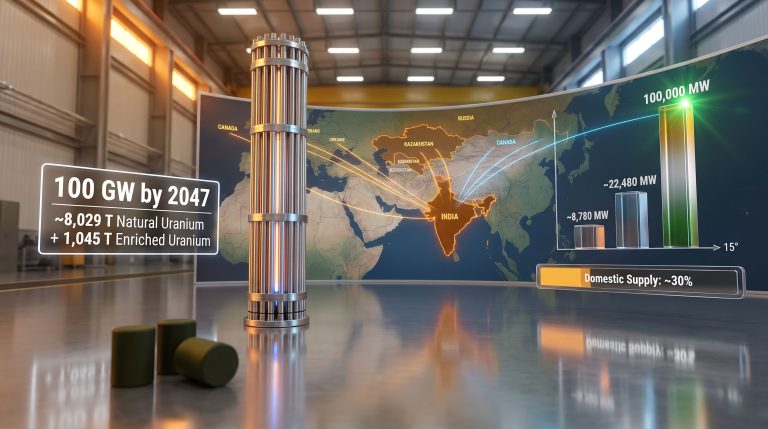
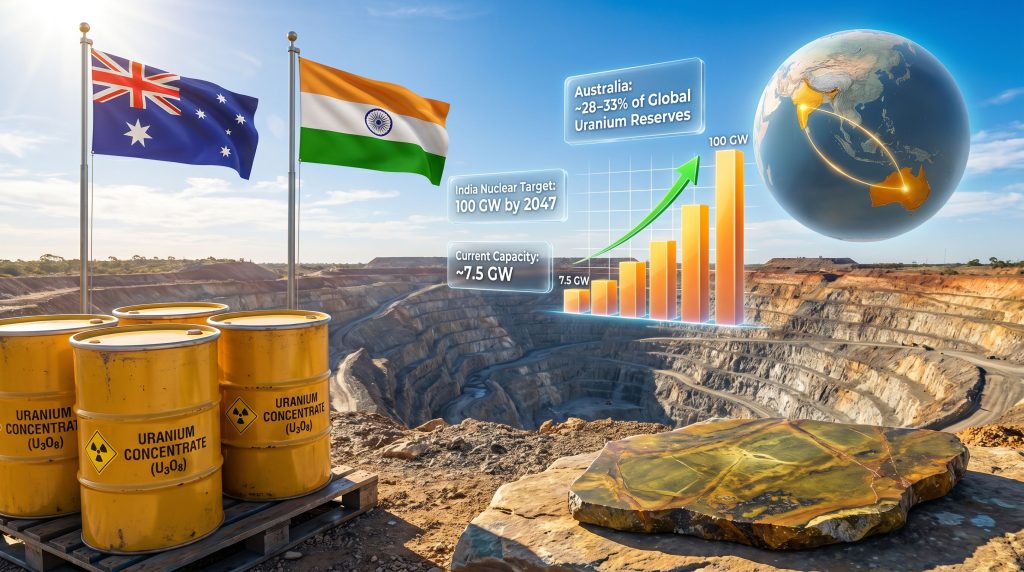
To appreciate what Australian uranium supply actually means for India, it is necessary to confront the arithmetic of India's nuclear ambitions. India's installed nuclear capacity sits at approximately 7.5 gigawatts as of mid-2026. The government's stated target is 100 GW by 2047, implying a roughly 13-fold expansion over two decades. No other country in modern history has attempted a scaling exercise of this magnitude within a comparable timeframe.
India's energy transition challenge is also fundamentally different from that facing most Western economies. Rather than simply decarbonising an existing grid, India must simultaneously expand total energy supply to support ongoing economic development while shifting away from a heavily coal-dependent generation mix. Nuclear energy is uniquely suited to this dual objective because it provides firm, dispatchable baseload power that intermittent solar and wind capacity cannot replicate.
The fuel supply implications are enormous. Scaling from 7.5 GW to 100 GW of nuclear capacity will require a sustained, decades-long supply of uranium. India's domestic uranium resources are limited in both grade and accessible reserve size, making import diversification a strategic necessity rather than a commercial preference. Furthermore, the uranium supply challenges facing the global market add another layer of urgency to securing reliable, long-term sources.
Prior to this agreement, India's nuclear fuel supply chain carried a significant concentration risk. Rosatom, Russia's state nuclear corporation, has been the dominant supplier of both reactor technology and nuclear fuel to India. However, the commercial and geopolitical risks of single-source dependency have become increasingly apparent in the post-2022 global energy landscape. Australian uranium introduces a strategically significant alternative fuel source from a stable, rules-based supplier operating under transparent IAEA compliance infrastructure.
Australia's Uranium Endowment: A Resource Asset Few Countries Can Match
Australia holds approximately 28 to 33 percent of the world's known uranium reserves, the largest single national reserve share of any country globally. This is not a marginal advantage. It positions Australia as a tier-one long-term uranium supplier capable of supporting multi-decade nuclear buildouts across multiple client nations simultaneously. In addition, understanding global uranium reserves and their distribution helps contextualise just how significant Australia's position truly is.
The country's key producing operations are concentrated in South Australia and the Northern Territory. These include some of the world's largest and longest-life uranium deposits, assets that have historically operated well below their potential given the constrained export market.
The global uranium supply landscape provides useful context:
| Supplier Nation | Approximate Global Reserve Share | India Supply Relationship |
|---|---|---|
| Australia | ~28-33% | Formalised July 2026 |
| Kazakhstan | ~12% | Active supplier |
| Canada | ~9% | Active supplier |
| Russia | ~8% | Dominant current supplier via Rosatom |
| Namibia | ~5% | Emerging supplier |
Formalising India as a customer fundamentally changes the addressable market for Australian uranium producers. India's 100 GW nuclear target, if achieved over the next two decades, would constitute one of the largest sustained uranium demand growth stories of the 21st century. Unlike spot-market uranium trading, nuclear fuel procurement tends to operate through long-term offtake contracts, meaning the commercial relationships established now will likely define supply chains well into the 2040s.
A Lesser-Known Dimension: India's Uranium Grade Constraints
One aspect of India's nuclear fuel challenge that rarely surfaces in mainstream coverage involves the quality of India's domestic uranium deposits. Indian uranium ores are generally characterised by low grades, with average uranium concentrations significantly below those of Australian, Canadian, or Kazakhstani deposits. This geological reality constrains how much India can economically extract domestically, even with expanded mining investment.
Australian uranium deposits, by contrast, include some of the world's highest-grade and most economically exploitable reserves. The grade differential matters enormously in nuclear fuel economics because uranium enrichment and fuel fabrication costs are partly a function of the concentration and purity of the feedstock. Higher-grade Australian uranium translates into more competitive fuel cycle economics for Indian operators, reinforcing the commercial logic of the supply relationship beyond its geopolitical dimensions. Consequently, the uranium market dynamics at play here are reshaping long-term procurement strategies across the Indo-Pacific.
Critical Minerals, Green Hydrogen, and the Broader Resource Partnership
The Modi Australia-India nuclear energy cooperation story is best understood as one pillar within a broader multi-vector resource and energy alliance. During his address at the Australia-India economic roadmap business event in Melbourne, Modi identified several parallel cooperation streams with material commercial potential. These span critical minerals and energy security considerations that are increasingly central to both nations' long-term strategic planning.
- Critical minerals supply chains: lithium, cobalt, and rare earth elements essential for India's electric vehicle manufacturing and battery storage ambitions
- Green hydrogen development: leveraging Australia's renewable energy surplus and land availability to produce exportable clean hydrogen for India's industrial decarbonisation needs
- Low-carbon aluminium: potential joint projects aligning with both nations' growing obligations under emerging carbon border adjustment mechanisms in export markets
- Infrastructure investment: a direct appeal to Australian institutional capital for India's road, port, rail, and urban development pipeline
The infrastructure investment dimension gained immediate commercial validation. AustralianSuper, Australia's largest pension fund, announced a further A$500 million (approximately USD $347 million) investment into India's National Investment and Infrastructure Fund. This is not a symbolic gesture. It represents institutional capital allocating at scale to India's growth story, signalling that fiduciary-grade investors now view India's infrastructure pipeline as a credible, risk-adjusted destination for long-term capital.
The transition from diplomatic frameworks to deployable institutional capital marks a maturation point in bilateral relationships that few emerging-market partnerships achieve within a generation.
Why Low-Carbon Aluminium Deserves Closer Attention
Both Australia and India are significant aluminium producers with established bauxite and alumina processing infrastructure. What makes the cooperation signal around low-carbon aluminium particularly interesting is its alignment with global trade dynamics. The European Union's Carbon Border Adjustment Mechanism and similar frameworks being developed in other major markets are beginning to price carbon-intensive metals production. Aluminium produced using renewable energy commands a growing premium over conventionally smelted material.
A coordinated Australia-India approach to low-carbon aluminium production could position both nations as preferred suppliers to decarbonising industrial buyers in Europe, North America, and Japan — markets that are actively seeking to shift procurement away from carbon-intensive sources. This is an emerging commercial opportunity that sits at the intersection of resource endowment, clean energy availability, and evolving trade policy.
The next major ASX story will hit our subscribers first
The Quad Context: Why This Is More Than a Bilateral Story
Australia and India are both members of the Quadrilateral Security Dialogue, commonly known as the Quad, alongside the United States and Japan. The Quad was revitalised in 2017 and formalised at leader level in 2021 with an explicit focus on supply chain resilience, technology cooperation, and Indo-Pacific stability.
The uranium and critical minerals cooperation announced during Modi's Melbourne visit directly reinforces Quad supply chain objectives. Specifically, it advances the collective Quad goal of reducing dependence on Chinese-controlled mineral processing and Russian energy inputs — two supply chain vulnerabilities that have attracted sustained attention from all four member governments.
Australia's motivation in deepening the India relationship also has a clear structural logic. China remains Australia's largest trading partner, a relationship that has generated both economic benefit and diplomatic friction. Expanding high-value resource trade with India provides meaningful diversification of Australia's export revenue base, with India's economic trajectory suggesting it could become one of the world's top three economies within the next two decades.
India is currently Australia's fifth-largest trading partner, sitting behind China, Japan, the United States, and South Korea. The commercial infrastructure being built through uranium supply agreements, critical minerals cooperation, and institutional investment flows has the potential to significantly reshape that ranking over the coming decade. For instance, India's lithium supply strategy offers a revealing parallel for how New Delhi is approaching resource diplomacy with Canberra more broadly.
The Diaspora Dimension and Soft Power Architecture
Approximately one million Australians claim Indian ancestry, a demographic reality that provides an unusually robust foundation for people-to-people commercial ties. Business relationships, investment networks, and regulatory familiarity tend to flow through cultural and linguistic corridors, and the Indian diaspora in Australia represents exactly the kind of bilateral connector that transforms government-level agreements into actual commercial activity at the firm and individual level.
Modi's stadium event in Melbourne, attended by thousands of expatriate Indians, underscored that the diplomatic relationship carries genuine social depth. Large-scale diaspora events during Modi's overseas visits to the United Kingdom, United States, and Australia serve a dual function: reinforcing soft power narratives domestically while demonstrating to host-country governments the political salience of the India relationship with their own electorates.
Frequently Asked Questions on Modi Australia-India Nuclear Energy Cooperation
Has Australia Exported Uranium to India Before?
No. Despite the civil nuclear cooperation framework existing since 2014, commercial uranium exports from Australia to India had not commenced prior to the July 2026 agreement finalisation. Non-proliferation safeguard arrangements and administrative procedures required full resolution before exports could legally proceed.
Is India a Signatory to the Nuclear Non-Proliferation Treaty?
India is not an NPT signatory. However, India operates under an India-specific IAEA Safeguards Agreement covering its civilian nuclear facilities, which came into force in 2009. This provides the international legal basis for uranium trade with NPT-compliant supplier nations, including Australia.
What Is India's Current Nuclear Energy Capacity?
India's installed nuclear capacity is approximately 7.5 GW as of mid-2026. The government's stated target of 100 GW by 2047 would require sustained large-scale reactor construction over the next two decades, representing one of the most ambitious nuclear expansion programmes ever attempted.
How Does This Deal Affect Rosatom's Position in India?
Australian uranium diversifies India's nuclear fuel supply base and reduces concentration risk associated with reliance on Russia's Rosatom. While Rosatom is expected to remain an important partner for reactor technology and construction, Australian supply introduces a strategically significant alternative. In nuclear fuel procurement, diversification is a standard risk management practice for any large-scale operator.
What Other Agreements Did Modi Sign During His 2026 Asia-Pacific Tour?
Prior to arriving in Australia, Modi visited Indonesia, where agreements were signed across agriculture and defence sectors, including arrangements related to the BrahMos cruise missile system. Following Australia, Modi was scheduled to visit New Zealand before returning to India.
Long-Term Implications: Nuclear as a Baseload Bridge in India's Energy Transition
India's decarbonisation pathway cannot be modelled on European or North American templates. The country's development trajectory demands energy abundance, not just energy transition. Nuclear power's value proposition in this context is its ability to deliver firm, carbon-free baseload generation at scale, complementing rather than competing with the massive solar and wind deployment already underway.
The 100 GW nuclear target sits alongside India's world-leading renewable energy expansion plans. Together, these pillars are designed to displace coal-fired generation over time while supporting the electrification demands of a rapidly growing economy. Uranium supply from Australia becomes a foundational input to this entire architecture.
The full scope of what Australia contributes to India's transition is best understood as a package:
- Australian uranium supports India's nuclear baseload capacity
- Australian critical minerals support India's battery and EV manufacturing supply chains
- Australian green hydrogen can supplement India's industrial decarbonisation over time
- Australian institutional capital finances the infrastructure backbone connecting these energy systems
No single bilateral relationship delivers across all four dimensions simultaneously. That is what makes the depth of the Australia-India partnership, accelerated substantially by Modi's July 2026 Melbourne visit, genuinely distinctive in the global energy transition landscape.
Key Facts at a Glance
| Dimension | Detail |
|---|---|
| Agreement Type | Commercial uranium supply under 2014 Civil Nuclear Cooperation Agreement |
| Safeguards Framework | IAEA-governed, civilian end-use only |
| Australia's Reserve Share | ~28-33% of global known uranium reserves |
| India's Nuclear Target | 100 GW capacity by 2047 |
| Current India Nuclear Capacity | ~7.5 GW |
| Required Expansion Factor | Approximately 13x over two decades |
| AustralianSuper Investment | A$500 million into India's National Investment and Infrastructure Fund |
| Geopolitical Context | Quad partnership; Australian trade diversification beyond China |
| Additional Cooperation Areas | Critical minerals, green hydrogen, low-carbon aluminium, infrastructure |
| India's Trade Rank for Australia | 5th largest trading partner |
| Diaspora Connection | ~1 million Australians of Indian ancestry |
This article contains forward-looking statements and projections, including references to India's 100 GW nuclear target and anticipated supply chain developments. These represent policy objectives and analyst assessments, not guaranteed outcomes. Readers should conduct independent research before making investment or strategic decisions based on energy sector forecasts.
Want to Capitalise on the Next Major Uranium Discovery Before the Market Catches On?
As India's landmark uranium agreement with Australia signals a potential surge in long-term uranium demand, Discovery Alert's proprietary Discovery IQ model delivers real-time ASX alerts the moment a significant mineral discovery is announced — turning complex data across 30+ commodities into a single, actionable insight. Explore how historic mineral discoveries have generated extraordinary returns and begin your 14-day free trial at Discovery Alert to position yourself ahead of the market.