August 5, 2026
The Strategic Minerals Race: Why Allied Nations Are Rewriting Industrial Supply Chains
The global scramble for critical minerals has fundamentally altered how governments think about economic security. For decades, policymakers treated mineral supply chains as commercial matters best left to market forces. That assumption has been dismantled by a combination of accelerating clean energy demand, the semiconductor revolution, and the growing recognition that concentrated supply chains represent national vulnerabilities rather than efficient market outcomes. The result is a new era of resource diplomacy where Australia Japan critical minerals ties carry the weight of industrial policy, not just trade agreements.
Nowhere is this strategic recalibration more visible than in the deepening partnership between Australia and Japan, two nations whose resource relationship has spanned more than six decades but is now undergoing its most significant transformation since the postwar era.
When big ASX news breaks, our subscribers know first
A$1.67 Billion in Commitment: Understanding the Scale of Intent
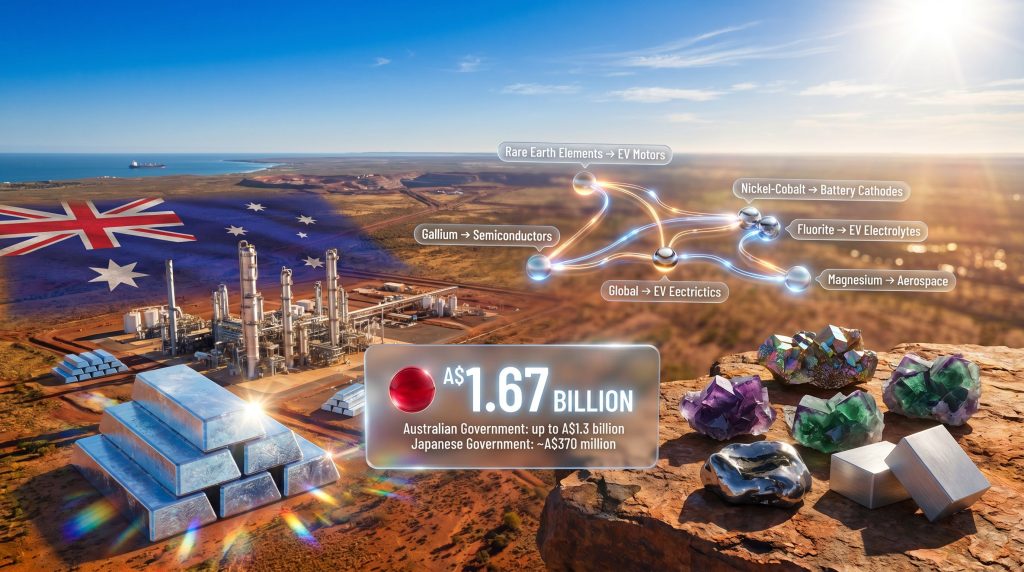
During Japan's Prime Minister's State visit to Australia in May 2026, both governments announced a combined A$1.67 billion in support for the critical minerals sector, with Australia committing up to A$1.3 billion and Japan contributing approximately A$370 million through investments and grants. At prevailing exchange rates, the combined package equates to roughly USD $1.20 billion.
The numbers alone are significant, but the more revealing element is the language attached to them. Both governments explicitly flagged that further investments and grants would follow as qualifying projects advance through development stages. This framing positions the announced figure as an opening commitment rather than a fixed ceiling, suggesting the two nations view this as a multi-year industrial programme with capital requirements that will grow alongside project pipelines.
| Funding Source | Committed Amount | Form of Support |
|---|---|---|
| Australian Government | Up to A$1.3 billion | Grants, co-financing, project support |
| Japanese Government | Approximately A$370 million | Investments and grants |
| Total Combined | A$1.67 billion (~USD $1.20 billion) | Joint pipeline funding |
The structure of this funding matters as much as its volume. By combining grants with co-financing mechanisms, the architecture is specifically designed to reduce the risk premium that deters private capital from committing to early-stage critical minerals projects. This is a well-understood challenge in the sector: the development gap between feasibility studies and commercial production is where projects most commonly stall, not because geology fails but because risk-adjusted returns cannot attract institutional investors without some form of concessional public participation.
From Coal Ships to Cathode Materials: Six Decades of Bilateral Resource Trade
To understand the depth of the current Australia Japan critical minerals ties, the historical foundation of the relationship must be appreciated. Japan's investment in Australian extractive industries stretches back to the 1960s, when the post-war reconstruction of Japan's industrial economy created an insatiable appetite for bulk commodities. That relationship matured over subsequent decades into one of the most reliable commodity trading partnerships in the Asia-Pacific region.
The scale of current energy and resource dependencies remains substantial:
- Australia supplies Japan with approximately 43% of its LNG
- Australia provides roughly 66% of Japan's coal imports
- Australia accounts for over 55% of Japan's iron ore supply
These figures, reported by Mining Weekly in May 2026, illustrate the degree to which Japan's heavy industrial and energy economy has historically relied on Australian resource extraction. The trust infrastructure built through decades of commodity trade, involving contract structures, logistics networks, and institutional relationships between Japanese trading houses and Australian miners, now provides the scaffolding for a new generation of supply chain cooperation.
The critical difference between the old model and the new is the nature of the materials involved. Iron ore and coal move in bulk at relatively transparent commodity prices. Furthermore, critical minerals such as rare earths, gallium, and acid-grade fluorite require precision processing, involve complex chemical specifications, and serve end-use industries where supply disruptions can halt semiconductor fabrication lines or battery production plants. The stakes of supply chain failure are categorically higher.
Why Japan's Industrial Structure Creates Unique Vulnerability
Japan's industrial exposure to critical mineral supply chains is among the most concentrated of any developed economy. The country's globally significant positions in automotive manufacturing, consumer electronics, semiconductor production, and robotics all depend on secure and consistent access to materials that are currently either dominated by Chinese production or processed almost exclusively in China.
Gallium, for example, is a critical input for compound semiconductors used in high-frequency communications, radar systems, and solar cells. Global gallium production has historically been concentrated in China, which accounts for the vast majority of refined output. For Japanese electronics manufacturers and defence contractors, this concentration represents a supply chain vulnerability that no amount of inventory stockpiling can permanently resolve.
Japan's net-zero emissions commitments compound this challenge. Achieving decarbonisation targets requires a dramatic scaling of electric vehicles, wind turbines, grid storage systems, and clean energy infrastructure, each of which depends on specific mineral inputs that Japanese industry currently cannot source domestically or at meaningful scale from allied nations. In addition, the energy transition's growing demand for these materials makes securing diversified supply chains an urgent strategic priority.
The Five Projects Anchoring the Pipeline
The May 2026 announcement identified five projects that may be in line for support under the bilateral framework, each targeting a different material gap in the Japan-Australia supply chain architecture.
Gallium Recovery: Alcoa's Western Australian Alumina Operations
Gallium recovery from Alcoa's operating alumina refineries in Western Australia, developed in partnership with Sojitz and the Japanese government, represents one of the most capital-efficient approaches in the project pipeline. Rather than constructing a greenfield mining and processing operation, this initiative extracts gallium as a by-product of existing alumina refining streams. Gallium occurs naturally in bauxite ore and concentrates during the Bayer process used to produce alumina from bauxite.
Recovery at an operating refinery therefore leverages existing infrastructure, reducing both capital intensity and execution risk. The target applications span semiconductors, LED technology, and solar cell manufacturing, three sectors where Japanese firms hold significant global positions and where supply security carries both commercial and strategic importance.
High-Purity Magnesium: Magnium Australia
The Magnium Australia project in Western Australia targets high-purity magnesium production for the automotive and aerospace sectors. Magnesium's value in these applications derives from its exceptionally high strength-to-weight ratio. As electric vehicle platforms prioritise weight reduction to extend battery range, high-purity magnesium has moved from a niche specialty material toward a strategically important input in next-generation vehicle design.
The purity specification matters significantly here. Standard magnesium alloys serve general engineering applications, but high-purity grades meeting aerospace and advanced automotive specifications command price premiums and face supply constraints that are structurally different from the broader magnesium market.
Acid-Grade Fluorite: Tivan's Speewah Project
Tivan's Speewah Fluorite project in Western Australia is positioned to address what is arguably the least publicly understood supply vulnerability in this group. Acid-grade fluorite, which must achieve very high purity to qualify for chemical processing applications, serves as the primary feedstock for hydrofluoric acid production. Hydrofluoric acid is a critical input for semiconductor etching processes and also functions as a key electrolyte component in certain EV battery chemistries.
The supply chain dependency here is less visible than rare earths but potentially as consequential. Japan's advanced semiconductor fabrication ecosystem depends on consistent hydrofluoric acid availability, and disruptions to acid-grade fluorite supply translate directly into production vulnerabilities for chipmakers and battery manufacturers alike.
Rare Earths and Mineral Sands: Copi Critical Minerals Project
The Copi critical minerals project in New South Wales, owned by RZ Resources with participation from JX Advanced Metals and Marubeni, targets both rare earth elements and mineral sands commodities from a single development. The involvement of two major Japanese trading entities signals that this is not speculative positioning, as trading houses of this scale commit equity and offtake participation when their industrial clients have identified genuine supply requirements and long-term demand visibility.
Mineral sands deposits in New South Wales can contain a range of heavy minerals including zircon, ilmenite, rutile, and monazite, with monazite serving as a valuable rare earth-bearing mineral. Projects that can separate and process multiple mineral streams from a single ore body often achieve better project economics through product diversification, though the processing complexity increases accordingly.
Nickel-Cobalt: Ardea Resources' Goongarrie Project
Ardea Resources' Goongarrie nickel-cobalt project in Western Australia, developed as a joint venture with Sumitomo Metal Mining and Mitsubishi, occupies a distinct position in the pipeline as one of Australia's largest nickel-cobalt resources. Nickel and cobalt are both essential components in the cathode chemistry of lithium-ion batteries used in electric vehicles and grid-scale energy storage.
The involvement of Sumitomo Metal Mining is particularly notable given the company's position as one of the world's most significant nickel refining operations and a major supplier to battery manufacturers. Mitsubishi's co-participation adds trading house logistics and offtake capability alongside Sumitomo's technical processing expertise, creating a project structure that connects the orebody directly to end-use industrial demand.
Lynas: The Proof-of-Concept That Anchors Confidence
Any analysis of Australia Japan critical minerals ties must account for Lynas Rare Earths, whose long-standing relationship with Sojitz and the Japan Organization for Metals and Energy Security represents the most mature expression of the cooperation model being expanded across the five projects described above.
Lynas operates as the world's largest producer of rare earth elements outside China, a distinction that carries profound strategic significance at a moment when allied governments are urgently seeking to reduce their dependence on Chinese rare earth processing. The Lynas-Sojitz-JOGMEC relationship, which has now spanned more than a decade, demonstrates that the Australia-Japan critical minerals framework can progress from policy intent through to sustained commercial production at scale.
This track record matters for investor and government confidence alike. The question for the five new projects is not whether the cooperation model works in principle, but whether it can be replicated across a broader set of materials and project structures in a compressed timeframe.
Supply Chain Realignment: Targeting China's Concentration
The common thread running through every project in the bilateral pipeline is the deliberate targeting of materials where Chinese production or processing concentration is highest. This is not coincidental. The partnership is architecturally designed to address the most acute supply chain vulnerabilities facing Japanese industry, which in practice means the materials where Chinese market dominance creates the greatest strategic exposure. Consequently, China's export controls on minerals such as bismuth have further accelerated the urgency of diversifying supply chains among allied nations.
| Critical Mineral | Key Application | Project Addressing Supply |
|---|---|---|
| Rare Earth Elements | EV motors, wind turbines, defence systems | Lynas (ongoing), Copi (NSW) |
| Gallium | Semiconductors, LEDs, solar cells | Alcoa/Sojitz (WA) |
| Magnesium | Automotive, aerospace lightweighting | Magnium Australia (WA) |
| Fluorite | Semiconductors, EV electrolytes | Tivan Speewah (WA) |
| Nickel-Cobalt | EV battery cathodes, grid storage | Ardea Goongarrie (WA) |
This approach aligns with the broader "friend-shoring" strategy being pursued across multiple allied-nation groupings, whereby supply chains are deliberately reconstructed among geopolitically aligned partners to reduce single-source dependency risk. The Australia-Japan partnership represents one of the more advanced bilateral implementations of this strategy in the mining and minerals processing sector.
The Role of Government Co-Investment in Unlocking Private Capital
A critical and sometimes underappreciated dynamic in critical minerals project development is the relationship between public concessional finance and private capital formation. Many critical minerals projects possess credible geology and viable processing pathways but cannot attract institutional investment at acceptable risk-adjusted return thresholds without some form of government participation.
The combination of Australian and Japanese government funding mechanisms in this partnership effectively reduces the financial risk premium that would otherwise prevent early-stage projects from securing private equity and debt financing. When major trading houses such as Sumitomo, Mitsubishi, Marubeni, and Sojitz observe that both governments are co-investing in project development, their own risk calculus shifts meaningfully. Furthermore, Australia's strategic reserve initiatives signal a long-term commitment that facilitates the commercial investment decisions transforming policy into operating mines and processing facilities.
The next major ASX story will hit our subscribers first
The Institutional Timeline: How This Partnership Evolved
The depth of the current cooperation did not emerge overnight. A structured progression underpins the May 2026 announcement, as confirmed in Australia and Japan's key bilateral documents:
- 1960s onward – Japan begins investing in Australian coal, iron ore, and LNG, establishing the foundational bilateral resource relationship
- October 2022 – Formal Critical Minerals Partnership signed, establishing institutional architecture including working groups, co-financing provisions, and coordination mechanisms under the Japan-Australia Energy and Resources Dialogue
- Early 2025 – Mitsui acquires a stake in the Rhodes Ridge iron ore project, signalling continued deepening of Japanese industrial investment in Australian resources
- April 2026 – Rare earths cooperation advances alongside broader defence and security cooperation
- May 2026 – A$1.67 billion joint commitment announced during Japan's Prime Minister's State visit
The October 2022 formal partnership established provisions for co-financing arrangements, recycling programme coordination, and alignment on advanced manufacturing inputs, creating the institutional framework within which the 2026 project pipeline could be identified and funded. This sequencing reflects a deliberate approach: architecture first, capital second.
Frequently Asked Questions: Australia Japan Critical Minerals Ties
What minerals are covered under the Australia-Japan critical minerals partnership?
The partnership spans rare earth elements, gallium, magnesium, acid-grade fluorite, nickel, and cobalt, covering materials essential to semiconductors, electric vehicles, clean energy infrastructure, aerospace manufacturing, and advanced industrial processes. However, the surge in critical minerals demand suggests this list is likely to expand as industrial requirements evolve.
Why is Western Australia central to the project pipeline?
Western Australia hosts the majority of identified projects due to its established mining and refining infrastructure, significant geological endowment across battery and critical minerals, and logistical proximity to Asian supply chains. The gallium recovery, magnesium, fluorite, and nickel-cobalt projects are all located within the state.
What role do Japanese trading houses play?
Companies including Sojitz, Sumitomo Metal Mining, Mitsubishi, JX Advanced Metals, and Marubeni participate as equity partners, offtake counterparties, and co-development investors. Their involvement transforms government policy intent into commercially structured project commitments and links Australian ore bodies directly to Japanese industrial end-users.
Is the A$1.67 billion figure a total commitment?
No. Both governments have confirmed that further investments and grants are planned as projects advance, indicating the announced figure represents an initial tranche rather than a total ceiling on bilateral investment. For instance, the Australia-Japan Critical Minerals Partnership framework explicitly anticipates capital scaling as qualifying projects move through development stages.
What the Partnership Means for Australia's Minerals Industry
The Japan partnership reinforces Australia's emerging identity as a preferred critical minerals supplier to allied economies, a positioning that is being reinforced through parallel partnerships with the United States, the European Union, South Korea, and the United Kingdom. The compounding effect of multiple bilateral frameworks targeting Australia as a trusted source nation creates a durable structural advantage that extends well beyond any single bilateral agreement.
Critically, several of the projects in the pipeline, particularly the gallium recovery initiative and the high-purity magnesium project, signal a deliberate push toward value-added processing on Australian soil rather than simple raw material export. This distinction matters economically: downstream processing generates significantly higher revenue per tonne, creates more skilled employment, and builds durable industrial capability rather than perpetuating a resource extraction model with limited domestic value retention.
Risks and Structural Challenges Worth Monitoring
Investors and industry observers should weigh several structural challenges against the strategic optimism surrounding this partnership:
- Development timeline risk: The gap between announced commitments and operational production in critical minerals projects frequently exceeds initial projections
- Commodity price volatility: Nickel and cobalt prices in particular have experienced significant cycles that can alter project economics materially before construction begins
- Workforce and infrastructure constraints: Regional Western Australia faces real limitations in skilled labour, water, and energy access that affect project execution timelines
- Regulatory and environmental pathways: Permitting processes for new mining and processing operations involve significant lead times that are not always reflected in project announcement timelines
- Processing technology maturity: Some of the targeted minerals, particularly high-purity magnesium and acid-grade fluorite, involve processing pathways that have not been demonstrated at commercial scale in Australia
This article is intended for informational purposes only and does not constitute financial or investment advice. References to specific companies and projects reflect publicly available information and should not be interpreted as recommendations to buy, sell, or hold any securities.
The trajectory of Australia Japan critical minerals ties points toward sustained deepening of both capital commitment and industrial integration. Whether that trajectory translates into durable supply chain transformation will ultimately be determined not by the scale of announcements but by the pace at which tonnes enter production, processing capacity comes online, and Japanese industrial buyers reduce their structural dependence on concentrated supply sources. The architecture is in place. The execution phase is what follows.
Want to Capitalise on the Next Major Critical Minerals Discovery Before the Market Moves?
Discovery Alert's proprietary Discovery IQ model scans ASX announcements in real time, instantly identifying significant mineral discoveries across the commodities driving the Australia-Japan supply chain revolution — from rare earths and gallium to nickel-cobalt. Explore why major mineral discoveries have historically delivered extraordinary returns, and begin your 14-day free trial today to position yourself ahead of the broader market.