August 5, 2026
The Chokepoint That Can Be Bypassed From Within
Every major oil supply shock in modern history has exposed the same structural weakness: economies that run on imported crude have no short-term defence against disruptions at critical maritime chokepoints. The Suez Crisis of 1956, the Arab oil embargo of 1973, and the Iranian Revolution of 1979 all demonstrated how a single choke in global tanker logistics could transmit economic pain across entire continents within weeks. What those episodes could not demonstrate was a demand-side variable large enough to meaningfully offset the supply shock itself. That variable now exists, and it is reshaping the strategic calculus around the world's most consequential oil passage.
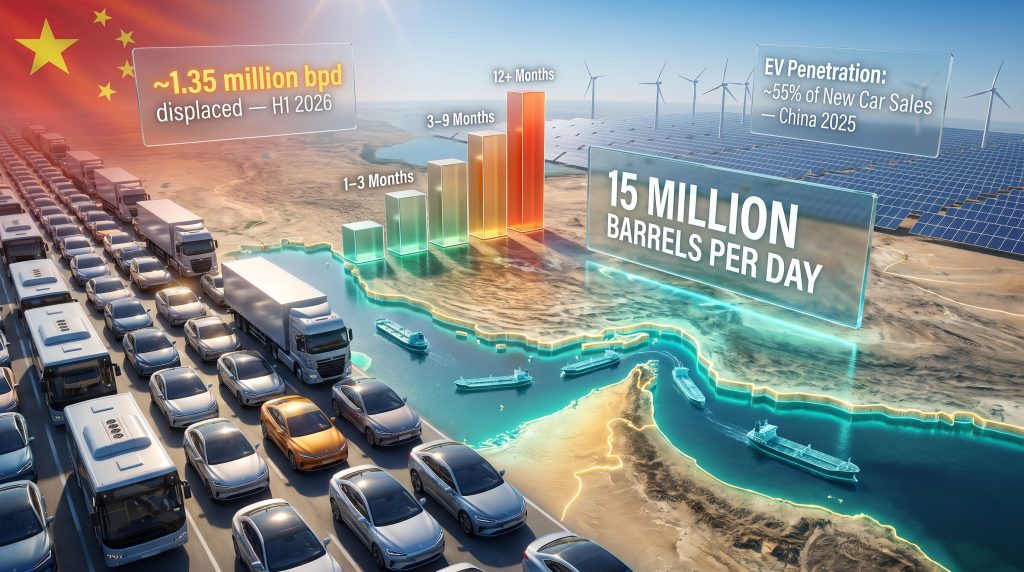
The Strait of Hormuz, a narrow waterway separating Iran from the Arabian Peninsula, remains the single most consequential maritime chokepoint in global energy logistics. Approximately 15 million barrels per day (bpd) of crude oil transited its narrow corridor in 2025, according to IEA data. No pipeline network exists with the capacity to replicate that volume on short notice. No alternative sea route avoids the significant cost and time penalties of rerouting around Africa or through alternative Asian corridors.
Yet the strategic architecture surrounding Hormuz is shifting in ways that conventional geopolitical analysis has been slow to incorporate. The China EV boom and Strait of Hormuz oil demand dynamics are now deeply intertwined, and understanding that relationship requires moving beyond the standard vulnerability narrative. Furthermore, this shift has implications that extend well beyond China's borders, touching everything from an oil price shock to long-term structural demand trends.
When big ASX news breaks, our subscribers know first
Why Hormuz Exposure Is Structural for China, Not Incidental
China and India together accounted for roughly 44% of all crude flows through the Strait of Hormuz in 2025, according to ChinaPower/CSIS analysis. China alone imported approximately 11 to 12 million barrels per day of crude that year, making it the world's largest crude importer by a substantial margin. An estimated 45 to 50% of that total transited Hormuz, representing 5 to 6 million barrels per day of daily exposure.
This dependency is not an oversight of Chinese energy planning. It reflects decades of deliberate refinery investment. China's coastal refining complex was largely configured to process medium and heavy sour crude grades originating from Saudi Arabia, Iraq, the UAE, and Kuwait. These grades are cost-competitive, consistently available, and logistically straightforward when Hormuz is open.
Replacing Gulf crude during a disruption introduces compounding complications:
- Longer shipping distances from West Africa or Latin America increase freight costs and delivery lead times
- Russian crude, while geographically closer, enters through different loading terminals and carries its own geopolitical risk premium
- Alternative crude grades from non-Gulf suppliers often have different sulphur content and density profiles that Chinese refineries are not optimally configured to process
- Freight and war-risk insurance premiums on rerouted tankers raise effective import costs even when physical supply volumes are maintained
The IEA reported that Chinese seaborne crude imports fell by approximately 3.6 million barrels per day between February and April 2026 during the most acute phase of Hormuz disruption. Refineries reduced throughput, and commercial and strategic inventories were drawn down to bridge the gap. These are crisis management tools, not structural solutions.
What China's EV Fleet Is Actually Displacing: The Numbers in Context
The figure that reframes the entire Hormuz vulnerability discussion is this: in the first half of 2026, China's electric vehicle fleet displaced an estimated 34 million tonnes of oil, equivalent to approximately 1.35 million barrels per day (IEA, Global EV Outlook 2026). Consequently, the scale of the China EV boom and Strait of Hormuz oil demand relationship becomes far clearer when viewed through this lens.
| Metric | Figure |
|---|---|
| Oil displaced by EVs, H1 2026 | ~34 million tonnes |
| Barrels per day equivalent | ~1.35 million bpd |
| As a share of China's annual crude imports (H1 basis) | ~6% |
| Annualised share of crude imports | ~12% |
| As a share of total Hormuz daily throughput | ~9% |
| IEA projected EV demand reduction by 2035 | 4+ million bpd |
This figure is a counterfactual, not a direct import reduction. It represents the fuel that an equivalent fleet of internal combustion engine vehicles would have consumed to deliver the same mobility output. The distinction matters analytically, but the strategic implication is identical: those barrels no longer need to be purchased, shipped through Hormuz, insured against geopolitical risk, or stored in strategic reserves.
The most underappreciated dimension of China's EV fleet is not its environmental benefit. It is the permanent removal of recurring import demand that would otherwise compound annually as vehicle numbers grew.
Passenger cars currently account for an estimated 54% of China's total EV-related oil displacement. More than 13 million electric cars were sold in China in 2025, representing close to 55% of new passenger car sales that year. China's total electric car stock reached an estimated 44 million vehicles by end-2025, according to IEA data.
The economics that enabled this scale are worth understanding precisely. The IEA's Global EV Outlook 2026 found that approximately 70% of battery-electric cars sold in China in 2025 were cheaper than the average conventional vehicle. This was driven by manufacturing scale, supply chain integration, and the widespread adoption of lithium iron phosphate (LFP) battery chemistry, which sacrifices some energy density relative to nickel-manganese-cobalt formulations but achieves dramatically lower cell costs and significantly better thermal stability. In addition, lithium supply growth from producers such as Argentina has supported the raw material economics underpinning this cost advantage.
The Diesel Dimension: Why Electric Trucks Change the Equation
The electrification of passenger cars displaces gasoline demand. That matters, but the sector that carries greater strategic weight for oil markets is heavy freight, which runs on diesel. Diesel is a distinct refined product with different supply and pricing dynamics, and historically it has been assumed to be among the last transport segments to electrify at scale.
China has disproven that assumption through a targeted deployment logic that prioritised routes where battery trucks already made economic sense before the technology was mature enough for long-haul general freight:
- Port logistics – short, fixed routes with predictable loads and depot charging infrastructure
- Mining operations – high-utilisation haul cycles, captive fleets, on-site energy management
- Industrial clusters – regional distribution networks with predictable round-trip distances
- Fixed regional corridors – where battery swap infrastructure could be deployed at predictable intervals
This sequencing allowed volume to scale rapidly in addressable niches while battery energy density, swap infrastructure, and payload economics continued improving for longer-haul applications. For instance, electric vehicles transforming transport across mining and industrial sectors has been a particularly notable catalyst.
The results are striking. Electric heavy-freight trucks reached 28% of Chinese heavy-truck sales in 2025, rising from 13% in 2024, according to IEA data. In December 2025 alone, their share reached approximately half of monthly heavy-truck sales. Electric semi-trailer oil displacement reportedly grew by approximately 150% year-on-year in the first half of 2026.
A dimension that receives limited analytical attention is the interaction between electric trucks and China's large LNG-powered freight fleet. Where battery trucks displace LNG-powered vehicles rather than diesel ones, the displacement effect simultaneously reduces China's exposure to both oil and natural gas import markets. This is closely connected to broader LNG supply dynamics that are reshaping global energy trade, narrowing the country's overall fossil fuel import dependency across multiple energy vectors at once.
China's Renewable Build-Out: The Grid Behind the Fleet
The strategic value of transport electrification depends substantially on the energy source powering the vehicles. A commonly raised objection is that coal-heavy electricity generation undermines the energy security case for EVs if coal is itself subject to supply chain risks.
The objection has some validity from a carbon accounting perspective. From a pure import-security standpoint, it largely dissolves. Coal, nuclear, hydro, wind, and solar power all generate electricity without requiring a tanker to transit the Strait of Hormuz. Even a coal-powered EV substitutes a domestically available energy source for an imported barrel of crude, eliminating the associated foreign exchange cost, shipping logistics, and geopolitical vulnerability. China's coal and renewables strategy illustrates precisely how this domestic energy mix is being managed through the transition period.
Critically, the long-run trajectory of China's electricity mix is moving decisively away from coal. China added approximately 500 gigawatts of new renewable capacity in 2025, including around 370 GW of solar and 117 GW of wind (IEA, Global Energy Review 2026). China's installed solar capacity is on track to surpass total coal capacity within the current decade. This means new electricity demand from transport electrification is increasingly met by domestic zero-carbon generation, improving the emissions profile of the EV fleet automatically without requiring vehicle replacement.
Scenario Architecture: How the EV Buffer Performs Under Hormuz Stress
Translating the displacement figures into strategic terms requires scenario analysis across different disruption timelines. According to CNBC's analysis of China's oil shock response, the interplay between EV adoption and Hormuz disruption represents one of the most consequential structural shifts in global energy markets.
| Disruption Timeline | Primary Defence | EV Fleet Contribution | Residual Exposure |
|---|---|---|---|
| 1 to 3 months | SPR and commercial inventory drawdown | Supplementary buffer | Low to moderate |
| 3 to 9 months | Alternative supplier diversification | Significant demand reduction | Moderate to high |
| 12+ months | Structural demand reduction | Primary long-run resilience factor | Petrochemicals, aviation, industry |
Short disruption (1 to 3 months): Strategic petroleum reserves and commercial inventories absorb most of the supply gap. The EV displacement of approximately 1.35 million bpd reduces the volume of replacement crude that must be emergency-sourced from Russia, West Africa, or Latin America, extending the effective life of existing reserves.
Medium disruption (3 to 9 months): Inventory buffers thin. Replacement crude sourcing becomes the primary management tool, but freight premiums and alternative grade compatibility constraints raise effective import costs. EV displacement becomes proportionally more valuable as each barrel not needed extends inventory coverage and reduces the number of alternative tanker voyages required.
Prolonged disruption (12 months or more): At this horizon, structural demand reduction becomes the dominant resilience variable. The IEA's projection of more than 4 million bpd in EV-driven demand reduction by 2035 would, if realised, offset more than 25% of total Hormuz throughput volumes recorded in 2025. Petrochemical feedstocks, aviation fuel, and industrial process oil would remain fully exposed, meaning complete insulation is not achievable through electrification alone.
The next major ASX story will hit our subscribers first
Where the EV Shield Has Real Limits
Intellectual honesty requires acknowledging where transport electrification cannot protect China from Hormuz disruption.
- Road transport electrification does not reduce crude demand from petrochemicals, aviation, maritime shipping, or industrial heat, sectors that collectively account for a growing share of Chinese oil consumption as road transport demand peaks
- The 1.35 million bpd figure is a counterfactual against a demand trajectory that never materialised, not a reduction against current observed import volumes
- A prolonged Hormuz closure would still transmit through global commodity prices, freight cost inflation, and feedstock cost pressures, channels that EVs cannot insulate against regardless of fleet size
- Petrochemical demand may actually absorb some of the crude that road transport no longer requires, as refiners optimise for different product slates under changing demand conditions
Energy security analysis must resist the temptation to treat partial resilience as complete insulation. China's EV fleet materially reduces Hormuz leverage, but it does not eliminate the strategic rationale for supply diversification, reserve accumulation, and diplomatic engagement with Gulf producers.
How China's Position Compares to Other Major Importers
The multi-layered nature of China's Hormuz resilience architecture becomes most visible in cross-economy comparison. As the Oxford Institute for Energy Studies notes, the structural differences between major importing economies are stark when assessed against both Hormuz exposure and transport electrification progress.
| Economy | Hormuz Crude Exposure | EV Share of New Sales (2025) | Strategic Reserves | Supplier Diversification |
|---|---|---|---|---|
| China | ~45 to 50% of crude imports | ~55% | High | High (Russia, Africa, LatAm) |
| India | ~40 to 45% of crude imports | ~5 to 8% | Expanding | Moderate (Russia pivot active) |
| Japan | ~85 to 90% of crude imports | ~3 to 5% | High (IEA member) | Limited |
| European Union | Lower direct exposure | ~15 to 20% | Moderate | Moderate |
India is actively responding to Hormuz risk through alternative crude sourcing, including purchasing Nigerian crude to bypass Gulf supply chains, and is expanding domestic storage infrastructure. Japan faces the highest structural Hormuz dependency of any major economy, with minimal EV penetration providing almost no demand-side insulation. The contrast with China's position illustrates how decisively transport electrification at scale alters the strategic geometry of oil import dependency.
The Long Compounding Effect: Why Each Year Matters More Than the Last
The strategic significance of China's EV fleet compounds annually in a way that strategic reserves and supplier diversification cannot replicate. A barrel stored in a reserve can only be used once. A supplier relationship can be disrupted by sanctions, logistics constraints, or competing buyer demand. However, an EV sold in 2026 continues displacing fuel demand for its entire operational life, typically a decade or more, without requiring any additional policy intervention.
ChinaPower/CSIS modelling suggests EV adoption could reduce China's oil demand by approximately 2 million bpd by 2030, doubling the current displacement rate within four years. The IEA's Global EV Outlook 2026 projects this rising to more than 4 million bpd by 2035 under both current and stated policy scenarios. At that scale, the cumulative demand removed from global oil markets would exceed the entire crude export volume of several major OPEC producers.
For global oil market participants, this trajectory carries underappreciated implications. OPEC+ production decisions, Gulf state fiscal breakeven calculations, and tanker insurance pricing all incorporate assumptions about Chinese demand growth. Those assumptions are being systematically eroded by a vehicle fleet that grows regardless of geopolitical conditions, crude prices, or shipping disruptions. The China EV boom and Strait of Hormuz oil demand connection, consequently, is no longer a theoretical construct — it is an observable shift in the structural foundations of global energy markets.
The Strait of Hormuz will retain enormous strategic significance for decades. But the leverage embedded in its control diminishes proportionally as the world's largest crude importer reduces its structural dependence on the volumes that flow through it. That process began quietly, accelerated dramatically, and is now large enough to register in global oil market balances.
Disclaimer: This article is intended for informational purposes only and does not constitute financial, investment, or energy policy advice. All projections and forecasts referenced are sourced from third-party analytical organisations and should not be interpreted as guarantees of future outcomes. Readers should conduct their own due diligence before making any investment or policy decisions.
Want To Stay Ahead of the Commodity Shifts Reshaping Global Energy Markets?
Discovery Alert's proprietary Discovery IQ model scans ASX announcements in real time, instantly identifying significant mineral discoveries — including those tied to the critical commodities driving the global energy transition — so investors can act on actionable opportunities before the broader market reacts. Explore historic discovery returns on Discovery Alert's discoveries page and begin a 14-day free trial to gain a market-leading edge.