May 9, 2026
Understanding Australia's Lithium Value Chain Evolution
Australia's lithium processing landscape stands at a critical juncture where traditional mining operations must adapt to capture greater value from their mineral resources. The PLS lithium midstream project represents a pivotal development in this transformation, demonstrating how Australian lithium innovations are reshaping the sector's approach to value capture and operational integration.
The evolution toward integrated processing capabilities reflects broader industry recognition that preserving operational flexibility during commodity cycles provides substantial competitive advantages. Companies that maintain processing infrastructure and technical expertise through market downturns position themselves to respond rapidly when conditions improve.
Defining Midstream Operations vs Traditional Mining
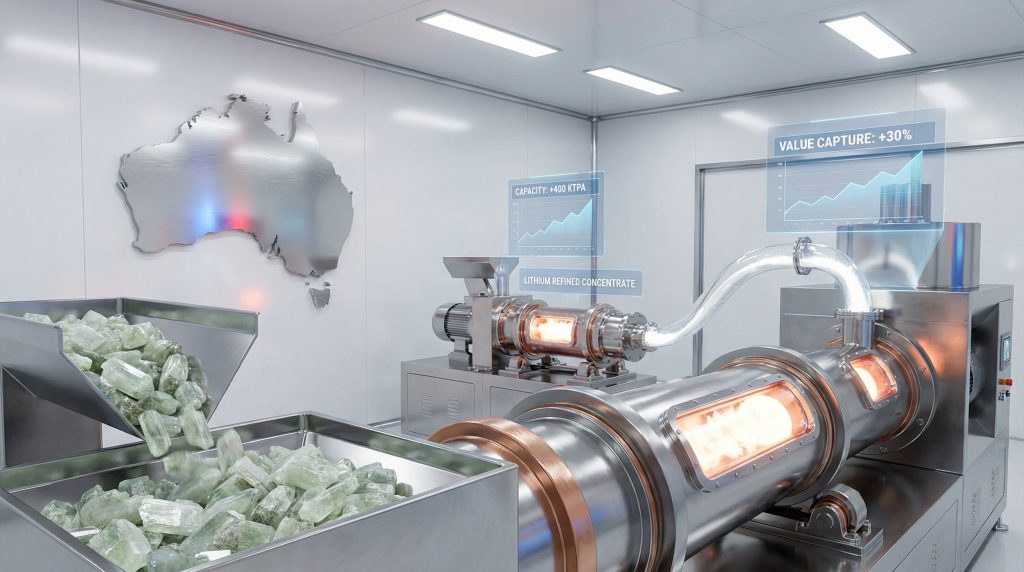
Midstream processing occupies the crucial space between raw mineral extraction and final product refining. Unlike traditional mining operations that focus primarily on extracting and concentrating spodumene ore, midstream facilities enhance concentrate quality through specialised processing techniques.
These operations typically involve:
• Spodumene concentrate enhancement – Improving lithium content and reducing impurities
• Thermal processing – Converting raw concentrates into higher-grade products
• Quality optimisation – Meeting specific downstream refinery requirements
• Volume reduction – Minimising transport costs through concentrate densification
The economic rationale centres on capturing additional value that would otherwise flow to offshore processors. Furthermore, lithium mining work traditionally involves shipping raw or lightly processed concentrates to Asian refineries, missing opportunities to retain processing margins domestically.
Australia's Strategic Push for Downstream Value Capture
Government policy frameworks increasingly support local processing initiatives through targeted incentives and strategic mineral classifications. The Critical Minerals Strategy identifies lithium as essential for national economic security, creating regulatory environments that favour domestic value-addition.
Investment incentives include:
• Accelerated depreciation for processing equipment
• Research and development tax concessions for innovative technologies
• Infrastructure support for specialised facility development
• Skills development programmes for technical workforce training
Australia's competitive positioning against established offshore refining hubs requires leveraging proximity to mining operations and high technical standards to offset labour cost disadvantages. However, the strategy focuses on producing premium-grade concentrates that command price premiums in battery material supply chains.
When big ASX news breaks, our subscribers know first
How Electric Calcination Technology Transforms Processing Economics
Electric calcination represents a technological shift away from conventional fossil fuel-powered kilns toward electrically-heated processing systems. This transformation addresses both environmental concerns and operational efficiency objectives that are reshaping lithium processing economics.
Revolutionary Kiln Technology Breaking Traditional Constraints
| Processing Method | Energy Source | Temperature Control | Carbon Emissions | Capital Requirements |
|---|---|---|---|---|
| Conventional Calcination | Natural Gas/Coal | Variable | High | Moderate |
| Electric Calcination | Electricity | Precise | Lower* | Higher Initial |
| Hybrid Systems | Mixed Sources | Moderate | Moderate | Variable |
*Emissions depend on electricity grid composition
Electric calcination systems offer several operational advantages over conventional methods. Precise temperature control enables consistent product quality, while reduced maintenance requirements lower operating costs over equipment lifecycles.
The technology delivers particular benefits in Australian operating environments where:
• Grid electricity increasingly incorporates renewable sources
• Remote locations benefit from reduced fuel transport requirements
• Environmental regulations favour lower-emission technologies
• Technical expertise in electrical systems supports maintenance capabilities
Operational Efficiency Gains from Mine-Site Processing
Integrating processing facilities with mining operations creates multiple efficiency opportunities. Transport cost reductions represent immediate benefits, with concentrate enhancement reducing shipping volumes by 15-25% through improved density and grade.
Quality control improvements emerge from integrated operations where processing parameters can be adjusted based on ore characteristics. This flexibility enables optimisation of product specifications to meet specific customer requirements or market conditions.
Volume optimisation benefits include:
• Reduced container requirements for export logistics
• Lower handling costs at port facilities
• Decreased inventory holding costs through faster processing
• Enhanced supply chain reliability and responsiveness
Strategic Advantages of Full Project Ownership
Operational control consolidation enables mining companies to optimise decision-making processes and technology development timelines. The transition from joint venture structures to full ownership models reflects recognition that operational flexibility provides tangible strategic value.
Operational Flexibility Through Consolidated Control
Full ownership eliminates complex approval processes that can delay critical decisions during volatile market conditions. This capability proves particularly valuable in commodity markets where timing of production adjustments can significantly impact profitability.
Technology adaptation opportunities expand under consolidated ownership structures. Companies can implement process improvements, scale demonstrations to commercial operations, and modify technical specifications without navigating partner approval requirements.
Decision-making speed improvements include:
• Immediate response to market price signals
• Rapid scaling of successful pilot programmes
• Flexible resource allocation across multiple projects
• Streamlined procurement and contractor management
Risk Management in Cyclical Lithium Markets
Preserving capability through commodity downturns enables rapid response when markets recover, providing decisive competitive advantages over operations that curtailed infrastructure during challenging periods.
Capital allocation flexibility under full ownership allows companies to maintain essential infrastructure and technical capabilities during market downturns while competitors reduce operations. Consequently, this strategic approach positions companies to capture disproportionate value during recovery phases.
Risk mitigation benefits encompass both operational and financial dimensions. Consolidated ownership enables integrated planning across mining, processing, and marketing functions, reducing exposure to supply chain disruptions and price volatility.
Production Capacity Integration and Strategic Timing
The coordination of processing plant restarts with midstream technology development demonstrates sophisticated strategic planning that maximises operational synergies. The Ngungaju plant's 200,000 tonnes per annum capacity restart in early July 2026 illustrates how preserved infrastructure enables rapid market response.
Production Capacity Optimisation Across Multiple Facilities
| Facility | Capacity (tpa) | Status | Timeline |
|---|---|---|---|
| Ngungaju | 200,000 | Restart Phase | July 2026 |
| Pilgangoora | Active Production | Operational | Ongoing |
| P2000 Expansion | Under Study | Feasibility | Q4 2026 |
| Midstream Demo | Development | Technology Validation | Progressive |
Strategic timing coordination enables companies to bring additional capacity online when market conditions support profitable operations. In addition, the integration of restart activities with technology development creates operational momentum that can accelerate commercialisation timelines.
Market positioning implications of enhanced production flexibility extend beyond simple volume considerations. Companies with multiple operational options can optimise product mix, customer allocation, and pricing strategies based on real-time market dynamics.
Cost Structure Analysis for Integrated Operations
Unit operating costs at the upper end of $560-$600 per tonne FOB reflect restart preparation activities rather than ongoing operational expenses. This cost structure demonstrates disciplined capital allocation where restart investments remain within existing financial guidance parameters.
Capital expenditure alignment across multiple projects enables efficient resource utilisation and technical expertise deployment. The coordination of crusher upgrades, facility readiness assessments, and technology development creates economies of scale in engineering and procurement activities.
Integration benefits include:
• Shared technical expertise across processing facilities
• Coordinated maintenance scheduling and resource allocation
• Bulk procurement advantages for equipment and consumables
• Integrated quality control systems and product optimisation
Market Conditions Driving Strategic Evolution
Lithium market recovery indicators support production restart decisions through demonstrated customer demand and strengthening price fundamentals. The combination of contract security and improving market conditions provides confidence for capital deployment in processing capabilities.
Lithium Market Recovery Indicators and Customer Contracting
Customer contracting activity reflects broader market confidence in demand recovery and supply chain stability. Long-term agreements provide revenue certainty that justifies restart investments while maintaining operational flexibility for spot market opportunities.
Demand fundamentals supporting production decisions include:
• Electric vehicle adoption acceleration in key markets
• Battery manufacturing capacity expansion programmes
• Energy storage deployment for grid stabilisation applications
• Supply chain diversification initiatives by major consumers
Price stabilisation trends in spodumene markets indicate reduced volatility compared to previous cycles. This stability enables more predictable financial planning and reduces execution risks associated with production expansion decisions.
Global Supply Chain Positioning for Australian Producers
Australia's push for midstream processing addresses supply chain vulnerabilities exposed during recent market volatility, creating strategic positioning advantages in critical mineral supply chains.
Australian producers benefit from geographic positioning outside major geopolitical risk zones while maintaining proximity to key Asian processing and manufacturing centres. This strategic location enables responsive supply chain management and reduced logistics complexity.
Competitive advantages in battery material supply chains include:
• Resource security through domestic mining operations
• Processing capability development for value-added products
• Quality assurance systems meeting international standards
• Supply chain transparency and ethical sourcing compliance
Policy Framework Supporting Processing Development
Government support mechanisms create enabling environments for midstream processing investments through targeted incentives and regulatory frameworks. These policies address market failures where private investment alone may not achieve optimal outcomes for national economic development.
Federal and State Support Mechanisms for Value-Added Processing
| Support Type | Federal Level | State Level | Impact |
|---|---|---|---|
| Tax Incentives | R&D Concessions | Accelerated Depreciation | Reduced Capital Cost |
| Direct Funding | Critical Minerals Strategy | Innovation Grants | Risk Mitigation |
| Infrastructure | Major Project Status | Specialised Facilities | Reduced Development Cost |
| Skills Development | Training Programmes | Technical Education | Workforce Capability |
Policy alignment with critical minerals energy transition creates long-term investment certainty through consistent regulatory approaches and sustained funding commitments. This stability enables companies to justify long-term technology development programmes and infrastructure investments.
The coordination between federal strategic objectives and state-level implementation provides comprehensive support frameworks that address technical, financial, and regulatory challenges simultaneously.
Regulatory Framework Supporting Technology Innovation
Environmental approvals for advanced processing technologies reflect evolving regulatory recognition of cleaner processing methods. Electric calcination systems, in particular, benefit from streamlined approval processes when powered by renewable electricity sources.
Regulatory support includes:
• Fast-track approvals for low-emission technologies
• Flexible licensing for demonstration and pilot projects
• Coordinated assessment across multiple regulatory agencies
• Technical standards development for emerging technologies
Skills development initiatives create workforce capabilities essential for specialised processing operations. These programmes address technical education gaps while providing career pathways in emerging technology sectors.
The next major ASX story will hit our subscribers first
Australia's Future in Global Lithium Processing
The scaling pathway from demonstration to commercial operations requires coordinated investment, technology validation, and market development activities. Success depends on maintaining technological advantages while achieving cost competitiveness against established international processors.
Scaling Pathways from Demonstration to Commercial Operations
Technology validation milestones establish credibility for commercial-scale investments while providing opportunities to optimise process parameters and economic performance. Demonstration projects serve as proving grounds for both technical capabilities and market acceptance.
Commercial scalability factors include:
• Process optimisation through operational experience
• Equipment standardisation for cost reduction
• Supply chain development for specialised components
• Workforce training for technical operations
Investment requirements for full-scale midstream facilities depend on technology selection, processing capacity, and integration complexity. Electric calcination systems typically require higher initial capital but offer operational cost advantages over equipment lifecycles.
Timeline projections for industry-wide adoption suggest 5-10 year development cycles from demonstration to commercial deployment, depending on technology maturity and market conditions.
Competitive Positioning Against Global Processing Hubs
Scenario analysis indicates Australia could achieve 15-25% global market share in processed lithium products through strategic technology adoption and processing capability development. This positioning requires sustained investment in technology development and operational excellence.
Cost competitiveness factors for Australian midstream operations include:
• Energy costs and renewable electricity access
• Labour productivity and technical expertise levels
• Transport logistics and proximity to customers
• Regulatory compliance costs and approval timelines
Strategic partnerships with technology providers, equipment manufacturers, and downstream customers enable capability development while sharing risks and development costs. These collaborative approaches accelerate technology commercialisation and market penetration.
Investment and Industry Development Implications
The evolution toward integrated lithium processing creates multiple implications for investment strategies and industry development patterns. Understanding these dynamics helps stakeholders position for emerging opportunities and navigate changing competitive landscapes.
Investment Themes for the PLS Lithium Midstream Project
Key investment themes emerging from midstream consolidation include:
• Increased focus on integrated value chain strategies across mining and processing
• Technology differentiation becoming competitive advantage in commodity markets
• Operational flexibility preservation during market cycles creates long-term value
• Strategic partnerships enabling risk sharing and capability development
Investment decision frameworks must incorporate operational flexibility values alongside traditional financial metrics. Furthermore, companies demonstrating ability to maintain capabilities through market cycles command premium valuations reflecting strategic positioning advantages.
Risk profile improvements result from diversified revenue streams and reduced dependence on commodity price volatility. Integrated processing capabilities provide natural hedging against margin compression in mining operations.
For instance, the PLS lithium midstream project exemplifies how mining industry innovation creates strategic value through operational integration and technology adoption.
Future Outlook for Australian Lithium Processing
Production capacity expansion scenarios through 2030 suggest potential for 300-500% growth in domestic processing capabilities, depending on technology adoption rates and market development success. This growth trajectory requires coordinated investment in technology, infrastructure, and workforce development.
Technology adoption rates across the industry depend on demonstration project outcomes and commercial viability validation. Early movers gain advantages through operational experience and customer relationship development.
Export market positioning for value-added products creates opportunities to capture processing margins while maintaining Australia's position in global lithium supply chains. However, success requires meeting quality specifications and delivery reliability standards demanded by battery manufacturers.
In addition, securing lithium supply remains a critical consideration for international partners, particularly as global demand continues to expand.
Frequently Asked Questions About Lithium Midstream Processing
What makes electric calcination different from traditional methods?
Electric calcination uses electrical heating elements instead of fossil fuel combustion to achieve processing temperatures. This approach provides precise temperature control, reduces carbon emissions (depending on electricity sources), and eliminates combustion-related impurities from processed materials. The technology requires higher initial capital investment but offers operational advantages through improved product consistency and reduced maintenance requirements.
How does midstream processing affect lithium pricing?
Midstream processing typically commands price premiums over raw concentrates due to enhanced purity, reduced impurities, and improved suitability for downstream refining. These premiums vary based on market conditions but generally range from 5-15% above standard concentrate prices. The enhanced products reduce refinery processing costs and improve final product quality, justifying premium pricing.
What are the environmental benefits of onshore processing?
Onshore processing reduces transport-related emissions while enabling implementation of cleaner technologies like electric calcination. When powered by renewable electricity, these systems significantly reduce carbon intensity compared to conventional processing. Additionally, stringent Australian environmental standards ensure responsible waste management and emissions control that may exceed standards in some offshore processing locations.
How does this impact Australia's position in global lithium markets?
Midstream processing capabilities enhance Australia's strategic positioning by capturing additional value from domestic mineral resources while reducing dependence on offshore processing capacity. This development strengthens supply chain resilience and provides competitive advantages in serving battery manufacturing markets. The strategy supports Australia's evolution from raw material supplier to value-added processor in global lithium supply chains.
This analysis is based on publicly available information and industry developments as of March 2026. Investment decisions should consider comprehensive due diligence and professional advice. Commodity markets involve inherent risks and potential investors should carefully evaluate their risk tolerance and investment objectives.
Further Exploration:
Readers interested in learning more about Australian lithium industry developments can explore additional educational content and industry analysis from Pilbara Minerals' updated demonstration plant structure and Calix's midstream technology advancements to understand the technical foundations underlying these strategic developments.
Want to Capitalise on Australia's Lithium Processing Revolution?
Discovery Alert's proprietary Discovery IQ model delivers instant alerts when ASX lithium companies announce breakthrough processing technologies and strategic developments that could reshape industry valuations. Don't miss the next midstream processing breakthrough – begin your 14-day free trial today and position yourself ahead of market-moving lithium sector announcements.