June 26, 2026
Why Process Research Battery Materials in Mexico Is Attracting Billion-Dollar Capital
The global battery supply chain is undergoing its most significant structural realignment in decades. For the better part of thirty years, the processing of critical battery materials moved in one direction: toward Asia, where low-cost manufacturing, accumulated technical expertise, and tightly integrated supply networks made it the undisputed centre of cathode chemistry, anode production, and electrolyte synthesis. That gravitational pull is now reversing, and the country absorbing much of that redirected momentum is Mexico.
Understanding why requires looking beyond headlines about individual investment decisions. The forces reshaping where battery materials get processed are deeply structural, involving trade architecture, energy policy, geopolitical risk repricing, and the hard economics of proximity to end-use manufacturing. Canada-based Process Research battery materials in Mexico evaluations, including capital assessments reaching as high as US$380 million, are not isolated commercial decisions. They represent a broader thesis about where the North American battery raw materials market is heading over the next decade.
When big ASX news breaks, our subscribers know first
The Trade Architecture Advantage: Why USMCA Changes Everything
At the foundation of Mexico's emerging position in battery materials processing sits a legal and commercial framework that few other jurisdictions can replicate. The United States-Mexico-Canada Agreement, known as USMCA, establishes rules of origin requirements for electric vehicles and their components that create substantial incentives for keeping material processing within the trade bloc.
Under USMCA's EV provisions, qualifying for preferential tariff treatment requires that a specific and rising percentage of critical minerals used in battery production originate from North American sources or from countries with qualifying free trade agreements. This threshold is not static. It steps up progressively through the late 2020s, meaning that automotive manufacturers with US assembly operations face increasing commercial pressure to source processed battery materials from within the region rather than importing refined chemicals from Asia.
Mexico sits in an unusually favourable position within this framework for several reasons:
- It shares land borders with the United States, reducing logistics costs and transit times compared to overseas suppliers
- It operates under the same USMCA trade architecture as Canada, allowing Canadian technical partners to engage without triggering cross-border complexity
- Its existing automotive manufacturing base creates proven supply chain infrastructure that battery materials logistics can leverage
- Labour and energy cost structures remain competitive with, and in many cases below, comparable Canadian processing economics
The Inflation Reduction Act in the United States adds a further layer of incentive. While the IRA's direct tax credits apply to US-based manufacturers, the upstream pull effect is significant. US battery cell producers and EV manufacturers seeking IRA-compliant supply chains are actively pressuring their upstream suppliers to demonstrate North American material sourcing. This commercial pressure flows directly through to processing facility investment decisions in Mexico. Furthermore, the broader implications for critical minerals and energy security are reshaping how governments and investors view the region's strategic importance.
What Battery Materials Processing Actually Involves
The term battery materials processing covers a wide range of value-adding activities that are frequently conflated in public discussion. Clarity on the distinctions matters enormously for understanding where investment is flowing and why Mexico is positioned where it is on the maturity curve.
Defining the Three Core Processing Tiers
Tier 1 – Raw Extraction: Mining or brine pumping to produce a mineral concentrate or raw lithium-bearing solution. This is the least value-added stage and, under Mexico's current Lithium Law, the stage subject to nationalisation controls for lithium specifically.
Tier 2 – Precursor Refining: Converting raw concentrates or solutions into intermediate chemical forms. For lithium, this means producing lithium carbonate or lithium hydroxide. For nickel and cobalt, it means producing sulphate solutions. This stage requires meaningful chemical engineering capability and is where a significant portion of the US$380 million investment thesis is focused.
Tier 3 – Battery-Grade Chemical Synthesis: The final transformation into battery-specification materials, including cathode active material precursors (pCAM and CAM), anode graphite processing, and electrolyte formulation. Achieving consistent 99%+ purity at commercial scale is technically demanding and remains the most significant gap in Mexico's current processing infrastructure.
The scale requirements involved are substantial. A single gigawatt-hour of lithium-ion battery production requires:
| Battery Material | Required per 1 GWh of Li-ion Production |
|---|---|
| Cathode Materials | 1,200 – 1,800 tonnes |
| Anode Materials | 700 – 1,000 tonnes |
| Electrolyte Materials | 800 – 1,200 tonnes |
These figures illustrate why processing capacity is not simply a commercial opportunity but a genuine infrastructure necessity for any country seeking to participate meaningfully in the EV manufacturing ecosystem.
Mexico's Geological Foundation: Clay Lithium as a Strategic Differentiator
Most global lithium supply discussions focus on two source types: South American brine deposits, where lithium is extracted by evaporating saline groundwater in large surface ponds, and hard-rock spodumene deposits, primarily in Australia, where lithium-bearing pegmatite rock is mined and processed through acid roasting or other thermal methods.
Mexico holds something different and, from a supply chain perspective, potentially more strategically valuable: large-scale clay-hosted lithium deposits, concentrated principally in the state of Sonora. In addition, shifts in the global lithium market are increasingly drawing attention to these unconventional deposit types as viable alternatives to traditional sources.
How Clay Lithium Differs from Conventional Sources
Clay-hosted lithium occurs when lithium ions are adsorbed onto the surface of clay mineral particles, primarily smectite and illite clays formed through volcanic weathering processes. Extracting this lithium requires breaking the adsorption bond rather than simply concentrating an existing solution or crushing and roasting a pegmatite mineral.
This creates both a technical challenge and a competitive moat. The extraction methodology cannot simply be borrowed from Chilean brine operations or Australian hard-rock processing. It requires purpose-designed hydrometallurgical approaches, and the specific chemistry of a clay deposit matters significantly. Two deposits described as clay lithium may require substantially different processing solutions depending on the mineralogy of the host clay, the presence of competing ion species in the feed solution, and the physical characteristics of the ore.
Mexico's development of technology for battery-grade lithium from clay, pioneered through CIMAV's patented extraction process specifically engineered for Mexican clay lithium mineralogy, has demonstrated 99% purity output at laboratory and pilot scale. The commercial viability of this technology at full production volumes remains under evaluation, and the step from pilot demonstration to sustained high-throughput production is rarely straightforward. However, the existence of domestically developed, country-specific processing intellectual property represents a meaningful advantage that most emerging lithium jurisdictions lack.
Current Processing Infrastructure Benchmarks
Mexico's existing battery materials processing capacity, while growing, remains modest relative to the demand volumes that North American EV manufacturing will require:
| Processing Region | Material Type | Current Annual Capacity |
|---|---|---|
| Sonora and San Luis Potosí | Lithium Carbonate / Hydroxide | 15,000 – 25,000 tonnes/year |
| Nuevo León and Coahuila | Nickel / Cobalt Sulphate | 5,000 – 8,000 tonnes/year |
| Combined Target by 2029 | North American Battery Supply | 80,000 – 120,000 tonnes/year |
Reaching the 80,000-120,000 tonne combined target within four years represents an aggressive but commercially motivated build-out trajectory. It requires not just capital deployment but concurrent development of domestic reagent supply chains, water management infrastructure, and a technically trained workforce in battery materials chemistry.
The Canadian Technical Partnership Model
One of the less commonly discussed dynamics in Mexico's battery materials processing development is the role that Canadian firms are positioned to play as technical partners rather than simply capital providers. Canada has built a substantial base of hydrometallurgical processing expertise over decades of nickel, cobalt, and uranium processing in Ontario and Manitoba. Firms with this background bring process engineering knowledge, reagent management systems, and quality control methodologies that are directly applicable to battery-grade chemical production.
For a capital evaluation of US$380 million scale, the de-risking effect of pairing Canadian processing expertise with Mexican mineral resources and USMCA trade positioning is significant. The partnership model addresses several risk dimensions simultaneously:
- Technical risk is reduced through the application of proven hydrometallurgical process design
- Jurisdictional risk is partially offset by the involvement of an internationally recognised technical partner with established permitting and environmental management track records
- Commercial risk is addressed through access to existing customer relationships in North American battery cell manufacturing
This complementarity explains why Canadian capital and technical capacity continue to be directed toward Mexico specifically, rather than toward other Latin American jurisdictions with comparable mineral endowments.
Emerging Research: When Waste Becomes an Electrode
One of the more unexpected developments emerging from Mexican academic research involves the potential use of artisanal limestone craft waste as a precursor material for lithium-ion battery anodes. Research from the Benemérita Universidad Autónoma de Puebla has explored the conversion of Mexican onyx, a calcium carbonate-rich stone widely used in decorative crafts, into functional anode structures through a pyrolysis-based transformation process.
The underlying mechanism involves coating calcium oxide (CaO) particles derived from the limestone with carbon, then subjecting this composite to controlled thermal treatment to create a charge-storing electrode architecture. Testing in half-cell configurations across a 0.01-3V voltage window, with particle sizes below 50 micrometers combined with carbon black as a conductive additive, has demonstrated electrochemical activity consistent with anode functionality.
This type of research matters not because it will immediately displace conventional graphite anodes in commercial production, but because it demonstrates a principle: that locally abundant, low-cost, and previously discarded material streams can serve as functional battery precursors under the right processing conditions. If scalable, waste-derived anode materials could reduce input costs while simultaneously diverting industrial waste from landfill disposal.
The broader implication for Process Research battery materials in Mexico investment theses is that the country's processing potential extends beyond conventional mineral pathways. Circular economy approaches to battery material sourcing may become a commercially relevant differentiator as sustainability requirements tighten across North American supply chains.
The next major ASX story will hit our subscribers first
LFP Chemistry and Why It Aligns with Mexico's Resource Profile
Lithium iron phosphate (LFP) cathode chemistry has moved from niche application to mainstream dominance in stationary energy storage and is rapidly gaining ground in entry-level and standard-range electric vehicles. The commercial appeal of LFP is well understood: lower cost, longer cycle life, superior thermal stability, and complete elimination of cobalt and nickel from the cathode formulation.
For Mexico specifically, LFP's rise creates a strategically favourable demand signal. The country's mineral resource profile is more strongly aligned with iron and lithium than with cobalt and high-grade nickel. As LFP chemistry captures a larger share of the cathode market, demand for iron phosphate precursor production grows accordingly. Furthermore, advances in direct lithium extraction technology are expected to enhance the efficiency with which lithium can be processed from Mexican clay deposits specifically for LFP-grade specifications.
The downstream processing requirement for LFP involves producing battery-grade iron phosphate with tightly controlled particle morphology, impurity profiles, and tap density. This is technically achievable within Mexico's existing industrial chemistry infrastructure, particularly in the northern industrial corridors of Nuevo León and Coahuila where chemical processing facilities are already concentrated.
The Regulatory Landscape: Navigating Lithium Nationalisation
Mexico's 2022 Lithium Law declared lithium a strategic resource exclusively reserved for state exploitation, creating significant uncertainty across the investment community regarding the viability of private-sector participation in the lithium value chain. Understanding what this legislation actually covers and what it does not is essential for any investor or processing project developer operating in this space.
Policy Note: The nationalisation framework applies specifically to the extraction of lithium from Mexican territory. It governs the act of removing lithium from the ground. Downstream processing and refining operations, including the conversion of lithium-bearing intermediates into battery-grade lithium carbonate or lithium hydroxide, are not subject to the same state reservation and remain accessible to private and foreign capital under existing Mexican commercial law.
This distinction has significant practical implications. A processing facility that receives lithium carbonate or hydroxide feedstock from an authorised source and performs further purification, chemical conversion, or formulation is operating in a segment of the value chain that is not nationalised. The commercial and regulatory risk profile of such a facility is materially different from that of an upstream lithium mining operation.
Key regulatory considerations for foreign-owned processing operations include:
- Environmental permitting requirements under SEMARNAT (Mexico's environmental ministry), which apply to any facility handling chemical reagents at scale
- Water use concessions, particularly critical for processing operations in arid northern states where lithium deposits are concentrated
- Foreign investment notification requirements under Mexico's Foreign Investment Law for facilities exceeding applicable size thresholds
- Industrial safety compliance under STPS standards for chemical processing environments
None of these represent insurmountable barriers, but they do require careful pre-investment regulatory mapping, particularly for greenfield processing facilities that have not previously operated under Mexican jurisdiction.
Competitive Positioning: Mexico Against the Field
Mexico does not compete in isolation. Capital targeting North American battery materials processing has several destination options, each with distinct advantages and constraints:
| Dimension | Mexico | Canada | Chile | Indonesia |
|---|---|---|---|---|
| Raw Material Base | Clay lithium, nickel, cobalt | Hard rock lithium, nickel | Brine lithium | Nickel laterite |
| Processing Maturity | Emerging / Scaling | Established | Emerging | Scaling |
| Trade Alignment | USMCA | USMCA | No major US FTA | ASEAN |
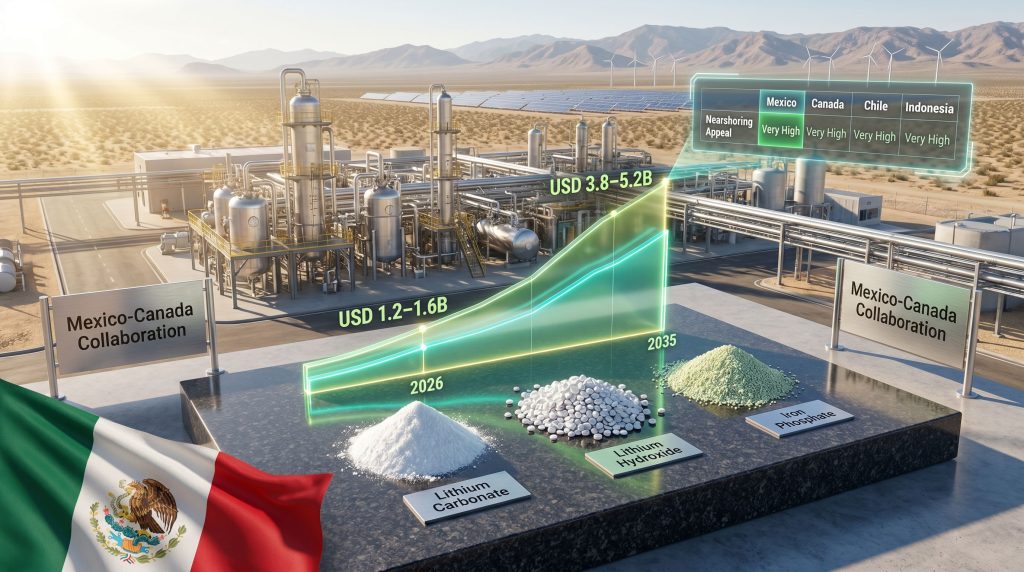
| Nearshoring Appeal | Very High | High | Moderate | Low |
| Regulatory Complexity | Moderate-High | Moderate | Moderate | High |
Chile's absence from a qualifying US free trade agreement is a structural disadvantage that is difficult to overcome through other means. Indonesian nickel processing, while scaled, faces growing scrutiny over environmental practices and does not benefit from proximity to North American manufacturing. Canada remains the strongest alternative, but land and labour cost structures make certain processing operations more economically viable south of the border.
Mexico's combination of USMCA alignment, geographic proximity, cost competitiveness, and raw material endowment creates a positioning that no other single jurisdiction currently matches for North American-oriented battery supply chain investment.
Market Scale and the Growth Trajectory to 2035
The energy storage chemicals market in Mexico is projected to expand from approximately USD 1.2-1.6 billion in 2026 to USD 3.8-5.2 billion by 2035. This trajectory reflects the compound effect of nearshoring investment, domestic renewable energy integration requirements, and the upstream pull from North American EV manufacturing growth. Consequently, the role of battery storage expansion in driving upstream chemical processing demand cannot be overstated.
Mexico has committed to a 50% clean energy target by 2050, a target that carries substantial implications for grid-scale battery storage deployment. Variable renewable energy sources, particularly solar in the northern states and wind along the Isthmus of Tehuantepec, require storage capacity to manage generation intermittency and deliver dispatchable clean power. That storage deployment creates a domestic demand base for battery materials that complements the export-oriented processing investment thesis.
Three scenarios frame the plausible range of outcomes for Mexico's processing sector:
- Accelerated Integration: Full USMCA supply chain alignment achieved by 2030, with Mexico contributing 15-20% of North American battery-grade lithium chemical supply, underpinned by successful commercialisation of clay lithium processing technology and rapid capex deployment
- Constrained Growth: Regulatory uncertainty around the Lithium Law's implementation boundaries, combined with infrastructure gaps in water access and domestic reagent supply, limits scale-up to specialty high-value processing niches rather than volume commodity chemical production
- Innovation-Led Emergence: Domestic R&D breakthroughs, including the CIMAV clay lithium process and waste-derived anode materials research, attract global licensing interest and position Mexico as an intellectual property exporter within the battery materials sector rather than simply a low-cost processing location
Key Milestones for Investors to Monitor
- Regulatory clarification on the precise boundaries between state-reserved lithium extraction and privately accessible downstream processing
- Progress toward the 80,000-120,000 tonne combined processing capacity target by 2029
- Commercial scale demonstration of CIMAV's clay lithium extraction technology beyond pilot stage
- Expansion of iron phosphate precursor capacity in northern industrial corridors aligned with LFP cathode demand growth
- Capital deployment timelines associated with the US$380 million Process Research battery materials in Mexico evaluation
Challenges That Cannot Be Ignored
Balanced assessment of Mexico's battery materials processing opportunity requires honest engagement with the structural challenges that could constrain the growth scenarios outlined above.
Water Intensity in Arid Regions: Lithium processing is chemically water-intensive. The states with the largest clay lithium deposits, particularly Sonora, are also among Mexico's most water-stressed regions. Processing facilities will require either significant water recycling infrastructure investment or access to non-potable water sources, both of which add capital and operational complexity.
Domestic Reagent Supply Gaps: Battery-grade chemical processing requires consistent access to high-purity acids, bases, and speciality reagents. Mexico's domestic production of these inputs is limited, meaning processing facilities currently depend on imported reagent supply chains that add cost and introduce logistics fragility.
Workforce Development Lag: The specialised skill set required for battery materials chemistry, including hydrometallurgical process engineers, analytical chemists capable of managing purity specifications, and environmental compliance specialists, is not yet available at scale in Mexico. Building this workforce through training partnerships and university curriculum development will take years rather than months.
Purity Consistency at Commercial Scale: Achieving 99%+ battery-grade purity in a laboratory or pilot environment is a meaningfully different challenge from sustaining that specification across continuous commercial-scale production. The step-change in process control complexity when moving from hundreds of kilograms per batch to thousands of tonnes per year has caused significant operational difficulties for processing facilities globally, and Mexico will not be exempt from these realities.
Disclaimer: Market projections, capacity targets, and investment figures referenced in this article reflect industry estimates and publicly available forecasts as of the time of writing. They involve inherent uncertainty and should not be interpreted as guarantees of future outcomes. Investors should conduct independent due diligence before making any investment decisions related to battery materials, processing infrastructure, or related equities.
Want to Stay Ahead of the Next Major Battery Materials Discovery?
Discovery Alert's proprietary Discovery IQ model delivers real-time alerts on significant ASX mineral discoveries — including those tied to the critical minerals driving the battery materials revolution — instantly translating complex data into actionable investment insights for both short-term traders and long-term investors. Explore historic examples of exceptional discovery returns and begin your 14-day free trial today to position yourself ahead of the market.