June 26, 2026
The Hidden Layer Blocking Battery Supply Chain Independence
The global energy transition has a problem that sits invisibly between the mine and the vehicle. While headlines fixate on lithium discovery announcements and electric vehicle sales figures, the real constraint shaping the battery economy operates at a layer most investors and policymakers rarely examine closely: the midstream conversion and refining infrastructure that transforms raw lithium minerals into the battery-grade salts and cathode materials that actually power cells.
The ex-China lithium processing bottleneck is the defining structural challenge of this moment, and understanding it requires stepping back from individual project announcements to appreciate the scale of industrial architecture that China has spent more than a decade constructing — and that the rest of the world is only beginning to seriously attempt to replicate. The global lithium market is increasingly shaped by this midstream gap, not just by what is mined or what is sold in finished vehicles.
When big ASX news breaks, our subscribers know first
China's Midstream Grip: Scale, Depth, and Duration
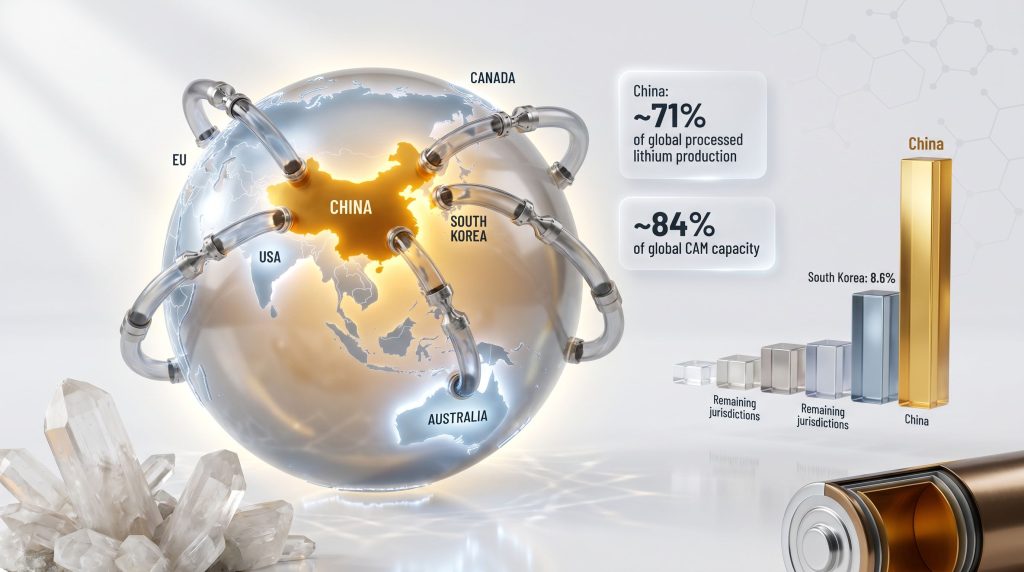
The numbers paint a stark picture of concentration. According to Fastmarkets' research, China is forecast to account for approximately 71% of global processed lithium production on a lithium carbonate equivalent (LCE) basis in 2026. In the cathode active material (CAM) layer immediately above lithium salt production, the concentration is even more pronounced, with China controlling roughly 84% of globally announced CAM capacity in the same year.
South Korea battery expansion efforts place the country as the second-largest CAM producer by nation, holding just 8.6% of globally announced CAM capacity in 2026. That distant second-place ranking is itself a measure of how concentrated this industry has become. Every other nation combined accounts for less than a tenth of cathode manufacturing output.
What makes this concentration particularly durable is its origin. China's dominance in lithium midstream processing was not accidental or purely market-driven. It reflects more than a decade of coordinated industrial policy, deliberate infrastructure investment, and the systematic co-location of refining, cathode production, and cell manufacturing within integrated supply chain clusters. The result is a cost structure and technical capability that cannot be replicated simply by building a plant in Australia or the United States and expecting equivalent economics.
The Feedstock Dependency Loop
Compounding the processing concentration is a structural feedstock dependency that few outside the industry fully appreciate. More than 90% of Australian spodumene output is currently exported to China for conversion into battery-grade lithium salts. Australia produces the majority of the world's hard-rock lithium, yet the value-adding conversion step happens almost entirely within Chinese borders.
This creates a loop that is difficult to break: without domestic or allied-nation processing capacity, spodumene producers have no alternative but to ship to China; without reliable feedstock supply, new ex-China processors cannot secure the material flows needed to justify capital investment or achieve the utilisation rates required for commercial viability.
The Gap Between Announced Capacity and Real Output
One of the most consequential misunderstandings in current supply chain discourse is the conflation of nameplate capacity announcements with operational reality. Across the ex-China processing landscape, the gap between what has been announced and what is actually producing battery-grade material at commercial scale is widening, not narrowing.
The following operational situations illustrate the breadth of the challenge:
| Project / Operation | Country | Status | Primary Issue |
|---|---|---|---|
| Covalent Lithium (Kwinana) | Australia | Extended ramp-up | Processing stability and odour management |
| Albemarle Kemerton Plant | Australia | Idled / curtailed | Cost-curve uncompetitiveness vs. Chinese converters |
| POSCO-PLS Refining Lines | South Korea | Curtailed capacity | Demand softness and margin compression |
| Tesla Texas Refinery | USA | Pre-commercial | Customer qualification and approval timelines |
| Albemarle Richburg Plant | USA | Delayed | Processing cost economics and policy uncertainty |
A recurring theme across these cases is that achieving first production is a vastly different milestone from sustaining high-utilisation commercial output. Technical commissioning, reagent sourcing, waste management, and the iterative refinement of processing parameters all take considerably longer at greenfield sites than project timelines typically anticipate.
The Hydroxide Sub-Bottleneck
Within the broader midstream challenge, lithium hydroxide production represents a particularly acute pressure point. Furthermore, direct lithium extraction technologies are being explored as a potential pathway to ease upstream constraints, though the downstream processing challenge remains largely separate. Lithium hydroxide is chemically and operationally more demanding to produce than lithium carbonate, requiring tighter control of purity parameters to meet battery-grade specifications of typically 56.5% LiOH minimum with strict limits on trace metal contamination including calcium, magnesium, sodium, and sulphate.
Beyond the processing challenge itself, customer qualification cycles add a further layer of friction. Before an automaker or cell manufacturer will accept hydroxide from a new supplier, they must independently verify that the product consistently meets their internal specifications across multiple production batches. This qualification process routinely extends 12 to 24 months beyond commercial production commencement, effectively delaying revenue generation and complicating the economics of project financing. According to Fastmarkets' research on ex-China lithium hydroxide production, these delays are proving more persistent than initially anticipated across multiple jurisdictions.
The Cost Arithmetic That Makes Ex-China Processing So Difficult
Understanding why ex-China facilities struggle commercially requires working through the actual price mechanics. Fastmarkets assessed spodumene at $2,220 to $2,320 per tonne (cif China) in late June 2026, down from $2,450 to $2,520 per tonne just one week prior. Lithium carbonate at 99.5% Li2CO3 battery grade (cif China, Japan and Korea) was assessed at $20.00 to $21.50 per kg on June 23, 2026, up sharply from $13.00 to $16.00 per kg at the start of the year on January 2.
The critical insight lies in the spread between these two numbers. When spodumene's input cost is converted to a per-kilogram lithium equivalent basis, the margin remaining between feedstock cost and battery-grade salt pricing closely approximates the marginal cash cost of Chinese conversion operations. Chinese processors, with lower energy costs, mature reagent supply chains, and decades of process optimisation, can operate within that spread profitably.
Outside China, processing costs are estimated to run at two to three times the Chinese equivalent depending on jurisdiction. Albemarle's chief commercial officer Eric Norris made this cost differential explicit at Fastmarkets' Global Lithium, Battery and Critical Materials conference in Las Vegas on June 23, 2026, describing how the spread between spodumene input cost and battery-grade salt output price effectively defines the marginal cash cost of Chinese processing, and noting that ex-China processing runs materially higher. This spread problem has real consequences: Albemarle has idled its Kemerton hydroxide facility in Australia and delayed its planned Richburg plant in South Carolina due precisely to the absence of policy mechanisms that would make these operations economically viable.
"The cost gap between Chinese and ex-China lithium processing is not a transitional inefficiency that will self-correct as Western plants mature. It reflects structural advantages built into China's industrial architecture over more than a decade, and closing it requires deliberate policy architecture rather than capital investment alone."
The LFP Shift: Complicating the Hydroxide Picture
One underappreciated dynamic reshaping the ex-China lithium processing bottleneck is the global pivot toward lithium iron phosphate (LFP) battery chemistry. LFP cathodes use lithium carbonate as their primary lithium input, not lithium hydroxide. High-nickel cathode chemistries such as NMC 811 or NCA, which dominate premium EV and high-energy-density applications, require lithium hydroxide.
As LFP's market share expands, particularly in stationary energy storage and volume EV segments where energy density is less critical than cost and cycle life, the relative commercial pressure on hydroxide conversion capacity outside China eases. This partly explains why some ex-China hydroxide projects are facing reduced urgency to resolve their technical ramp-up challenges: the market is shifting toward a product form where Chinese carbonate processors hold an even more insurmountable cost advantage.
However, premium vehicle segments, long-range applications, and aviation-adjacent electrification will continue to demand high-nickel chemistries for the foreseeable future, sustaining a long-term structural need for ex-China hydroxide capacity even if near-term volume growth flows toward carbonate. Consequently, the lithium carbonate supply dynamics of the next five years will remain a critical variable for anyone assessing midstream investment viability.
Policy Architecture: The Missing Variable
There is broad consensus among senior industry figures and policy analysts that market economics alone cannot bridge the ex-China processing cost gap. The more contentious question is not whether price support or floor mechanisms are needed, but who bears the cost. Governments, automakers, battery manufacturers, and ultimately consumers each face different incentive structures and political constraints.
Gracelin Baskaran, director of the Critical Minerals Security Program at the Center for Strategic and International Studies (CSIS), has noted publicly that while near-universal agreement exists on the need for price support, fundamental disagreement persists on the allocation of that cost burden. Western processors cannot sustain loss-making operations while awaiting market convergence with Chinese benchmarks.
The 45X Credit: Effective but Time-Limited
The US 45X Advanced Manufacturing Production Credit represents the most tangible current mechanism for supporting ex-China processing economics in North America. By providing per-unit production incentives for domestically manufactured battery components and critical minerals, it partially compensates for the cost disadvantage that ex-China facilities face relative to Chinese competitors.
The structural problem is the credit's scheduled phase-out in 2032. For an industry where projects require eight to twelve years from exploration through permitting, construction, commissioning, and customer qualification to reach full commercial production, a policy window ending in 2032 is insufficient to anchor the multi-decade investment commitments that new processing infrastructure demands.
The 30D clean vehicle tax credit provides a cautionary precedent. In the quarter immediately preceding its September 2025 expiration, US electric vehicle sales reached a record quarterly high, demonstrating the potency of demand-side incentives when active. Following the phase-out, sales momentum reversed. The lesson is direct: policy discontinuity creates market discontinuity, and investors making decade-scale processing decisions cannot ignore that pattern.
"Policy incentives with five-to-seven year horizons create a structural mismatch against investment cycles that operate over ten to fifteen years. Durable processing capacity requires durable policy commitment, not politically convenient time horizons."
The next major ASX story will hit our subscribers first
Where Ex-China Processing Can Realistically Develop
A clear-eyed assessment of the leading ex-China processing jurisdictions reveals a landscape of meaningful but unequal prospects:
| Jurisdiction | Comparative Advantage | Key Constraints |
|---|---|---|
| Australia | Proximity to spodumene feedstock; established mining infrastructure | High processing costs; limited domestic battery demand |
| United States | IRA policy support; large EV market; allied-nation offtake potential | Regulatory complexity; workforce development needs |
| South Korea | Established CAM manufacturing base (8.6% of global capacity) | Feedstock dependency; margin pressure |
| Canada | Critical minerals partnerships; resource endowment | Early-stage midstream infrastructure |
| European Union | Strong EV demand; CRMA regulatory framework | High energy costs; limited domestic lithium resources |
Australia's position is particularly noteworthy given the operational launch of Pilbara Minerals' (PLS) mine-site lithium phosphate processing facility at its Pilgangoora operation in Western Australia in June 2026. This facility, the first of its kind in Australia to produce an intermediate lithium product at the mine site rather than exporting raw spodumene, represents a significant proof-of-concept for the vertical integration model.
PLS chief executive Dale Henderson characterised the broader geopolitical diversification environment as presenting substantial commercial opportunities for businesses positioned to capitalise on midstream and downstream development. Rio Tinto Lithium managing director Barbara Fochtman reinforced a consistent message from senior executives: the structural demand underpinning the current environment is qualitatively different from the speculative surge of 2021 to 2023, with resilient supply chain development now the primary strategic focus.
Comparing Market Cycles: What Has Changed
The current period differs from the previous lithium price supercycle in ways that matter for processing investment:
| Dimension | 2021-2023 Cycle | 2025-2026 Environment |
|---|---|---|
| Price Driver | Speculative demand surge | Structural supply chain policy |
| Demand Visibility | Uncertain and volatile | ESS and EV dual demand vectors |
| Ex-China Investment | Early-stage announcements | Active commissioning phase |
| Policy Support | Limited and fragmented | IRA 45X, allied-nation frameworks |
| Processing Bottleneck Severity | Emerging | Acute and well-documented |
The emergence of the Energy Storage System (ESS) sector as a substantial and growing demand vector is particularly significant. Unlike automotive demand, which is subject to consumer sentiment, credit availability, and model cycle timing, utility-scale and grid storage procurement operates on longer procurement cycles with greater volume visibility. This broadens the addressable market for battery-grade lithium and provides a more stable demand signal, as explored in depth within analysis of the battery raw materials market and its evolving dynamics.
Scenarios for Ex-China Processing Share by 2030
Three plausible trajectories shape the outlook for how meaningfully the ex-China lithium processing bottleneck resolves over the remainder of this decade:
Scenario 1: Policy-Accelerated Buildout
- 45X-equivalent incentives extended beyond 2032 with allied-nation processing agreements
- Ex-China processing share grows toward 40 to 45% of global LCE output by 2030
- Requires sustained price floor mechanisms, long-duration offtake agreements, and government-backed midstream financing
Scenario 2: Incremental Progress with Persistent Bottlenecks
- Policy support remains fragmented and time-limited
- Ex-China share reaches 33 to 37% by 2030 with significant variance between carbonate and hydroxide
- Ongoing reliance on Chinese CAM despite partially diversified lithium salt production
Scenario 3: Stagnation and Re-concentration
- Policy discontinuity undermines investor confidence; additional ex-China plant idlings
- Chinese capacity expansion, projected to triple over the decade, widens the processing gap further
- Ex-China share remains below 32% by 2030; diversification remains aspirational
As noted in analysis from Benchmark Mineral Intelligence, an ex-China premium in lithium pricing highlights a market that remains structurally short of processing supply, reinforcing why these three scenarios carry such significant implications for supply chain independence.
Frequently Asked Questions
What is the ex-China lithium processing bottleneck?
The ex-China lithium processing bottleneck describes the inability of nations outside China to construct and operate midstream refining infrastructure, including lithium hydroxide plants, carbonate converters, and CAM facilities, at the scale, cost, and technical reliability required to support independent battery supply chains.
Why does China control so much lithium processing capacity?
China's dominance reflects over a decade of deliberate industrial policy, subsidised energy costs, proximity of refining to cathode and cell manufacturing, accumulated technical expertise, and integrated supply chain co-location that ex-China jurisdictions have only recently begun attempting to replicate.
What is cathode active material (CAM) and why does it matter?
CAM is the functional core component of lithium-ion battery cathodes. It directly determines a battery's energy density, cycle life, and thermal stability. China controlling roughly 84% of globally announced CAM capacity means that even where lithium salts are processed outside China, the subsequent cathode manufacturing step often remains within the Chinese supply chain ecosystem.
How does the LFP battery trend affect the bottleneck?
LFP cathodes use lithium carbonate rather than lithium hydroxide, partially reducing pressure on hydroxide conversion capacity outside China. However, the broader concentration issue at the CAM and cell manufacturing layers is not resolved by the chemistry shift alone.
Disclaimer: This article contains forward-looking statements, market forecasts, and scenario projections that involve material uncertainty. Price assessments, capacity estimates, and policy timelines are subject to change. Nothing in this article constitutes financial or investment advice. Readers should conduct independent research and consult qualified advisers before making investment decisions.
Want to Catch the Next Major ASX Mineral Discovery Before the Market Does?
Discovery Alert's proprietary Discovery IQ model scans ASX announcements in real time, instantly identifying high-potential mineral discoveries across more than 30 commodities — including the lithium and battery materials reshaping global supply chains — and delivering actionable insights directly to subscribers. Explore historic discoveries and their remarkable returns, then begin your 14-day free trial at Discovery Alert to position yourself ahead of the broader market.