June 25, 2026
Africa's Critical Minerals Are No Longer Free for the Taking
For decades, the dominant model of resource extraction across Sub-Saharan Africa followed a familiar pattern: foreign capital arrived, ore left, and the infrastructure serving those operations remained the property of the investor rather than the nation. That model is fracturing. Across the continent's most mineral-rich corridors, governments are renegotiating the terms under which their geology is made available to the world, and nowhere is that renegotiation more consequential than in Zimbabwe.
The Zimbabwe lithium for China infrastructure deal currently under negotiation represents something more nuanced than a simple loan agreement. It is a test case for whether African sovereign governments can convert commodity leverage into lasting physical assets, or whether the structural dynamics that undermined earlier arrangements will repeat themselves at scale.
When big ASX news breaks, our subscribers know first
Understanding Resource-Backed Financing and Why It Differs From Conventional Borrowing
Resource-backed debt instruments occupy a distinct category in sovereign finance. Unlike traditional foreign direct investment, where an external party acquires equity in a commercial operation, or conventional sovereign bonds, where a government borrows against its general creditworthiness, resource-backed financing pledges a specific future commodity revenue stream against a defined capital loan.
The mechanics matter because they determine who controls the repayment flow. In most configurations, the commodity revenues that would ordinarily accrue to the government are routed through an escrow or offtake structure that services the loan directly, reducing the sovereign's discretionary access to those revenues until the debt is extinguished.
This structure appeals to developing-nation governments facing several simultaneous constraints:
- Limited access to international capital markets at acceptable interest rates
- Infrastructure deficits too large to address through domestic fiscal capacity
- Commodity endowments that are commercially attractive but require logistics investment to monetise
- Political pressure to demonstrate tangible development progress
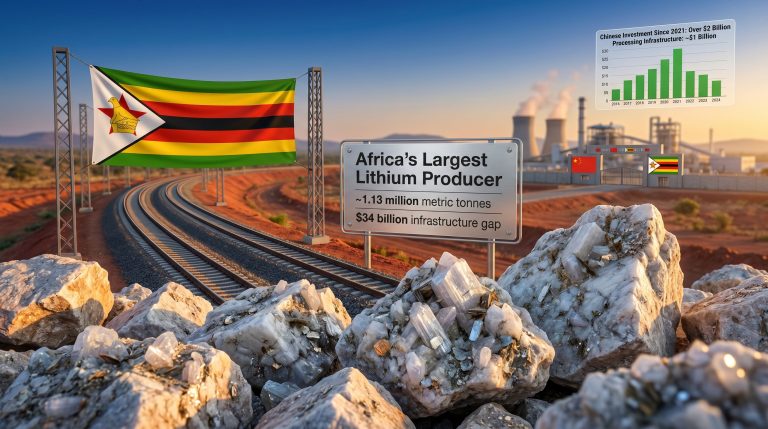
Zimbabwe fits all four criteria. The African Development Bank estimates the country's logistics modernisation requirement at approximately US$34 billion, a figure that reflects decades of infrastructure neglect following prolonged economic mismanagement. Its road and rail networks, once among the most capable on the continent, have deteriorated to the point where ore movement to coastal export terminals represents a meaningful operational constraint for active mining operations.
"The transport network is not simply a development challenge for Zimbabwe. It is a direct cost burden on every tonne of lithium moved from mine to market, and an active ceiling on the country's ability to convert its geological endowment into export revenue."
Finance Minister Mthuli Ncube opened preliminary discussions with China Railway during the World Economic Forum in Dalian, signalling that the government is actively exploring resource-linked debt instruments to fund road and rail construction. Critically, Ncube acknowledged that the government must first conduct detailed project prioritisation work, including cost estimates and toll revenue modelling, before any formal commitment is made.
The DRC Sicomines Deal: What the Precedent Actually Reveals
No serious analysis of Zimbabwe's proposed arrangement can avoid the Sicomines comparison, and the data embedded in that precedent deserves careful examination rather than surface-level citation.
In 2008, the Democratic Republic of Congo entered a landmark resource-backed financing arrangement with Chinese entities tied to the Sicomines copper and cobalt operation. The structure committed US$7 billion in mining-revenue-backed investment, with infrastructure delivery forming a central component of the bargain.
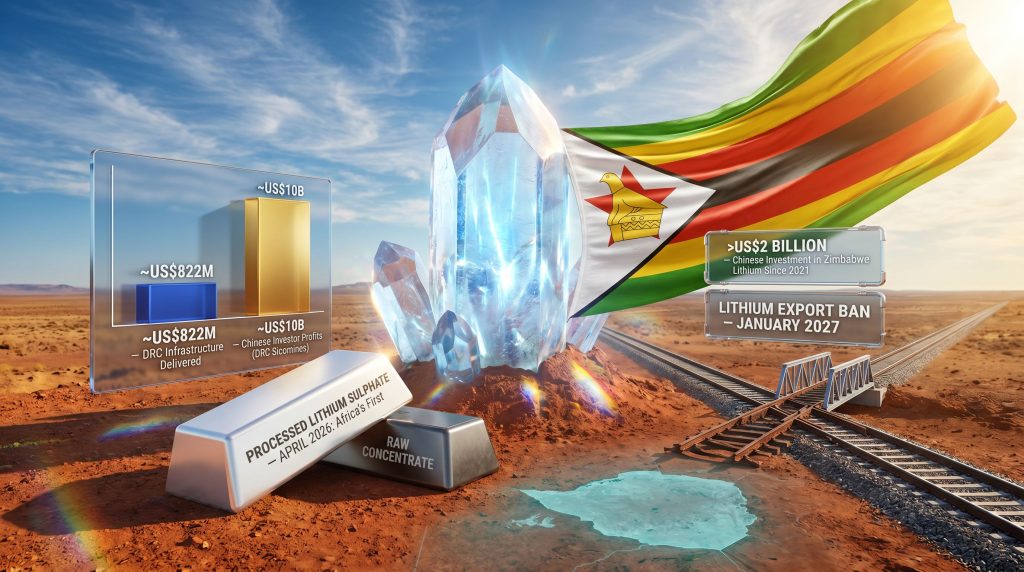
The outcome, as documented by researchers examining Chinese dominance in African lithium mines, was deeply asymmetric. Actual infrastructure disbursement reached approximately US$822 million while Chinese investors generated close to US$10 billion in profits from the mining operation. The gap between what was promised and what was delivered was not marginal.
| Metric | DRC Sicomines Deal | Zimbabwe Proposed Deal |
|---|---|---|
| Year Initiated | 2008 | 2026 (negotiations) |
| Primary Commodity | Copper and Cobalt | Lithium |
| Agreed Investment Value | US$7 billion | To be determined |
| Infrastructure Focus | Transport links | Roads and Rail |
| Verified Infrastructure Spend | ~US$822 million | Pending |
| Chinese Investor Returns | ~US$10 billion (profits) | Pending |
The structural lesson is not that China acted in bad faith, but that the deal architecture failed to create enforceable accountability. Without milestone-linked disbursement, independent audit rights, and penalty mechanisms for underdelivery, resource-backed arrangements can generate outstanding returns for the financing party while delivering a fraction of the promised public value.
Risk Callout: The Sicomines outcome illustrates a specific failure mode in resource-backed deal design: when commodity revenue flows are secured but infrastructure delivery is not tied to verifiable milestones, the financing party captures the upside while the host nation absorbs the shortfall. Zimbabwe's negotiators must treat this not as political rhetoric but as an engineering problem in contract design.
For Zimbabwe's team, the actionable takeaways from the DRC experience include:
- Insist on milestone-linked infrastructure disbursement, with capital released in tranches against verified completion stages
- Embed independent third-party audit rights into the core agreement structure
- Define specific penalty or clawback mechanisms if infrastructure targets are not met within agreed timeframes
- Ensure that the revenue pledge covers a finite commodity volume, not an open-ended flow
Zimbabwe's Lithium Leverage: The Export Ban as a Structural Negotiating Tool
Zimbabwe holds Africa's largest lithium reserves and leads the continent in lithium production by volume. Since 2021, Chinese firms have deployed more than US$2 billion into the country's lithium sector, establishing operational control across all six active lithium mining operations. Furthermore, Chinese entities also control approximately 60% of global lithium refining capacity, making Zimbabwe's upstream concentrate output directly relevant to Beijing's domestic battery supply chain for electric vehicles.
This concentration of Chinese investment creates a strategic interdependency that Zimbabwe is now actively leveraging. The government has legislated a full prohibition on raw lithium concentrate exports, effective January 2027, and introduced a preliminary suspension of raw mineral exports in February 2026 as an interim signal of policy resolve. Ncube confirmed at Dalian that the January 2027 deadline will not be delayed.
The export ban fundamentally reframes the value equation. Raw lithium concentrate commands significantly lower prices than processed lithium sulphate or battery-grade lithium hydroxide. By mandating that processing occurs inside Zimbabwe, the government is attempting to capture a larger share of the economic surplus generated by its mineral endowment, rather than exporting that value creation opportunity alongside the ore. Understanding how lithium mining works helps clarify why this distinction between raw and processed output carries such significant commercial weight.
Two major processing commitments are already underway, though both are Chinese-controlled:
- Zhejiang Huayou Cobalt (Prospect Lithium Zimbabwe): Committed approximately US$400 million for a lithium sulphate processing facility at Arcadia, plus approximately US$300 million for a concentrator plant
- Sinomine Resource Group (Bikita Minerals): Constructed an estimated US$500 million lithium sulphate plant, with further capital investment announced in May 2026
In April 2026, Prospect Lithium Zimbabwe became the first operation on the African continent to export domestically processed lithium sulphate, marking a structural transition from raw commodity exporter to midstream processor. This is not a minor commercial distinction. Processed lithium sulphate sits several price points above concentrate on the value chain, and the ability to demonstrate commercial-scale processing output strengthens Zimbabwe's position in any downstream offtake or loan negotiation.
Milestone Marker: The April 2026 lithium sulphate export from Zimbabwe is a commercially significant inflection point. It demonstrates that the processing mandate is not aspirational policy but operational reality, which materially improves the country's negotiating credibility in the China infrastructure discussions.
The Beneficiation Strategy: Value Addition, Ownership Risk, and the Dependency Problem
There is an important distinction that Zimbabwe's industrial development narrative tends to underemphasise. Moving up the lithium value chain toward battery-grade hydroxide or processed sulphate does capture more economic value per tonne. However, if the processing infrastructure is entirely Chinese-owned, the nationality of value capture shifts only marginally.
The processing plants currently operational or under construction inside Zimbabwe are predominantly controlled by Chinese parent companies. Zhejiang Huayou Cobalt and Sinomine are not Zimbabwean enterprises. Their investment in domestic processing reflects compliance with the export ban and a desire to protect their supply chains, not a transfer of industrial ownership to Zimbabwean entities.
This creates a structural tension at the heart of Zimbabwe's beneficiation strategy:
- The export ban successfully compels in-country processing
- That processing is performed inside Chinese-controlled facilities
- The value-add accrues primarily to Chinese operators through controlled offtake arrangements
- Zimbabwe captures royalties, taxes, and employment but not industrial ownership or pricing control
The Mutapa Investment Fund (MIF), Zimbabwe's sovereign wealth vehicle, is being positioned as a co-financing instrument in public-private partnership structures across lithium infrastructure, renewable energy, and water systems. Sovereign fund participation introduces a degree of domestic capital ownership into arrangements otherwise dominated by foreign counterparties, though the MIF's available capital remains modest relative to the investment scale required.
A more robust long-term strategy would require parallel engagement with non-Chinese capital sources, including Western development finance institutions, multilateral lenders, and strategic investors seeking to diversify battery supply chains away from Chinese-controlled midstream infrastructure. Innovations such as direct lithium extraction technology may also play a role in attracting diversified international investment by reducing processing costs and environmental impact.
A Continental Shift: Resource Nationalism as Coordinated Policy Signal
Zimbabwe's export ban does not exist in isolation. Across the African continent, governments sitting atop minerals central to electric vehicle battery chemistry are simultaneously tightening the terms of extraction. The critical minerals demand driven by the global energy transition is fundamentally reshaping how these governments approach resource negotiations.
| Country | Mineral | Policy Instrument | Year Enacted |
|---|---|---|---|
| Zimbabwe | Lithium | Raw concentrate export ban | 2027 (effective) |
| Mozambique | Multiple minerals | 15% mandatory state equity | 2026 |
| DRC | Cobalt | Export volume quotas | 2024 to 2025 |
The convergence is not coincidental. African policymakers have observed for decades that raw commodity exports generate a fraction of the value that processed or refined outputs command in global markets. The regulatory tightening across these three jurisdictions signals a coordinated shift in continental negotiating philosophy, even if the specific instruments differ.
How Has Chinese Investment Shaped Zimbabwe's Mineral Sector?
Chinese operators have built entrenched positions across African mineral jurisdictions over two decades, cultivating government relationships and securing offtake agreements during periods when host nations had less sophisticated policy frameworks and fewer financing alternatives. As analysed in depth by geopolitical monitor coverage of China's approach in Zimbabwe, this dynamic extends well beyond commercial interests into questions of political leverage and regime legitimacy.
Western mining companies and institutional investors entered these markets later and with less consistency, creating a structural competitive disadvantage that is now difficult to close. The global lithium market dynamics consequently reflect a significant concentration of Chinese influence across upstream and midstream operations.
The irony is that Western governments are accelerating battery supply chain diversification strategies precisely as the regulatory environment across lithium, cobalt, and copper jurisdictions is tightening. This timing mismatch creates a genuine strategic problem for governments seeking to reduce dependency on Chinese-controlled mineral midstream capacity.
How Zimbabwe structures its final agreement with China Railway will be observed closely by Zambia, Tanzania, and other mineral-rich African nations evaluating comparable arrangements. The ratio of infrastructure delivered to mineral revenue pledged will become a reference point for the next generation of resource-backed financing negotiations across the continent. In addition, the broader mining geopolitics of this era suggest that these negotiations will have implications far beyond any single bilateral deal.
The next major ASX story will hit our subscribers first
Key Data Summary: The Zimbabwe Lithium Infrastructure Equation
| Data Point | Figure |
|---|---|
| Zimbabwe infrastructure funding gap | ~US$34 billion |
| Chinese investment in Zimbabwe lithium (since 2021) | >US$2 billion |
| Lithium export ban effective date | January 2027 |
| Preliminary raw mineral export suspension | February 2026 |
| DRC Sicomines infrastructure spend (actual) | ~US$822 million |
| DRC Sicomines Chinese investor profits | ~US$10 billion |
| Huayou Arcadia processing commitment (combined) | ~US$700 million |
| Sinomine Bikita processing investment | ~US$500 million |
| Chinese share of global lithium refining capacity | ~60% |
Frequently Asked Questions: Zimbabwe Lithium for China Infrastructure Deal
What is Zimbabwe offering as the basis for the China infrastructure deal?
Zimbabwe is proposing to pledge future natural resource revenue, with lithium as the primary strategic asset, against capital loans tied to road and rail construction projects. The government has not yet committed to specific projects, as cost estimates and toll revenue modelling are still being developed.
When does Zimbabwe's lithium export ban take full effect?
The complete prohibition on raw lithium concentrate exports is scheduled for January 2027. A preliminary suspension of raw mineral exports was introduced in February 2026 as an interim enforcement signal.
Why does China have an interest in improving Zimbabwe's infrastructure?
Chinese firms control all six active lithium mining operations in Zimbabwe and have invested more than US$2 billion in the sector since 2021. Degraded roads and railways increase the cost of moving ore to export ports, directly affecting the commercial returns of Chinese-operated mines. Infrastructure investment consequently serves Chinese commercial interests as much as Zimbabwean development objectives.
What is the main risk of the proposed deal for Zimbabwe?
The DRC Sicomines precedent shows that resource-backed deals can deliver disproportionate returns to the financing party while underdelivering on infrastructure commitments. Zimbabwe must negotiate enforceable milestone-linked disbursement, independent audit mechanisms, and penalty provisions to avoid a comparable outcome.
Is Zimbabwe's lithium processing capacity sufficient to support the export ban?
Processing plants operated by Zhejiang Huayou Cobalt and Sinomine are operational or under advanced construction, providing a baseline capacity argument. However, if aggregate mine output exceeds processing throughput, operational bottlenecks will emerge. The processing facilities are Chinese-controlled, meaning the value-add benefit accrues primarily to foreign operators rather than to Zimbabwean industrial entities.
Disclaimer: This article contains forward-looking statements, financial estimates, and deal structure analysis based on publicly available information current at the time of writing. Negotiations between Zimbabwe and China Railway are ongoing, and final deal terms have not been confirmed. Nothing in this article constitutes investment advice. Readers should conduct independent research before making financial or investment decisions related to any entities or commodities discussed.
Want to Track the Next Major Mineral Discovery Before the Market Moves?
Discovery Alert's proprietary Discovery IQ model delivers real-time alerts on significant ASX mineral discoveries — instantly converting complex mineral data into actionable investment insights for both short-term traders and long-term investors — with a 14-day free trial available today. To understand how historic discoveries have generated extraordinary returns, explore Discovery Alert's dedicated discoveries page and see why being first to a major find can make all the difference.