June 25, 2026
The Structural Economics Behind Resource-Backed Mineral Deals
When a country sits atop one of the world's most strategically critical mineral deposits yet cannot access conventional development financing, the terms of engagement with capital shift fundamentally. The logic is not ideological — it is arithmetic. Future commodity revenues become the only viable collateral when multilateral lending windows are effectively closed, and the infrastructure deficit compounding annually makes inaction more expensive than imperfect deal structures.
This is the context in which the Zimbabwe lithium-backed infrastructure deal with China must be understood. It is not simply a bilateral financing negotiation. It represents a calculated attempt to simultaneously resolve a decades-old infrastructure constraint, extract greater value from a booming mineral sector, and reposition a resource-dependent economy within the global lithium market — all at once, using a single commodity as the pivot point.
When big ASX news breaks, our subscribers know first
Why Zimbabwe's Infrastructure Deficit Has Become a Mineral Competitiveness Problem
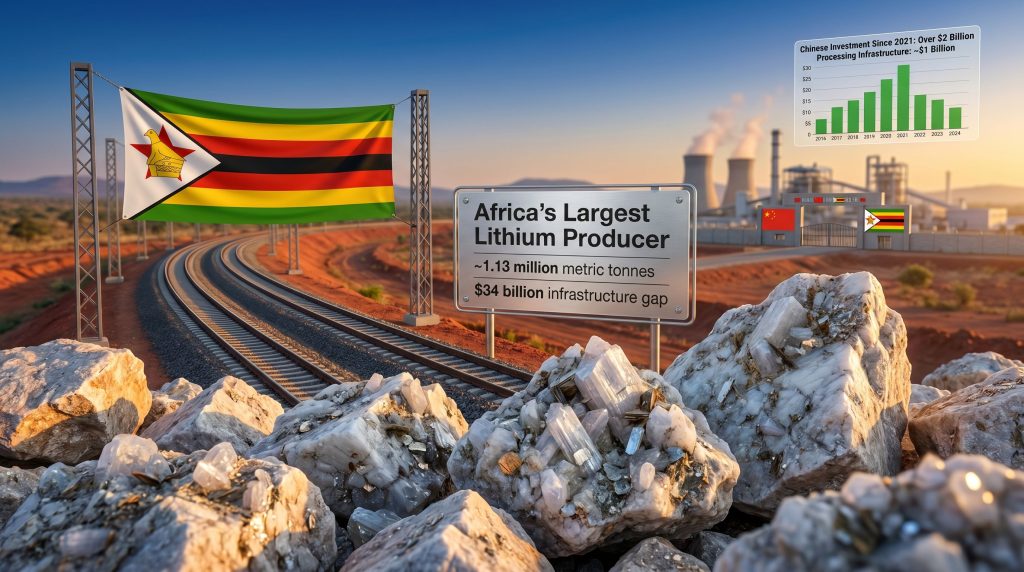
The African Development Bank estimates Zimbabwe requires approximately $34 billion to bring its transport and logistics networks up to modern operational standards. That figure encompasses road networks, rail corridors, and the broader logistics systems that determine whether a mining nation can move bulk commodities efficiently to regional ports.
Zimbabwe's rail network carries particular significance in this context. Historically the backbone of bulk commodity movement across the region, the system has experienced prolonged underinvestment that has progressively increased logistics friction for mining operators. The practical consequence is that spodumene concentrate — the primary lithium-bearing product mined in Zimbabwe — faces avoidable cost inflation before it ever reaches an export port.
For Chinese mining companies already deeply embedded in Zimbabwe's lithium operations, this is not an abstract policy problem. It directly affects their unit economics. Better transport infrastructure would reduce their export bottlenecks, lower per-tonne shipping costs, and accelerate mineral movements to ports in Mozambique and South Africa. This alignment of national development priorities with investor commercial interests is precisely what makes the proposed deal structure coherent from both sides of the negotiating table.
How Resource-Linked Debt Instruments Actually Function
Resource-backed financing is a specific class of structured debt instrument that most policy discussions reduce to oversimplified characterisations. Understanding its mechanics is essential to evaluating Zimbabwe's proposed approach.
At its core, the instrument works as follows:
-
A government identifies infrastructure projects with measurable economic returns — roads with toll revenue potential, railways with freight tariff income.
-
The construction cost of those projects is calculated, and projected revenue from tolls or freight charges is modelled against the financing timeline.
-
Any shortfall between infrastructure revenue and total loan repayment obligation is covered by pledging a portion of future commodity revenue streams as supplementary collateral.
-
The lender — in this case, potentially China Railway Group — receives repayment from a blended stream of infrastructure revenue and resource income rather than general government budget allocations.
Zimbabwe's Finance Minister Mthuli Ncube has described this framework publicly, noting that the government's task is to determine which infrastructure projects to prioritise, estimate construction and toll revenue figures, and identify what residual financing gap would need to be covered by natural resource income. Furthermore, the talks with China Railway Group were initiated at the World Economic Forum in Dalian, though no binding agreements had been publicly confirmed as of mid-2026.
Critical distinction: Resource-backed loans are not inherently predatory. Their risk profile is almost entirely a function of three variables: commodity price assumptions used in the revenue model, the transparency of contract terms, and the governance architecture governing enforcement of repayment conditions.
Zimbabwe's Lithium Sector: Scale, Operators, and Chinese Dominance
The asset underpinning this entire strategy is Zimbabwe's lithium endowment, which has elevated the country to the position of Africa's largest lithium producer. The scale of Chinese investment in that sector over the past several years is substantial.
| Metric | Data Point |
|---|---|
| Continental ranking | Africa's largest lithium producer |
| 2025 spodumene concentrate exports to China | ~1.13 million metric tonnes |
| Share of China's lithium concentrate imports | ~15% |
| Chinese investment since 2021 | Over $2 billion |
| Domestic processing investment secured | ~$1 billion |
| Proposed battery metals industrial park | $2.8 billion |
Chinese firms account for approximately 90% of Zimbabwe's mining operations, with four major groups holding dominant positions across the country's lithium sector:
-
Zhejiang Huayou Cobalt operates the Arcadia mine and has committed approximately $400 million for processing infrastructure plus a $300 million concentrator. Its lithium sulphate plant is already operational, with the first consignment delivered — making it the most advanced operator in the country's emerging midstream sector.
-
Sinomine Resource Group operates Bikita Minerals and has committed approximately $500 million toward a lithium sulphate processing facility, currently under development.
-
Chengxin Lithium Group is active in Zimbabwe's upstream lithium sector, contributing to the country's concentrate production base.
-
Yahua Group is developing the Kamativi project with processing ambitions, though its facility remains in the study and early development phase.
Why Spodumene Grade and Processing Chemistry Matter
A less commonly understood dimension of Zimbabwe's lithium competitiveness relates to the specific mineral chemistry of its deposits. Spodumene extraction at operations like Arcadia and Bikita typically needs to reach a lithium oxide (Li₂O) grade of 6% or above to be commercially viable for export and downstream processing. Zimbabwe's hard-rock pegmatite deposits have demonstrated the geological consistency required to achieve these grades at scale, which is a key reason Chinese refiners have prioritised the country as a supply source.
Spodumene must be converted through either a sulphate or hydroxide processing route before it can enter battery-grade chemical production. The lithium sulphate pathway being pursued by Huayou and Sinomine is generally considered more capital-efficient for African conditions, though it produces an intermediate product rather than battery-ready lithium hydroxide. This technical nuance is important: Zimbabwe's processing ambitions currently target the midstream conversion step, not the final battery chemical stage — a distinction that shapes how much value the country actually captures relative to the full supply chain.
The 2027 Export Ban: Policy Mechanics and Competitive Implications
Zimbabwe's industrial policy is creating a hard deadline that is already reshaping operator behaviour. A February 2026 ban on raw mineral exports marked the beginning of a phased prohibition, with a full ban on lithium concentrate exports scheduled for January 2027.
The strategic logic is straightforward: raw spodumene concentrate is a low-margin, high-volume product that transfers most of the value creation to the processing and refining stages conducted in China. By prohibiting concentrate exports, Zimbabwe forces mining operators to invest in domestic processing facilities or lose market access entirely. Consequently, understanding how lithium mining works is increasingly relevant for investors assessing the operational complexity behind this policy shift.
| Operator | Facility Type | Status |
|---|---|---|
| Zhejiang Huayou Cobalt (Arcadia) | Lithium sulphate plant | Operational |
| Sinomine / Bikita Minerals | Lithium sulphate facility | Under development |
| Yahua Group (Kamativi) | Processing plant | Study / early development |
| Other operators | Various | Planning stages |
The competitive asymmetry this creates is significant. Huayou's operational advantage means it can continue exporting compliant processed product after January 2027, while competitors face disruption if their facilities are not commissioned in time. Industry participants have lobbied for deadline extensions, citing capital intensity, power supply reliability, and policy consistency as preconditions for accelerated construction — but the government's stated position, as of mid-2026, is that the timeline will not be relaxed.
The Power Constraint: A Structural Risk Rarely Discussed
One of the least publicly examined risks in Zimbabwe's processing ambition is the country's electricity grid. Lithium processing facilities are energy-intensive operations, and Zimbabwe's grid has historically struggled to meet peak industrial demand. If processing plants come online but cannot access reliable power, the export ban creates an operational trap: operators cannot export concentrate, but cannot run their processing facilities at full capacity either. This scenario would suppress output, reduce royalty and tax revenues, and potentially undermine the very resource income stream that the infrastructure financing model depends on.
Africa's Resource-for-Infrastructure Playbook: Lessons from Precedent
Zimbabwe's approach draws on a well-established continental template, though with meaningfully different risk characteristics than prior examples.
| Country | Commodity | Infrastructure Delivered | Key Risk Outcome |
|---|---|---|---|
| Angola | Oil | Roads, housing, public buildings | Revenue volatility during oil price crashes |
| DRC (Sicomines) | Copper and Cobalt | Roads, hospitals, schools | Transparency concerns; terms renegotiated |
| Guinea (Simandou) | Iron ore | Rail and port infrastructure | Prolonged delays; governance complexity |
| Zimbabwe (proposed) | Lithium | Roads and rail networks | Deal still in negotiation as of mid-2026 |
The DRC's Sicomines agreement is perhaps the most instructive precedent. Infrastructure was delivered, but the arrangement became a reference point for concerns about transparency deficits in resource-backed deals, with contract terms renegotiated over time under pressure from civil society and international creditors. Angola's oil-backed model showed that commodity price cycles can rapidly transform manageable debt into fiscal stress — a particular concern given lithium's own price volatility in recent years.
What differentiates Zimbabwe's position from Angola's historical model is that Angola pledged revenues from a mature, decades-old production base. Zimbabwe is effectively pledging future revenues from a sector still in the early stages of scaling its processing capacity. The revenue projections underpinning any resource-linked loan will necessarily be built on assumptions about processing plant commissioning timelines, lithium price trajectories, and grid power availability — each of which carries meaningful uncertainty.
Investor note: The DRC's Sicomines deal demonstrates that resource-backed arrangements can deliver infrastructure while simultaneously generating long-term governance liabilities. The terms of any Zimbabwe equivalent will be as important as the deal's existence.
The next major ASX story will hit our subscribers first
The Geopolitical Dimension: Critical Minerals Competition and Western Alternatives
The Zimbabwe lithium-backed infrastructure deal with China does not exist in a geopolitical vacuum. Zimbabwe's lithium deposits are increasingly contested territory in the broader competition between China and Western nations to secure battery mineral supply chains. Indeed, the battery raw materials market dynamics make this competition increasingly consequential for investors and policymakers alike.
Chinese investment exceeding $2 billion since 2021, combined with operational processing infrastructure, creates a structural depth of engagement that is difficult for alternative partners to replicate quickly. The depth of Chinese presence in Zimbabwe's lithium sector means that any Western partnership strategy would need to layer onto an existing Chinese industrial foundation rather than displace it.
However, Zimbabwe's export ban and processing localisation agenda theoretically creates an opening. If Zimbabwe achieves its goal of becoming a midstream processing hub rather than a raw material exporter, it gains leverage to negotiate technology and capital partnerships with a wider range of partners — including Western firms and institutions seeking to diversify away from Chinese battery supply chain dominance. As Al Jazeera has reported, smaller local miners are frequently left behind in this dynamic, raising important questions about whether Harare can cultivate genuine diversification or whether the depth of existing Chinese investment forecloses the option in practice.
Risk and Reward: Scenario Analysis for Zimbabwe's Dual Strategy
The following scenarios represent plausible outcome ranges, not predictions. All forecasts regarding commodity prices, infrastructure timelines, and financing structures involve significant uncertainty.
Scenario 1 — Full Transformation: Processing plants reach operational status before the January 2027 deadline. Infrastructure financing is executed with publicly disclosed contract terms. Lithium prices stabilise at levels consistent with positive debt service. Zimbabwe captures meaningful midstream value and begins attracting Western technology partners as a counterbalance to Chinese capital concentration.
Scenario 2 — Partial Progress: Some processing capacity becomes operational, infrastructure projects are initiated but subject to delays, and Zimbabwe captures incremental industrial value while remaining heavily dependent on Chinese capital, technology, and market access for the foreseeable future.
Scenario 3 — Structural Setback: Sustained lithium price weakness erodes revenue projections used to justify resource-linked loan terms. Processing plants face construction delays due to capital constraints or power supply failures. Resource-backed loan obligations create fiscal stress that compounds Zimbabwe's existing debt arrear problems — potentially replicating the debt vulnerability cycles seen in other African resource-for-infrastructure arrangements.
Furthermore, advances in direct lithium extraction technology could shift global supply dynamics in ways that affect the revenue assumptions underpinning Zimbabwe's financing model. The four variables that will most directly determine which scenario materialises are: commodity price trajectory, contract governance transparency, processing capacity readiness before the export ban, and grid power reliability for industrial operations.
Frequently Asked Questions
What is the Zimbabwe lithium-backed infrastructure deal with China?
Zimbabwe is exploring a resource-linked financing arrangement with China Railway Group, under which projected future revenues from the country's lithium sector would serve as the repayment mechanism for loans financing road and rail infrastructure. The discussions were initiated at the World Economic Forum in Dalian, with no binding agreements publicly confirmed as of mid-2026.
How large is Zimbabwe's infrastructure financing gap?
The African Development Bank estimates Zimbabwe requires approximately $34 billion to modernise its transport and logistics networks to standards consistent with competitive mineral export operations.
Why is the January 2027 lithium export ban significant?
The ban prohibits the export of unprocessed lithium concentrate, effectively compelling mining operators to build domestic processing capacity or lose market access. It is designed to shift Zimbabwe's position in the battery supply chain from raw material supplier toward midstream processor, retaining substantially more economic value within the country.
Which company has already achieved processing compliance?
Zhejiang Huayou Cobalt's lithium sulphate plant at the Arcadia mine is fully operational, with its first consignment already delivered. It is the only operation in Zimbabwe that has demonstrably achieved midstream processing status ahead of the 2027 deadline.
What are the primary risks of resource-backed financing for Zimbabwe?
The core risks include lithium price volatility reducing revenue available for debt service, insufficient transparency in contract terms, Zimbabwe's existing debt arrears amplifying fiscal vulnerability, power grid constraints limiting processing plant throughput, and the possibility that insufficient processing infrastructure is operational before the export ban takes full effect.
How much have Chinese companies invested in Zimbabwe's lithium sector?
Chinese firms have invested over $2 billion in Zimbabwe's lithium sector since 2021. The export ban policy has catalysed approximately $1 billion in domestic processing infrastructure commitments, with a proposed $2.8 billion battery metals industrial park under separate discussion.
This article is intended for informational purposes only and does not constitute financial or investment advice. Forecasts, scenario projections, and deal valuations discussed herein involve assumptions that may not be realised. Readers should conduct independent research before making investment decisions related to any sector, company, or instrument referenced above.
Want to Stay Ahead of the Next Major Mineral Discovery?
Discovery Alert's proprietary Discovery IQ model scans ASX announcements in real time, instantly identifying significant mineral discoveries across lithium and over 30 other commodities — translating complex geological data into clear, actionable investment insights. Explore how historic discoveries have generated substantial returns on Discovery Alert's dedicated discoveries page, and begin your 14-day free trial today to position yourself ahead of the broader market.