June 24, 2026
The Hidden Economics of Stranded Mining Infrastructure
Most discussions about the future of battery metals focus on resource discovery and grade quality. Comparatively little attention goes to the infrastructure bottleneck that has quietly become one of the most decisive factors in determining which lithium projects actually reach production, and which ones stall indefinitely at the feasibility stage. Furthermore, the growing critical minerals demand across global supply chains is making this infrastructure question increasingly urgent.
Building a remote processing facility in northern Canada from scratch is not simply expensive, it is slow. Permits can take years to navigate. Construction timelines in subarctic conditions routinely exceed projections. The capital commitment required before a single tonne of concentrate ships can run into the hundreds of millions. For junior developers, this reality has historically been a near-insurmountable barrier.
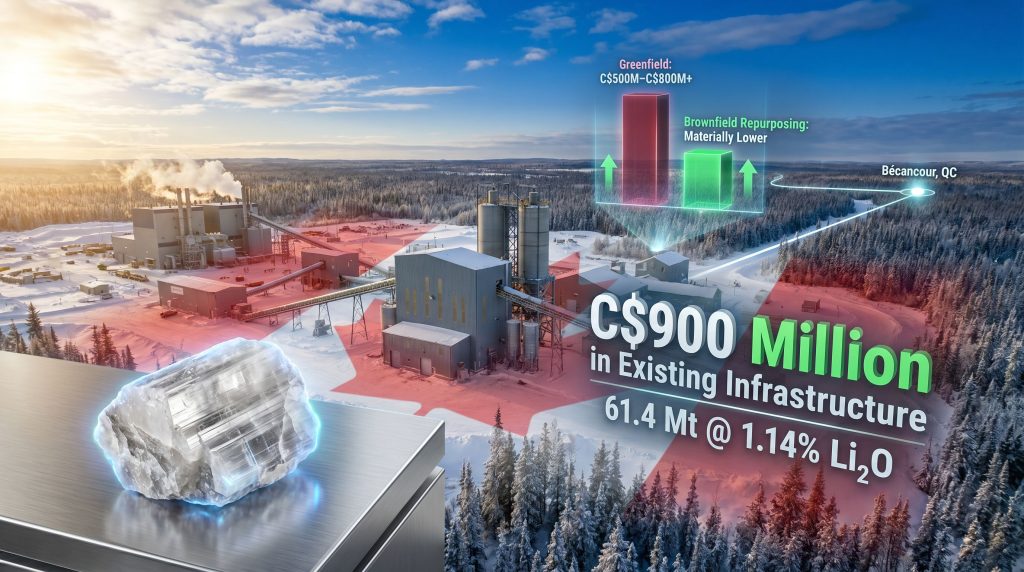
That is precisely why the strategic logic behind the Li-FT Renard mine lithium hub concept is attracting attention across the critical minerals sector. By targeting a dormant diamond processing complex with an estimated replacement value of approximately C$900 million, Li-FT Power (TSX-V: LIFT) is attempting to leapfrog the infrastructure problem entirely, rather than waiting years and spending hundreds of millions to solve it conventionally.
When big ASX news breaks, our subscribers know first
Understanding the Adina Lithium Asset Before the Renard Equation
Scale, Grade, and the Tier-One Question
Before evaluating the Renard acquisition logic, it is worth understanding what Adina actually represents within the Canadian lithium development landscape. Located in Québec's Eeyou Istchee James Bay region, the Adina Lithium Project hosts an Indicated Mineral Resource of 61.4 million tonnes at 1.14% Li₂O, placing it among the largest hard-rock lithium deposits currently advancing in North America.
Li-FT secured Adina from Winsome Resources in May 2026, adding a project with substantial scale to a portfolio that was already gaining attention for its regional lithium exposure. The 2024 Scoping Study modelled a 4,650 tonne-per-day operation capable of producing 5.5% Li₂O concentrate over a mine life exceeding 20 years, with an after-tax net present value of C$1.0 billion.
Those numbers are compelling on paper. However, NPV figures modelled at the scoping stage carry significant uncertainty, and the distance between a resource estimate and a producing mine is measured in capital, permits, and time — all three of which the Renard option directly addresses.
Why the Eeyou Istchee James Bay Region Is a Structural Advantage
The James Bay region of northern Québec has emerged as one of the most geologically prospective lithium jurisdictions in the western hemisphere. The area hosts multiple spodumene pegmatite systems, the same lithium-bearing rock type that underpins projects in Western Australia's Pilbara region and Brazil's Jequitinhonha Valley. Critically, Québec's clean hydroelectric grid gives operations in this region a material ESG and cost advantage over lithium producers in coal-dependent jurisdictions.
Beyond geology, the diamond mining era in northern Québec left behind something equally valuable: physical infrastructure. Roads, power connections, camps, and processing facilities built for the diamond industry now represent potential brownfield assets for incoming lithium developers. Adina's proximity to the Renard site, at approximately 60 kilometres, is not coincidental to Li-FT's strategy; it is the geographic foundation of the entire thesis.
What Makes Renard More Than Just a Mothballed Mine
A Closer Look at the Asset's Physical Inventory
The Renard diamond mine, formerly operated by Stornoway Diamonds, ceased commercial production and has been in care and maintenance. What remains on site is a remarkably complete mining complex, which is rare for any remote Canadian location.
| Infrastructure Component | Specification |
|---|---|
| Processing Plant Capacity | 2.2 million tonnes per year |
| Power Station Output | 16 megawatts |
| Accommodation Capacity | 330-bed camp |
| Distance from Adina Project | ~60 km south |
| Estimated Existing Asset Value | C$900 million (~US$630 million) |
The site includes a fully enclosed processing plant, tailings management facilities, water treatment infrastructure, an on-site airport, and the accommodation camp. Each of these components would require years of permitting and tens of millions in capital to replicate at a greenfield site. Collectively, they represent a near-complete operational foundation for a processing hub.
Perhaps equally important is the site's logistics connectivity. An all-season road links Renard to the national railway at Chibougamau, which in turn connects southward to Bécancour, Québec — an industrial corridor that has attracted significant battery materials investment and is positioned as a central node in Canada's emerging EV supply chain.
Dense Media Separation: The Technical Compatibility Argument
One of the less-discussed but highly consequential aspects of the Renard acquisition thesis is the alignment between the mine's existing processing technology and lithium processing requirements.
Renard's processing circuit relies on dense media separation (DMS), a gravity-based ore sorting technique that uses a heavy liquid medium to separate minerals by density. In the diamond context, DMS isolates high-density diamond crystals from lower-density gangue material. In contrast to more complex processing methods such as direct lithium extraction, DMS offers a well-understood and proven approach for hard-rock spodumene deposits.
For spodumene, the lithium-bearing mineral in hard-rock pegmatite deposits, DMS plays an analogous role. Spodumene has a specific gravity of approximately 3.1 to 3.2, distinct enough from most gangue minerals to allow effective DMS-based pre-concentration before downstream processing. This technique is used routinely at operating spodumene projects, including those producing battery-grade lithium hydroxide in Australia.
The overlap between diamond and spodumene processing via DMS technology is not widely understood outside of mineral processing circles. It represents one of the most technically substantive arguments for why Renard is a genuine brownfield opportunity, rather than simply a conveniently located piece of idle real estate.
This compatibility does not mean conversion is trivial. Engineering validation at commercial scale for this specific ore type, flow rates, and circuit configuration would still be required. However, the foundational technology alignment meaningfully reduces the risk that Renard's plant would require wholesale replacement rather than adaptation.
The Option Structure: What C$12 Million Buys
Breaking Down the Agreement's Terms
On June 23, 2026, Li-FT signed a binding call option agreement granting it the exclusive right to acquire either the physical assets of the Renard mine or the shares of Stornoway Diamonds. The key commercial and legal parameters are:
- Option fee paid upfront: C$12 million (approximately US$8 million)
- Option duration: Two years from signing, expiring June 2028
- Potential extension: One additional year, to June 2029
- Acquisition scope: Full optionality over physical assets or corporate shares
- Care and maintenance: Li-FT funds ongoing site costs throughout the option period
- Court oversight: Subject to Québec Superior Court approval under active creditor protection, with a hearing scheduled July 2, 2026
The structure is essentially a staged due diligence investment. Li-FT pays a relatively modest upfront fee for exclusive access and the right to conduct deep technical, environmental, and social evaluation before committing to full acquisition. If the feasibility work returns unfavourable results, the C$12 million represents a sunk cost. If it confirms the thesis, Li-FT holds an option on infrastructure that would cost vastly more to recreate.
What the Two-Year Window Is Actually For
The option period is not passive holding time. Li-FT has outlined four parallel workstreams for the evaluation phase:
- Technical assessment of the processing plant's conversion requirements for spodumene throughput
- Economic modelling of the integrated Adina-Renard development scenario versus alternatives
- Environmental and permitting review, including assessment of whether existing Renard permits can transition to support lithium processing operations
- Social and Indigenous consultation with communities in the Eeyou Istchee region, a non-negotiable legal and ethical requirement for any mining development in the area
Each of these workstreams carries its own timeline and uncertainty. The permitting question in particular is complex: Renard's existing authorisations were designed around diamond processing, and any commodity transition would require regulatory engagement with Québec and federal authorities.
Quantifying the Capital Efficiency Argument
Build vs. Repurpose: A Framework for Comparison
The brownfield advantage is most clearly understood through a capital comparison framework. Constructing a 2-million-tonne-per-year processing facility in a remote northern Canadian location would be an extraordinarily expensive and time-consuming undertaking under current conditions. For context, underground lithium mining projects in comparably remote jurisdictions have faced similar capital intensity challenges.
| Development Scenario | Estimated Capital Requirement | Estimated Timeline to Production |
|---|---|---|
| Greenfield processing facility at Adina | C$500M to C$800M+ (estimated) | 7 to 10+ years |
| Renard repurposing (brownfield conversion) | Materially lower | Potentially 3 to 5 years |
| Renard with full permit transfer | Lowest scenario | Potentially accelerated by 2 to 4 years |
These figures are illustrative estimates based on comparable Canadian lithium and base metal project benchmarks. They are not Li-FT's official projections and should not be treated as forward guidance.
The C$12 million option fee, measured against the C$900 million infrastructure replacement value on site, frames the entry cost in a way that is difficult to argue against purely on asset valuation terms. The real question is whether conversion is technically feasible, whether permits can follow the commodity transition, and whether the economics of the integrated development scenario hold up under a detailed feasibility study.
How Adina-Renard Compares to Canada's Broader Lithium Pipeline
Competitive Positioning in a Maturing Development Landscape
Canada's hard-rock lithium development pipeline has grown substantially over the past four years, but most projects in the queue face the same fundamental infrastructure challenge: remote location, high greenfield capital costs, and lengthy permitting timelines. The Adina-Renard combination stands apart from most peers precisely because it targets a brownfield processing solution. Moreover, when considered alongside shifts in global lithium reserves and geopolitical supply concerns, Canada's position becomes increasingly strategic.
| Project | Developer | Resource Scale | Processing Strategy | Development Stage |
|---|---|---|---|---|
| Adina (with Renard option) | Li-FT Power | 61.4 Mt @ 1.14% Li₂O | Brownfield repurposing | Pre-feasibility |
| Whabouchi | Nemaska Lithium | ~50 Mt @ 1.53% Li₂O | Greenfield + electrochemical | Restart/Development |
| Corvette | Patriot Battery Metals | 109.2 Mt @ 1.42% Li₂O | Greenfield | Resource definition |
| Georgia Lake | Rock Tech Lithium | ~11 Mt @ 1.15% Li₂O | Greenfield | Pre-development |
Resource figures are sourced from publicly available NI 43-101 technical reports. Comparisons are for educational context only and do not constitute investment recommendations.
What this table illustrates is that virtually every other advanced Canadian lithium project is pursuing a greenfield processing pathway, with all of the associated capital intensity and timeline risk that entails. The brownfield strategy, if technically validated, creates a genuinely differentiated development thesis for Adina.
The next major ASX story will hit our subscribers first
Key Risks That Investors Must Weigh Carefully
The Uncertainty Framework: What Could Go Wrong?
No analysis of this transaction is complete without a clear-eyed assessment of the risks involved. The brownfield narrative is compelling, but several material uncertainties sit between Li-FT's current position and a producing lithium mine.
Court approval dependency sits at the top of the risk register. The agreement is subject to Québec Superior Court sanction under creditor protection proceedings. Creditor dynamics in insolvency processes can be unpredictable, and approval is not guaranteed regardless of the commercial terms agreed between the parties.
Technical conversion risk is a substantive engineering challenge. DMS circuit compatibility with spodumene is well-established in principle, but converting a diamond processing plant for a different ore type, at different feed rates and with different downstream chemistry, requires rigorous validation. The specific gravity differential between diamond and spodumene, while conceptually similar in its exploitation via DMS, involves meaningfully different operational parameters.
Permitting transition complexity adds regulatory uncertainty. Tailings chemistry differs between diamond and lithium processing operations. Water treatment requirements and effluent profiles may vary considerably. Environmental baseline studies, community impact assessments, and regulatory engagement with both provincial and federal authorities all represent procedural hurdles that could extend timelines or require facility modifications.
Cost exposure during the option period is ongoing. Li-FT bears care and maintenance costs for Renard throughout the two-year window, regardless of the ultimate acquisition decision. In remote northern Quebec, these costs are not trivial.
Option expiry risk is the floor-case scenario. If feasibility work over the next two years produces unfavourable findings, the C$12 million option fee is a sunk cost with no recoverable asset value.
Investors should treat this transaction as exactly what it is: a staged, time-limited feasibility bet on a brownfield infrastructure thesis. The upside case is materially compelling. The downside case involves a complete write-off of the option fee. Both outcomes are plausible.
The Broader Implication: Legacy Mine Infrastructure as Critical Minerals Capital
A Trend That May Accelerate Across Canada's Mining Landscape
The Li-FT Renard mine lithium hub reflects a wider dynamic that is beginning to reshape how critical minerals developers think about capital allocation. As commodity cycles shift and former producing mines enter care and maintenance, they leave behind physical infrastructure that was built to industrial standards, permitted through regulatory processes that took years, and located in regions that are now geologically prospective for battery metals.
The overlap between legacy mine infrastructure and emerging lithium districts in northern Québec is not unique to the Adina-Renard case. Furthermore, other shuttered operations across the Canadian Shield may hold similar brownfield potential as the lithium development pipeline continues to mature. For comparison, Chile's lithium strategy demonstrates how deliberate infrastructure planning can accelerate production timelines at a national scale.
Institutional capital increasingly recognises this dynamic. Brownfield optionality, particularly where it involves processing infrastructure, existing permits, and logistics connectivity, has become a meaningful valuation input in critical minerals project financing conversations. Consequently, the cost of capital for a project with a credible brownfield processing solution is structurally lower than for an equivalent greenfield development.
Key Timeline Milestones to Monitor
For those following the development of this ambitious project, analysts at Northern Miner have noted that the C$12 million option represents a high-stakes but strategically rational bet on brownfield infrastructure. The following milestones mark the critical decision points over the next several years:
- June 23, 2026: Binding call option agreement executed
- July 2, 2026: Québec Superior Court hearing to consider agreement approval
- 2026 to 2027: Technical, environmental, and social feasibility studies across four workstreams
- June 2028: Option expiry deadline (extendable to June 2029)
- Post-exercise (if applicable): Processing plant conversion engineering and regulatory transition process
Each of these dates represents a binary event that could materially alter the project's trajectory. Court approval in July 2026 is the immediate gate. Technical validation over the subsequent 18 months is, however, the substantive one.
This article is intended for informational purposes only and does not constitute financial or investment advice. All financial figures, resource estimates, and timeline projections should be independently verified. Readers considering investment decisions should conduct their own due diligence and consult a qualified financial adviser. Forward-looking statements involve inherent uncertainty, and actual outcomes may differ materially from those described.
Want to Stay Ahead of the Next Major Mineral Discovery on the ASX?
Discovery Alert's proprietary Discovery IQ model scans ASX announcements in real time, instantly identifying significant mineral discoveries and turning complex data into actionable investment insights — the same kind of strategic edge that matters when infrastructure-driven opportunities like Li-FT's Renard thesis emerge. Explore how historic discoveries have generated substantial returns on Discovery Alert's dedicated discoveries page, and begin your 14-day free trial today to position yourself ahead of the broader market.