June 24, 2026
The Engineering Inflection Point Reshaping U.S. Lithium Supply
Most discussions about the future of domestic lithium supply focus on geology, policy, or commodity prices. Far fewer examine the moment when a technology transitions from pilot-scale curiosity to engineered industrial reality. That transition is defined not by a press release or a funding round, but by a specific and consequential decision: appointing an EPCM contractor. For the Lilac Great Salt Lake lithium plant, that moment has arrived with the selection of Hatch as its EPCM partner, and the implications extend well beyond a single facility in Utah.
When big ASX news breaks, our subscribers know first
What the Great Salt Lake Represents in the U.S. Lithium Supply Picture
The United States currently produces a fraction of the lithium it consumes. Domestic output remains heavily concentrated at a single operation, Silver Peak in Nevada, while battery manufacturers source the overwhelming majority of their lithium from overseas, primarily Australia and the Lithium Triangle nations of Chile, Argentina, and Bolivia. The structural gap between domestic production and domestic demand has widened steadily as electric vehicle adoption accelerates.
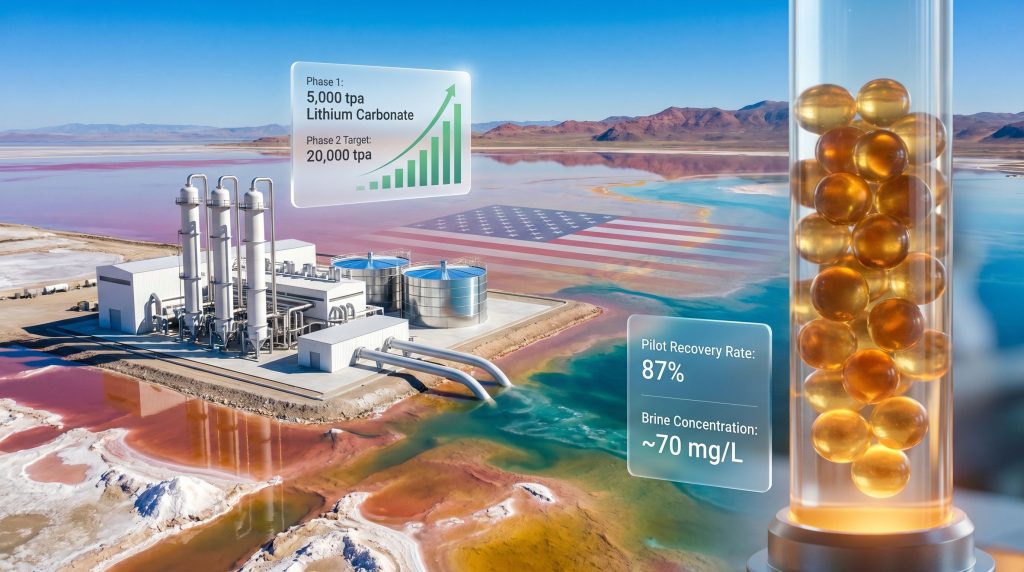
The Great Salt Lake sits at the centre of a potential course correction. Utah's hypersaline lake contains lithium concentrations that, while dilute by conventional mining standards, are accessible through modern direct lithium extraction chemistry. The brine chemistry at the GSL differs substantially from the high-grade Atacama brines that traditional evaporation-based producers have relied upon for decades. At approximately 70 milligrams per litre, the lithium concentration is ultra-low grade by global benchmarks, yet Lilac Solutions' ion-exchange platform has been engineered specifically around this challenge.
Phase 1 of the facility targets 5,000 tonnes per annum (tpa) of lithium carbonate equivalent, with a defined expansion pathway to 20,000 tpa in Phase 2. At full build-out, the project has the potential to approximately double current annual U.S. lithium output, making it one of the highest-impact individual projects in the domestic critical minerals pipeline.
How EPCM Contracting Works and Why Hatch's Role Matters
Understanding why the Hatch appointment carries such significance requires clarity on what EPCM actually means in practice. Engineering, Procurement, and Construction Management contracting differs fundamentally from a full turnkey EPC model in how risk is distributed between the project owner and the contractor.
Under an EPC arrangement, the contractor assumes responsibility for delivering a completed facility at an agreed price, absorbing cost overruns and schedule risk in exchange for a higher margin. Under EPCM, the owner retains direct contractual relationships with vendors and construction firms, while the EPCM contractor provides engineering design, procurement coordination, and construction oversight. This preserves transparency over costs and gives the owner greater control over technical decisions, which is particularly important when the underlying process technology is novel and evolving.
For a first-of-kind facility like the Lilac Great Salt Lake lithium plant, the EPCM model is the rational choice. It allows Lilac to maintain direct oversight of critical technical interfaces, particularly the integration of its proprietary ion-exchange media circuits with conventional downstream lithium carbonate crystallisation infrastructure.
Hatch brings specific credentials relevant to this assignment. The firm has a track record in complex processing plant delivery across hydrometallurgy and novel extraction technologies. The technical challenge here is considerable: designing brine intake systems, media contacting vessels, eluate processing circuits, and product finishing stages around a chemistry that has been validated at pilot scale but never operated at continuous commercial throughput.
The engagement has commenced under a limited notice to proceed (LNTP), which allows detailed engineering to advance before a final investment decision (FID) is formalised. This phased authorisation structure is standard practice for capital-intensive projects where detailed engineering itself generates information needed to sharpen cost estimates and bankability assessments.
The Technology at the Core: Fifth-Generation Ion-Exchange DLE
Direct lithium extraction is not a single technology but a category that encompasses at least three distinct mechanisms: sorbent-based systems, membrane-based separation, and ion-exchange media. Each carries different selectivity profiles, regeneration requirements, and compatibility characteristics with various brine chemistries.
Lilac Solutions operates within the ion-exchange category, using solid beads engineered to selectively bind lithium ions from dilute brine while rejecting competing ions including sodium, magnesium, potassium, and calcium. The Great Salt Lake presents a particularly hostile ionic environment because of its high salinity and complex multi-ion chemistry, which makes selectivity engineering the defining technical challenge.
The fifth-generation bead formulation represents iterative refinement across multiple development cycles, improving on selectivity ratios, mechanical durability under repeated adsorption-elution cycling, and media longevity. Bead degradation in earlier generations was one of the primary technical risks for ion-exchange DLE systems, because media replacement costs at commercial scale can materially affect operating economics. Advances in bead durability across successive generations have progressively reduced this risk.
Pilot operations at the Great Salt Lake have demonstrated 87% lithium recovery from brine containing approximately 70 mg/L lithium. That recovery efficiency at such low feed grades is technically significant. For context, conventional evaporation pond operations in the Atacama typically work with brines several times more concentrated and still experience lithium losses through pond inefficiencies, impurity co-precipitation, and seasonal variability.
Key Performance Metrics at a Glance
| Metric | Value |
|---|---|
| Brine lithium concentration | ~70 mg/L |
| Pilot recovery rate | 87% |
| Phase 1 annual output target | 5,000 tpa lithium carbonate |
| Phase 2 expansion target | 20,000 tpa lithium carbonate |
| Offtake agreement volume | 50,000 tonnes (10-year, take-or-pay) |
| Target first production | 2028 |
| Capital raised to date | Over US$300 million |
| FID target | Late 2026 |
One lesser-appreciated aspect of the GSL project's technical architecture is its reliance on a non-consumptive brine circuit. Lithium-depleted brine is returned to the lake following extraction, meaning the process does not net-remove water from the system. This is architecturally different from evaporation-based operations, where water is permanently lost to solar evaporation, and it addresses one of the primary environmental objections that has complicated lithium development in water-stressed regions.
Manufacturing Integration: The Fernley, Nevada Hub
A detail that receives less attention than the Utah plant itself is Lilac's ion-exchange media manufacturing facility in Fernley, Nevada. This site serves as the supply anchor for the proprietary bead systems deployed at the Great Salt Lake and, potentially, at future licensed projects elsewhere.
The existence of a domestic manufacturing hub for DLE media creates a form of vertical integration that most technology licensors in this space have not yet achieved. It means bead supply is not dependent on international procurement chains, which reduces schedule risk during construction and commissioning and protects operational continuity once the plant is running. For lenders evaluating project bankability, domestic media manufacturing is a meaningful risk mitigant.
This also has implications for Lilac's broader commercial strategy. The company is not purely a project developer; it is also positioning its technology for licensing to third-party operators, particularly in the Arkansas Smackover Formation, where a number of oil and gas companies have begun evaluating lithium co-production from existing brine operations. The Smackover brine chemistry differs from the Great Salt Lake environment, furthermore, requiring some adaptation of the ion-exchange platform, but the core bead technology is transferable across brine types with appropriate reformulation.
The Traxys Offtake: Revenue Certainty and What It Signals
One of the most commercially significant structural elements underpinning the project is the binding 10-year take-or-pay offtake agreement with Traxys North America, covering 50,000 tonnes of lithium carbonate. This volume represents the entirety of Phase 1 output across the agreement's duration. In addition, the lithium carbonate market context in which this offtake was secured adds further weight to its significance.
Take-or-pay structures occupy a specific role in project finance. By obligating the offtake counterparty to purchase a fixed volume regardless of whether the buyer ultimately uses the material, they function as a revenue floor guarantee. For project lenders, a creditworthy take-or-pay counterparty effectively transforms commodity price risk into counterparty credit risk, which is a far more manageable variable in a debt facility underwriting model.
Traxys North America is an established commodity trading and supply chain intermediary with established presence across metals and mineral markets. Its participation in a decade-long, take-or-pay structure for a pre-production project sends a signal to the broader financing community about perceived project viability. Lenders watch these signals closely.
The combination of secured offtake, FEL-3 engineering completion, EPCM contractor appointment, and over US$300 million in prior capital raising represents a degree of concurrent de-risking that places the GSL project in rare company among North American DLE initiatives currently in development.
The next major ASX story will hit our subscribers first
Benchmarking the GSL Project Against Global DLE Peers
To understand where the Lilac Great Salt Lake lithium plant sits in the competitive landscape, it helps to examine how other major DLE initiatives compare across key development metrics. The global lithium market provides important context for evaluating where this project sits relative to international supply ambitions.
| Project | Location | Technology Type | Target Capacity | Status |
|---|---|---|---|---|
| Lilac Solutions, GSL | Utah, USA | Ion-exchange beads | 5,000-20,000 tpa | FID expected late 2026 |
| Salton Sea (EnergySource/CTR) | California, USA | DLE sorbent | 20,000+ tpa | Development stage |
| Smackover (various) | Arkansas, USA | DLE (multiple approaches) | Variable | Early-stage |
| Lithium Americas, Thacker Pass | Nevada, USA | Sedimentary/DLE hybrid | ~40,000 tpa | Construction |
| SQM/Codelco, Atacama | Chile | Evaporation + DLE pilot | Large-scale | Transitioning |
What separates the GSL project from most peers is not technology alone but the convergence of execution-ready indicators. FEL-3 completion means the engineering basis is sufficiently mature to support a credible cost estimate with a defined accuracy range. EPCM contractor appointment means the engineering workforce is engaged and detailed design is underway. Secured offtake means revenue underpinning is contractually in place. These milestones together represent an execution-readiness profile that most other U.S. DLE projects have not yet achieved.
Key Risks That Investors and Observers Should Understand
No assessment of this project is complete without an honest accounting of the risks that remain between current status and commercial production in 2028.
Technical execution risks include:
- Scaling ion-exchange bead performance from validated pilot conditions to continuous commercial throughput, where flow rates, temperature variation, and media loading cycles create stress conditions not fully replicable at smaller scale
- Brine variability across the Great Salt Lake, which experiences seasonal and multi-year fluctuations in ionic composition and water level that could affect consistent lithium grades reaching the plant intake
- Process integration complexity at the interface between Lilac's proprietary ion-exchange circuits and conventional crystallisation and product finishing infrastructure
Regulatory and environmental risks include:
- Water rights permitting in Utah, which operates under prior appropriation doctrines and where industrial brine extraction on a sensitive water body requires navigation of overlapping state and federal regulatory frameworks
- Community and conservation group scrutiny, given that the Great Salt Lake has experienced significant water level declines in recent decades and any industrial activity on the lake must be carefully framed relative to conservation objectives
Market and financial risks include:
- Lithium carbonate price volatility, which has seen significant cycles in recent years and could affect project economics if prices remain depressed through the construction and ramp-up period
- Concentration of Phase 1 revenue in a single offtake counterparty, creating counterparty dependency that lenders will scrutinise carefully
- FID execution risk if financing markets shift materially before the late 2026 target decision date
Disclaimer: The financial projections, timelines, and commercial outcomes referenced in this article involve forward-looking estimates that are subject to material uncertainty. Nothing in this article constitutes financial or investment advice. Readers should conduct their own due diligence and consult qualified advisors before making investment decisions.
What Happens After FID: The Path to 2028 Production
The staged de-risking pathway for the project follows a logical sequence that financing professionals will recognise:
- LNTP phase: Detailed engineering advances, refining cost estimates and resolving technical uncertainties without committing full capital
- FID (target: late 2026): Full project sanctioning, financial close on debt facilities, commencement of full construction mobilisation
- Construction phase: Brine intake infrastructure, ion-exchange media circuit installation, eluate processing and crystallisation plant commissioning
- Commissioning and ramp-up: Progressive plant optimisation toward nameplate capacity
- Commercial production (target: 2028): Full Phase 1 output of 5,000 tpa lithium carbonate, with Phase 2 expansion planning proceeding in parallel
Each stage generates technical and commercial data that de-risks the next. The LNTP-to-FID transition is particularly consequential because it is at FID that lender commitments crystallise and the project's financing structure is locked.
The Broader Significance of Getting DLE Right at Scale
There is an argument, not widely articulated, that the GSL project carries importance beyond its own output numbers. The global DLE industry faces a credibility challenge. Multiple projects have announced promising pilot results over the past decade, raised capital on the strength of those results, and subsequently struggled to demonstrate consistent commercial-scale performance. The gap between pilot recovery rates and sustained commercial throughput has been wider in practice than technology presentations have implied.
If the Lilac Great Salt Lake lithium plant achieves its 87% pilot recovery rate at commercial scale and hits its 2028 production target, it will establish an engineering template and a performance benchmark that other ion-exchange DLE developers can reference when approaching lenders and offtake partners. That demonstration effect, if realised, could meaningfully accelerate capital flows into the broader U.S. lithium brines sector.
Conversely, significant underperformance would reinforce lender caution toward DLE projects more broadly, tightening financing conditions across the sector at a time when domestic lithium supply development is critically needed.
The Hatch EPCM appointment is therefore not simply a procurement milestone for one company. It marks the point at which the most advanced ion-exchange DLE project in the United States entered the execution phase, carrying with it consequences for the entire domestic critical minerals supply chain.
For ongoing technical coverage of processing innovation and direct lithium extraction developments across the global mining sector, Technology Review provides regular reporting on emerging extraction technologies and plant delivery milestones.
Want to Know Which ASX Lithium Discoveries Are Emerging Right Now?
As direct lithium extraction technology moves from pilot scale to commercial reality, the investment opportunities emerging across the critical minerals sector are accelerating — and timing is everything. Discovery Alert's proprietary Discovery IQ model scans ASX announcements in real time, instantly identifying significant mineral discoveries and delivering actionable alerts to subscribers before the broader market reacts; explore historic examples of major discovery returns and begin your 14-day free trial at Discovery Alert to position yourself ahead of the next transformative find.