June 24, 2026
The Battery Metal No Major Miner Can Afford to Ignore
The mining industry has historically operated on multi-decade commodity cycles, where the hierarchy of metals shifts slowly and capital repositioning takes generations. Yet the past five years have compressed what would ordinarily be a 20-year realignment into a single strategic window. Lithium, once relegated to specialist chemical applications and niche industrial uses, now sits at the centre of the most significant industrial transformation since the internal combustion engine displaced the horse. For diversified mining giants, the question is no longer whether to enter the battery metals space. It is whether they have moved decisively enough, and with sufficient strategic coherence, to matter when peak EV demand arrives.
For Rio Tinto (ASX: RIO), the world's second-largest mining company by market capitalisation, that question has a clear answer: the group has staked a defining portion of its strategic future on lithium, and it is now executing that vision against one of the most turbulent commodity backdrops in recent memory.
When big ASX news breaks, our subscribers know first
Why Lithium Has Become Rio Tinto's Fastest-Growing Division
Rio Tinto's internal portfolio is anchored by iron ore, which continues to generate the bulk of near-term operating cash flows, and copper, which benefits from long-run infrastructure spending cycles. Lithium occupies an entirely different structural position: it is high-growth, supply-constrained over a multi-year horizon, and increasingly driven by long-term contract demand rather than spot market speculation.
The numbers underpinning the Rio Tinto lithium growth strategy are stark. Global EV sales have expanded at roughly 27% year-on-year in recent periods, translating into a structural step-change in lithium demand that is expected to compound for decades. Unlike steel demand, which is tied to infrastructure cycles, or aluminium, which follows industrial output patterns, lithium demand is linked directly to the adoption curve of a technology that governments, consumers, and manufacturers across the developed world are actively incentivising.
Rio Tinto's executive leadership has publicly classified lithium as its fastest-growing business division, a designation that is not merely aspirational. It reflects a deliberate reweighting of capital allocation, management bandwidth, and long-term investment planning toward battery supply chain exposure at a scale that most pure-play lithium producers simply cannot match.
What distinguishes Rio Tinto's lithium ambitions from those of smaller peers is not just financial firepower. It is the company's ability to offer OEM customers multi-decade supply visibility backed by one of the strongest balance sheets in global mining.
The $6.7 Billion Arcadium Acquisition: What Rio Tinto Actually Bought
A Portfolio Built Across Four Continents
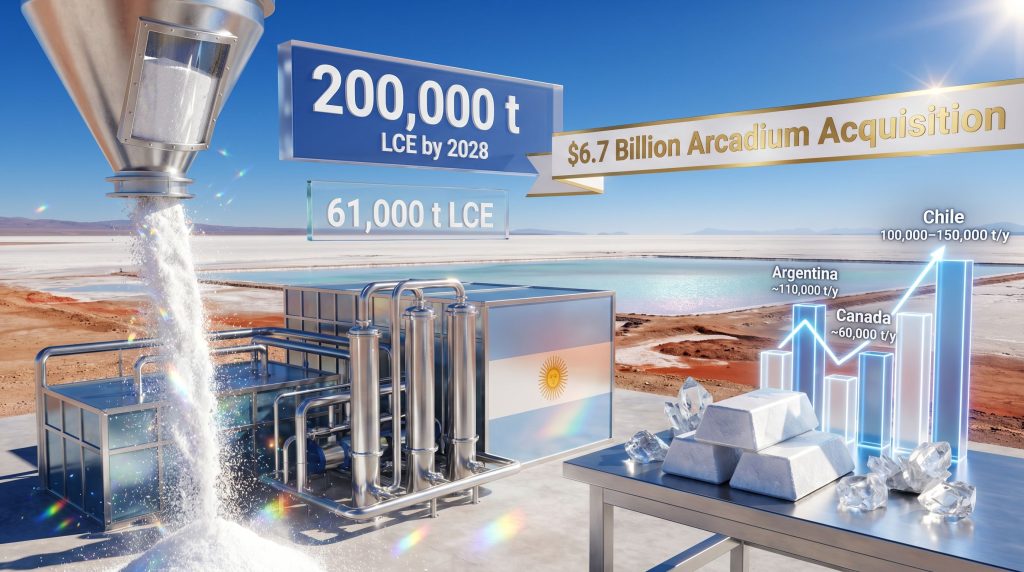
Rio Tinto's entry into large-scale lithium production was crystallised through the $6.7 billion acquisition of Arcadium Lithium, completed in 2025 and representing the company's most significant single commitment to the battery metals sector. The transaction was not simply an asset purchase. It was a strategic compression tool that delivered in a single transaction what would otherwise have required a decade of organic development.
The Arcadium deal provided Rio Tinto with:
- Operating mines and processing facilities spanning Argentina, Canada, and beyond
- Established long-term offtake relationships with major EV manufacturers including Tesla
- A multi-jurisdictional asset base offering geographic diversification and supply redundancy
- Proprietary expertise in direct lithium extraction (DLE) technology
- Processing infrastructure that reduces the capital intensity of future production ramp-ups
| Acquisition Component | Strategic Value Delivered |
|---|---|
| Multi-continent asset base | Geographic diversification and supply security |
| Existing customer contracts | Immediate revenue with bilateral price protections |
| DLE technology platform | Competitive advantage in low-cost, low-impact extraction |
| Processing infrastructure | Reduces future capital requirements |
| Tesla and major OEM relationships | Long-term offtake visibility and pricing stability |
The Price Environment Rio Tinto Walked Into
The Arcadium acquisition was completed during one of the most severe periods of lithium market downturn in the sector's modern history. Chinese oversupply, driven by a wave of new refining capacity additions, flooded the global market with lithium chemicals at a pace that overwhelmed demand growth. The result was industry-wide margin compression, a wave of project cancellations among junior producers, and widespread layoffs across the sector.
Rio Tinto absorbed this portfolio into precisely that environment, a fact that tests both its integration capability and its confidence in the long-term demand thesis. According to reporting by S&P Global, the lithium market has only begun to show signs of stabilisation, meaning Rio Tinto's production growth is being executed against a pricing backdrop that remains fundamentally uncertain. This context makes the company's capital discipline framework not just prudent but essential.
How Rio Tinto Plans to Triple Production by 2028
The Production Roadmap in Detail
Rio Tinto has committed to producing a minimum of 61,000 metric tonnes of lithium carbonate equivalent (LCE) in the current year. Its stated capacity target reaches 200,000 metric tonnes per annum by 2028, representing a near-tripling of output within a compressed three-year window.
Critically, Jérôme Pécresse, Rio Tinto's head of aluminium and lithium, has emphasised that this figure represents a production capacity ceiling, not a guaranteed floor. Output will be calibrated to actual market demand conditions to avoid Rio Tinto inadvertently contributing to the oversupply dynamics it is currently navigating. This demand-responsive production discipline reflects a more sophisticated approach than simple volume targeting.
Geographic Pillars of the 2028 Target
The production growth roadmap is structured across three primary geographies:
- Argentina (Rincon and Sal de Vida): The centrepiece of near-term production expansion. The Rincon project is already delivering first production and carries a 40-year operational lifespan with reserves estimated at up to 11.68 million tonnes LCE at full build-out. Combined capacity at Rincon and Sal de Vida is targeting approximately 110,000 tonnes per annum.
- Canada: A brownfield expansion corridor targeting approximately 60,000 tonnes per annum, with project economics designed to remain viable even if lithium prices decline again from current levels.
- Chile: A longer-dated optionality position, where Chile lithium resources offer potential capacity of 100,000 to 150,000 tonnes per annum, subject to permitting progress and market conditions.
| Geography | Target Capacity (t/y LCE) | Development Timeline |
|---|---|---|
| Argentina (Rincon + Sal de Vida) | ~110,000 | Near-term |
| Canada | ~60,000 | Medium-term |
| Chile | 100,000 to 150,000 | Longer-dated optionality |
| Total Portfolio Capacity Target | ~200,000 | By 2028 |
Direct Lithium Extraction: The Technology Moat at the Heart of the Strategy
How DLE Works and Why It Matters
Direct lithium extraction (DLE) is among the most consequential emerging technologies in the global battery supply chain. Unlike conventional brine operations, which rely on large-scale evaporation ponds that can take 12 to 24 months per production cycle and consume vast areas of land and water, DLE recovers lithium directly from brine solutions through physical or chemical separation processes. The entire production cycle can be compressed from years to weeks.
The implications extend well beyond production speed:
- Water consumption is significantly reduced, addressing one of the primary environmental criticisms of lithium extraction in water-stressed regions like the Atacama
- Land footprint shrinks dramatically, replacing sprawling evaporation ponds with compact processing infrastructure
- Lithium recovery rates can potentially reach 80 to 90 percent or higher, compared to 40 to 60 percent for conventional evaporation methods
- Scalability improves in geographies where evaporation pond construction is physically or regulatorily constrained
| Dimension | Conventional Brine Evaporation | Direct Lithium Extraction |
|---|---|---|
| Production cycle time | 12 to 24 months | Weeks to months |
| Water consumption | High | Significantly lower |
| Land footprint | Large evaporation ponds required | Compact processing facility |
| Lithium recovery rate | 40 to 60% | Potentially 80 to 90%+ |
| Environmental profile | Significant surface disruption | Substantially reduced impact |
| Upfront capital | Moderate | Higher upfront, lower long-run cost |
Why Arcadium's DLE Platform Was a Core Acquisition Motive
One dimension of the Arcadium deal that deserves closer attention from an investment perspective is that DLE technology capability was explicitly cited as a key motivator for the acquisition. Arcadium had developed proprietary DLE processes that Rio Tinto has now inherited, giving it a technological head start over peers who are still in early-stage DLE development.
Pécresse has indicated that at least one of Rio Tinto's DLE projects is expected to reach operational status within the next few years. If successful, this would mark one of the first commercial-scale deployments of DLE technology outside of small pilot operations, a milestone with implications extending well beyond Rio Tinto's own production economics.
DLE's commercial viability across diverse brine chemistries and geographies remains unproven at full scale. Rio Tinto's ability to deploy this technology successfully will be watched closely across the entire lithium sector as a proof-of-concept benchmark.
Capital Discipline: Relevance Over Dominance
The Philosophy That Separates Rio Tinto From Volume-Chasing Peers
One of the most strategically interesting aspects of Rio Tinto's lithium approach is what it explicitly does not aim to achieve. Pécresse has been unambiguous in his public statements that market share leadership is not the objective. Rio Tinto's target is to build an asset portfolio large enough to maintain commercial relevance with major customers, a fundamentally different strategic posture than pursuing production volume rankings.
This philosophy has direct capital allocation consequences:
- Jadar (Serbia) mothballed: Rio Tinto's $2.4 billion Serbian lithium deposit was suspended following permitting failures, demonstrating the company's willingness to delay major commitments when regulatory and social licence conditions are not met
- Capital expenditure declining: Group-level capex is expected to fall below US$10 billion per annum by 2028, signalling that lithium growth is being funded through portfolio optimisation rather than balance sheet expansion
- No further acquisitions planned: Management has confirmed it is not pursuing additional lithium asset purchases, with the Arcadium integration representing the full inorganic commitment for this strategic cycle
- Capital intensity target: New project economics are being structured around approximately $30 per kilogram of production capacity, a benchmark designed to ensure economic viability across a range of pricing environments
Execution Discipline as the Primary Management Focus
Pécresse, a former General Electric executive who joined Rio Tinto in 2023, has stated that demonstrating the ability to deliver projects on time and on budget is consuming the vast majority of his operational focus. For a company managing the integration of a complex multi-continent asset base while simultaneously ramping production in Argentina, this discipline is less a corporate value statement and more an operational necessity.
This execution-first posture reflects a hard lesson from across the mining industry: growth strategies that outrun operational delivery capability tend to generate significant capital destruction.
The next major ASX story will hit our subscribers first
Competitive Positioning and Key Risks
Where Rio Tinto Sits in the Global Lithium Landscape
Albemarle (NYSE: ALB) retains its position as the world's largest lithium producer by volume, and Rio Tinto's stated strategy is not to displace it. Furthermore, within the global lithium market, Rio Tinto does offer a combination of capabilities that pure-play lithium producers structurally cannot replicate: major balance sheet depth, multi-continent geographic diversification, DLE technology access, and established OEM customer relationships with bilateral price protection mechanisms.
| Strategic Dimension | Rio Tinto | Pure-Play Producers | Other Diversified Majors |
|---|---|---|---|
| Capital backing | Major balance sheet | Equity-dependent | Variable |
| DLE technology | Proprietary platform | Mixed | Limited |
| OEM customer contracts | Including Tesla | Spot and contract mix | Emerging |
| Geographic reach | Four continents | Typically one to two jurisdictions | Variable |
| Price risk management | Floor/ceiling structures | Largely spot-exposed | Mixed |
| Production growth target | Approximately 3x by 2028 | High variance | Conservative |
Risk Factors Investors Should Monitor
No honest assessment of Rio Tinto's lithium growth strategy omits the material risks involved:
- Lithium price cyclicality: The recent crash demonstrated how rapidly oversupply can erode project economics. Rio Tinto's contract structures provide partial insulation, but are not a full hedge.
- Chinese refining dominance: China controls an estimated 60 to 70 percent of global lithium refining capacity. This structural concentration creates persistent pricing pressure that no single Western producer can unilaterally offset.
- Permitting and political risk: Argentina's investment environment, while currently constructive, carries inherent political risk across long-duration asset timelines. The Jadar suspension in Serbia illustrates permitting risk in sharper relief.
- DLE commercial scale risk: DLE has not yet been proven at commercial scale across the diversity of brine chemistries present in Rio Tinto's asset base. The technology's advantages are real but contingent on successful deployment.
- Integration complexity: Absorbing Arcadium's multi-continent portfolio within a compressed timeframe introduces meaningful operational risk. Management has acknowledged this as the dominant near-term operational priority.
In addition, the Rio Tinto Congo lithium strategy illustrates how the company continues to evaluate emerging jurisdictions as part of its broader diversification approach, even as near-term capital is concentrated in more established corridors.
This article contains forward-looking statements and strategic projections. Past production trends, acquisition values, and market dynamics do not guarantee future outcomes. Investors should conduct independent due diligence before making any investment decisions.
What This Means for the Battery Supply Chain
If Rio Tinto successfully executes its production roadmap to 200,000 tonnes per annum by 2028, it would become a structurally significant contributor to Western-aligned lithium supply at a moment when EV manufacturers are actively seeking to reduce dependence on Chinese-controlled refining capacity. The company's contract model, featuring bilateral price protections that buffer both supplier and buyer, is increasingly the preferred procurement framework for OEMs managing multi-year production planning.
For the broader battery supply chain, Rio Tinto's scale, financial durability, and DLE technology positioning represent something that junior producers, regardless of asset quality, cannot offer: certainty. Details on the company's full lithium operations and ambitions confirm how deeply this commitment now runs across the organisation. In a sector where supply reliability has become as commercially valuable as price, that certainty commands a structural premium. The Rio Tinto lithium growth strategy is, ultimately, a bet that this premium will compound as EV adoption accelerates toward the second half of the decade.
Want to Spot the Next Major Battery Metals Discovery Before the Market Does?
Discovery Alert's proprietary Discovery IQ model delivers real-time alerts on significant ASX mineral discoveries — including battery metals — instantly converting complex geological data into actionable investment insights for both short-term traders and long-term investors. Explore historic discoveries and their exceptional returns on Discovery Alert's dedicated discoveries page, and begin your 14-day free trial today to position yourself ahead of the next major find.