June 24, 2026
The Geology That Changes Everything: Understanding Lithium-Boron Co-Deposits
Most discussions about the global lithium supply chain focus on a familiar cast of deposit types: hard rock spodumene extraction from Western Australia, lithium brine operations across the South American Lithium Triangle, and clay-hosted deposits scattered across Nevada. What rarely enters the mainstream conversation is a third geological category so rare it effectively does not exist in commercial form anywhere in the world except one location currently in active development.
Lithium-boron sedimentary co-deposits form under highly specific lacustrine conditions, where ancient volcanic activity delivers both lithium-bearing brines and boron-rich fluids into enclosed basin environments over geological timescales. The resulting mineralogy locks both commodities into the same rock sequence, meaning a single mining and processing operation can yield two distinct, commercially valuable output streams simultaneously.
This geological coincidence is not merely interesting from a scientific standpoint. It fundamentally restructures the economics of the project that sits above it.
Ioneer Ltd's (ASX: INR | NASDAQ: IONR) Rhyolite Ridge project in Esmeralda County, Nevada is built on exactly this type of deposit. It represents one of only two known lithium-boron co-deposits globally, and it is the only one currently in active development. That singular status, combined with the commercial partnerships now forming around it, is drawing institutional attention from South Korea in a way that carries significant implications for how allied nations are approaching critical minerals security in 2026.
When big ASX news breaks, our subscribers know first
What Makes Rhyolite Ridge Technically Distinctive
The project's ore body hosts lithium primarily in a mineral called searlesite and within sodium-lithium borosilicate phases, a compositional profile that differs meaningfully from the lithium aluminosilicate mineralogy found in hard rock spodumene deposits. Processing this ore requires a tailored hydrometallurgical approach rather than the pyrometallurgical roasting methods used for spodumene.
Furthermore, Ioneer has engineered the entire processing circuit to operate on-site, eliminating the need to ship concentrate to third-party refineries.
This is not a trivial distinction. One of the persistent vulnerabilities in the Western lithium supply chain has been the concentration of midstream refining capacity. Australia produces the majority of the world's spodumene concentrate, but a dominant share of that material has historically been shipped to China for conversion into battery-grade lithium chemicals. Rhyolite Ridge bypasses this bottleneck entirely by converting ore directly into finished lithium hydroxide and boric acid within the project boundary.
At full production, the operation is projected to yield:
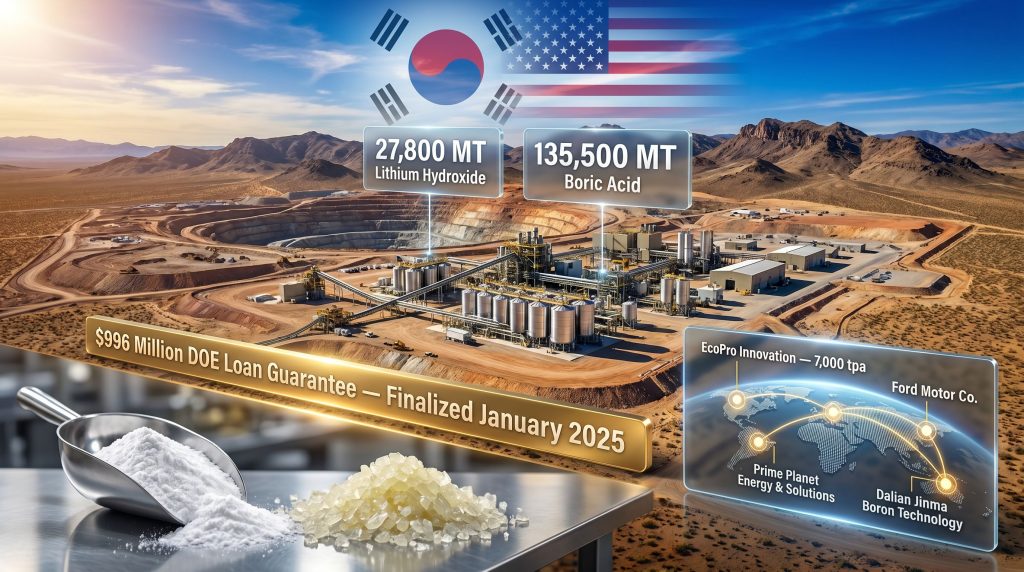
- 27,800 metric tons of lithium hydroxide per year, targeting battery-grade specifications for EV and energy storage applications
- 135,500 metric tons of boric acid per year, serving glass manufacturing, agriculture, semiconductors, and nuclear energy sectors
The boric acid stream is particularly underappreciated in most market analyses. Global boron demand has been growing steadily, driven by applications in borosilicate glass for pharmaceutical packaging, boron neutron capture therapy in cancer treatment, and emerging uses in boron nitride substrates for power electronics. Owning a large-scale domestic boron production asset is independently valuable, and the co-production model means that neither output stream bears the full capital cost burden alone.
Project Readiness: Where Rhyolite Ridge Stands Heading Into FID
The project's development status is what separates it from the broader field of pre-production lithium projects. Many development-stage assets in North America remain years away from completing environmental reviews and permitting. Rhyolite Ridge cleared that hurdle. It holds full permitting status and is described by Ioneer as shovel-ready, a term that carries real weight in a sector where regulatory timelines routinely extend by years.
| Development Milestone | Status |
|---|---|
| Engineering Design Completeness | Greater than 70% |
| U.S. DOE ATVM Loan Guarantee | $996 million, finalized January 2025 |
| Full Permitting Status | Complete |
| Estimated Total Capital Cost | $1.67 billion |
| Target Final Investment Decision | Second half of 2026 |
| Projected First Commercial Production | 2029 |
| Construction Timeline | Approximately 36 months |
| Permanent On-Site Employment | 275 to 300 positions |
The U.S. Department of Energy's Advanced Technology Vehicles Manufacturing loan guarantee, finalized at $996 million in January 2025, provides a substantial debt anchor for the project's financing structure. However, this loan does not cover the full capital requirement. The $1.67 billion total cost leaves a meaningful equity gap that the ongoing strategic partnering process is designed to address.
Goldman Sachs was appointed as financial advisor in July 2025 to manage a formal global partnering process aimed at securing equity co-investors and strategic industrial partners ahead of the Final Investment Decision. The South Korean partnerships now emerging from that process represent the most advanced product of this effort to date.
The Ioneer Rhyolite Ridge Korean Partners: Who They Are and What They Bring
Three South Korean entities have now established formal relationships with Ioneer around the Rhyolite Ridge project, each occupying a distinct functional role within the broader commercial and financing architecture.
EcoPro Innovation: The Binding Commercial Anchor
EcoPro Innovation Co. Ltd. is a subsidiary of the EcoPro Group, which holds the distinction of being the world's second-largest producer of high-nickel cathode active materials. High-nickel cathodes, particularly NMC 811 and NCA chemistries, require battery-grade lithium hydroxide as a precursor input.
The chemical properties of lithium hydroxide matter here: unlike lithium carbonate, which is suited to lower-nickel cathode formulations, lithium hydroxide enables the higher-temperature synthesis required for advanced nickel-rich cathode production. Consequently, demand for this specific product grade is closely tied to the global rollout of high-performance EV battery platforms, making the battery raw materials market a critical consideration for this partnership.
EcoPro Innovation's relationship with Ioneer began with a binding offtake agreement signed in 2021, which was subsequently expanded to 7,000 tonnes per annum of lithium in early 2022. A binding Research and Development Memorandum of Understanding executed in 2023 added a second dimension to the partnership, covering the commercialisation of Rhyolite Ridge's lithium clay resource, referred to internally as the M5 material.
Under this R&D MOU, EcoPro Innovation commits to funding and constructing a commercial refining facility dedicated to processing the M5 lithium clay fraction, with profits from that facility shared equally between the two companies. A joint Project Committee governs technical and commercial milestones, creating an institutional governance structure that goes beyond a typical offtake relationship. You can read more about Ioneer's partnership with EcoPro and how it aims to develop the lithium clay potential of Rhyolite Ridge.
KIND: Institutional Capital With a National Mandate
The Korea Overseas Infrastructure and Urban Development Corporation operates as a specialised public institution under South Korea's Ministry of Land, Infrastructure and Transport. Its institutional remit covers overseas infrastructure investment, energy projects, urban development, and critical minerals, deploying capital through equity stakes, structured project finance, and public-private partnership frameworks.
KIND's participation at the letter of intent stage signals an alignment between South Korea's national resource security priorities and the specific attributes of Rhyolite Ridge. South Korea's domestic lithium production is effectively zero. The country's battery and EV manufacturing base, which includes global champions such as LG Energy Solution, Samsung SDI, and SK On, operates in a state of complete upstream import dependence. Securing equity positions in allied-nation lithium projects has consequently become a core pillar of South Korean resource policy.
Chris Soeung Kim, director of the plant business division for KIND, has characterised the project as a major milestone that advances bilateral cooperation and strengthens the strategic partnership between South Korea and the United States, reflecting the institutional framing that governs KIND's overseas investment mandate.
Hyundai Engineering: Construction Execution Capability
Hyundai Engineering Co. Ltd. brings full-cycle engineering, procurement, and construction capability to the table. The company's scope under its letter of intent covers potential participation in engineering, procurement, and design work from front-end engineering through construction execution.
The significance of Hyundai Engineering's involvement extends beyond the technical. EPC contractor selection is one of the most consequential decisions in large-scale mining project development, directly affecting capital cost certainty, construction schedule, and commissioning risk. Hyundai Engineering's track record across industrial facilities, energy infrastructure, and process plants addresses a specific concern that sophisticated investors apply to development-stage projects: the gap between engineering design completion and actual construction delivery.
Seung Dong Lee, head of the process plant business execution office at Hyundai Engineering, has noted that Rhyolite Ridge stands apart from other critical minerals projects on the metrics that matter most, citing permitting status, construction readiness, and long-term supply certainty as the basis for the company's engagement.
| South Korean Partner | Partnership Type | Primary Role |
|---|---|---|
| EcoPro Innovation Co. Ltd. | Binding offtake and binding R&D MOU | 7,000 tpa lithium offtake; fund and build M5 refining facility; equal profit sharing |
| KIND | Non-binding Letter of Intent | Equity investment, structured financing, PPP project development |
| Hyundai Engineering Co. Ltd. | Non-binding Letter of Intent | Engineering, procurement, and design from FEED through construction |
The Equity Gap Problem: Why Korean Capital Matters
To understand why the Ioneer Rhyolite Ridge Korean partners dynamic carries such weight, it is necessary to understand the capital structure challenge Ioneer faces.
In February 2024, Sibanye-Stillwater exited its 50% joint venture interest in Rhyolite Ridge. The South African platinum group metals producer had entered the partnership in 2021 but faced significant internal financial pressures that made capital deployment into a pre-FID lithium project untenable. This departure removed the primary equity co-investor from the project at a point when lithium prices were experiencing a severe correction from their 2022 peaks.
The $996 million DOE loan guarantee, while substantial, covers approximately 60% of the total $1.67 billion project cost. Closing the remaining equity requirement requires either a single large co-investor or a consortium of smaller participants. KIND's institutional mandate and financing capacity position it as a credible candidate for a meaningful equity role, though the quantum of any potential investment has not been publicly disclosed.
The LOI-to-binding conversion pathway matters enormously here. Non-binding letters of intent carry no legal obligation to proceed, and the history of critical minerals project development is littered with announced partnerships that did not survive due diligence. The targeted MOU execution in July 2026 represents the first real escalation test for the KIND and Hyundai Engineering relationships.
The Full Offtake Network: Commercial Risk Distribution Across Three Continents
One structural feature of Rhyolite Ridge that distinguishes it from most development-stage peers is the breadth and geographic diversity of its existing offtake commitments. In addition to the South Korean anchor, Ioneer has assembled a multi-continental network of offtake partners that spans North America, East Asia, and beyond.
| Offtake Partner | Country | Product | Agreement Type |
|---|---|---|---|
| EcoPro Innovation Co. Ltd. | South Korea | Lithium (7,000 tpa) | Binding offtake and R&D MOU |
| Ford Motor Co. | United States | Lithium hydroxide | Binding offtake |
| Prime Planet Energy and Solutions | Japan | Lithium hydroxide | Binding offtake |
| Dalian Jinma Boron Technology | China | Boric acid | Binding offtake |
Prime Planet Energy and Solutions, the joint venture between Toyota and Panasonic, represents the Japanese dimension of this network. Toyota's long-term commitment to both hybrid and battery electric vehicle platforms creates durable lithium hydroxide demand that extends well beyond near-term market cycles.
The boric acid offtake with Dalian Jinma Boron Technology addresses the industrial revenue stream independently of battery market dynamics. This is a meaningful structural hedge: in periods of lithium price weakness, boric acid revenues continue to flow, and vice versa. Very few lithium projects globally offer this kind of built-in commodity diversification.
The next major ASX story will hit our subscribers first
Critical Path to 2029: The Decision Sequence That Determines Everything
The pathway from current status to first commercial production in 2029 follows a defined sequence, and the Korean partnership escalation sits near the top of the critical path.
- MOU execution with KIND and Hyundai Engineering, targeted for July 2026
- Equity financing closure, bridging the gap between the $996 million DOE loan and the $1.67 billion total project cost
- Final Investment Decision, targeted for the second half of 2026
- EPC contract award, with Hyundai Engineering positioned as a primary candidate given the existing LOI relationship
- Construction commencement, following FID and contractor mobilisation
- First commercial production, targeted for 2029 following approximately 36 months of construction
The compression of steps one through three into a six-month window in the second half of 2026 is aggressive by the standards of major mining project development. It reflects both the urgency Ioneer's leadership has communicated about the project's timeline and the degree to which the groundwork has already been laid through a decade of permitting, engineering, and commercial relationship development.
Ioneer Managing Director Bernard Rowe has framed this moment as the product of a decade of effort across permitting, financing, and partnership development, positioning the Korean relationships as the mechanism that brings construction commencement into realistic view.
Risk Factors Investors Should Weigh Carefully
Readers considering the commercial and investment implications of these developments should be aware of the following material risks. This article does not constitute financial advice, and all projections referenced are forward-looking statements subject to change.
- LOI non-conversion risk: Neither the KIND nor Hyundai Engineering letters of intent create binding commercial obligations. Either party may decline to proceed to MOU or binding agreement at any stage.
- Equity quantum uncertainty: The scale of KIND's potential equity contribution has not been disclosed. A smaller-than-needed contribution would leave a residual funding gap ahead of FID.
- Lithium price sensitivity: Sustained weakness in battery-grade lithium hydroxide prices could affect project economics, partner appetite, and DOE loan drawdown conditions.
- Construction execution complexity: Rhyolite Ridge's integrated ore-to-product processing circuit is more complex than simple concentrate operations, elevating EPC execution risk.
- Regulatory continuity: Any material changes to the DOE ATVM programme structure or associated federal incentive frameworks could alter the project's financing calculus.
What 27,800 Tonnes of Annual Lithium Hydroxide Means for U.S. Supply Chain Independence
To contextualise the scale of Rhyolite Ridge's potential contribution, consider that 27,800 metric tons of lithium hydroxide per year is sufficient to supply battery materials for several hundred thousand electric vehicles annually, depending on battery chemistry and pack size. Against a backdrop where the United States currently relies on imported lithium chemicals for the overwhelming majority of its domestic battery manufacturing needs, a single domestically produced source at this scale represents a structurally meaningful supply chain development.
The 135,500 metric tons of annual boric acid output adds a second dimension to this domestic supply contribution. The United States imports significant volumes of refined boron products, and a large-scale Nevada-based producer would reduce this dependence while creating the 275 to 300 permanent on-site positions that accompany industrial-scale operations in rural Nevada.
Ioneer Executive Chairman James Calaway has characterised securing domestic critical minerals as an economic imperative, framing the Korean letters of intent as evidence of the project's technical and commercial sophistication and as a milestone on the path to construction of what the company describes as a once-in-a-generation domestic critical minerals asset.
The decade of effort that preceded this moment, combined with the geological rarity of the underlying resource, the breadth of the existing offtake network, and the calibre of the South Korean institutions now engaging with the project, suggests that the Ioneer Rhyolite Ridge Korean partners story is not simply about a mining company finding new investors. It is, however, about a specific geologic asset, uniquely positioned by circumstance and design, becoming the focal point of a broader allied-nation effort to build a critical minerals supply chain that does not run through Chinese refining infrastructure.
Furthermore, innovations such as direct lithium extraction may over time complement the hydrometallurgical approach employed at Rhyolite Ridge, underscoring the broader technological evolution shaping the sector.
Whether the Korean relationships convert from letters of intent into binding equity and construction commitments in the second half of 2026 will determine whether that decade of work translates into ground broken by the end of this year.
Want to Stay Ahead of the Next Major Critical Minerals Discovery?
Discovery Alert's proprietary Discovery IQ model delivers real-time alerts on significant ASX mineral discoveries — turning complex geological and commodity data into actionable investment insights the moment they hit the exchange. Explore historic discoveries and the returns they generated, then begin your 14-day free trial at Discovery Alert to position yourself ahead of the broader market.