June 25, 2026
The Grid Is Now the Growth Engine: How Battery Storage Is Reshaping Lithium's Demand Architecture
For most of the past decade, commodity analysts modelled lithium demand as though it were a single-variable equation. Electric vehicles were the input, and everything else was noise. That intellectual framework shaped how mines were permitted, how offtake agreements were structured, and how investors priced lithium producers on public markets. The assumption felt bulletproof at the time. It no longer is.
The power grid has entered the equation, and it is changing every variable in the model.
When big ASX news breaks, our subscribers know first
From Automotive Input to Infrastructure Material: A Demand Reclassification in Progress
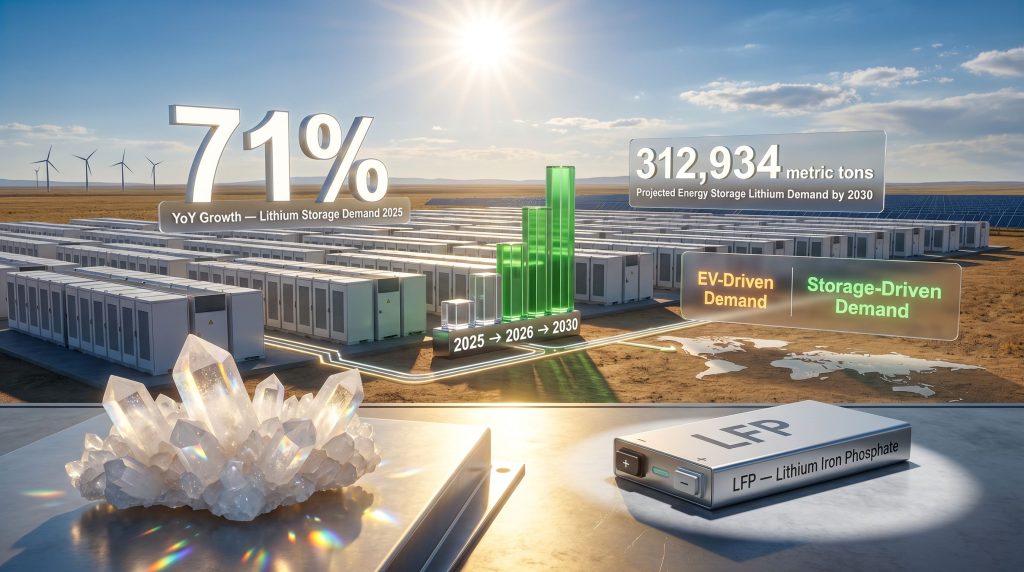
Lithium demand from battery storage systems is not a supplementary theme quietly playing out beneath the EV narrative. It is now the fastest-growing demand signal in the entire lithium market, expanding at rates that EV adoption has never sustained. Industry data cited at the Fastmarkets Global Lithium, Battery and Critical Materials Conference in Las Vegas in June 2026 puts the annual growth rate for storage-driven lithium demand at approximately 40% per year, with 2025 recording year-on-year growth of 71% and 2026 projected to deliver a further 55%.
To contextualise what those numbers mean in absolute terms, lithium demand from stationary energy storage is projected to reach 312,934 metric tons by 2030, representing more than 2.5 times current consumption levels. By 2026, storage is expected to account for roughly 31% of total global lithium demand, a share that was negligible as recently as 2020.
The reclassification of lithium from an automotive sector input to a power infrastructure material carries consequences that extend far beyond headline demand figures. It changes the buyer profile, the procurement logic, the geographic distribution of demand, and ultimately the pricing dynamics of the commodity itself.
Raju Daswani, CEO of Fastmarkets, stated at the conference that the period of market overcorrection has passed and that energy storage has become a primary driver of growth in the lithium market, noting that the structural shift toward storage creates a more robust demand foundation compared to the volatility inherent in consumer-driven EV markets. (Source: Reuters / Mining.com, June 24, 2026)
What Is Actually Driving Lithium Demand from Battery Storage Systems
Grid Modernisation as a Captive Demand Creator
The single most important distinction between EV demand and storage demand is the nature of the buyer. Consumers purchase electric vehicles when economic conditions, fuel prices, government incentives, and personal preferences align. Grid operators, however, do not have that discretion. They operate under regulatory obligations to maintain supply reliability, and as solar and wind generation account for growing proportions of grid capacity, battery storage expansion becomes a non-negotiable infrastructure requirement, not an optional purchase.
This creates what economists call captive demand — procurement that is structurally obligated rather than behaviourally driven. The implications for lithium demand stability are significant. Unlike automotive cycles, which can compress rapidly when interest rates rise or subsidies are withdrawn, grid storage procurement operates on multi-year capital planning horizons governed by utility regulators and energy policy frameworks.
Utility-scale battery deployments are accelerating across North America, Europe, and the Asia-Pacific region simultaneously. This is not a regionally concentrated phenomenon, which distinguishes storage demand meaningfully from EV demand, where China, the European Union, and the United States account for the overwhelming majority of consumption.
Artificial Intelligence Infrastructure and the New Power Demand Frontier
One of the less widely understood drivers of storage demand growth is the intersection between AI infrastructure expansion and grid-scale battery deployment. Hyperscale data centres supporting large language models, training workloads, and inference computing require firm, uninterrupted, high-quality power supply at a scale that existing grid infrastructure was not designed to deliver reliably in many locations.
Battery storage systems are increasingly being co-located with or integrated into data centre campuses to provide power quality management, demand response capability, and backup capacity. Consequently, every new hyperscale data centre development effectively generates a corresponding demand signal for grid-scale battery storage, and therefore for lithium.
This feedback loop operates entirely independently of automotive market cycles. It is driven by corporate capital expenditure decisions at major technology companies, not by consumer purchasing behaviour or government incentive structures. That independence is analytically valuable when assessing the structural durability of storage demand.
Electrification Beyond Transportation
The third demand driver is the broadest and, in some respects, the most durable: the progressive electrification of industrial, commercial, and residential energy consumption. Microgrids, behind-the-meter storage systems, and distributed energy resource networks are proliferating across both mature economies and rapidly developing markets.
Albemarle, the world's largest lithium producer, has explicitly noted that grid storage demand is more evenly distributed geographically than EV demand, describing it as an interesting and increasingly significant driver from a commercial standpoint. (Source: Reuters / Mining.com, June 24, 2026) That geographic breadth reduces the concentration risk that has historically made lithium a geopolitically sensitive commodity, and it creates market access opportunities for Western and Australian producers that do not exist within China-dominated EV battery supply chains.
Comparing the Structural Profiles of EV and Storage Demand
The qualitative differences between these two demand streams have material implications for how lithium should be valued and how producers should structure their commercial frameworks.
| Demand Characteristic | EV-Driven Lithium Demand | Storage-Driven Lithium Demand |
|---|---|---|
| Primary demand driver | Consumer purchasing decisions | Grid operator procurement and regulation |
| Demand volatility | High, sensitive to subsidies and interest rates | Lower, infrastructure-led and recurring |
| Geographic concentration | China, EU, USA dominant | Globally distributed |
| Growth trajectory (2026) | Moderating in key markets | +55% year-on-year |
| Demand predictability | Lumpy and cyclical | Steady and distributed |
| Policy dependency | High, EV incentive structures | Moderate, grid reliability obligations |
Rio Tinto's head of its aluminium and lithium business, Jérôme Pécresse, stated at the conference that lithium demand over the next two years is expected to become considerably more balanced between EVs and energy storage, with the company targeting production capacity increases by 2028 to position for that demand evolution. (Source: Reuters / Mining.com, June 24, 2026)
This shift toward demand balance between two structurally distinct pillars is not merely a market expansion story. It is, furthermore, a risk reduction event for the lithium commodity complex as a whole.
LFP Chemistry: The Electrochemical Architecture Behind the Storage Boom
Understanding how storage demand translates into lithium mining demand requires understanding which battery chemistry is doing the work. Lithium Iron Phosphate (LFP) has established itself as the dominant electrochemical architecture for stationary energy storage globally, and its competitive advantages in this application are well-documented.
LFP batteries offer:
- Superior thermal stability and safety performance, which is critical for large-format grid installations
- Extended cycle life in the range of 3,000 to 6,000+ full charge cycles, compared to fewer cycles for NMC alternatives
- A lower raw material cost structure with no cobalt or nickel dependency
- Declining cell-level manufacturing costs driven by Chinese production scale
The upstream implication that receives insufficient analytical attention is this: LFP batteries are manufactured using lithium carbonate rather than lithium hydroxide. As NMC chemistry has historically dominated EV battery production, the lithium supply chain has been calibrated toward hydroxide demand. The rapid scaling of LFP for grid storage is, consequently, creating a structural divergence in demand between carbonate and hydroxide markets, with the lithium carbonate market accelerating at a disproportionate rate.
This chemistry-specific dynamic is generating differentiated pricing signals between the two lithium chemical forms — a nuance that producers with carbonate-dominant output profiles are positioned to benefit from in ways that hydroxide-focused operations are not.
The Supply-Side Constraint That Mining Capacity Alone Cannot Solve
The bullish demand trajectory carries an important caveat that investors frequently underweight: the binding constraint on Western lithium supply chains is not the extraction of raw material. It is the processing of lithium into battery-grade chemicals.
Global lithium chemical processing capacity is heavily concentrated among Chinese operators, who benefit from integrated supply chains, scale economies, and operating cost structures that Western processors cannot currently replicate. This concentration creates a structural bottleneck that persists regardless of how many new mines are permitted and developed in Australia, the Americas, or Europe.
Industry executives across the sector have called on governments to financially support the development of non-Chinese processing infrastructure, characterising it as a security-of-supply cost that Western governments have not yet committed to absorbing. Dale Henderson, CEO of Pilbara Minerals, Australia's largest independent lithium producer, framed this plainly at the conference: governments need to decide what price they are willing to pay for supply security, because that cost exists whether it is acknowledged or not. (Source: Reuters / Mining.com, June 24, 2026)
U.S. Assistant Energy Secretary Audrey Robertson signalled at the conference that the methodology for lithium processing is expected to undergo fundamental transformation within a five-year horizon, pointing to technological innovation rather than pure capacity replication as the pathway forward. (Source: Reuters / Mining.com, June 24, 2026)
Direct lithium extraction technology represents one such innovation pathway. DLE processes selectively extract lithium from brine sources using membrane or adsorption-based methods, potentially reducing processing time from months to hours and dramatically lowering water consumption relative to conventional lithium brine extraction methods. EnergyX's launch of the first U.S.-based DLE plant in Texas in early 2026 marks a concrete step toward commercially viable alternative processing infrastructure.
The next major ASX story will hit our subscribers first
Demand Projections Through 2030: Quantifying the Storage Pillar
| Projection | Value | Timeframe |
|---|---|---|
| Lithium demand from energy storage | 312,934 metric tons | By 2030 |
| Energy storage share of total lithium demand | 31% | 2026 |
| YoY growth in storage lithium demand | 71% | 2025 |
| YoY growth in storage lithium demand | 55% projected | 2026 |
| Combined EV and storage share of total demand | 91% | By 2035 |
| Battery applications share of total demand | approximately 95% | By 2030 |
| Uncertainty range in demand forecasts | over 765,000 metric tons LCE | Spread between scenarios |
The uncertainty range in long-range demand forecasts deserves explicit acknowledgment. A spread exceeding 765,000 metric tons of lithium carbonate equivalent between high and low demand scenarios reflects genuine ambiguity around storage deployment pace, the rate of LFP adoption in new geographic markets, and the sustainability of AI infrastructure investment at current rates. These are not trivial variables.
Despite this uncertainty, the directional consensus is unusually coherent: storage demand is growing faster than supply in 2026, and the battery raw materials market is approaching balance after an extended oversupply period that depressed prices from their 2022 peak. Lithium prices have since recovered by more than 200% from their trough, supported in part by the emergence of storage as a credible second demand pillar.
What This Means for Western Producers and Project Financing
The geographic distribution of storage demand creates commercial opportunities that were structurally unavailable when EV adoption was the dominant demand narrative. Utility-scale storage procurement is occurring across the United States, Europe, Australia, and Southeast Asia, creating pathways for non-Chinese lithium producers to establish direct supply relationships with storage developers and grid operators outside China-centric EV supply chains.
Ioneer's signing of a letter of intent with Hyundai Engineering and a South Korean government entity related to its Nevada lithium project illustrates how the strategic framing of lithium supply is evolving at an institutional level. (Source: Reuters / Mining.com, June 24, 2026) Lithium is increasingly being treated as an energy infrastructure input requiring the same supply security logic applied to natural gas pipelines or electricity transmission assets.
Producers targeting capacity expansions by 2028 are positioning to capture the pricing upside of a market transitioning from oversupply into structural balance. The 2026 to 2028 window represents the most consequential near-term period for project financing decisions, offtake structuring, and capacity deployment timing.
Investor Consideration: The structural diversification of lithium demand across EVs and grid storage is expected to reduce the amplitude of lithium price cycles over the medium to long term. A commodity supported by two structurally independent demand pillars — one consumer-driven and one infrastructure-driven — carries a meaningfully different risk profile than one dependent on a single end market. This has direct implications for project financing terms, discount rates applied in valuation models, and the long-term equity risk premium assigned to lithium producers.
Disclaimer: This article is intended for informational purposes only and does not constitute financial or investment advice. Demand projections, price forecasts, and market outlook statements involve inherent uncertainty. Readers should conduct their own due diligence before making investment decisions related to lithium or any associated commodities or equities.
Want to Know Which ASX Lithium Discoveries Are Emerging Right Now?
Discovery Alert's proprietary Discovery IQ model delivers real-time alerts on significant ASX mineral discoveries — including lithium — the moment they are announced, turning complex geological data into actionable investment insights for both short-term traders and long-term investors. Explore Discovery Alert's dedicated discoveries page to understand why major mineral discoveries can generate substantial market returns, and begin a 14-day free trial to position yourself ahead of the broader market.