June 25, 2026
The New Architecture of Allied Critical Mineral Supply Chains
The global race to secure battery-grade lithium is no longer purely a commercial competition. It has evolved into something more structural: a coordinated effort by allied nations to build parallel supply chains that reduce collective exposure to concentrated processing chokepoints. For countries like South Korea, whose entire electric vehicle battery manufacturing ecosystem depends on a steady upstream flow of lithium hydroxide, the stakes of getting this wrong are existential at an industrial scale.
South Korea sits in a particularly exposed position. Despite being home to some of the world's most technically advanced battery cell manufacturers, the country has historically relied on supply chains with significant linkages to Chinese lithium processing infrastructure. That dependence is increasingly viewed not as a cost-of-business calculation, but as a strategic liability that must be systematically dismantled through overseas resource investment, bilateral agreements, and engineering partnerships with trusted allies.
Furthermore, South Korea battery alliances have become a defining feature of how the nation is repositioning itself across the critical minerals landscape. It is within this broader context that the Rhyolite Ridge lithium-boron project in Nevada, operated by Ioneer Ltd., has attracted a new layer of Korean institutional and industrial interest, with Rhyolite Ridge Korean partners KIND and Hyundai Engineering both signing non-binding letters of intent ahead of a planned Final Investment Decision in the second half of 2026.
When big ASX news breaks, our subscribers know first
What Makes Rhyolite Ridge Geologically Unusual
Most lithium projects fall into one of two geological categories: hard-rock spodumene deposits or brine-hosted salars. Rhyolite Ridge belongs to neither. It represents a rare third category: one of the world's few sedimentary lithium deposits hosted within lacustrine (ancient lake bed) sediments, where lithium occurs as the mineral searlesite and related phases alongside boron minerals including ulexite and probertite.
This geological origin is not merely a curiosity. It has direct consequences for project economics and strategic positioning.
- The co-occurrence of lithium and boron within the same ore body means both commodities can be processed through an integrated flowsheet, reducing per-unit processing costs compared to operating two separate facilities
- Nevada's Esmeralda County location places Rhyolite Ridge within the broader cluster of lithium development projects sometimes referred to as the Lithium Loop, approximately 200 road miles southeast of Tesla's Gigafactory Nevada
- The deposit type is rare globally, and Rhyolite Ridge is the only project of this specific lithium-boron character currently in active development anywhere in the world
The Dual-Commodity Production Model and Why It Matters
Rhyolite Ridge's design calls for complete on-site processing, meaning ore extracted from the open-pit mine would be converted into finished battery-grade lithium hydroxide and refined boric acid within the project boundary. This is a meaningful departure from many mining projects that ship concentrate to third-party refineries, often overseas, before the material reaches end users.
| Output Product | Projected Annual Volume | Primary End-Use Markets |
|---|---|---|
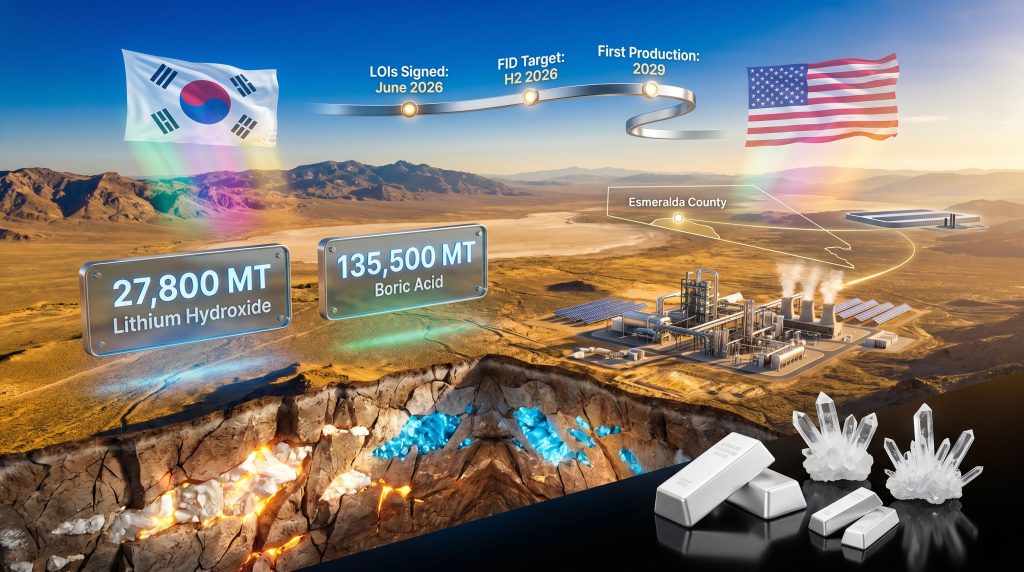
| Lithium Hydroxide | 27,800 metric tonnes | EV batteries, energy storage systems |
| Boric Acid | 135,500 metric tonnes | Industrial manufacturing, advanced materials, energy |
The boric acid output is a dimension of this project that receives less attention than it deserves. Global boron supply is heavily concentrated, with Turkey accounting for a dominant share of world production through its state mining entity. A large-scale North American boric acid producer would represent a meaningful diversification of supply for industrial users across aerospace, semiconductors, fiberglass insulation, and nuclear applications, all sectors with growing strategic relevance.
Key Insight: Boric acid derived from Rhyolite Ridge would not only complement lithium hydroxide revenues but could also serve as a supply diversification mechanism for boron-dependent industries that currently have limited non-Turkish sourcing options in the Western Hemisphere.
Understanding KIND and Hyundai Engineering as Rhyolite Ridge Korean Partners
What KIND Actually Does and Why Its Involvement Carries Weight
KIND, the Korea Overseas Infrastructure and Urban Development Corporation, is a specialised public institution operating under South Korea's Ministry of Land, Infrastructure and Transport. Its mandate extends beyond passive investment. KIND is structured to:
- Provide equity investment in overseas projects that align with South Korean industrial and infrastructure policy priorities
- Deploy structured financing mechanisms to help bridge the gap between project-stage development and construction-ready status
- Support Korean companies seeking to participate in overseas public-private partnership frameworks
- Operate across transportation, energy, urban development, and critical minerals sectors internationally
KIND's involvement in a Nevada mining project is not incidental. It reflects a deliberate institutional mandate to support South Korean access to critical mineral supply chains that can serve the country's domestic battery and EV manufacturing base. While letters of intent carry no legally binding investment commitments, KIND's participation signals that Rhyolite Ridge has cleared a meaningful institutional screening process.
Hyundai Engineering's Role: More Than a Construction Contractor
Hyundai Engineering brings a different dimension to the partnership. As an engineering, procurement, and construction company with experience across plant engineering, industrial processing facilities, and energy infrastructure, its letter of intent covers potential participation in engineering, procurement, and design work specific to Rhyolite Ridge.
This distinction matters in project finance terms. EPC contractors with deep process plant experience are not interchangeable, and securing alignment with an engineering partner of this calibre at the pre-FID stage provides lenders and equity investors with greater confidence in the project's construction execution pathway. Hyundai Engineering has publicly indicated that Rhyolite Ridge's permitting status, construction readiness, and long-term supply certainty set it apart from competing critical mineral development projects.
Important Distinction: Letters of intent are pre-commercial instruments. They signal serious institutional intent and help structure the path toward binding agreements, but they do not represent committed capital or contracted project work. The transition from LOI to MOU, and from MOU to binding financing agreements, involves additional due diligence, legal structuring, and negotiation that can extend or alter the terms of any partnership.
The Existing Commercial Architecture Around Rhyolite Ridge
The KIND and Hyundai Engineering letters of intent do not arrive in isolation. They layer onto a pre-existing set of commercial relationships that already give Rhyolite Ridge a stronger downstream demand foundation than most pre-production critical mineral projects can demonstrate.
| Partner | Agreement Type | Year | Role |
|---|---|---|---|
| EcoPro Innovation (South Korea) | Binding offtake agreement | 2021 | High-nickel cathode production |
| Ford Motor Co. (USA) | Offtake agreement | Undisclosed | Battery/EV supply chain integration |
| Prime Planet Energy & Solutions (Toyota-Panasonic JV) | Offtake agreement | Undisclosed | Downstream battery supply |
| KIND (South Korea) | Non-binding letter of intent | 2026 | Project financing and risk mitigation |
| Hyundai Engineering (South Korea) | Non-binding letter of intent | 2026 | EPC and process plant engineering |
The EcoPro Innovation relationship deserves particular attention. EcoPro is one of South Korea's leading high-nickel cathode active material producers, supplying major battery cell manufacturers including Samsung SDI. Its 2021 offtake agreement with Ioneer was an early commercial validation of Rhyolite Ridge's battery-grade lithium hydroxide quality credentials, predating the current wave of interest from Korean institutional investors.
The addition of Ford and the Prime Planet Energy and Solutions joint venture (a Toyota and Panasonic collaboration) as offtake partners creates what amounts to a diversified customer base spanning Korean, Japanese, and American automotive supply chains, all drawing from the same Nevada source.
The Development Timeline Leading to FID
- Non-binding letters of intent signed with KIND and Hyundai Engineering: June 2026
- Memorandums of understanding expected to be formalized: July 2026
- Final Investment Decision targeted: Second half of 2026
- First commercial production planned: 2029
Capital Deployed and Engineering Progress to Date
Rhyolite Ridge represents approximately a decade of continuous development effort. More than $220 million has been invested in the project since 2016, with over 70% of advanced engineering completed ahead of the Final Investment Decision. Full permitting has been cited by Ioneer as a key differentiator from competing North American critical mineral projects, many of which remain years away from regulatory clearance.
This level of pre-FID capital deployment is uncommon in the critical minerals sector and reflects a deliberate strategy of reducing execution risk before approaching construction financing. Lenders and equity partners evaluating a project at this stage face materially lower permitting and engineering uncertainty than they would with an earlier-stage development asset.
Once operational, Rhyolite Ridge is projected to support between 275 and 300 permanent on-site positions, with broader economic multiplier effects flowing through Esmeralda County and the surrounding region.
Scenario Analysis: Three Pathways to First Production
The path from signed letters of intent to first lithium hydroxide output involves multiple sequential milestones, each carrying its own execution risk. The table below maps three plausible scenarios based on publicly available timeline guidance.
| Scenario | FID Timing | Key Assumptions | Production Start |
|---|---|---|---|
| Accelerated | Q3 2026 | MOUs finalised rapidly, financing committed, construction begins Q4 2026 | Late 2028 |
| Base Case | Q4 2026 | MOUs signed July 2026, FID confirmed H2 2026 | 2029 |
| Delayed | H1 2027 | Financing negotiations extend, partners require additional due diligence | 2030 |
Disclaimer: The scenarios presented above are for analytical purposes only and do not constitute financial advice or investment recommendations. Actual timelines depend on factors including financing conditions, lithium hydroxide market pricing, regulatory processes, and commercial negotiations, all of which remain subject to change.
Lithium Hydroxide Pricing as a Key FID Variable
One factor that receives insufficient attention in project-level analysis is the sensitivity of Final Investment Decisions to prevailing lithium hydroxide spot and contract pricing. The global lithium market has experienced significant volatility since its 2022 peak, with battery-grade lithium hydroxide prices declining sharply through 2023 and 2024 before stabilising.
For projects like Rhyolite Ridge where long-term offtake agreements provide partial price certainty, the remaining uncontracted volume exposure still influences lender risk appetite and the cost of capital available to fund construction. Korean institutional partners with experience across energy and infrastructure project finance are likely conducting rigorous sensitivity analyses on this dimension, which may explain the structured progression from LOI to MOU to binding agreements rather than a direct leap to committed capital.
The next major ASX story will hit our subscribers first
The Geopolitical Dimension: Why Allied Capital Is Flowing Into Western Lithium Projects
The pattern emerging at Rhyolite Ridge is part of a broader reorientation of critical mineral investment flows. South Korea, Japan, Australia, and the European Union are all pursuing policies designed to redirect strategic material sourcing away from supply chains that pass through Chinese processing infrastructure.
For South Korea specifically, this reflects the vulnerability of its battery manufacturing sector, which feeds directly into the global export competitiveness of Hyundai, Kia, and the broader Korean automotive industry. A disruption to lithium hydroxide supply, whether from price volatility, trade restrictions, or geopolitical tension, would propagate upstream through cathode production and downstream into vehicle manufacturing in ways that would be difficult to absorb quickly.
In addition, the rising critical minerals demand driven by the global energy transition is intensifying pressure on allied nations to secure resilient upstream supply. KIND's director of plant business division has publicly framed the Rhyolite Ridge engagement as a milestone in advancing bilateral cooperation between South Korea and the United States across energy, infrastructure, and critical minerals. This framing reflects institutional recognition that the project's significance extends beyond its commercial merits.
Analytical Frame: The convergence of Korean engineering capability, Korean institutional finance, and Korean cathode offtake demand around a single Nevada lithium project illustrates how allied-nation supply chain strategies are becoming vertically integrated at the project level, not merely coordinated at the policy level.
Frequently Asked Questions: Rhyolite Ridge, KIND, and Hyundai Engineering
What is Rhyolite Ridge and where is it located?
Rhyolite Ridge is a development-stage lithium-boron project located in Esmeralda County, Nevada, operated by Ioneer Ltd. It sits within the region commonly referred to as Nevada's Lithium Loop and is approximately 200 road miles southeast of Tesla's Gigafactory Nevada. It hosts the only known lithium-boron deposit in North America currently in active development.
What is KIND and why is it involved in a Nevada mining project?
KIND is the Korea Overseas Infrastructure and Urban Development Corporation, a specialised public institution under South Korea's Ministry of Land, Infrastructure and Transport. It is mandated to facilitate overseas infrastructure and PPP project investment on behalf of Korean institutional and industrial interests, with critical minerals now an active focus area.
What is the difference between a letter of intent and a memorandum of understanding in mining project finance?
A letter of intent establishes non-binding mutual interest between parties and outlines the general parameters of a potential agreement. A memorandum of understanding is typically more detailed, may include specific terms, timelines, and obligations, but still falls short of a legally binding contract. Both instruments are used to structure the path toward binding financing or commercial agreements while due diligence and legal documentation are being finalised.
When is the Rhyolite Ridge Final Investment Decision expected?
Ioneer has targeted the second half of 2026 for its Final Investment Decision, with first commercial production planned for 2029.
Who are the existing offtake partners for Rhyolite Ridge lithium hydroxide?
Current offtake agreements are in place with EcoPro Innovation (South Korea), Ford Motor Company (USA), and Prime Planet Energy and Solutions, the joint venture between Toyota and Panasonic.
How much lithium hydroxide will Rhyolite Ridge produce annually?
The project is designed to produce an average of 27,800 metric tonnes of battery-grade lithium hydroxide per year alongside 135,500 metric tonnes of boric acid annually.
What role will Hyundai Engineering play at Rhyolite Ridge?
Under the letter of intent signed in June 2026, Hyundai Engineering is expected to potentially participate in engineering, procurement, and design work tied to the project, with a more formal memorandum of understanding anticipated in July 2026.
Why the Boron Dimension Is Underappreciated by the Market
Investor and analyst attention tends to cluster around lithium hydroxide as the primary value driver for Rhyolite Ridge, but the boric acid output stream carries strategic weight that is consistently underweighted in public discussion. Notably, innovations in direct lithium extraction technology are also influencing how project flowsheets are being evaluated across the sector more broadly.
Boron compounds are, however, essential across a range of advanced industrial applications:
- Borosilicate glass used in laboratory, pharmaceutical, and display panel manufacturing
- Fiberglass insulation and reinforcement materials used in construction and wind turbine blades
- Neutron absorption applications in nuclear reactor control systems
- Specialty fertilisers for high-value agricultural production
- Emerging applications in solid-state battery electrolyte development and semiconductor processing
With global boron supply dominated by a small number of producers and concentrated geographically, a large-scale Western Hemisphere boric acid producer would enter a market where supply security commands a premium among industrial buyers. The 135,500 metric tonne annual boric acid output from Rhyolite Ridge would place Ioneer among the significant global producers of this material, with revenue diversification benefits that provide a partial buffer against lithium price cycles.
The Template for Future Allied-Nation Mining Partnerships
What Rhyolite Ridge illustrates is the emergence of a new project development template for Western critical mineral assets: one where allied-nation institutional investors, engineering contractors, and end-user offtakers are assembled around a project well before construction begins, creating a layered commercial and financial structure that reduces the risk profile for each individual participant.
This model contrasts with earlier eras of mining finance where projects typically sought a single major equity partner or relied primarily on debt markets. The current environment favours coalition-style project structures where multiple allied stakeholders share both the risk and the strategic benefits of bringing a critical mineral project into production.
For Rhyolite Ridge Korean partners KIND and Hyundai Engineering, alongside the project's existing commercial relationships, the question is no longer whether the project has strategic merit. Consequently, Ioneer's progress at Rhyolite Ridge is being closely watched by industry observers as a bellwether for how allied-nation mining partnerships can be structured effectively at scale. The question is whether the financing structure can be finalised in time to meet the second-half 2026 FID target and deliver first production by 2029 as planned.
Readers seeking additional context on North American critical mineral development and allied-nation supply chain partnerships can explore related coverage at Metal Tech News, which covers the intersection of mining technology, battery materials, and energy policy across the continent.
Want to Track the Next Major Critical Mineral Discovery Before the Market Moves?
Discovery Alert's proprietary Discovery IQ model scans ASX announcements in real time, instantly identifying significant mineral discoveries — including lithium and boron projects with the kind of strategic weight explored in this article — and delivering actionable insights to subscribers ahead of the broader market; explore historic discoveries and their returns to see what early positioning can mean, then begin your 14-day free trial at Discovery Alert to secure your market-leading edge.