June 8, 2026
The Currency Beneath the Ore: How RMB Is Reshaping Iron Ore Trade Architecture
The global commodity trading system was not built in a day, and it will not be dismantled in one either. For decades, the architecture governing how raw materials move across borders has rested on a foundation of US dollar pricing, correspondent banking networks, and Western-administered benchmark indices. Yet within this entrenched system, quiet structural changes are compounding. Australia mining giants using yuan for iron ore trade has become one of the most consequential testing grounds for a monetary transition that could, over time, reshape how value is assigned and exchanged across global resource markets.
Understanding what is actually happening requires looking past the headline currency substitution narrative and examining the underlying mechanics: who controls the price-discovery process, through whose banking infrastructure settlement flows, and where corporate financing originates. The shift from US dollar to Chinese yuan in iron ore trade is not simply a labelling exercise. It is a reconfiguration of financial architecture.
When big ASX news breaks, our subscribers know first
Why China's Position as Iron Ore's Dominant Buyer Creates Asymmetric Leverage
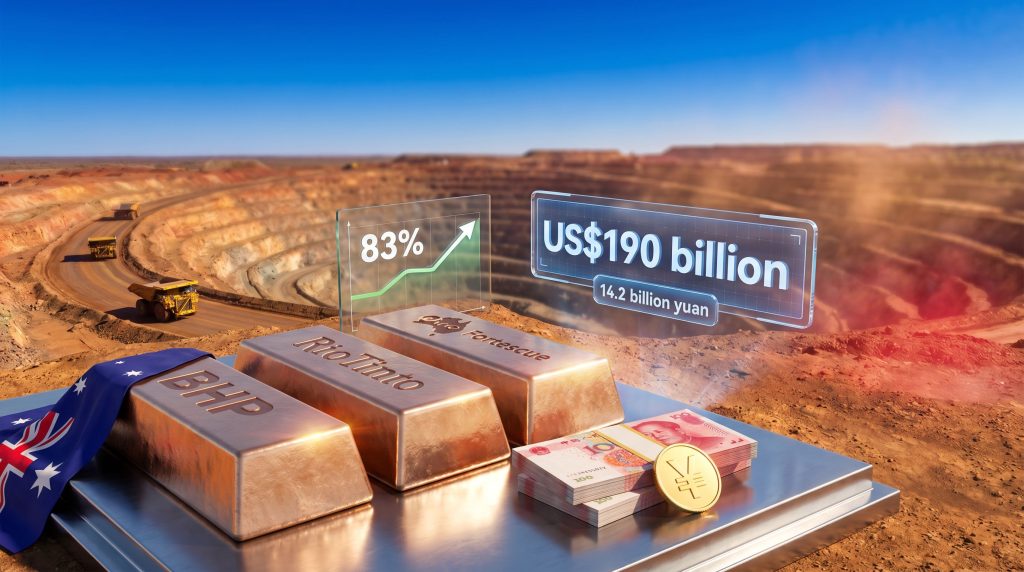
Few commodity markets exhibit the degree of demand concentration that characterises global iron ore. China iron ore demand absorbs the dominant share of seaborne iron ore supply worldwide, and within that structure, Australia occupies the position of primary supplier, with approximately 83% of Australian iron ore exports directed toward Chinese buyers. The annual market value of this trade is estimated at roughly US$190 billion, making it one of the largest bilateral commodity flows on earth.
This concentration of demand creates a structural asymmetry that is central to understanding China's ability to influence settlement and pricing norms. In most commodity markets, buyers must compete against each other for supply, limiting their leverage over terms. In iron ore, China's position is effectively that of a monopsonist, or near enough to one that the practical effect is equivalent. When the dominant buyer expresses preferences about how transactions are denominated, suppliers face a binary choice: adapt or risk losing access to the market that defines their business model.
China's yuan internationalisation strategy has long identified commodity trade as a high-priority channel for expanding RMB circulation. The logic is straightforward:
- Commodity transactions are high-volume and recurring, generating consistent demand for the settlement currency
- Bulk materials like iron ore require significant financing, creating opportunities for RMB-denominated credit facilities
- Normalising RMB in commodity settlement reduces China's systemic exposure to USD-based sanctions and financial system disruptions
- Each transaction settled in yuan adds another data point establishing the currency's credibility in international commerce
The incentive structure is reinforced by China's domestic monetary environment. Relatively low policy lending rates have made Chinese state-bank financing genuinely cost-competitive against equivalent facilities in USD or AUD capital markets, giving foreign corporations a financial reason to engage with RMB-denominated instruments beyond mere compliance with buyer preferences.
From Pricing Benchmarks to Settlement Infrastructure: The Three-Layer Shift
Analysing the yuan's advancing role in iron ore trade requires distinguishing between three separate but interconnected layers of the trading system, each of which is experiencing transformation at a different pace.
Layer One: Benchmark Authority and Price Discovery
Historically, iron ore pricing has been referenced against indices administered by Western commodity price reporting agencies, denominated in US dollars, and reflecting the analytical frameworks of organisations embedded in Western financial markets. The Platts and Argus indices represent this established architecture.
The agreement concluded in early 2026 between BHP and the China Mineral Resources Group (CMRG) introduced a yuan-denominated spot index, incorporating Chinese domestic market trading data, as a pricing reference for a portion of BHP's iron ore product sales. This is the first documented instance of Chinese domestic market data being formally embedded in a globally relevant iron ore pricing benchmark. The significance lies not in the currency denomination alone but in the epistemic shift: the authoritative source of price information is now partially located within China's domestic trading infrastructure.
Furthermore, as noted in recent coverage of the BHP-CMRG settlement, China's broader iron ore leverage is expected to continue well beyond this single agreement. BHP's Chief Financial Officer Vandita Pant indicated at the Macquarie Australia Conference that the company was open to issuing yuan-denominated bonds in the future, suggesting that RMB exposure could extend well beyond trade settlement mechanics into the company's core capital structure.
Layer Two: Settlement Infrastructure and Documentation
The conventional iron ore settlement process involves letters of credit administered through correspondent banking networks, denominated in US dollars, with documentation cycles that can extend the effective settlement period and introduce friction costs. Rio Tinto's trajectory illustrates how this is changing.
In 2019, Rio Tinto executed what is understood to be the mining sector's first yuan-denominated iron ore spot contract with a Chinese counterparty. The following year, in 2020, Rio Tinto and Baoshan Iron & Steel completed what has been recognised as the industry's first fully paperless yuan settlement, using blockchain technology to replace the traditional paper-based letter-of-credit documentation process entirely.
The technological dimension here deserves specific attention. Distributed ledger technology eliminates the intermediary verification steps that extend conventional settlement timelines. In a traditional cross-border commodity settlement, multiple banks must verify, authenticate, and relay documentation between counterparties — a process vulnerable to delays, errors, and geographic coordination friction. A blockchain-based settlement collapses this into a single shared ledger where both parties and their respective banking counterparts can verify transaction validity simultaneously, consequently reducing settlement time and lowering transaction costs.
Layer Three: Corporate Financing Architecture
The deepest structural change involves corporate balance sheets rather than individual transactions. In 2024, Fortescue executed a 14.2 billion yuan syndicated loan (equivalent to approximately US$2.1 billion) from two Chinese state-owned banks, at a fixed interest rate of 3.8% per annum. This represented the first yuan-denominated syndicated term facility ever completed by an Australian corporation.
The fixed rate of 3.8% reflects the cost structure of Chinese state-bank lending, and for the period in which this facility was arranged, it offered a meaningful cost advantage relative to equivalent USD or AUD-denominated financing. This cost differential is not incidental to the strategy; it is central to it. When a mining company's financing costs are denominated in yuan, the rational management of that liability involves generating yuan-denominated revenue streams through commodity contracts, creating an organic incentive to convert pricing and settlement arrangements to match the financing currency.
This structural alignment between financing costs and revenue currency is how RMB adoption tends to deepen over time: not through a single decisive switch but through incremental balance sheet adjustments that progressively increase a corporation's natural exposure to the Chinese currency.
A Comparative View: Where Each Major Producer Stands
The following table maps the current state of RMB integration across the primary iron ore suppliers to China:
| Producer | Country | RMB Integration Stage | Key Development |
|---|---|---|---|
| BHP | Australia | Partial adoption | Yuan-based CMRG pricing index (2026); CFO open to yuan bonds |
| Rio Tinto | Australia/UK | Advanced adoption | First yuan spot contract (2019); first blockchain paperless settlement (2020) |
| Fortescue | Australia | Advanced adoption | First Australian corporate yuan syndicated loan, 14.2bn yuan at 3.8% (2024) |
| Vale | Brazil | Partial adoption | RMB terms reportedly agreed; no price premium confirmed |
| Fenix Resources | Australia | Exploratory | Chairman publicly expressed strong interest in yuan financing (May 2026) |
The geographic and size distribution of this table is instructive. Adoption is not confined to the largest producers or to Australian companies. The May 2026 statement from John Welborn, Chairman of Fenix Resources — a smaller-scale iron ore producer — signals that appetite for yuan-denominated financing extends across the sector's size spectrum. Welborn indicated that his company would be enthusiastic about accessing low-cost Chinese debt if it could be structurally matched with yuan-priced commodity contracts, framing the arrangement as commercially logical rather than merely compliant.
The situation with Brazil's Vale adds a cautionary dimension. Reports indicate that Vale agreed to yuan-denominated terms without securing compensating price premiums, suggesting that acceptance of RMB structures may not automatically translate into improved commercial terms for the seller. This asymmetry is worth noting for smaller miners evaluating such arrangements, particularly given the broader China steel outlook and its implications for pricing power.
The Commercial Pressure Dimension
Beyond financial incentives, there are reports suggesting that China has applied direct commercial pressure on major mining companies to accelerate yuan adoption. Unverified accounts from mid-2025 described threats to suspend iron ore imports from BHP — a volume valued at approximately US$30 billion annually to China — as leverage to encourage settlement compliance. It is important to note that these reports remain unconfirmed and no major escalation had been documented as of May 2026.
However, the structural reality of Australia's export dependency creates a negotiating environment that favours the buyer regardless of whether explicit pressure is applied. With 83% of Australian iron ore exports destined for China and no comparable alternative demand centre existing at equivalent scale, Australian mining companies operate within a market structure that inherently limits their resistance to buyer preferences on settlement terms.
This dynamic distinguishes iron ore from many other commodities. In markets where demand is more geographically distributed, a buyer's preference for a particular settlement currency can be more easily declined. In iron ore, the absence of alternative buyers of equivalent scale means that the cost of non-compliance is disproportionately borne by the seller. Furthermore, the iron ore tariff impact of evolving US trade policy adds another layer of complexity to how Australian producers navigate their commercial relationships.
What This Means for the Dollar's Role in Commodity Markets
It is important to calibrate expectations carefully when assessing the implications of these developments for US dollar primacy. The USD remains the dominant pricing and settlement currency for the overwhelming majority of global iron ore trade. The developments described above represent a structurally meaningful shift, but they do not constitute an imminent displacement event.
Several factors sustain the dollar's position:
- The depth and liquidity of USD-denominated financial markets has no RMB equivalent
- China's capital account restrictions limit the yuan's free convertibility, reducing its attractiveness as a reserve asset
- Hedging instruments for RMB exposure are less developed and less liquid than their USD counterparts
- Institutional inertia in trade finance, legal contracts, and corporate treasury management favours established currency infrastructure
However, the cumulative significance of the current trajectory should not be underestimated. China's approach mirrors its strategy across multiple commodity categories, including oil via the Shanghai International Energy Exchange's yuan-denominated crude futures contract, building parallel infrastructure rather than directly confronting existing USD-based systems. The strategy is not designed to win a currency war in a single engagement; it is designed to progressively reduce the systemic necessity of the dollar in commodity transactions by creating viable alternatives. In addition, analysts examining global commodity markets have noted that this incremental approach may prove more durable than a direct challenge to dollar dominance.
Every percentage point of global commodity trade that shifts from USD to RMB settlement reduces the structural demand for dollar holdings in foreign exchange reserves, contributing over time to a potential recomposition of the global reserve currency landscape.
The iron ore market's scale — approximately US$190 billion annually — means that even partial RMB adoption at this level generates meaningful incremental demand for yuan in international circulation, contributing to the currency's credibility and liquidity profile in ways that support adoption in adjacent commodity markets.
The next major ASX story will hit our subscribers first
Risks Australian Mining Companies Must Navigate
The financial incentives of RMB adoption are real, but they exist alongside a set of structural risks that Australian mining companies must manage carefully. In this context, commodity hedging strategies are becoming an increasingly important consideration for corporate treasury teams operating across multiple currency exposures.
| Risk Category | Operational Description |
|---|---|
| Currency Convertibility | RMB is not freely convertible; repatriation of yuan earnings requires navigating capital account controls |
| Hedging Limitations | RMB hedging instruments are less liquid and more expensive than USD equivalents, leaving corporations with residual currency exposure |
| Pricing Authority Erosion | Adopting yuan-indexed benchmarks gradually shifts the price-discovery process toward Chinese domestic market data, potentially favouring buyers |
| Geopolitical Scrutiny | Western institutional investors and governments may view deepening RMB integration as a political signal beyond its commercial rationale |
| Regulatory Evolution | Australian foreign investment and financial regulation may evolve in ways that create compliance friction for RMB-denominated transactions |
| Interest Rate Risk | Fixed-rate RMB facilities carry interest rate risk if Chinese monetary policy shifts materially over the loan term |
The geopolitical dimension merits particular attention. As Australia's mining companies deepen their RMB integration, they may face increasing scrutiny from governments and institutional investors in Western markets concerned about the strategic implications of normalising Chinese banking infrastructure in critical resource supply chains. The mining geopolitical landscape is, furthermore, evolving rapidly, making this an active consideration rather than a hypothetical one. Resource supply chain security is now a policy priority across multiple advanced economies.
Moreover, as analysis from the University of Sydney has highlighted, Australian financial institutions may not yet be fully equipped to support the scale of yuan-denominated transactions that deeper RMB integration would require, adding an additional layer of operational risk for mining companies pursuing this path.
The Longer Arc: What the Iron Ore Market Tells Us About Monetary Transitions
Monetary transitions in commodity markets do not follow a linear path. They develop through a series of incremental threshold crossings: a first yuan spot contract, a first paperless settlement, a first syndicated loan, a first pricing index integration. Each threshold normalises what previously seemed exceptional, reducing the perceived risk for subsequent adopters and creating network effects that accelerate broader adoption.
The trajectory documented across BHP, Rio Tinto, Fortescue, and now smaller producers like Fenix Resources follows exactly this pattern. What Rio Tinto pioneered in 2019 and 2020 has become, by 2026, an arrangement that the world's largest diversified mining company has adopted and extended. What Fortescue demonstrated with its 2024 syndicated loan has created a visible precedent for Australian corporate borrowing in Chinese capital markets.
The question for investors, policymakers, and market participants is not whether Australia mining giants using yuan for iron ore trade will continue to accelerate, but at what velocity it will proceed, what structural ceiling it will encounter, and what second-order effects it will generate across global commodity pricing architecture, corporate financing strategies, and the long-term composition of international monetary reserves.
This article contains forward-looking analysis and references to unverified reports, including claims regarding commercial pressure applied by Chinese buyers. Readers should independently verify current market conditions and treat speculative projections with appropriate caution. Nothing in this article constitutes investment advice.
Want to Stay Ahead of Significant ASX Mineral Discoveries Before the Broader Market Does?
Discovery Alert's proprietary Discovery IQ model delivers real-time alerts on significant ASX mineral discoveries, translating complex commodity and exploration data into actionable insights for both short-term traders and long-term investors — explore historic discovery returns on Discovery Alert's discoveries page to understand the scale of opportunity, and begin your 14-day free trial today to position yourself ahead of the market.