May 13, 2026
Underground Contracting Thrives Where Commodity Cycles Break Down
Few dynamics in the resources sector are as misunderstood as the relationship between falling commodity prices and rising demand for mining services. The instinct is to assume that when commodity prices decline, the entire supply chain contracts in parallel. In practice, the opposite frequently holds true for a specific subset of operators: underground development contractors.
When lithium producers face weakened balance sheets during a prolonged pricing trough, the economics of self-performing capital-intensive underground development deteriorate sharply. The capital required to sink declines, establish underground infrastructure, and commission production drives cannot easily be deferred indefinitely without forfeiting reserve value. What producers increasingly do instead is shift that capital burden onto specialist contractors, converting fixed development expenditure into a recurring service cost. The risk transfers. The mine still gets built. And the contractor gets paid regardless of where the spot price sits.
This structural mechanism sits at the heart of the Develop Global Core Lithium contract announced in May 2026, and understanding it changes how the deal should be read by investors examining the ASX mining services sector.
When big ASX news breaks, our subscribers know first
What the Develop Global Core Lithium Contract Actually Looks Like
Breaking Down the Contract Architecture
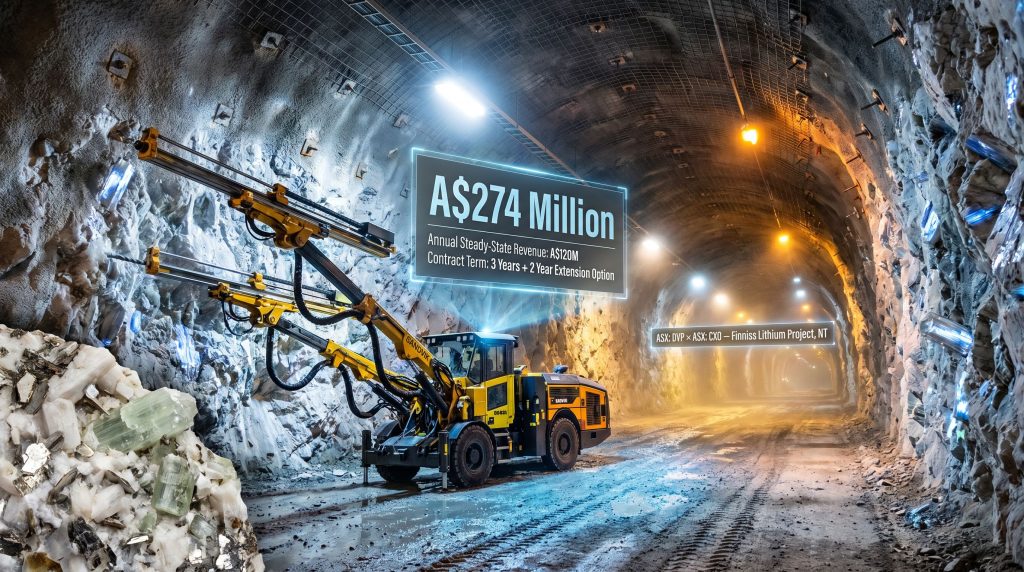
The Develop Global Core Lithium contract covers underground development and production services at Core Lithium's BP33 orebody, situated within the Finniss Lithium Operation in the Northern Territory. Core Lithium (ASX: CXO), carrying an approximate market capitalisation of around A$1 billion, is the 100% owner-operator of the Finniss project and secured a A$205 million funding package to restart and fully construct the operation ahead of awarding this contract.
The headline contract figure of A$274 million spans a minimum three-year term, with an option to extend by a further two years. Mobilisation is scheduled for June 2026, with underground mining operations at BP33 initiating the following month.
| Metric | Detail |
|---|---|
| Total Contract Value | A$274 million |
| Annual Steady-State Revenue | A$120 million |
| Base Contract Term | 3 years minimum |
| Extension Option | 2 additional years |
| Mobilisation Start | June 2026 |
| Underground Operations Start | July 2026 |
| Project Location | Finniss Lithium Project, NT |
| Client (ASX Code) | Core Lithium (CXO) |
| Client Market Cap (approx.) | ~A$1 billion |
| Client Project Funding Secured | A$205 million |
Why Run-Rate Revenue Is the Metric That Matters
There is a persistent tendency among investors to anchor on headline contract values when evaluating mining services businesses. For underground contractors, this creates a systematic misreading of the underlying economics. A single contract figure captures total lifetime value across a term, but it obscures the recurring, annualised cash flow that actually supports the business model.
The A$120 million per year steady-state figure is the number that matters most here. It represents predictable, contract-backed revenue with a defined commencement date, which is a fundamentally different input for financial modelling than spot-price-dependent producer income. The known July 2026 start date eliminates a significant category of forecast uncertainty and gives the market a concrete anchor for near-term earnings projections.
There is also an arithmetic worth noting. A pure three-year run at full steady-state would theoretically generate approximately A$360 million. The A$274 million headline implies either a ramp period in the first six to twelve months, productivity assumptions embedded in the pricing, or conservative scheduling. This compression between theoretical maximum and headline value is normal in underground contracting and reflects genuine start-up costs during the mobilisation window.
Furthermore, the lithium market downturn has made this kind of contracting arrangement increasingly attractive for producers seeking to preserve capital while still advancing their development timelines.
Contractors in the underground mining space live and die by run-rate revenue visibility, not aggregate contract totals. The A$120 million annualised figure gives analysts something to model with confidence across a multi-year horizon. (Stocks Down Under, May 2026)
How the BP33 Orebody Changes the Risk Calculus
Understanding the Asset Beneath the Agreement
Not all underground contracts are created equal. The longevity of the orebody a contractor is working on materially affects the credibility of extension options, the probability of ongoing scope, and the strategic value of establishing a physical presence within a mine.
BP33 is characterised by an estimated mine life exceeding 10 years, placing it firmly in the category of long-duration underground assets. This is a critical distinction. A short-life orebody renders a two-year extension option essentially nominal, because the mine may exhaust economically recoverable material before the extension period can be exercised. A long-life orebody does the opposite: the extension option becomes a probabilistic near-certainty if operations perform to schedule.
If the full five-year contract life is achieved, the total revenue contribution from this single agreement pushes materially beyond the A$274 million headline. Investors pricing the stock on the base contract term alone are therefore undervaluing the extension optionality embedded in the asset. Advances in lithium extraction technology may also improve recoveries over the mine's long life, further underpinning the asset's value.
The Dual-Contractor Structure at Finniss
Core Lithium has deliberately split surface and underground contracting at Finniss between two separate operators:
- NRW Pty Ltd has been contracted for open-pit surface mining at the Grants deposit
- Develop Global holds the underground development and production contract at BP33
The Grants open-pit deposit is expected to contribute more than 50% of total Finniss production over the mine's life, meaning both contracting relationships are material to overall project performance. The logic behind this dual-contractor approach is primarily one of operational specialisation. Open-pit bulk mining demands different equipment fleets, management systems, and productivity metrics than deep underground development. Running separate contractors for each allows Core Lithium to optimise for expertise at each extraction method rather than compromising on either.
From a risk segmentation perspective, it also means that operational issues in one method do not automatically contaminate the other. A productivity problem underground does not flow through to surface mining performance, and vice versa.
Is Develop Global Building a Platform or Just Accumulating Deals?
Two Flagship Contracts in Six Months
The Develop Global Core Lithium contract did not emerge in isolation. Approximately six months earlier, Develop Global secured a A$200 million underground contract at OceanaGold's Waihi North project in New Zealand. The structural similarities between the two deals are instructive:
- Both are multi-year underground contracts with extension options
- Both involve long-life orebodies with credible extension probability
- Both were awarded in a period of broader sector softness in the commodities being extracted
- Both contribute meaningfully to annualised run-rate revenue
Together with the ongoing Woodlawn zinc-copper mine operations, which serve as a third concurrent revenue stream, this represents a multi-asset, multi-commodity, geographically diversified underground contracting platform with substantial recurring revenue commitments stretching into the back half of this decade.
The pattern of two contracts of this scale being awarded within a six-month window is not coincidental. It reflects what management at Develop Global has described as an environment of exceptionally strong demand for experienced underground crews, a characterisation that points to genuine tightening of specialist contractor supply rather than a general market expansion. (Stocks Down Under, May 2026)
What a Tender Pipeline Signal Actually Means
A strong forward tender pipeline is frequently cited as a positive indicator for mining services businesses, but it requires careful interpretation. Pipeline strength can reflect two very different underlying conditions:
- Market growth: More projects are reaching underground development decisions, expanding the total addressable market
- Competitor capacity constraints: The same volume of work is chasing fewer credentialed operators, concentrating opportunity among established players
In the current underground mining labour market, the second dynamic appears to be the dominant force. The binding constraint on growth is not the availability of contracts to bid on. It is the availability of trained, experienced underground crews to execute them. This is a meaningful distinction for investors because it implies that future contract wins will be paced by workforce capacity, not pipeline conversion. Understanding junior mining risks is similarly important in this context, as junior producers face comparable execution constraints when scaling operations.
The Labour Reallocation Signal at Bellevue Gold
What Crew Movements Reveal About Management Priorities
One of the more analytically interesting elements of the Develop Global Core Lithium contract announcement was the decision to redeploy experienced underground personnel from existing Bellevue Gold operations to the Core Lithium assignment. On the surface, this looks like routine resource management. In context, it reveals considerably more.
Skilled underground miners are among the most operationally constrained resources in the Australian resources sector. The qualification and experience pathway for a proficient underground operator, particularly in development roles involving drilling, blasting, and ground support in hard rock environments, cannot be compressed into weeks. Training pipelines typically span twelve to twenty-four months minimum before operators reach genuine proficiency, and competency certification requirements add further lead time.
When management makes an active decision to move crews from one active project to another, it signals an internal hierarchy of strategic priorities. The Core Lithium assignment was assessed as sufficiently important to the platform's growth trajectory that it warranted reallocating the organisation's scarcest resource away from an existing relationship.
Scenario Analysis: Labour as the Ceiling on Growth
The key variables in any scenario model for Develop Global's growth trajectory over the next two to three years converge on one binding input: labour availability.
| Scenario | Labour Availability | Contract Conversion | Margin Outcome |
|---|---|---|---|
| Base Case | Stable retention, moderate market tightness | Selective wins, 3-4 major contracts active | Margins maintained in operating range |
| Bull Case | Crew expansion via training pipelines and targeted recruitment | Accelerated accumulation of contracts | Margin expansion as productivity improves |
| Bear Case | Crew attrition in a competitive labour market | Pipeline wins outpace execution capacity | Margin compression and delivery risk |
The surface mining labour market operates with considerably more flexibility than underground mining, primarily because the skill set is more transferable and the training period shorter. Underground development in particular, involving drilling and blasting cycles in confined hard rock environments, demands sustained experience that cannot be hired in from adjacent sectors. This structural difference explains why the contractor market for underground services is demonstrably tighter than for open-pit operations and why labour retention is not merely an HR issue but a core business risk.
Indirect Lithium Exposure Without the Commodity Price Risk
Why the Contractor Model Outperforms in a Pricing Trough
There is a considered irony in Develop Global adding lithium sector exposure through the Finniss contract at a moment when spot lithium pricing has been persistently challenging for producers and developers alike. Many pure-play lithium equities have seen significant balance sheet deterioration through this cycle. The contractor position inverts this exposure entirely.
Develop Global earns its A$120 million per year from Finniss based on the mining services it delivers underground, not on the value of the spodumene concentrate that exits the facility. Whether lithium prices remain flat, recover meaningfully, or deteriorate further through the contract period, the annualised revenue contribution to Develop Global is determined by contract terms and operational performance metrics, not commodity market movements.
This positions the Develop Global Core Lithium contract as a form of royalty-adjacent exposure to the lithium sector: participation in the operational activity of a mine without bearing the price risk that continues to penalise producers directly. In this regard, underground lithium mining via contracted services represents a structurally distinct risk profile compared to direct commodity ownership.
Producer vs. Contractor: A Side-by-Side Risk Framework
| Dimension | Lithium Producer (e.g., CXO) | Underground Contractor (e.g., DVP) |
|---|---|---|
| Revenue Driver | Lithium spot price | Contract terms and operational rates |
| Commodity Price Risk | Direct and material | Indirect or negligible |
| Capital Intensity | Very high (mine construction) | Moderate (equipment fleet) |
| Cash Flow Predictability | Variable and cyclical | High (known run-rate) |
| Upside in Price Recovery | Full commodity leverage | Limited; no price participation |
| Downside in Price Weakness | Severe cash flow impact | Contractually insulated |
The next major ASX story will hit our subscribers first
Margin Risks That Investors Should Monitor
Where the Underground Contracting Model Is Vulnerable
Underground contract mining is structurally a lower-margin business than many retail investors assume. The capital required to mobilise experienced crews, maintain a heavy equipment fleet in demanding subterranean conditions, and absorb the inevitable productivity variability of hard rock development does not leave much room for error.
Key cost drivers to monitor as Develop Global's combined contract book scales into FY27 include:
- Labour costs, which represent the dominant line item and the one most exposed to tightening market conditions
- Equipment maintenance and consumables, which escalate materially in underground hard rock environments
- Fuel and energy, particularly relevant for diesel-powered underground fleets during the development phase
- Mobilisation front-loading, where June 2026 costs will precede the July 2026 revenue commencement date for the Core Lithium contract
Schedule-of-rates contracts, which are common in Australian underground mining services, allocate some pricing risk between contractor and client depending on productivity outcomes. The specific payment structure of the Develop Global Core Lithium contract has not been publicly disclosed in full, but the steady-state annualised revenue figure implies a level of predictability consistent with either a fixed-rate or volume-based schedule structure.
Key Financial Indicators to Watch as Contracts Ramp
Investors tracking the Develop Global Core Lithium contract through the remainder of 2026 should focus on a specific set of leading financial indicators:
- First full-quarter revenue recognition encompassing both the Core Lithium and OceanaGold contracts simultaneously, expected in Q1 FY27
- EBITDA margin trajectory as the cost base scales with new mobilisations
- Equipment utilisation rates across the fleet, which serve as an operational efficiency proxy
- Cash conversion quality from contract revenue, particularly important given the front-loaded nature of mobilisation costs in June 2026
The margin story will be the defining re-rating catalyst or derating risk. If the first fully combined quarterly result demonstrates that the business can execute across multiple large concurrent underground contracts without meaningful margin compression, the platform thesis becomes materially more credible. Drilling programs and development expenditure at analogous projects further illustrates how capital deployment decisions shape contractor demand over the medium term.
Frequently Asked Questions: Develop Global Core Lithium Contract
What is the Develop Global Core Lithium contract?
Develop Global (ASX: DVP) has secured a A$274 million underground development and production contract at Core Lithium's Finniss Lithium Project in the Northern Territory. The agreement runs for a minimum of three years with an option to extend by two additional years, and is expected to generate A$120 million in annualised steady-state revenue.
When does the Develop Global Core Lithium contract start?
Equipment and crew mobilisation commences in June 2026, with underground mining operations at the BP33 orebody beginning in July 2026.
What is the BP33 orebody at the Finniss Lithium Project?
BP33 is the primary long-life underground production target within Core Lithium's Finniss Lithium Operation. With an estimated mine life exceeding 10 years, it represents the central production hub around which the broader Finniss restart has been structured.
How does this contract fit into Develop Global's broader business?
This contract follows the earlier award of a A$200 million underground mining contract at OceanaGold's Waihi North project in New Zealand. Combined with active operations at the Woodlawn zinc-copper mine, the three revenue streams form a diversified underground contracting platform generating substantial recurring annual revenue across multiple commodities and geographies.
Does Develop Global carry lithium price risk through this contract?
No. Develop Global is compensated for underground mining services delivered, not for the lithium extracted. Its revenue from the Finniss project is governed by contract terms and operational performance, completely insulated from lithium spot price movements.
How has Core Lithium funded the Finniss restart?
Core Lithium secured a A$205 million project financing package to restart and fully construct the Finniss Lithium Operation. This funding underpins both the Develop Global underground contract and the separate NRW Pty Ltd open-pit contract for the Grants deposit.
Three Scenarios for Develop Global's Contract Platform Through FY28
Scenario 1: Execution Delivers and Pipeline Converts (Base Case)
Both the Core Lithium and OceanaGold contracts ramp on schedule through the second half of 2026. One to two additional contract wins are announced through FY27, reflecting continued pipeline conversion. Labour retention remains broadly stable, EBITDA margins consolidate in the low-to-mid teens percentage range, and Woodlawn's zinc-copper operations provide secondary commodity optionality. The market re-rates Develop Global's earnings multiple toward the upper end of the mining services peer group as execution proof accumulates.
Scenario 2: Labour Tightness Constrains Growth (Risk Case)
Crew reallocation from existing projects limits the organisation's capacity to mobilise new contract wins, even as the tender pipeline remains structurally active. Labour cost escalation outpaces contract rate adjustments, compressing margins below initial guidance ranges. The market shifts its focus from pipeline optionality to execution risk, applying a discount to forward earnings multiples until the business demonstrates it can scale its workforce to match its contract ambitions.
Scenario 3: Lithium Sector Recovery Expands the Addressable Market (Upside Case)
A meaningful recovery in lithium spot pricing accelerates underground project development timelines across Northern Territory and Western Australian assets. Multiple developers that have been holding back final investment decisions reach construction phase simultaneously. Develop Global's established Northern Territory footprint, demonstrated through the Core Lithium contract, positions it as a preferred contractor for adjacent and new lithium underground projects. The contract book grows to A$600 million or more across four to five concurrent projects, and the market assigns a platform premium to the earnings base.
The most important near-term catalyst for investors is not another contract announcement. It is the first set of financial results that demonstrate margin quality across the combined OceanaGold and Core Lithium revenue base running simultaneously. Execution proof, not pipeline narrative, is what determines whether this business re-rates or consolidates. (Stocks Down Under, May 2026)
This article is intended for general informational purposes only and does not constitute financial advice. Past performance is not indicative of future results. All financial projections and scenario analyses contain inherent uncertainty. Readers should conduct their own independent research and consult a licensed financial adviser before making investment decisions. References to Develop Global (ASX: DVP) and Core Lithium (ASX: CXO) are for analytical context only and do not represent a buy or sell recommendation.
For additional independent coverage of the Finniss Lithium Project and Core Lithium's broader operational strategy, readers can explore related analysis at Stocks Down Under, which provides independent ASX research on mining and resources sector developments.
Want to Identify the Next Major ASX Mining Discovery Before the Market Does?
Discovery Alert's proprietary Discovery IQ model delivers real-time alerts on significant ASX mineral discoveries the moment they hit the exchange, transforming complex geological data into actionable investment insights for both traders and long-term investors — explore historic examples of exceptional discovery returns to understand the potential at stake, and start your 14-day free trial at Discovery Alert to position yourself ahead of the broader market.